How to Answer “What Motivates You?” in an Interview
How to answer what motivates you is a question that trips up even seasoned professionals because it sounds simple but demands a thoughtful, strategic response. Interviewers aren’t just making small talk — they’re testing your self-awareness, your fit with the role, and whether your internal engine aligns with the company’s culture. A vague or cliché answer like “I’m motivated by success” won’t cut it. This guide breaks down exactly what interviewers are listening for, how to structure a memorable answer, and how to tailor your response so it lands with impact.
Key Takeaways
- The “what motivates you” question is a behavioral probe designed to reveal whether your core drivers match the day-to-day realities of the job and the company’s culture.
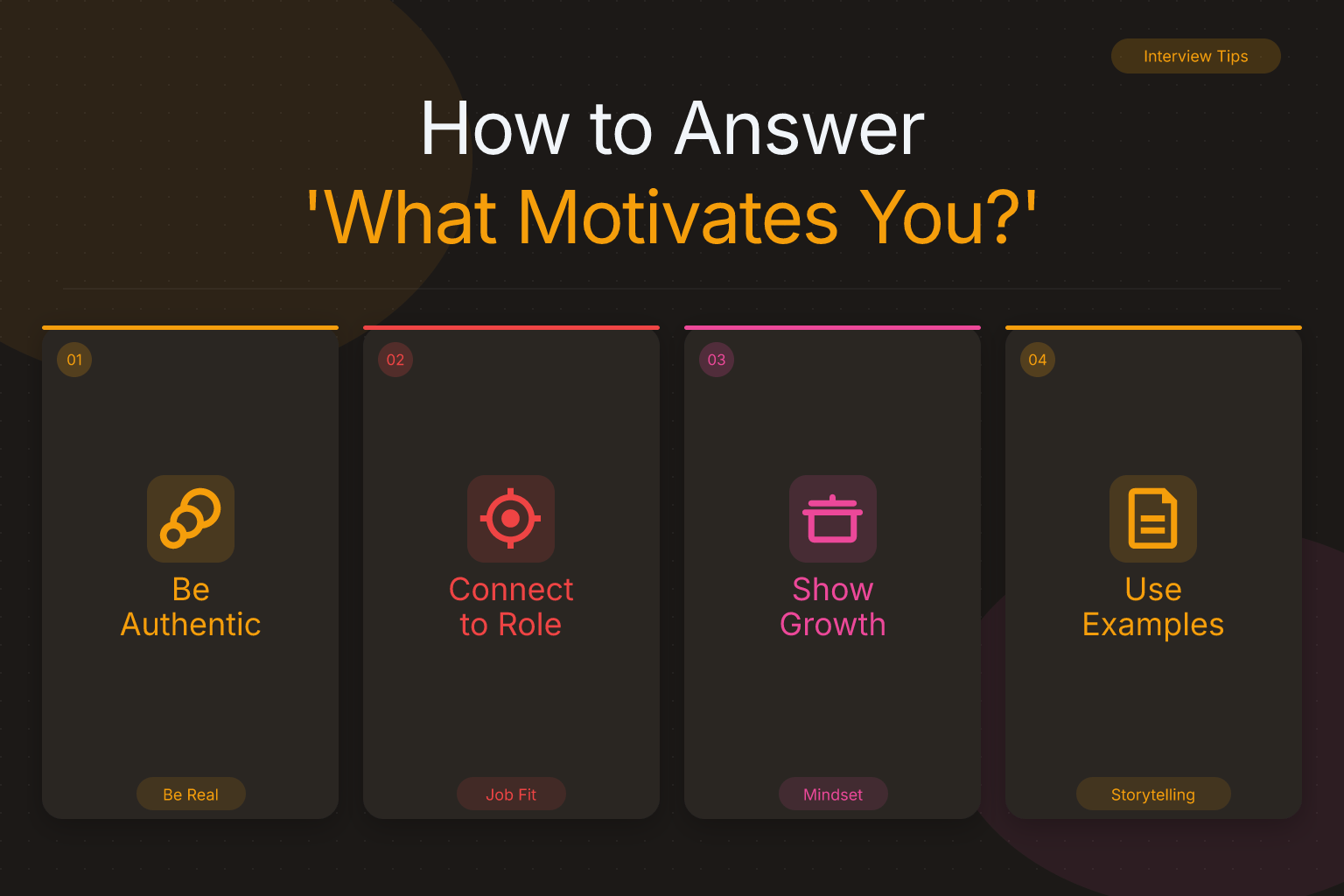
- A strong answer follows a three-part structure: name your motivator, prove it with a specific example, and connect it directly to the role you’re pursuing.
- Avoid generic, money-focused, or status-driven answers; instead, choose a motivator that shows you’ll thrive in the work itself — like solving complex problems, helping others, or mastering new skills.
- Tailor your motivator to the job description by identifying which of your genuine drivers overlaps with what the role offers daily.
- Practice your answer out loud until it sounds natural, not rehearsed, and always have a second motivator ready in case the interviewer asks for more.
Summary Table
| What to Do | Why It Matters | Time |
|---|---|---|
| Identify 2–3 authentic motivators from your past work | Ensures your answer is grounded in real experience, not a script | 15–20 min |
| Match your motivator to the job description | Shows the interviewer you’ll be engaged and productive in this specific role | 10 min |
| Structure your answer with a clear example | Transforms a vague claim into a credible, memorable story | 5 min prep |
| Avoid mentioning money, title, or perks as primary motivators | These can signal you’ll leave as soon as a better offer appears | Ongoing awareness |
| Practice with a friend or record yourself | Eliminates filler words and helps you sound confident, not robotic | 10–15 min |
What Interviewers Really Want to Know When They Ask “What Motivates You?”
When a hiring manager asks how to answer what motivates you, they’re not looking for a rehearsed line. They’re trying to understand three things:
- Will you enjoy the actual work? If your primary motivator is learning new technologies and the role involves repetitive tasks, you’ll likely disengage quickly. Interviewers want to see a match between what energizes you and what the job requires day to day.
- Are you self-aware? A candidate who can articulate what drives them — and back it up with examples — demonstrates emotional intelligence. That’s a strong predictor of workplace success.
- Will you fit the team culture? If you’re motivated by collaboration and the team works in silos, there’s a mismatch. The question helps interviewers spot culture-fit issues before they become problems.
This question often appears alongside other behavioral prompts like “where do you see yourself in 5 years” or “what is your availability start date.” All of them aim to uncover who you are beyond the bullet points on your resume. Understanding the psychology behind these questions helps you prepare a cohesive narrative across the entire interview process.
How to Identify Your Core Motivators Before the Interview
You can’t craft a compelling answer if you haven’t done the self-reflection first. Start by reviewing your career history and asking yourself these questions:
- When did I feel most energized at work? What was I doing?
- Which projects did I voluntarily stay late for — not because I had to, but because I wanted to?
- What kind of feedback makes me proud? (e.g., “You solved a tough problem,” “You helped the team hit a deadline,” “You taught me something new”)
- If I could design my ideal workday, what activities would fill most of it?
Write down 3–5 themes. Common motivators include:
- Problem-solving: untangling complex issues, debugging, optimizing processes
- Learning and growth: mastering new skills, staying current, tackling unfamiliar challenges
- Impact and purpose: seeing how your work helps customers, patients, or colleagues
- Collaboration: being part of a high-functioning team, brainstorming together
- Autonomy: owning a project from start to finish, making decisions
- Recognition: being appreciated for quality work (note: frame this carefully — focus on the work being valued, not ego)
- Creativity: building something new, designing solutions, writing
Pick the one or two that feel most authentic and that you can support with a concrete story. If you’re struggling to articulate these drivers, try writing them down as bullet points on your resume first. Using an AI resume builder can help you structure these achievements clearly, which often makes it easier to spot the underlying motivation behind your best work.
The 3-Part Formula for Answering “What Motivates You?”
A scattered answer loses the interviewer. Use this simple structure to stay focused:
- Name your motivator clearly. Start with a direct statement: “I’m most motivated by…” or “What drives me is…”
- Prove it with a specific example. Describe a situation where that motivator pushed you to do your best work. Use the STAR method (Situation, Task, Action, Result) in miniature.
- Connect it to the role. Explain why that motivator makes you excited about this particular job.
Here’s how that formula sounds in practice:
“I’m most motivated by solving complex problems that don’t have an obvious answer. In my last role, we had a customer churn rate that spiked 12% in one quarter and nobody could pinpoint why. I volunteered to dig into the data, cross-referenced support tickets with usage patterns, and discovered that a recent UI change was causing confusion for a specific user segment. I presented the findings to the product team, they rolled back the change, and churn dropped back to baseline within six weeks. That kind of detective work is what gets me excited to start my day — and I see a lot of similar challenges in this role, especially around improving user onboarding flows.”
Notice the answer never says “I’m motivated by success” or “I work hard.” It shows motivation through action.
Sample Answers for Different Motivators
Here are adaptable templates for common motivators. Replace the details with your own experiences.
Motivated by Learning and Growth
“I’m driven by continuous learning. I get restless if I’m not picking up new skills. For example, when my team started migrating to cloud infrastructure, I spent my evenings earning an AWS certification — not because anyone asked me to, but because I genuinely wanted to understand the architecture. That knowledge let me lead the migration for our department, and we completed it two months ahead of schedule. I’m excited about this role because your team is adopting new AI tooling, and I’d love to be in an environment where learning is part of the job.”
Motivated by Impact and Helping Others
“What motivates me is knowing my work makes someone’s life easier. In my customer success role, I noticed that new users were dropping off during onboarding. I created a series of short video tutorials and a quick-start guide. Within three months, our onboarding completion rate went from 54% to 82%. Seeing those numbers — and reading the thank-you emails from customers — is what keeps me going. I’m drawn to this position because your product directly helps small business owners, and I want to be part of that impact.”
Motivated by Collaboration and Team Success
“I’m at my best when I’m part of a team that’s firing on all cylinders. During a product launch last year, our marketing and engineering teams were misaligned on timelines. I set up a daily 10-minute sync, created a shared tracker, and made sure blockers were surfaced early. The launch hit its deadline, and the post-mortem survey showed team satisfaction was the highest it had been in two years. I thrive in that kind of collaborative environment, and from what I’ve read about your cross-functional squads, it sounds like teamwork is baked into how you operate.”
Motivated by Autonomy and Ownership
“I’m motivated by having ownership over a project from start to finish. In my previous role, I was handed a stagnant email newsletter with declining open rates. I redesigned the content strategy, A/B tested subject lines, and segmented the audience — all on my own initiative. Within four months, open rates climbed from 18% to 34%, and the newsletter became a top lead-generation channel. I do my best work when I have the trust and space to run with an idea, and I can see that this role offers that kind of ownership.”
Motivated by Challenge and a Fast-Paced Environment
Some roles explicitly call for thriving under pressure. If you’re asked a question like “Compensation aside, what motivates you to thrive in a fast-paced, high-expectation environment?” — a real question used by companies like M32 — your answer must show resilience and a genuine appetite for intensity.
“I’m motivated by environments where the bar is high and the pace is relentless because that’s when I do my most focused work. In my last role, we had a client who needed a complete campaign turnaround in two weeks — normally a six-week project. I broke the work into daily sprints, coordinated with three departments, and we delivered on time with results that exceeded the client’s original KPIs. The pressure forced clarity and creativity. I’m not looking for an easy ride; I want to be in a place where my output matters and the expectations push me to grow every day.”
This specific type of question often appears in high-growth startups or competitive agencies. If you’re targeting these roles, ensure your resume highlights quantifiable results achieved under tight deadlines. You can verify how well your resume communicates these high-pressure wins using a free resume score checker to ensure your bullet points land with impact.
How to Tailor Your Answer to the Job Description
A generic answer won’t stand out. Before the interview, scan the job posting for clues about what the company values. Look for phrases like:
- “Fast-paced environment” → motivation by challenge, adaptability
- “Cross-functional collaboration” → motivation by teamwork
- “Self-starter,” “take initiative” → motivation by autonomy
- “Customer-obsessed” → motivation by impact, service
- “We value curiosity” → motivation by learning
Then, choose the motivator from your list that overlaps most with those signals. If the job emphasizes innovation and you’re genuinely motivated by creative problem-solving, lead with that. If the role is highly independent and you thrive on autonomy, make that your focus.
This same alignment principle applies to your resume. When you tailor your resume to a job description, you increase your chances of landing the interview in the first place. After you’ve customized your bullet points, you can run your resume through a free ATS resume checker to see how well it matches the role’s keywords and formatting expectations. If you’re still searching for the right role, browse the ResumeMate job board to find openings that genuinely match your motivators.
Common Mistakes That Derail Your Answer
Even well-intentioned candidates stumble here. Avoid these pitfalls:
- Leading with money or perks. Saying “I’m motivated by a high salary” or “I want a good work-life balance” may be honest, but it signals that external rewards matter more than the work itself. If compensation is a genuine driver, frame it as “I’m motivated by being rewarded for results” and pair it with a performance example.
- Giving a cliché without evidence. “I’m a hard worker” or “I’m passionate about excellence” means nothing without a story. Every claim needs a proof point.
- Choosing a motivator that clashes with the role. If you say you’re motivated by public speaking but the job is a solo coding role, the interviewer will question your fit.
- Rambling or giving multiple motivators. Pick one clear driver and stick to it. A laundry list dilutes your message.
- Sounding rehearsed. Your answer should feel conversational. Practice enough that the structure is second nature, but leave room to adapt in the moment.
- Ignoring the “why this company” layer. Even a great motivator falls flat if you don’t connect it to the specific organization. Always research the company’s mission, recent projects, or team structure and weave that into your closing sentence.
- Using a motivator you can’t back up. If you claim you’re driven by data but can’t recall a single instance where you used data to make a decision, the interviewer will see through it. Only choose motivators you can prove with real results.
What If You’re Asked “What Demotivates You?”
This is the flip side of the motivation question and often catches candidates off guard. The goal here is honesty without red flags. Never say “I’m demotivated by hard work” or “I hate deadlines.”
Instead, frame a demotivator as the absence of your motivator:
“I lose steam when I can’t see the outcome of my work. I’m most energized when I know how my contributions impact the broader goal, so environments where tasks feel disconnected from the mission can be challenging for me. That’s why I appreciate teams that prioritize transparent feedback loops.”
This answer is honest but constructive. It shows you care about impact without complaining about mundane tasks.
How to Practice and Refine Your Response
Writing out your answer is step one. Making it sound natural is step two. Here’s a practice routine:
- Write your full answer using the 3-part formula. Keep it under 90 seconds when spoken.
- Read it aloud and time yourself. Cut any sentences that feel stiff or unnecessary.
- Record yourself on your phone. Listen for filler words (“um,” “like”), pacing, and tone. Adjust until you sound like you’re having a conversation, not giving a speech.
- Practice with a friend or in front of a mirror. Ask them: “Did my motivator feel genuine? Could you picture me doing that work?”
- Prepare a backup motivator. Sometimes interviewers follow up with “What else motivates you?” Have a second, different driver ready with a brief example.
If you’re preparing for a virtual interview, don’t forget your setup. A professional background can subtly reinforce your seriousness about the role. Check out our guide on best professional virtual backgrounds to ensure your environment matches your polished answers.
If you’re preparing for a full round of behavioral questions, it helps to have a bank of stories ready. Our guide on how to answer “tell me about yourself” walks you through building a narrative that ties your background to the role — a perfect companion to this question.
What If You’re Asked “What Motivates Your Child?”
This variation appears in parent-teacher conferences, school admissions interviews, or childcare settings. The core approach is the same: be specific, give an example, and connect it to the environment.
Instead of saying “My child is motivated by praise,” try:
“My daughter is most motivated when she sees the real-world application of what she’s learning. Last semester, she was struggling with math until her teacher started using cooking to teach fractions. Suddenly she was excited to come home and practice. She thrives when lessons feel hands-on and relevant.”
This shows you understand your child’s learning style and gives the teacher actionable insight.
FAQ
Q: How to answer what motivates you in an interview?
A: Use a three-part structure: state your motivator clearly, back it up with a specific example from your work history, and explain why that motivator makes you a great fit for the role. Avoid generic answers and focus on one authentic driver.
Q: How to answer what motivates you at work?
A: Think about the tasks or situations that give you energy during the workday — solving problems, helping customers, learning new tools, collaborating with a team. Choose one, describe a time it led to a strong result, and tie it to the responsibilities of the job you’re applying for.
Q: How to answer what motivates you question when you’re entry-level?
A: Draw from internships, class projects, volunteer work, or extracurriculars. For example, you might say you’re motivated by learning new skills and describe how you taught yourself a programming language to build a class project. The key is to show initiative and a genuine desire to grow.
Q: How to answer what motivates you the most?
A: “The most” signals the interviewer wants your top driver. Pick the one that consistently shows up in your proudest accomplishments. Give a concise, high-impact example that demonstrates that motivator in action, and then connect it to the role.
Q: What demotivates you interview question?
A: Answer honestly but diplomatically. Frame a demotivator as the absence of your motivator — for example, “I lose steam when I can’t see the outcome of my work.” Never badmouth a previous employer; always pivot to what you need to do your best work.
Q: How to answer “Compensation aside, what motivates you to thrive in a fast-paced, high-expectation environment?”
A: This question wants to know if you genuinely enjoy intensity. Acknowledge the environment, then give an example of a time you delivered under pressure and what you learned from it. Emphasize that you’re not just surviving the pace — you’re fueled by it.
Q: How to answer what drives you?
A: “What drives you” is essentially the same question as “what motivates you.” Use the same formula: pick a core driver, illustrate it with a specific achievement, and link it to the role. The word “drives” can feel more personal, so it’s okay to mention an internal value like curiosity, as long as you ground it in professional results.
Related articles:
Track Every Application While You Job Hunt
Stop losing track of where you’ve applied. The ResumeMate Job Tracker is a free Chrome extension that tracks every application, deadline, and follow-up in one place — right from your browser.