How to Ask for a Letter of Recommendation: Email Templates That Work
You need a strong letter of recommendation, but how to ask for a letter of recommendation email template that actually gets a yes can feel awkward. You don’t want to sound demanding, and you don’t want to put your recommender in an uncomfortable position. The good news: most professors, managers, and mentors are happy to help — if you ask the right way. This guide gives you the exact wording, timing, and preparation steps to make your request easy to say yes to, plus email templates you can adapt and send today.
Key Takeaways
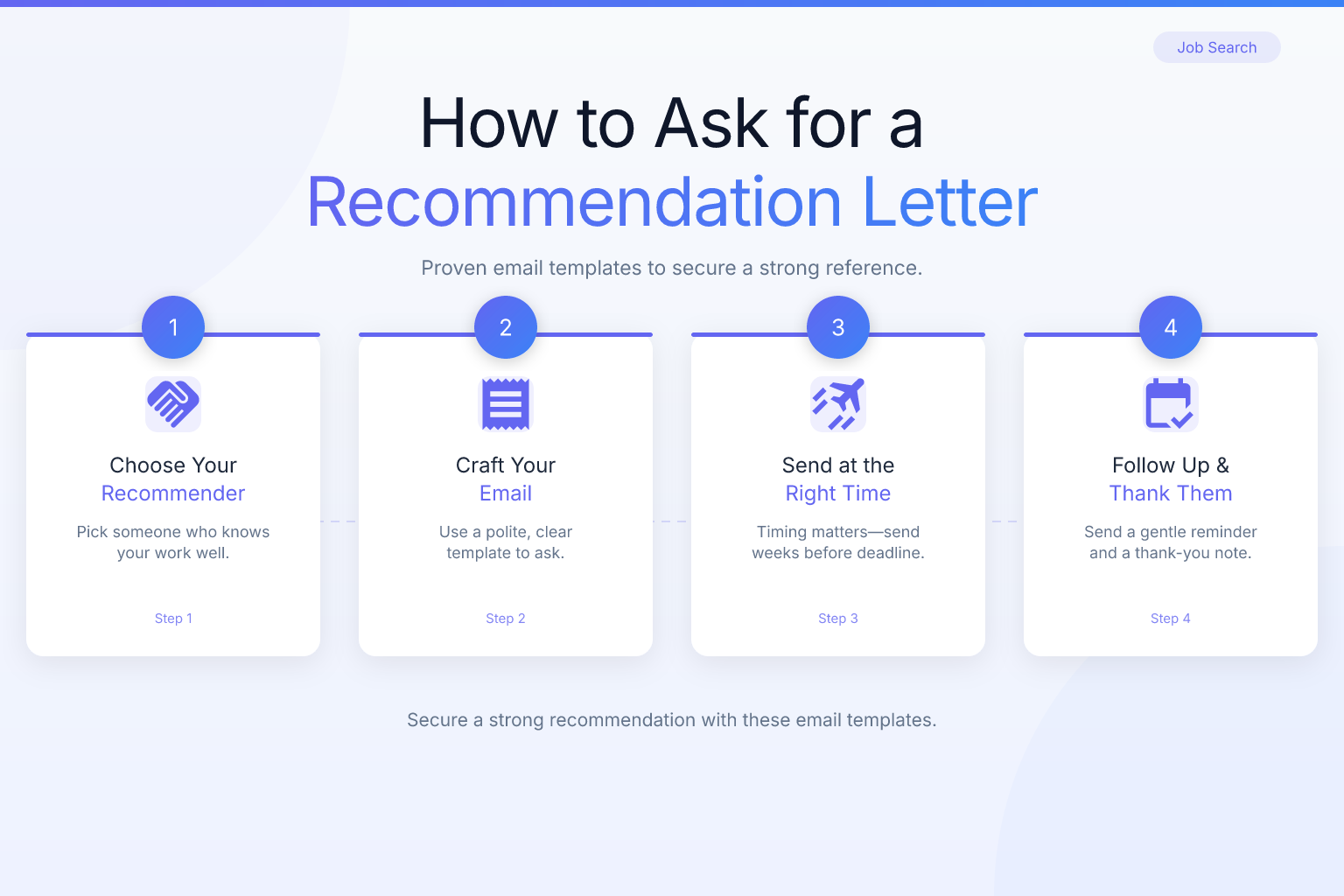
- Send your request at least three to four weeks before the deadline so your recommender has time to write a thoughtful letter.
- Choose someone who knows your work well and can speak to specific skills or achievements, not just a big name.
- Provide a “recommender packet” with your resume, the job or program description, and bullet points of key accomplishments you’d like them to highlight.
- Use a clear, polite email template that includes the deadline, submission instructions, and a genuine reason why you’re asking them specifically.
- Follow up once if you don’t hear back after a week, and always send a thank-you note after they agree or submit the letter.
| What to Do | Why It Matters | Time |
|---|---|---|
| Ask at least 3–4 weeks ahead | Gives your recommender enough time to write a detailed, personalized letter | Before deadline |
| Choose someone who knows your work well | A specific, enthusiastic letter carries more weight than a generic one from a big name | When selecting recommenders |
| Provide a “recommender packet” (resume, job description, talking points) | Makes it easy for them to write a strong, tailored letter | Before you send the request |
| Use a clear, polite email template with all details | Reduces back-and-forth and shows professionalism | When drafting the request |
| Send a gentle reminder and a thank-you | Keeps your request on their radar and shows appreciation | 1 week after initial request, and after submission |
How to Ask for a Letter of Recommendation: Email Template Essentials
A great request email does more than just ask. It makes the recommender’s job easy. Before you even open your email client, gather everything they’ll need to write a strong, specific letter. Then, structure your email so the key information is impossible to miss.
What to include in every request email:
- A clear subject line: “Letter of Recommendation Request for [Your Name]” or “Recommendation for [Position/Program] – [Your Name]”
- A warm but brief opening: Remind them how you know each other and when you last interacted.
- Why you’re asking them specifically: Mention a project, class, or skill they saw you demonstrate.
- What you’re applying for: Include the job title, program name, or scholarship, plus the deadline.
- Submission instructions: Is it an online portal, an email, or a form? Provide the link or address.
- Your recommender packet: Attach your resume, the job description, and a short list of bullet points you’d like them to highlight.
- An easy out: Give them permission to decline if they don’t feel they can write a strong letter.
When you make the request this easy, you’re not just asking for a favor — you’re setting them up to write the best possible letter for you.
When to Ask for a Letter of Recommendation
Timing can make or break your request. Ask too late, and you risk a rushed, generic letter — or no letter at all. Ask too early, and the recommender might forget.
Ideal timeline:
- 3–4 weeks before the deadline: Send your initial request. This gives busy professionals enough time to fit it into their schedule.
- 2 weeks before the deadline: If you haven’t heard back, send a polite follow-up (template below).
- 1 week before the deadline: Send a gentle reminder with the deadline date and any last-minute details.
- After submission: Send a thank-you note, and later, let them know the outcome.
If you’re applying to multiple positions, ask if they’d be willing to write a general letter you can adapt, or if they prefer separate requests. Some recommenders appreciate a single request with a list of deadlines.
Who to Ask for a Letter of Recommendation
The strongest letters come from people who have directly supervised your work, taught you in a relevant subject, or collaborated with you on a significant project. A famous name who barely knows you will write a vague letter that adds little value.
Good options:
- A recent manager or supervisor who can speak to your work ethic and results.
- A professor in your major who saw you excel in a challenging course.
- A mentor or advisor from an internship, volunteer role, or research project.
- A colleague or client (for character references, if the application allows it).
Avoid:
- Family members or friends (unless the application specifically requests a personal reference).
- Someone you haven’t spoken to in years who may not remember your work.
- A recommender who seems hesitant or rushed — a lukewarm letter can hurt more than help.
If you’re unsure, ask them directly: “Do you feel you know my work well enough to write a strong letter of recommendation?” This gives them an honest way to decline without awkwardness.
How to Prepare Before You Ask
Preparation is what separates a generic request from one that gets a detailed, enthusiastic letter. Before you hit send, create a “recommender packet” — a single PDF or a clear email with everything they need.
Your recommender packet should include:
- Your updated resume. If you haven’t refreshed it recently, use a free tool like the ResumeMate AI resume builder to create a clean, ATS-friendly version that highlights your most relevant experience.
- The job description or program details. Copy and paste the requirements so they can tailor the letter to what the reviewer is looking for.
- A short list of 3–5 bullet points you’d like them to mention. For example: “Led a team of four on the XYZ project, delivering two weeks early,” or “Consistently scored in the top 10% of class on analytical essays.”
- Submission instructions. Is it a link, an email address, or a form? Include the exact method and any access codes.
- The deadline (with time zone if applicable).
This packet shows respect for their time and dramatically increases the chances they’ll say yes — and write a letter that actually moves the needle.
Email Template for a Professor or Academic Reference
Use this template when asking a professor, academic advisor, or research supervisor. Personalize the bracketed sections.
Subject: Letter of Recommendation for [Your Name] – [Program/Scholarship Name]
Dear Professor [Last Name],
I hope this email finds you well. I thoroughly enjoyed your [Course Name] class last [semester/year], especially the [specific project or paper topic] where I [mention a specific achievement or insight]. Your feedback on my work helped me grow as a [writer/researcher/thinker], which is why I’m hoping you might consider writing a letter of recommendation for me.
I’m applying to [name of graduate program, scholarship, or fellowship] with a deadline of [date]. The selection committee is particularly interested in [mention 1–2 qualities they value, e.g., research potential, analytical writing]. I’ve attached my resume, the program description, and a few bullet points that might be helpful.
If you feel you can write a strong letter, I’d be grateful. The letter can be submitted via [portal link / email address]. Please let me know if you need any additional information.
Thank you for considering my request, and for the impact you’ve had on my academic journey.
Best regards, [Your Full Name] [Your Phone Number]
Email Template for a Manager or Professional Reference
This template works for current or former managers, supervisors, or internship coordinators.
Subject: Recommendation Request for [Your Name] – [Job Title] at [Company]
Hi [Manager’s Name],
I hope you’re doing well. I’m reaching out because I’m applying for a [position name] role at [company/organization], and I immediately thought of you. Working under your leadership on [specific project or team] taught me [specific skill or lesson], and I believe your perspective would carry a lot of weight with the hiring team.
The application requires a letter of recommendation by [deadline]. I’ve attached my updated resume, the job description, and a few notes on accomplishments from our time working together that might be relevant. The letter can be submitted [explain how — email, upload link, etc.].
I know you’re busy, so if you don’t feel you can write a strong letter, I completely understand. Either way, thank you for everything you’ve taught me.
Best, [Your Full Name] [Your Phone Number]
Email Template for a Character or Personal Reference
Some applications (especially for volunteer positions, scholarships, or certain graduate programs) allow a personal reference who can speak to your character, reliability, or community involvement.
Subject: Character Reference Request – [Your Name]
Dear [Name],
I hope you’re having a great week. I’m applying for [opportunity name] and they’ve asked for a character reference — someone who can speak to my integrity, work ethic, and commitment. You came to mind immediately because of our work together on [shared project, volunteer experience, or community activity].
I’ve attached a brief description of the opportunity and a few points about what they’re looking for. The deadline is [date], and the reference can be submitted [explain how].
If you’re comfortable writing a short letter, I’d be incredibly grateful. And if now isn’t a good time, I completely understand.
Thank you for considering it!
Warmly, [Your Full Name] [Your Phone Number]
Follow-Up Email Template (If You Don’t Hear Back)
People get busy. A polite follow-up can nudge your request back to the top of their inbox without being pushy.
Subject: Checking In – Recommendation for [Your Name]
Hi [Name],
I hope you’re doing well. I wanted to gently follow up on my request for a letter of recommendation for [position/program]. The deadline is [date], so I wanted to make sure you had everything you need from me.
If your schedule has changed and you’re no longer able to write the letter, I completely understand — just let me know. I’ve re-attached my resume and the details below for your convenience.
Thank you again for considering it.
Best, [Your Full Name]
Send this about one week after your initial email. If you still don’t hear back, it’s acceptable to send one more reminder a few days before the deadline, but after that, assume they’re unable to help and move on to a backup recommender.
Common Mistakes to Avoid When Asking for a Letter of Recommendation
Even a well-intentioned request can backfire if you make these errors.
- Asking at the last minute. A rushed letter is rarely a strong one. Give at least three weeks.
- Not providing enough context. If you just say “Can you write me a letter?” without details, you’re asking them to do extra work guessing what to include.
- Choosing the wrong person. A recommender who barely remembers you will write a vague letter. If you’re switching careers, for example, you might need a reference who can speak to transferable skills — similar to how you’d tailor a career change cover letter.
- Forgetting to waive your right to view the letter (if applicable). Many academic applications ask you to waive your FERPA right to see the recommendation. Recommenders often take this as a sign of trust and write more candidly.
- Not sending a thank-you. A simple thank-you email after they submit the letter goes a long way. If you get the job or admission, let them know — they’ll appreciate hearing the outcome.
- Using a generic template without personalization. The templates above are starting points. Always add a specific memory or detail that shows why you chose them.
If you’re also navigating how to ask for a referral on LinkedIn, the same principles apply: be specific, make it easy, and show genuine appreciation. Check out our guide on how to ask for a LinkedIn referral for more templates.
FAQ
Q: How far in advance should I ask for a letter of recommendation?
A: Aim for three to four weeks before the deadline. This gives your recommender enough time to write a thoughtful letter without feeling rushed. For graduate school applications with earlier deadlines, consider asking six weeks ahead.
Q: Can I ask for a letter of recommendation over email?
A: Yes, email is the standard and often preferred method. It gives the recommender a written record of the details and allows them to respond on their own schedule. If you have a very close relationship, a quick phone call or in-person conversation first can be a nice touch, but always follow up with an email that includes all the necessary information.
Q: What if my recommender says no?
A: Thank them for their honesty and move on. A “no” is better than a weak letter. Have a backup recommender in mind before you start asking. If they decline because they don’t know your work well enough, ask if there’s a project or course you could discuss to help them feel more comfortable — but don’t push.
Q: Should I waive my right to see the recommendation letter?
A: For academic and many professional applications, yes. Waiving your right (often through FERPA) signals that you trust your recommender and can lead to a more candid, credible letter. If you’re unsure, check the application instructions.
Q: How do I ask a former manager I haven’t spoken to in years?
A: Reconnect briefly first. Send a short email catching up, mention a specific project you worked on together, and then transition to your request. Acknowledge the time gap and make it easy for them to say no. Provide extra context about what you’ve been doing since you last worked together.
Q: Can I use the same letter of recommendation for multiple applications?
A: It depends. Some recommenders are happy to write a general letter you can submit to multiple places. Others prefer to tailor each letter. Ask upfront: “I’m applying to several similar positions. Would you be comfortable writing one letter I can use for all, or would you prefer separate requests?”
Related articles:
- Best Time of Day to Send a Job Application Email
- Speculative Application Cold Email: How to Get Noticed
Track Every Application While You Job Hunt
Stop losing track of where you’ve applied. The ResumeMate Job Tracker is a free Chrome extension that tracks every application, deadline, and follow-up in one place — right from your browser.