How to Ask for a LinkedIn Referral: Templates That Work
Asking for a referral can feel awkward, but knowing how to ask for a referral on LinkedIn effectively is one of the most powerful ways to get your resume seen by a hiring manager. This guide gives you the exact wording, strategy, and follow-up steps to request referrals with confidence — without burning bridges.
Key Takeaways
- Build a minimal relationship before asking for a referral by engaging with the person’s content, finding a mutual connection to introduce you, or referencing a past interaction.
- Spend 15–20 minutes researching the person and the specific role so you can personalize your request and show you’re a serious, well-informed candidate.
- Structure your referral request with four elements: a context reminder, a direct but polite ask, an easy-out statement to reduce pressure, and attached materials (resume and a short qualifications summary).
- Avoid common mistakes like sending a referral ask in a connection request, applying for roles you’re not qualified for, using generic copy-paste messages, applying guilt or pressure, or forgetting to attach your resume.
- After receiving a referral, thank the person immediately and keep them updated on your progress; if they decline or don’t respond, follow up once after 5–7 days, then move on without pushing further.
The Foundation of a Successful Referral Request
Before you copy and paste any template, understand this: a referral request is not a favor you’re owed. It’s a professional ask that works only when you’ve laid the groundwork. The most successful referral requests come from people who have at least a minimal relationship with you — a former colleague, a classmate, someone you’ve interacted with in a LinkedIn group, or even a friend of a friend.
If you’re reaching out to a stranger, you need to build a bridge first. That might mean engaging with their content for a week, sending a thoughtful connection request, or finding a mutual contact who can introduce you. Jumping straight to “Can you refer me?” without any context is the fastest way to get ignored or, worse, blocked.
Start by following the person and genuinely interacting with their posts. Leave a comment that adds value — ask a question, share a related experience, or thank them for an insight. After a few interactions, your name becomes familiar, and a connection request feels natural. When you do connect, mention that you’ve been enjoying their content; this tiny bit of rapport makes the eventual referral ask far less cold.
Once you have that foundation, the ask itself becomes a natural next step. The person already knows who you are and what you do. Now you’re simply asking them to vouch for your work — something they’re far more likely to do if they’ve seen your skills firsthand or heard about you from a trusted source.
Research the Person and the Role (15–20 Minutes Well Spent)
Generic messages get generic results. Before you type a single word, spend 15–20 minutes gathering information that will make your request feel personal and well-informed. This small investment dramatically increases your response rate and shows you’re serious, not just spraying requests everywhere.
Start with the person’s LinkedIn profile. Look for:
- Their current role and how long they’ve been at the company.
- Any shared connections, groups, or alma maters — these are instant rapport builders.
- Recent posts or articles they’ve shared. Commenting on one of these is a great icebreaker before you send the referral message.
Next, research the company and the specific job opening. Know the exact job title, the team, and one or two reasons why you’re a strong fit. This shows the referrer you’ve done your homework and aren’t asking them to vouch for a random application. If you’re using a mutual connection, reach out to that person first. A quick message like, “I noticed you’re connected to [Name] at [Company]. I’m applying for a role there — would you be comfortable introducing us?” can warm up the ask significantly and turn a cold outreach into a warm introduction.
Finally, check the company’s career page and recent news. Mentioning a recent product launch, award, or initiative in your message proves you’re genuinely interested in the organization, not just any job. This level of preparation separates a forgettable request from one that gets a fast “yes.”
Pro tip: Use LinkedIn’s Alumni tool (available on your university’s LinkedIn page) to find graduates who work at your target company. Alumni are often more willing to help fellow graduates, and you already share a meaningful connection.
The Anatomy of a Great LinkedIn Referral Request
Every effective referral message has four parts. Keep the entire message under 150 words — busy professionals skim, they don’t read novels.
- The context — Remind them how you know each other or why you’re reaching out. If you’ve never met, mention the mutual connection or the specific reason you’re contacting them.
- The ask — State clearly that you’re interested in a specific role and would appreciate a referral. Be direct but polite.
- The easy out — Give them a graceful way to decline. Something like, “If you’re not comfortable referring me, I completely understand.” This reduces pressure and actually increases the chance they’ll say yes.
- The materials — Attach your resume and a 2–3 sentence summary of your qualifications. Make it so easy that all they have to do is forward it.
Here’s the structure in action:
Hi [Name],
I hope you’re doing well. We connected briefly at [event/group] and I’ve been following your work at [Company] — really impressed by [something specific].
I’m reaching out because I’m applying for the [Job Title] role and noticed you’re on the [Team] team. If you feel comfortable, would you be open to referring me? I’ve attached my resume and a short blurb about my background.
No pressure at all if the timing isn’t right or you’d rather not. Either way, I appreciate your time.
Thanks, [Your Name]
LinkedIn Referral Message Templates for Different Scenarios
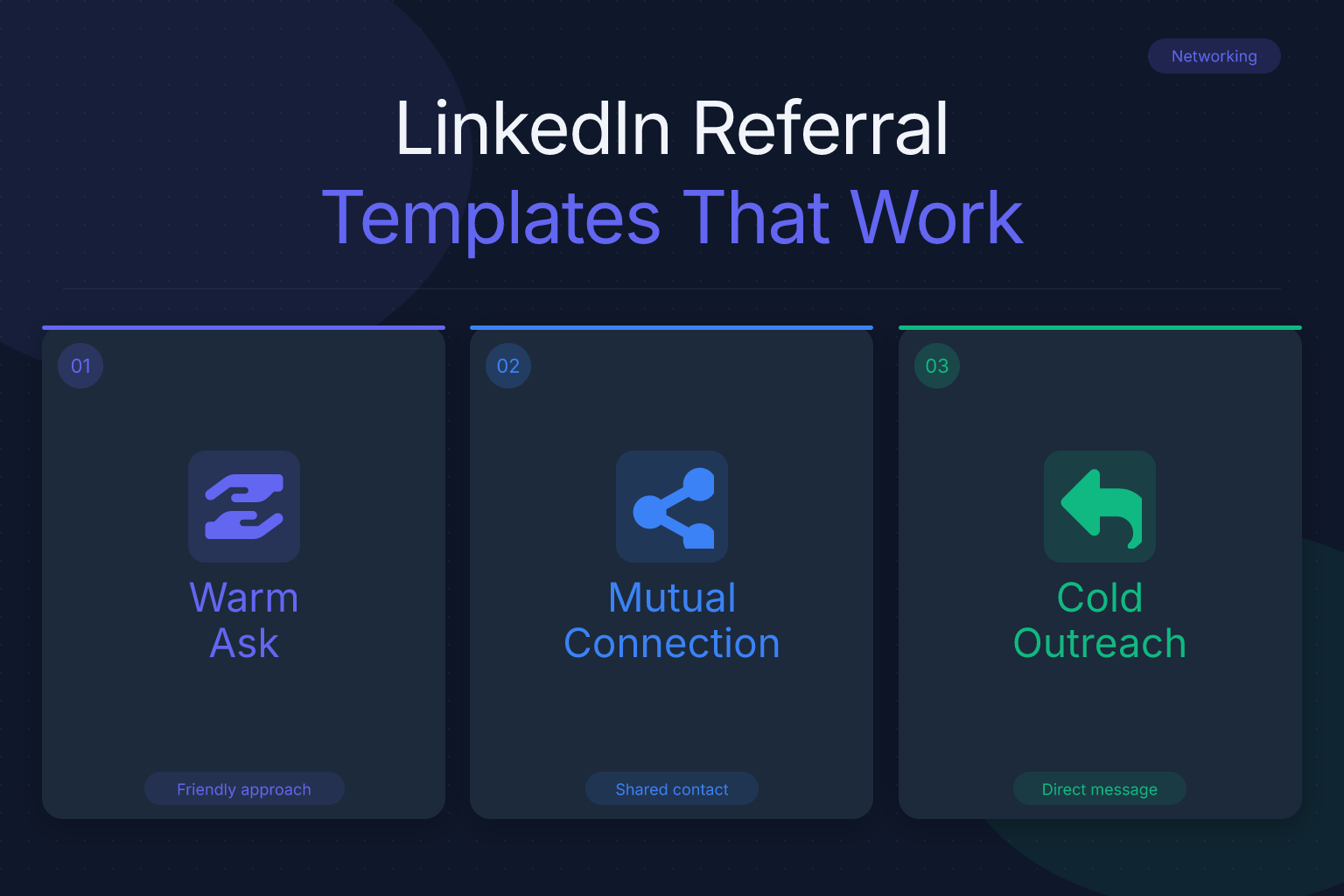
Template 1: The Warm Connection (Someone You Know Well)
Use this when you’ve worked together, studied together, or have a genuine friendship. You can be a bit more casual, but still include the key elements.
Hey [Name],
Hope things are great at [Company]! I saw the [Job Title] opening on your careers page and it looks like a perfect fit for my background in [skill/industry].
Would you be up for referring me? I’ve attached my resume and a quick summary you can forward. If it’s not a good time or you’d rather not, no worries at all.
Thanks a ton — and let’s catch up soon either way! [Your Name]
Template 2: The Mutual Connection (Friend of a Friend)
When you share a contact but don’t know the person directly, name-drop the mutual connection early.
Hi [Name],
[Mutual Contact] suggested I reach out to you. I’m exploring opportunities at [Company] and they thought you might be open to a quick chat.
I’m particularly interested in the [Job Title] role. If you’re comfortable, I’d be grateful for a referral — I’ve attached my resume and a brief overview of my experience.
Totally understand if you’d rather not, and I appreciate you even reading this.
Best, [Your Name]
How to Ask a Stranger for a Referral on LinkedIn
Reaching out to someone you’ve never met is the toughest scenario, but it’s far from impossible. The key is to warm up the contact before you ask. Spend a week or two engaging with their posts, then send a connection request that references a specific piece of content. Once they accept, wait a few days before sending the referral message. This sequence transforms a cold ask into a semi-warm one.
When you do send the message, lead with genuine appreciation for their work. Mention a recent article, project, or insight that impressed you. This shows you’re not just spraying generic requests — you’ve actually paid attention. Keep the tone humble and give them an easy way to say no.
Template 3: The Cold Outreach (No Prior Relationship)
Hi [Name],
I’ve been following [Company]’s work in [industry/area] for a while, and your recent post about [topic] really resonated with me — especially the part about [specific detail].
I’m reaching out because I’m applying for the [Job Title] position. I know we haven’t connected before, but if you’re open to it, I’d be grateful for a referral. I’ve attached my resume and a short summary of my qualifications.
No expectations at all — I know these requests can be awkward. Thanks for considering, and I hope to connect regardless.
Best, [Your Name]
Template 4: Following Up After an Event or Conversation
If you met someone at a conference, webinar, or networking event, reference that interaction immediately.
Hi [Name],
It was great meeting you at [Event] last week — I really enjoyed our conversation about [topic].
I noticed that [Company] is hiring for a [Job Title] role, and I’d love to throw my hat in the ring. If you’re comfortable, would you be willing to refer me? I’ve attached my resume and a quick blurb.
If now’s not a good time, I completely understand. Hope to stay in touch either way.
Cheers, [Your Name]
Common Mistakes to Avoid When Asking for a Referral
Even a well-crafted template can backfire if you make these errors.
- Sending a connection request with a referral ask in the note. LinkedIn limits connection notes to 300 characters. That’s not enough space to build context. Connect first, then send the referral message separately.
- Asking for a referral to a role you’re not qualified for. If your resume doesn’t match the job description, the referrer risks their own reputation. Before you ask, tailor your resume to the job description so it’s clear you’re a strong candidate.
- Using a generic, copy-paste message. If the person can tell you sent the same message to 20 people, they’ll ignore it. Personalization is non-negotiable.
- Guilt-tripping or applying pressure. Phrases like “I really need this” or “You’re my only hope” make people uncomfortable. Always include an easy out.
- Forgetting to attach your resume. You’d be surprised how often this happens. Double-check before you hit send.
- Ignoring the company’s referral program. Many companies offer referral bonuses, so employees may be actively looking for strong candidates to refer. If you know the company has a bonus, you can subtly acknowledge it: “I know [Company] values employee referrals, and I’d love to be considered through your program if you think I’d be a good fit.” This frames the ask as a potential win-win.
What to Do After You Get the Referral (or Don’t)
If they agree to refer you, thank them immediately. Then, keep them updated — a quick message when you get an interview or a final decision shows respect for their effort. Even if you don’t get the job, a thank-you note leaves the door open for future opportunities. If a mutual connection facilitated the introduction, send them a thank-you as well; it strengthens your network and shows you value their help.
If they decline or don’t respond, don’t take it personally. People are busy, and some companies have strict referral policies. Send one polite follow-up after 5–7 days if you haven’t heard back:
Hi [Name],
Just wanted to gently follow up on my message from last week about the [Job Title] role. No worries if you’re not able to refer me — I just wanted to make sure it didn’t get lost in your inbox.
Thanks again for your time. [Your Name]
After that, let it go. Pushing further can damage the relationship.
If you’re facing repeated rejections, it might be time to step back and assess your overall approach. Learning how to handle job rejection and ask for feedback can help you identify blind spots and improve for the next round.
Frequently Asked Questions About LinkedIn Referrals
Q: How do I ask for a referral on LinkedIn from a stranger?
A: Start by engaging with their content for a week or two — leave thoughtful comments on their posts. Then send a connection request referencing a specific piece of their work. Once connected, wait a few days before sending a polite, low-pressure message that explains why you’re reaching out and includes an easy out. Use the cold outreach template above as a starting point.
Q: What is the best LinkedIn referral message template?
A: The best template depends on your relationship. For someone you know well, keep it casual but include your resume and a short summary. For a mutual connection, name-drop the shared contact early. For a cold outreach, lead with genuine appreciation for their work and make the ask low-pressure. All effective templates include context, a clear ask, an easy out, and attached materials.
Q: How do I ask for a referral on LinkedIn without sounding pushy?
A: Always include an “easy out” statement like “No pressure at all if the timing isn’t right” or “I completely understand if you’d rather not.” Keep the message under 150 words, personalize it, and never guilt-trip. Frame the request as a question (“Would you be open to referring me?”) rather than a demand.
Q: What should I include in a referral message on LinkedIn?
A: Include four elements: (1) context — how you know them or why you’re reaching out; (2) the specific job title and why you’re a fit; (3) a polite ask for a referral; and (4) an easy out. Always attach your resume and a 2–3 sentence summary of your qualifications so the referrer can forward it easily.
Q: How do I follow up after asking for a referral on LinkedIn?
A: If you haven’t heard back after 5–7 days, send one gentle follow-up message. Acknowledge that they’re busy, reiterate that there’s no pressure, and thank them again. If they still don’t respond, move on — pushing further can damage the relationship.
Q: Can I ask for a referral on LinkedIn if I don’t know the person well?
A: Yes, but you need to build a bridge first. Engage with their content, find a mutual connection, or reference a shared group or alma mater. The more you can warm up the ask, the higher your chances. Even a small point of connection — like commenting on a post they wrote — can make a cold outreach feel more personal.
Q: What if someone doesn’t respond to my referral request on LinkedIn?
A: Don’t take it personally. People are busy, and some companies have strict referral policies. Send one polite follow-up after a week, then let it go. Focus your energy on other connections and alternative paths to the company.
How to Make Yourself Referral-Ready
A referral only works if your application materials back it up. Before you start sending messages, make sure your LinkedIn profile and resume are in top shape.
- Optimize your LinkedIn profile. Your headline, summary, and experience sections should mirror the language of the roles you’re targeting. If you’re unemployed, craft a LinkedIn headline that positions you as a professional, not a job seeker.
- Build a resume that passes ATS scans. Most referrals still go through an applicant tracking system. Use a clean, single-column format and include keywords from the job description. You can check your resume’s ATS score for free with ResumeMate’s tool to see exactly what needs fixing. For a deeper dive into what ATS systems actually look for (and what’s just myth), read our ATS myths vs. facts article.
- Prepare a short “referral blurb.” This is a 3–4 sentence paragraph that summarizes who you are, what you’ve done, and why you’re a fit for the role. Attach it alongside your resume so the referrer can copy and paste it into their internal referral form. For example: “Jane is a product manager with 6 years of experience in B2B SaaS, specializing in user research and roadmap strategy. She led a redesign that increased user retention by 22% at her current company. She’s excited about [Company]’s focus on [specific initiative] and believes her background in [skill] would make an immediate impact on the [Team] team.”
- Show your work. If you have a portfolio, GitHub, or relevant projects, make sure they’re linked on your resume and LinkedIn. The easier you make it for someone to vouch for you, the more likely they will.
- Tailor your resume format to your situation. If you’re changing careers, a combination resume format can help you highlight transferable skills while still showing a clear work history. Check out our career change resume format guide for a template that works.
If you’re starting from scratch or need a complete overhaul, ResumeMate’s free AI resume builder can help you create a professional, ATS-friendly resume in minutes — no design skills required.
Related articles:
- How to Ask for Feedback After Phone Screen (Templates)
- How to Use LinkedIn Open to Work Feature Effectively
- How to Ask for a Letter of Recommendation: Email Templates
When a Referral Isn’t Possible: Alternative Paths
Sometimes, despite your best efforts, you can’t secure a referral. That doesn’t mean the door is closed. Here are a few alternatives:
- Engage with the company’s content on LinkedIn. Comment thoughtfully on posts from employees and the company page. Recruiters often notice active, insightful commenters.
- Attend virtual or in-person events where employees will be present. A genuine conversation can lead to an informal referral down the line.
- Apply directly with a highly tailored resume and cover letter. A well-crafted application can still get noticed, especially if you write a career-change cover letter that tells a compelling story.
- Use your alumni network. Many universities have LinkedIn groups or directories where alumni explicitly offer to help fellow graduates.
- Reach out to recruiters directly. Find the company’s talent acquisition team on LinkedIn and send a concise, professional message expressing your interest. While not a referral, a direct recruiter contact can sometimes bypass the initial screening.
Track Every Application While You Job Hunt
Stop losing track of where you’ve applied. The ResumeMate Job Tracker is a free Chrome extension that tracks every application, deadline, and follow-up in one place — right from your browser.