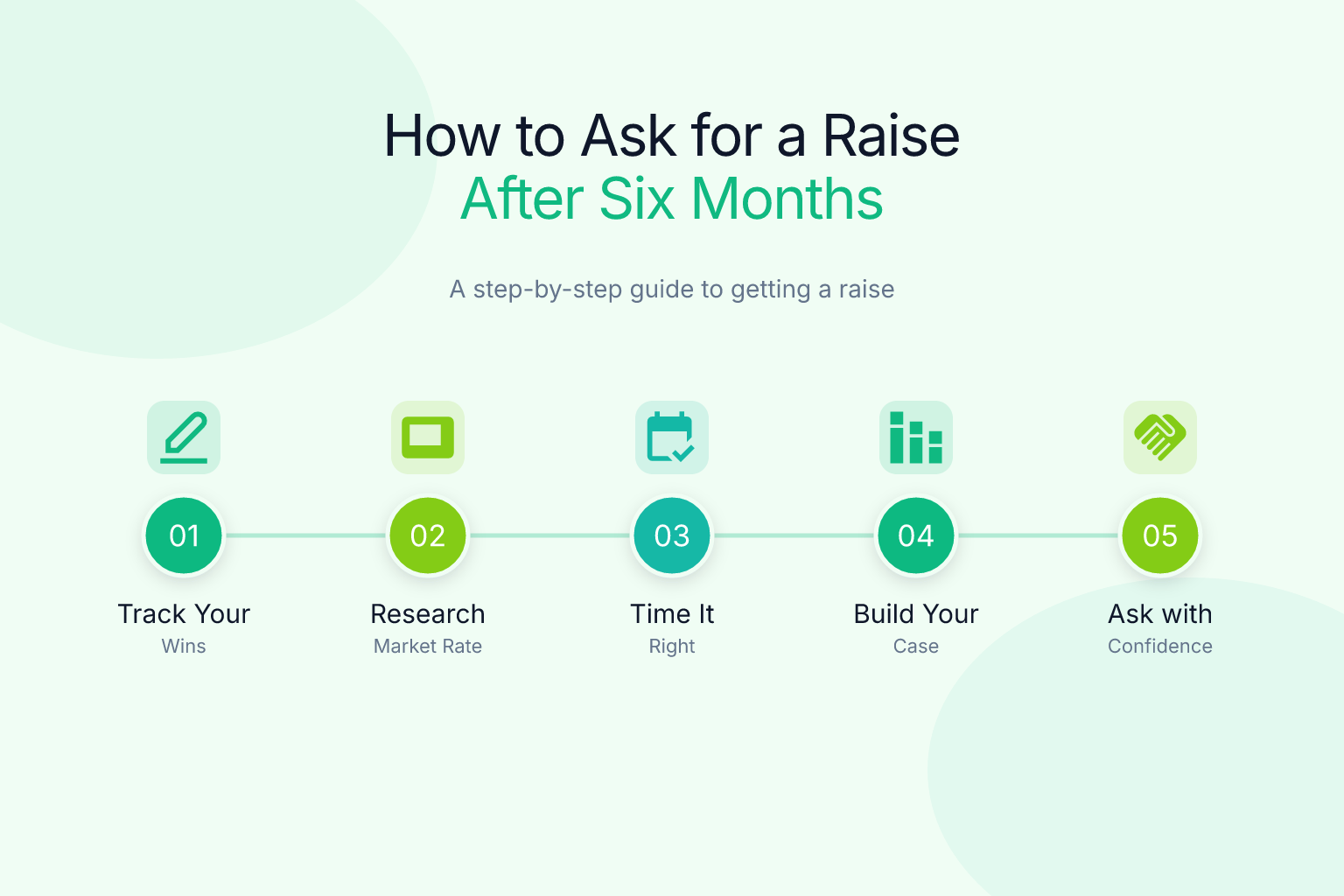
Knowing how to ask for a raise after six months can feel like walking a tightrope, but with the right preparation, it’s a conversation worth having. If you’ve delivered measurable results, taken on new responsibilities, or discovered your pay is below market, you can build a strong case for an off-cycle increase. The key is preparation, timing, and framing your request around the value you’ve already created — not just the time you’ve spent.
Key Takeaways
- You can ask for a raise after six months if you have concrete evidence of exceeding expectations, taking on significantly more responsibility, or being paid below market rate.
- Build a data-driven case by quantifying your impact in terms of revenue generated, costs saved, time saved, or other measurable outcomes rather than relying on tenure or personal need.
- Time your request strategically—ideally right after a major win, during a performance review, or when you’ve just taken on expanded responsibilities.
- If the answer is no, ask for specific, measurable goals and a clear timeline to revisit the raise, and confirm the plan in writing.
- Avoid common pitfalls like comparing yourself to coworkers, making emotional appeals, or issuing an ultimatum unless you are fully prepared to leave.
Key Takeaways
- You can ask for a raise after six months if you have concrete evidence of exceeding expectations, taking on significantly more responsibility, or if your salary is clearly below market for your role.
- Build a data-driven case that quantifies your impact — revenue generated, costs saved, processes improved — rather than relying on tenure or personal need.
- Time your request around a performance review, the completion of a major project, or a moment when your contributions are highly visible.
- If the answer is no, ask for a specific timeline, measurable goals, and a follow-up review to revisit the raise in the next three to six months.
- Avoid comparing yourself to coworkers, making emotional appeals, or threatening to leave unless you’re fully prepared to follow through.
Is It Too Early to Ask for a Raise After Six Months?
In most organizations, the standard review cycle is annual. According to the Society for Human Resource Management (SHRM), the majority of companies conduct performance reviews once a year, and raises are typically tied to that cycle. That doesn’t mean a six-month raise is impossible — it just means you need a stronger case than someone who’s been in the role for two years.
Six months is often the point where you’ve completed onboarding, mastered core responsibilities, and started delivering independent results. If you’ve already exceeded the expectations set during your hiring, you may have grounds to ask. The question isn’t “is six months too early?” but “have I done enough to justify an off-cycle increase?”
Situations where a six-month raise is realistic:
- You were hired at a below-market salary and have since proven your capabilities.
- Your role expanded significantly — you’re managing people, leading a project, or filling a gap that wasn’t in the original job description.
- You delivered a measurable win that directly impacted revenue, cost savings, or customer retention.
- The company is growing fast and you’re already performing at the next level.
If none of these apply, you may be better off waiting until the 12-month mark and using the next six months to build an undeniable track record.
When You Should (and Shouldn’t) Ask for a Raise at the 6-Month Mark
Before you schedule the meeting, do an honest self-assessment. A premature ask can damage your credibility, while a well-timed one can accelerate your earning trajectory.
Green Lights: When to Move Forward
- You have a quantifiable win. You closed a deal, launched a feature, reduced churn, or saved the company money — and you can put a number on it.
- Your manager has given you unsolicited praise. If they’ve told you you’re exceeding expectations, that’s a signal they see your value.
- You’re doing work above your pay grade. You’ve absorbed responsibilities from a departed colleague or are operating at a senior level without the title or pay.
- Market data backs you up. If you can show that the median salary for your role in your city is 15–20% higher than what you earn, you have a compelling external anchor.
Red Lights: When to Wait
- You’re still learning the ropes. If you’re asking basic questions daily or haven’t yet delivered a single independent project, hold off.
- The company is struggling financially. If there have been layoffs, hiring freezes, or budget cuts, a raise request will likely be tone-deaf.
- Your only reason is “I’ve been here six months.” Tenure alone is not a value argument.
- You haven’t had a single performance conversation yet. If your manager has no formal or informal feedback on your work, they have no basis to approve a raise.
How to Prepare a Data-Driven Case
Preparation is what separates a persuasive request from an awkward ask. You need to walk into the conversation with a narrative that makes the raise feel like a logical business decision, not a personal favor.
Step 1: Document Everything You’ve Achieved
Create a running document — a “brag file” — that captures your wins since day one. Include:
- Projects completed ahead of schedule
- Positive feedback from clients or colleagues
- Instances where you solved a problem that wasn’t your responsibility
- Any process improvements you initiated
Be specific. Instead of “improved team efficiency,” write “Created a shared dashboard that reduced weekly reporting time from 4 hours to 30 minutes for a team of 8.”
Step 2: Quantify Your Impact
Numbers make your case concrete. For each achievement, ask: How much revenue did this generate or protect? How much time or money did it save? How many customers did it affect? If you can’t find a direct number, estimate conservatively and be ready to explain your reasoning.
Managers approve raises when they can justify the expense to their own boss or HR. Your job is to give them the ammunition. Here’s how to frame different types of contributions:
- Revenue impact: “I led a upsell campaign that generated $45,000 in new recurring revenue within my first four months.”
- Cost savings: “By renegotiating our software vendor contract, I saved the company $12,000 annually.”
- Time savings: “I automated the monthly reporting process, saving 20 hours per month across the department — that’s roughly $15,000 in recovered productivity annually.”
- Customer impact: “My redesign of the onboarding flow increased trial-to-paid conversion by 8%, which projects to an additional 120 paying customers this year.”
- Risk mitigation: “I identified and fixed a compliance gap that could have resulted in fines up to $50,000.”
If you don’t have numbers this dramatic, don’t panic. Even smaller wins, when stacked together, paint a picture of consistent high performance. The key is to show a pattern of delivering more than what was expected at your level.
Step 3: Research Market Rates
Use sites like Glassdoor, Payscale, and Levels.fyi to find the salary range for your role, experience level, and location. If you’re underpaid relative to the market, that’s a powerful data point. Frame it as: “Based on market data, the median salary for this role is $X. I’m currently at $Y. I’d like to discuss bringing my compensation in line with the market, given the results I’ve delivered.”
Step 4: Align With Company Goals
Tie your achievements to the company’s priorities. If the business is focused on customer retention, highlight how your work reduced churn. If it’s growth, show how you contributed to new revenue. This shows you understand the bigger picture.
Timing Your Request: When to Have the Conversation
Even the strongest case can fail if you bring it up at the wrong moment. Aim for a time when your manager is receptive and your contributions are top of mind.
Best Times to Ask
- Right after a major win. The week you close a big deal or launch a successful project, your value is undeniable.
- During a performance review. Even if it’s an informal six-month check-in, this is a natural setting to discuss compensation.
- When you’ve just taken on more responsibility. If your boss asks you to lead a new initiative, that’s an opening to say, “I’m excited to take this on. Can we also discuss adjusting my compensation to reflect this expanded scope?”
- At the start of a new quarter or fiscal year. Budgets are often refreshed, and managers may have more flexibility.
Worst Times to Ask
- When your manager is stressed or overwhelmed. If they’re in the middle of a crisis, your raise will feel like another problem.
- Right after company-wide bad news. Layoffs, missed earnings, or budget cuts signal that money is tight.
- On a Monday morning or Friday afternoon. Aim for mid-week, mid-morning when people are generally more focused and less rushed.
How to Ask for a Raise: Scripts and Talking Points
You don’t need to memorize a monologue, but having a clear structure will keep you calm and on track. Here’s a simple framework:
- Open with appreciation and context. “I’ve really enjoyed my first six months here, and I’m proud of what we’ve accomplished together.”
- State your request clearly. “I’d like to discuss adjusting my compensation to reflect the contributions I’ve made and the market rate for my role.”
- Present your evidence. Walk through 2–3 key achievements with numbers.
- Anchor to market data (if applicable). “Based on my research, the median salary for this role is $X, and I’m currently at $Y.”
- Ask for their perspective. “I’d love to hear your thoughts on this and what a path forward might look like.”
Sample Script
“Thanks for making time today. I’ve learned a lot in my first six months and I’m excited about the direction we’re heading. I wanted to talk about my compensation. Since I started, I’ve [specific achievement with number], [second achievement], and I’ve also taken on [additional responsibility]. Based on market data for this role, the median salary is around $X, and I’m currently at $Y. I believe an adjustment to $Z would reflect the value I’m bringing. I’d love to hear your thoughts.”
Practice this out loud until it feels natural. If you stumble, that’s fine — authenticity matters more than perfection.
What to Do If They Say No (or Not Yet)
A “no” doesn’t have to be the end of the conversation. In fact, how you handle a rejection can set you up for a future yes.
If They Say “Not Right Now”
This is the most common response. It often means the timing is off, not that you don’t deserve it. Respond with: “I understand. Can we set a timeline to revisit this? What specific goals or milestones would you need to see from me to make a raise possible in the next three to six months?”
Get those goals in writing — send a follow-up email summarizing the conversation. This turns a vague “maybe later” into a concrete performance plan.
If They Say a Flat “No”
Ask for feedback: “I appreciate your honesty. Can you help me understand what’s missing so I can work on it?” This shows maturity and a growth mindset. If the reason is budget-related, ask when the next budget cycle begins and whether you can be considered then.
If the answer reveals that the company simply doesn’t value your role or there’s no path to growth, you may need to evaluate whether this is the right long-term fit. In that case, updating your resume and exploring other opportunities becomes a logical next step. For tips on refreshing your resume quickly, see our guide on updating your resume for a job search. Learning how to handle rejection professionally is a skill that serves you throughout your career — much like asking for feedback after a job rejection.
Common Mistakes to Avoid When Asking for a Raise Early
Even a well-prepared request can be undermined by these missteps:
- Comparing yourself to coworkers. “But Sarah got a raise after four months” will make you look petty and unprofessional. Focus on your own value.
- Making it personal. “I need more money because my rent went up” is not your employer’s problem. Keep the conversation about the value you deliver.
- Giving an ultimatum you’re not ready to execute. Threatening to quit unless you get a raise is a high-risk move. Only do it if you have another offer in hand and are genuinely willing to leave. If you do receive a counteroffer, learn how to evaluate a counteroffer.
- Apologizing for asking. Starting with “I’m sorry to bring this up” undermines your position. Be direct and confident.
- Accepting a vague promise. “We’ll look at it next quarter” without specifics is a recipe for disappointment. Always ask for a timeline and measurable criteria.
FAQ
Q: Should I ask for a raise after 6 months?
A: You should ask only if you have a strong, evidence-based case. If you’ve exceeded expectations, taken on significantly more responsibility, or your pay is well below market, a six-month request can be appropriate. If you’re still ramping up or haven’t delivered measurable results, it’s better to wait and build your track record.
Q: How do I ask for a raise after 6 months?
A: Schedule a private meeting with your manager, present a data-driven summary of your achievements, quantify your impact, and anchor your request to market data if possible. Use a clear, confident script and be ready to discuss a specific number. Follow up with an email summarizing the conversation and any agreed-upon next steps.
Q: Can you ask for a raise after 6 months?
A: Yes, you can. There’s no rule against it. However, success depends on your performance, the company’s financial health, and your manager’s perception of your value. Off-cycle raises are less common, so your case needs to be exceptionally strong.
Q: Is 6 months too early to ask for a raise?
A: It can be too early if you haven’t yet proven yourself. Most companies operate on an annual review cycle, so asking at six months requires a compelling reason — such as a major accomplishment, a significant increase in responsibilities, or a clear market discrepancy. If you’re unsure, ask for a six-month performance check-in first to gauge your standing.
Q: How to ask for a raise at work after 6 months?
A: The process is the same as asking at any time: prepare your case, time the conversation well, and present your request professionally. The difference at six months is that you need to emphasize the speed and impact of your contributions. Highlight what you’ve achieved in a compressed timeframe and why it warrants an early adjustment.
Q: What if my manager says no to a raise after 6 months?
A: Ask for specific, measurable goals and a timeline to revisit the conversation. If the reason is budget-related, find out when the next budget cycle begins. If the feedback reveals a performance gap, create a plan to close it. If the company can’t or won’t invest in your growth, it may be time to explore other opportunities — and having an updated resume ready will make that transition smoother.
Q: Should I get a raise after 6 months?
A: Not automatically. A raise is earned through performance, not time served. If you’ve delivered exceptional results, you may deserve one. If you’re meeting expectations but not exceeding them, a raise at the 12-month mark is more typical. Use the six-month point to assess your progress and set yourself up for a raise at your annual review.
Related articles:
- How to Ask for Feedback After Phone Screen (Templates)
- How to Fact Check AI Resume Content: A Step-by-Step Guide
Track Every Application While You Job Hunt
Stop losing track of where you’ve applied. The ResumeMate Job Tracker is a free Chrome extension that tracks every application, deadline, and follow-up in one place — right from your browser.