How to Ask for Internship Conversion to Full Time
You’ve put in the work, built relationships, and proven your value — now you want to turn that internship into a permanent role. Knowing how to ask for internship conversion to full time can feel awkward, but it’s a normal and expected part of the internship experience. Companies hire interns precisely because they want to evaluate future employees. The key is to approach the conversation with confidence, preparation, and the right timing.
Key Takeaways
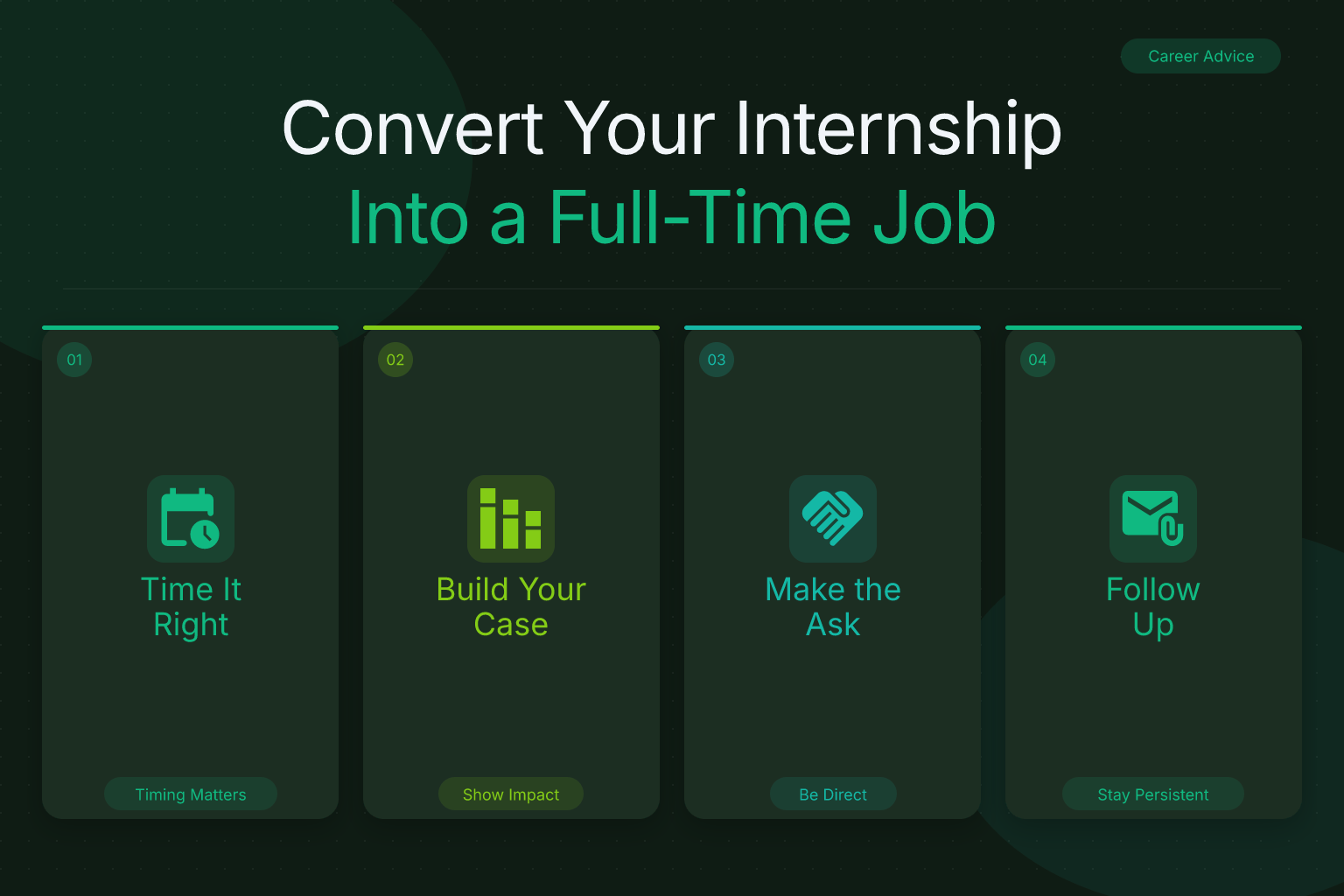
- The best time to ask about full-time conversion is 4–6 weeks before your internship ends, after you’ve delivered measurable results.
- Build a conversion case with a one-page summary of your contributions, skills gained, and positive feedback — don’t rely on your manager remembering everything.
- Frame the request around the value you can bring to the team long-term, not just your desire for a job.
- If a full-time role isn’t available, ask for a delayed offer, a referral, or a clear path to reapply — and leave on good terms.
- Update your resume and LinkedIn profile before the conversation so you’re ready to share them if asked.
Summary Table
| What to Do | Why It Matters | Time |
|---|---|---|
| Track your achievements weekly | Gives you concrete data to make your case | Throughout internship |
| Schedule a meeting with your manager | Shows initiative and professionalism | 4–6 weeks before end date |
| Prepare a one-page impact summary | Makes it easy for your manager to advocate for you | 1–2 days before the meeting |
| Ask directly but politely | Removes ambiguity and shows you’re serious | During the meeting |
| Follow up with a thank-you email | Reinforces your interest and professionalism | Same day |
How to Ask for Internship Conversion to Full Time: Timing and Preparation
Timing is everything. Ask too early and you’ll seem presumptuous — you haven’t yet proven yourself. Ask too late and the headcount may already be allocated to someone else. The sweet spot is typically 4–6 weeks before your internship ends. By then, you’ve had time to deliver results, build relationships, and demonstrate your fit with the team. Your manager has also likely started thinking about next year’s staffing needs.
For example, a finance intern who asked in week 8 of a 12-week internship was able to get a verbal offer before the final presentation, while another who waited until week 11 found the team had already extended an offer to a different intern. The early ask gave the manager time to secure budget approval and start the hiring process without pressure.
Before you schedule the conversation, do a self-assessment:
- Have you completed at least one significant project or contributed to a team goal?
- Have you received positive feedback from your manager or colleagues?
- Do you understand the team’s long-term goals and how you could contribute?
If the answer to these is yes, you’re ready. If not, focus on delivering something concrete in the next two weeks, then ask.
How to Prepare Your Case for Full-Time Conversion
Don’t walk into the conversation empty-handed. Prepare a one-page impact summary that you can email to your manager after the meeting or even hand them during the discussion. This document should include:
- Projects completed: List 2–3 key projects with measurable outcomes (e.g., “Redesigned the onboarding flow, reducing drop-off by 12%”).
- Skills developed: Highlight technical and soft skills you’ve built that are directly relevant to the full-time role.
- Positive feedback: Quote any praise you’ve received from managers, peers, or cross-functional partners.
- Team contribution: Show how you’ve supported the team beyond your assigned tasks — mentoring new interns, documenting processes, or volunteering for extra work.
- Future value: Briefly outline one or two ideas you’d like to pursue if brought on full-time.
This document serves two purposes: it makes your case concrete, and it gives your manager ammunition to advocate for you with HR or senior leadership. Many managers want to convert strong interns but need data to justify the headcount. Make it easy for them.
If you’re unsure how to frame your experience, the same principles apply when you write a resume for a part-time job — focus on impact, not just duties.
How to Ask for the Conversion: The Conversation
Schedule a 15–20 minute meeting with your manager. Don’t ambush them after a standup. Use a subject line like “Quick chat about my future on the team” so they know what to expect.
Opening the Conversation
Start by expressing gratitude and summarizing your experience. For example:
“I’ve really enjoyed this internship and learned a ton working with you and the team. I’d love to talk about the possibility of continuing here full-time after my internship ends.”
Then, ask an open-ended question:
“Are there any full-time opportunities on the team that might be a good fit for me?”
This approach is direct but not demanding. It invites a conversation rather than putting your manager on the spot.
What to Say Next
- If they say yes, ask about the process: “What would the next steps look like? Is there a formal application or interview process?”
- If they’re unsure, ask what would strengthen your case: “Is there anything I could do in the remaining weeks to make a stronger case for conversion?”
- If they say no, handle it gracefully (see the section below).
Throughout the conversation, listen more than you talk. Your manager may share insights about budget, headcount freezes, or upcoming roles you didn’t know about.
Email Templates for Asking About Full-Time Conversion
Sometimes an email is the right first step — especially if your manager is remote or you want to give them time to think before a meeting. Here are two templates.
Template 1: The Direct Ask (When You Have a Strong Relationship)
Subject: Exploring full-time opportunities on the team
Hi [Manager Name],
I’ve really enjoyed my internship so far and feel like I’ve grown a lot working with you and the team. As my internship wraps up in [X weeks], I’d love to explore the possibility of continuing here full-time.
I’ve attached a brief summary of my contributions and some ideas for how I could add value in a permanent role. Would you be open to a quick chat this week to discuss any opportunities?
Thanks for your time and mentorship.
Best, [Your Name]
Template 2: The Softer Approach (When You’re Unsure About Openings)
Subject: Chat about my future on the team?
Hi [Manager Name],
I’m really grateful for the experience I’ve gained during this internship. As I think about what’s next, I’d love to get your advice on whether there might be full-time opportunities on the team or elsewhere in the company that could be a good fit.
Would you have 15 minutes this week to share your perspective? I’m happy to work around your schedule.
Thanks so much, [Your Name]
Both templates are polite, professional, and make it easy for your manager to say yes to a conversation. If you’ve built a strong network during your internship, you might also consider asking for a LinkedIn referral from colleagues who can vouch for your work.
What to Do If They Say No (or “Not Right Now”)
A “no” doesn’t mean you failed. Headcount freezes, budget constraints, and restructuring happen. Here’s how to handle it:
- Stay professional. Thank them for the opportunity and express genuine appreciation. Burning a bridge helps no one.
- Ask for feedback. “Is there anything I could improve that would make me a stronger candidate in the future?” This shows maturity and gives you actionable insights.
- Request a delayed offer. Some companies can extend an offer for a start date 3–6 months out. Ask: “If a role opens up in the next few months, would it be possible to revisit this conversation?”
- Ask for a referral. Your manager likely knows people at other companies. A warm introduction can be more valuable than a job offer. For instance, when a product management intern was told there was no headcount, she asked her manager for a referral to a former colleague at a startup. That referral led to an interview and eventually a full-time offer.
- Stay in touch. Connect on LinkedIn, send occasional updates, and keep the relationship alive. Many interns get hired months later when a role opens up.
If you’re transitioning from an internship to a full-time job search, you’ll need to update your resume. The same strategies for showing scope and stability when moving from freelance to full-time apply here — frame your internship as a professional engagement with clear impact.
How to Negotiate the Offer Once You Get It
If the answer is yes, congratulations — but don’t accept the first offer blindly. Even as a former intern, you have room to negotiate. Here’s how:
- Research market rates. Use sites like Glassdoor, Levels.fyi, or the Bureau of Labor Statistics to understand the typical salary for your role and location.
- Consider the full package. Salary is just one piece. You can negotiate signing bonuses, relocation assistance, professional development budgets, or flexible work arrangements.
- Frame your ask around value. “Based on my contributions during the internship and the market rate for this role, I was hoping for a base salary closer to [X]. Is that within the range?”
- Be willing to walk away — politely. If the offer is far below market and non-negotiable, it’s okay to decline. You’ve just gained valuable experience that makes you a stronger candidate elsewhere.
Negotiation can feel uncomfortable, but it’s a normal part of the hiring process. The same principles apply whether you’re asking for a raise after six months or negotiating a starting salary — preparation and data are your best tools.
Common Mistakes to Avoid When Asking for Conversion
Even strong interns can sabotage their chances with these missteps. Avoiding them is just as important as making your case.
- Waiting until the last week. By then, decisions may already be made. For example, an intern at a marketing agency waited until the final day to ask, only to learn the team had already filled the only junior role two weeks earlier. Give your manager at least a month to explore headcount and start the hiring process.
- Making it all about you. Frame the conversation around the value you bring to the team, not just your desire for a job. Instead of saying “I really need this job,” say “I’ve seen how our team struggles with X, and I’d love to continue solving that problem.” This shifts the focus to what the company gains by keeping you.
- Not having a backup plan. Always keep your job search active until you have a signed offer letter. Internship conversions can fall through for reasons outside your control. One intern turned down other interviews assuming conversion was guaranteed, only to have the offer rescinded due to a budget freeze. Don’t put all your eggs in one basket.
- Neglecting other relationships. Your manager isn’t the only decision-maker. Build rapport with senior leaders, peers, and cross-functional partners who can support your case. A software engineering intern who only interacted with their direct manager missed the fact that the VP of Engineering was the one approving headcount; a brief coffee chat could have made a difference.
- Being too casual. Treat the conversion conversation with the same professionalism you’d bring to an external job interview. Dress appropriately, prepare talking points, and follow up with a thank-you note. Showing up in a hoodie and unprepared might signal you don’t take the opportunity seriously, even if you’ve already proven your skills.
How to Update Your Resume After an Internship
Whether you’re converting to full-time or searching elsewhere, your internship experience needs to shine on your resume. Here’s how to frame it:
- Use a professional title. Instead of “Intern,” use “Marketing Intern” or “Software Engineering Intern” to signal the function.
- Lead with impact. For each bullet, start with an action verb and include a measurable result when possible. “Analyzed customer support tickets and identified top 3 pain points, leading to a 15% reduction in repeat inquiries.”
- Highlight tools and skills. Mention specific software, programming languages, or methodologies you used.
- Include soft skills. Collaboration, communication, and adaptability matter. Weave them into your bullet points naturally.
- Add a “Projects” section if needed. If your internship involved a capstone project, give it its own section with a brief description and outcomes.
If you’re applying to full-time roles while still in your internship, you can list the internship as “Present” and describe ongoing work. Once it ends, update the end date and switch to past tense.
FAQ
Q: When is the best time to ask about internship conversion to full time?
A: Aim for 4–6 weeks before your internship ends. This gives your manager enough time to explore headcount and start the hiring process without feeling rushed. Asking too early can seem presumptuous; asking too late risks missing the decision window.
Q: What if my manager says there are no openings right now?
A: Ask if a delayed offer is possible, request a referral to other teams or companies, and stay in touch. Many interns get hired months later when a role opens up. Leave on good terms and keep the door open.
Q: Should I ask in person or over email?
A: In person or via video call is ideal because it allows for a real conversation. If that’s not possible, send a well-crafted email to start the discussion, then follow up with a meeting. Use the templates in this guide as a starting point.
Q: How do I prove I’m ready for a full-time role?
A: Prepare a one-page impact summary that lists your completed projects, measurable results, skills developed, and positive feedback. This document makes it easy for your manager to advocate for you with HR and senior leadership.
Q: Can I negotiate a full-time offer from an internship?
A: Yes. Research market rates, consider the full compensation package, and frame your ask around the value you’ve already demonstrated. Even as a former intern, you have leverage — the company already knows your work and wants to retain you.
Q: What if I haven’t received much feedback during my internship?
A: Ask for a brief feedback session before the conversion conversation. You can say, “I’d love to get your thoughts on my performance so far so I can make the most of my remaining time here.” This shows initiative and gives you material for your case.
Track Every Application While You Job Hunt
Stop losing track of where you’ve applied. The ResumeMate Job Tracker is a free Chrome extension that tracks every application, deadline, and follow-up in one place — right from your browser.