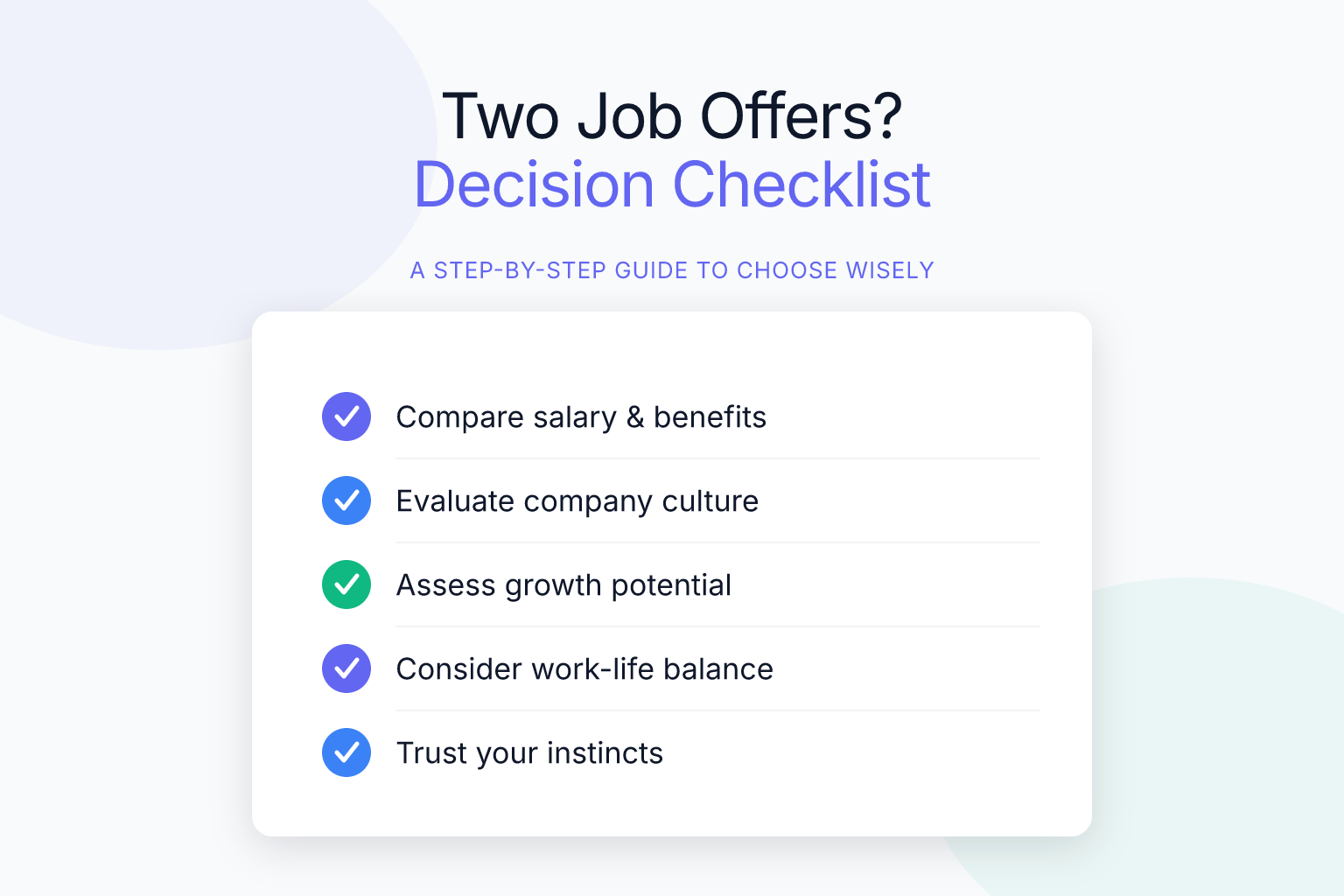
How to Decide Between Two Job Offers: A Complete Checklist
You’ve done the hard work — polished your resume, aced the interviews, and now you’re holding two job offers. But how to decide between two job offers can feel just as stressful as the search itself. The wrong choice could mean a toxic culture, slower career growth, or leaving money on the table. The right one could launch the next chapter of your career. This checklist breaks the decision into clear, comparable factors so you can move forward with confidence.
Key Takeaways
- A structured checklist that scores compensation, benefits, culture, growth, and logistics removes emotional bias and reveals which offer truly fits your priorities.
- Base salary is just the starting point — compare total compensation including bonuses, equity, retirement contributions, and health benefits to see the real financial picture.
- Culture and work-life balance are often the deciding factors; ask to speak with future teammates and pay attention to red flags during the interview process.
- Use a weighted decision matrix to quantify your comparison, then negotiate with the preferred employer before making a final choice.
- Track offer deadlines and follow-ups with a tool like the ResumeMate Job Tracker so you never miss a response window.
Summary Table
| What to Do | Why It Matters | Time |
|---|---|---|
| List all compensation elements (base, bonus, equity, 401k match) | Base salary alone can be misleading; total comp reveals the real financial value | 30 min |
| Score each offer on culture, manager quality, and work-life balance | These factors drive daily satisfaction more than a slightly higher paycheck | 1–2 hours (including conversations) |
| Map career growth potential — promotions, learning, and network | A job that accelerates your career can be worth more than a higher starting salary | 45 min |
| Run a weighted decision matrix with your personal priorities | Removes gut-feel bias and makes trade-offs explicit | 20 min |
| Negotiate the preferred offer before declining the other | You may close the gap or get a better deal without burning bridges | 1–2 days |
How to Decide Between Two Job Offers: A Step-by-Step Checklist
When you’re lucky enough to have multiple offers, the pressure to pick the “right” one can be paralyzing. The key is to break the decision into clear, comparable categories and evaluate each one systematically. This checklist walks you through every factor that matters — from salary to culture to long-term growth — so you can make a choice you won’t regret.
1. Compare Total Compensation, Not Just Base Salary
A higher base salary grabs your attention, but it’s only one piece of the financial puzzle. Two offers with the same base can differ by tens of thousands of dollars once you factor in everything else.
Create a side-by-side compensation table for each offer:
- Base salary — the obvious starting point.
- Bonus potential — is it guaranteed, performance-based, or a mix? What percentage of base is typical?
- Equity or stock options — for startups, understand the strike price, vesting schedule, and what the equity might actually be worth (not just the number of shares).
- Retirement contributions — a 6% 401(k) match vs. a 3% match can mean thousands per year.
- Sign-on bonus — one-time cash that can tip the scales, but don’t let it blind you to recurring differences.
- Other cash perks — profit sharing, commission structures, or annual raises tied to performance reviews.
If you’re comparing a startup offer with equity to an established company with a higher base, run the numbers over a 2–4 year horizon. Many startup equity packages end up worth little, so treat them as a potential bonus, not guaranteed income.
2. Evaluate Benefits and Perks That Affect Your Wallet and Well-Being
Benefits can easily add 20–30% to your total compensation, yet candidates often skim over them. Go deep on the details.
Health insurance — compare monthly premiums, deductibles, out-of-pocket maximums, and network quality. A job with a $200/month lower premium but a $3,000 higher deductible could cost you more if you have regular medical needs.
Paid time off — not all PTO is equal. Some companies offer “unlimited” PTO, which can sound great but often results in employees taking less time off due to cultural pressure. If you’re comparing a traditional PTO bank (e.g., 15 days) to unlimited, ask the hiring manager how many days team members typically take. For more on negotiating PTO, see our guide on how to negotiate PTO in a job offer.
Parental leave, sick days, and sabbaticals — if you plan to grow your family or need flexibility for caregiving, these policies matter enormously.
Remote work stipends, commuter benefits, and professional development budgets — these can add up to real money and signal how much the company invests in employees.
If you haven’t received a full benefits summary, ask for it. Most employers will share the details once an offer is extended. If you’re still in the interview stage, learn how to ask about a benefits package before a job offer without seeming pushy.
3. Assess Company Culture and Work-Life Balance
Culture is the hardest factor to quantify, but it’s often the reason people leave jobs. You’ll spend 40+ hours a week in this environment — it needs to fit you.
Ask to speak with future peers — not just the hiring manager. A 15-minute call with a potential teammate can reveal more about daily life than any formal interview. Ask questions like:
- “What does a typical week look like for your team?”
- “When was the last time you worked late or on a weekend?”
- “How does the team handle disagreements or feedback?”
Look for red flags — high turnover in the role you’re filling, vague answers about work hours, or a manager who seems disengaged during your conversations.
Work-life balance signals — does the company respect boundaries? Check if emails fly at 10 p.m. or if people actually use their PTO. Glassdoor reviews can help, but take them with a grain of salt; disgruntled ex-employees are overrepresented.
Remote, hybrid, or in-office — if one offer is fully remote and the other requires a commute, factor in the time and cost. A 45-minute commute each way adds up to 7.5 hours a week — nearly a full extra workday.
4. Consider Career Growth and Learning Opportunities
A job that pays slightly less today but accelerates your career can be the smarter long-term bet. Evaluate each offer’s growth potential:
- Promotion path — is there a clear ladder? Ask what the next level looks like and how long it typically takes to get there.
- Skill development — will you learn in-demand skills, work with modern tools, or get exposure to new areas? A role that builds your resume can pay dividends in your next job search.
- Mentorship and network — a strong manager who develops people is worth more than a 5% salary bump. Ask about the manager’s leadership style and track record of promoting from within.
- Company trajectory — a fast-growing company creates more opportunities than a stagnant one. Research funding rounds, revenue growth, and market position.
If one offer is at a well-known brand and the other at a lesser-known company, consider the resume value. A recognizable name can open doors later, but a smaller company might give you broader responsibility sooner.
5. Factor in Commute, Location, and Relocation
Logistics can make or break your daily happiness. Even a dream job can become a grind if the commute is miserable.
- Commute time and cost — calculate the weekly hours and transportation expenses. If one job requires a car and the other is transit-accessible, that’s a real financial difference.
- Relocation requirements — if you need to move, compare relocation packages. Some companies cover moving expenses, temporary housing, and even home-finding trips. Others offer a lump sum. Understand what’s reimbursed vs. paid upfront.
- Cost of living — a $100,000 salary in San Francisco is not the same as $100,000 in Austin. Use a cost-of-living calculator to adjust salaries to a common baseline.
- Flexibility — if one role allows remote work a few days a week, that can offset a longer commute or higher cost of living.
6. Trust Your Gut: Red Flags and Green Flags
After you’ve crunched the numbers, pay attention to how you feel. Your subconscious picks up on signals that spreadsheets miss.
Red flags to take seriously:
- The company rushed you through the interview process without letting you ask questions.
- They pressured you to accept quickly, using an exploding offer. (If you need more time, here’s how to request an extension on a job offer deadline.)
- The job description changed significantly from what was posted.
- You’d be replacing someone who left after less than a year.
- The manager bad-mouthed former employees or seemed evasive about team challenges.
Green flags:
- The team seemed genuinely excited about you joining.
- They proactively shared details about benefits, growth, and team dynamics.
- Your future manager asked about your career goals and discussed how this role fits into them.
- The interview process was organized and respectful of your time.
7. Use a Decision Matrix to Score Your Offers
A weighted decision matrix turns subjective feelings into a clear, numerical comparison. Here’s how to build one:
- List the factors that matter most to you — compensation, benefits, culture, growth, location, work-life balance, job security, etc.
- Assign a weight to each factor based on its importance (1–10, where 10 is critical).
- Score each job on each factor (1–10, where 10 is perfect).
- Multiply the score by the weight for each factor, then sum the totals.
Example:
| Factor | Weight | Job A Score | Job A Weighted | Job B Score | Job B Weighted |
|---|---|---|---|---|---|
| Total Compensation | 9 | 8 | 72 | 7 | 63 |
| Benefits | 7 | 6 | 42 | 8 | 56 |
| Culture | 8 | 9 | 72 | 6 | 48 |
| Growth Potential | 8 | 7 | 56 | 9 | 72 |
| Work-Life Balance | 7 | 8 | 56 | 5 | 35 |
| Commute/Location | 5 | 6 | 30 | 9 | 45 |
| Total | 328 | 319 |
In this example, Job A edges out Job B, but the numbers also show where Job B is stronger. If you can negotiate a better benefits package or work-life balance with Job B, it might become the winner.
Don’t just trust the math — use it as a conversation starter with yourself. If the matrix says Job A but you feel disappointed, that’s valuable data.
8. Negotiate Before You Decide
You have leverage when you hold two offers. Use it — respectfully — to improve the one you’re leaning toward.
How to approach it:
- Tell your preferred employer that you have another offer but would love to join their team if you can close the gap on a specific element (salary, PTO, signing bonus, etc.).
- Be honest but not threatening. Frame it as a problem you’re trying to solve together.
- Don’t reveal the other company’s name or exact numbers unless you’re comfortable. You can say, “I have another offer that’s competitive on compensation. Is there flexibility on the base salary or bonus?”
What’s negotiable beyond salary:
- Signing bonus (often the easiest for companies to approve)
- Extra PTO days
- Remote work flexibility
- Professional development budget
- Earlier performance review or guaranteed raise timeline
If the employer can’t budge on money, they might offer non-cash perks that tip the scales. Always negotiate before declining the other offer — you might be surprised what’s possible.
Once you’ve made your decision, decline the other offer graciously. Thank them for their time, be honest that you’ve chosen a role that aligns more closely with your current goals, and leave the door open for future opportunities.
Frequently Asked Questions
Q: How long should I take to decide between two job offers?
A: Most employers expect an answer within 3–5 business days. If you need more time, ask for it — especially if you’re waiting on another offer or need to evaluate benefits details. A polite request for a few extra days is usually granted. Use the time to complete this checklist and have any final conversations with the teams.
Q: What if both offers have the same salary?
A: Look beyond base pay. Compare bonuses, equity, benefits, retirement contributions, and perks. Then weigh culture, growth potential, and work-life balance. Often, the deciding factor isn’t money — it’s the manager you’ll work with or the skills you’ll build.
Q: Should I tell the other company I have a competing offer?
A: Yes, but only with the one you’re genuinely interested in. Use it as leverage to negotiate a better package. Be professional and frame it as wanting to make the numbers work so you can say yes. Avoid using it as a threat or to start a bidding war — that can backfire.
Q: How do I compare a startup offer with equity to a corporate offer with a higher base?
A: Treat equity as a high-risk, high-reward component. Ask about the percentage of the company the shares represent, the current valuation, and the vesting schedule. Then run two scenarios: one where the equity is worth nothing, and one where it’s worth the optimistic projection. If you’d still be happy with the startup offer in the “worth nothing” scenario, it’s a safer bet.
Q: What if I make the wrong choice?
A: No decision is permanent. If you realize a few months in that the job isn’t what you expected, you can start a new search. The experience you gain will still be valuable. Many professionals change jobs within the first year — it’s not a career-ender. The key is to learn from the experience and refine what you look for next time.
Q: Can I accept one offer and later switch to the other if I change my mind?
A: Legally, yes (in most at-will employment situations), but it burns a bridge. Reneging on an accepted offer can damage your reputation in that industry, especially if the company has already invested in onboarding. It’s far better to ask for more time upfront and make a decision you can commit to.
Related articles:
Track Every Application While You Job Hunt
Stop losing track of where you’ve applied. The ResumeMate Job Tracker is a free Chrome extension that tracks every application, deadline, and follow-up in one place — right from your browser.