How to Decline a Job Offer Politely Without Burning Bridges
You’ve just received a job offer — but after careful thought, you’ve decided it’s not the right move. Now you need to figure out how to decline a job offer politely without burning bridges. It’s a moment that can feel awkward, even guilt-ridden, especially if the hiring team invested time in you. But turning down an offer doesn’t have to damage your professional reputation. When handled with respect, clarity, and a touch of warmth, a well-delivered “no” can actually strengthen your network and leave the door open for future opportunities.
Recruiters and hiring managers understand that candidates make decisions based on fit, timing, and personal circumstances. What they remember isn’t the rejection itself — it’s how you delivered it. A gracious decline shows emotional intelligence and professionalism, two traits that make you someone they’d want to work with down the line. In this guide, you’ll get exact scripts, email templates, and a step-by-step framework to say no without guilt or fallout.
Key Takeaways
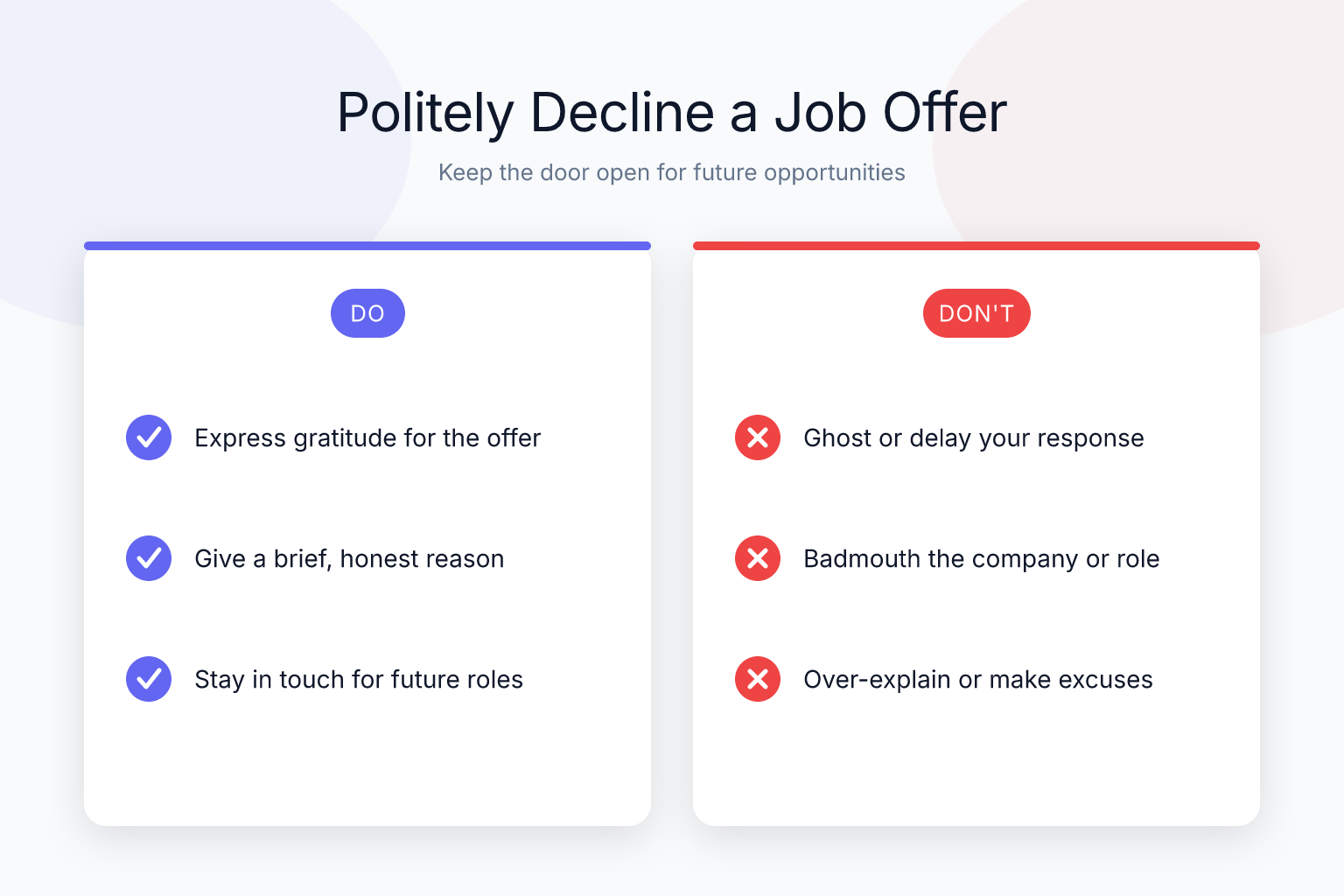
- Respond promptly and directly — ghosting is the fastest way to burn a bridge and damage your reputation.
- Express genuine gratitude and give a brief, non-negative reason for declining; you don’t need to over-explain.
- Use a phone call for the personal touch, then follow up with a concise email to document your decision.
- Offer to stay connected on LinkedIn or refer someone else to turn a “no” into a relationship-building moment.
- Keep the door open by leaving a positive final impression — many hiring teams will welcome a future application from you.
| What to Do | Why It Matters | Time |
|---|---|---|
| Call the hiring manager or recruiter | Shows respect and preserves the relationship | 10–15 minutes |
| Send a polite decline email | Provides a written record and reinforces professionalism | 5 minutes |
| Give a brief, honest reason | Avoids speculation and maintains trust | Part of the conversation |
| Connect on LinkedIn | Keeps the network alive for future roles | 2 minutes |
| Refer a qualified contact (optional) | Turns a “no” into a helpful gesture | 5 minutes |
Why Declining a Job Offer Politely Matters for Your Career
The first step in learning how to decline a job offer politely without burning bridges is understanding what’s at stake. Industries are smaller than they appear. The recruiter you say no to today could be the one sourcing candidates for your dream role at another company next year. The hiring manager might move to a different organization and remember how you handled the rejection. A single clumsy decline can quietly close doors you didn’t even know existed.
Beyond reputation, there’s a practical reason to get this right: you may want to apply to the same company again. Many organizations keep notes on candidates in their applicant tracking systems. A note that reads “declined offer — professional and gracious” is very different from “candidate ghosted us after verbal acceptance.” The first keeps you in the talent pool; the second can get you flagged as a do-not-contact.
Finally, declining well is a skill that reflects your own standards. It shows you can handle difficult conversations with poise — a quality every employer values. When you treat the process with care, you walk away with your integrity intact and a network that’s still rooting for you.
When to Decline a Job Offer (and When to Negotiate Instead)
Before you draft that rejection email, pause and ask: is this a “no” or a “not yet”? Sometimes what feels like a dealbreaker is actually negotiable. If the salary is lower than you expected, the title doesn’t match your level, or the benefits package falls short, you might have room to negotiate before walking away.
We’ve covered negotiation strategies in depth elsewhere. If the sticking point is the job title, read our guide on how to negotiate a job title without changing your role. If paid time off is the issue, check out how to negotiate PTO in a job offer: scripts and strategies. And if you’re torn between two offers, use our complete checklist for deciding between two job offers to make a clear-headed choice. If the compensation gap is the main hurdle, you might also explore negotiating a signing bonus — see our guide on how to ask for a signing bonus.
Decline only when the core mismatch can’t be fixed. Common non-negotiable reasons include:
- The role requires relocation you can’t make.
- The company culture or values don’t align with yours.
- You’ve accepted another offer that’s a better overall fit.
- The work itself doesn’t match your career direction.
- Personal circumstances (health, family) make the timing impossible.
If you’re certain the answer is no, move forward with confidence. A clean, timely decline is far better than dragging out the process or accepting an offer you’ll resent.
How to Decline a Job Offer Over the Phone: A Step-by-Step Script
A phone call is the gold standard for declining a job offer, especially if you’ve built rapport with the hiring manager or recruiter. It’s personal, immediate, and leaves little room for misinterpretation. Here’s a simple script you can adapt:
Step 1: Start with appreciation. “Hi [Name], thank you so much for the offer and for the time you’ve spent getting to know me. I’ve really enjoyed learning about the team and the work you’re doing.”
Step 2: Deliver the news clearly and kindly. “After careful consideration, I’ve decided to decline the offer. This wasn’t an easy decision because I was genuinely impressed by [something specific about the company or role].”
Step 3: Give a brief, honest reason (optional but recommended). “Ultimately, I’ve accepted another opportunity that aligns more closely with my current career goals / the timing isn’t right for personal reasons / the role isn’t quite the direction I want to take right now.”
Step 4: Reaffirm respect and leave the door open. “I have a lot of respect for what you’re building, and I’d love to stay in touch. If a role opens up in the future that’s a better fit, I’d be excited to explore it.”
Step 5: End warmly. “Thank you again for everything. I wish you and the team all the best.”
Practice the script out loud a couple of times so you sound natural, not rehearsed. The goal is to be warm, direct, and brief. You don’t need to apologize excessively or justify your decision at length.
What If They Don’t Answer? Leave a Voicemail
If you can’t reach them live, leave a concise voicemail and follow up with an email. A voicemail script could be:
“Hi [Name], this is [Your Name]. I’m calling to follow up on the offer for the [Job Title] role. I’ve decided to decline, but I wanted to thank you personally for the opportunity. I’ll send a quick email to confirm, and I’d love to stay in touch. Thanks again.”
This keeps the personal touch without putting them on the spot.
What If They Try to Change Your Mind?
Sometimes a hiring manager will counter with a better offer or ask what it would take to keep you. If you’re open to it, you can listen — but only if the original issues are truly fixable. If your decision is final, stay kind but firm: “I really appreciate that, but my decision is made. I’m grateful for the offer and the conversation.” Don’t get drawn into a negotiation you don’t intend to complete.
How to Write a Job Offer Rejection Email (With Templates)
After the phone call, send a short email to confirm your decision in writing. If a call isn’t possible — for example, if all communication has been via email — a well-crafted email alone can work. Here are three templates you can use.
Template 1: Standard Polite Decline
Subject: Job Offer – [Your Name]
Dear [Hiring Manager Name],
Thank you so much for offering me the [Job Title] position. I’m truly grateful for the time you and the team spent with me during the interview process, and I enjoyed learning about [Company Name]’s work in [mention something specific].
After careful thought, I’ve decided to decline the offer. This was a difficult decision, but I’ve chosen to pursue another opportunity that’s a closer fit for my current career direction.
I have great respect for your team and would welcome the chance to stay connected. I hope our paths cross again in the future.
Wishing you and the team continued success.
Best regards, [Your Name]
Template 2: Decline After Accepting Another Offer
Subject: Job Offer Decision – [Your Name]
Dear [Hiring Manager Name],
Thank you again for the offer to join [Company Name] as a [Job Title]. I’ve really appreciated getting to know you and the team.
Since we last spoke, I’ve received and accepted another offer that aligns closely with my long-term goals. As a result, I must respectfully decline your offer.
I’m genuinely grateful for the opportunity and hope we can keep in touch. Please don’t hesitate to reach out if I can ever be a resource to you or your team.
All the best, [Your Name]
Template 3: Declining When the Offer Doesn’t Meet Your Needs (Salary, Benefits, or Role)
Subject: Job Offer – [Your Name]
Dear [Hiring Manager Name],
Thank you for the offer to join [Company Name] as a [Job Title]. I’ve enjoyed learning about the team and the exciting work ahead.
After careful consideration, I’ve decided to decline. While I’m very drawn to the mission and the people I met, the overall package doesn’t align with what I need at this stage of my career. This was a tough call, and I’m grateful for the time you invested in me.
I’d love to stay in touch and hope our paths cross again under different circumstances.
Warm regards, [Your Name]
Keep the email concise. Avoid over-explaining, criticizing the role, or comparing the offer to the one you accepted. The tone should be warm, professional, and final.
How to Decline a Recruiter’s Outreach (Including LinkedIn Recruiters)
Not every “no” involves a formal offer. You may need to decline a recruiter who reached out about a role you’re not interested in — and doing it politely keeps that recruiter as a future resource. This is especially common on LinkedIn, where a quick, gracious reply can turn a cold message into a warm connection.
For a LinkedIn InMail or email from a recruiter:
“Hi [Name], thanks so much for reaching out about the [Role] opportunity. I’m flattered you thought of me. At the moment, I’m not exploring new roles, but I’d be happy to connect here on LinkedIn in case something more aligned comes up down the road. Best of luck with your search!”
If you’re open to future contact but the current role isn’t a fit:
“Thanks for the note! This role isn’t quite what I’m looking for right now, but I’d love to stay connected. If you come across opportunities in [your area of interest], please keep me in mind.”
When a recruiter calls you directly: Use a similar structure: thank them, decline clearly, and leave the door open. “I appreciate the call, but I’m not in the market at the moment. I’d be happy to connect on LinkedIn and revisit if my situation changes.”
These small replies take seconds but leave a lasting impression of professionalism. Recruiters remember candidates who respond thoughtfully — and they’ll be more likely to reach out again when the right role appears.
What to Say When You Decline: Crafting Your Reason
You don’t owe anyone a detailed explanation, but offering a brief, genuine reason can prevent awkward follow-up questions and show respect. The key is to frame your reason around your own situation, not the company’s shortcomings.
Safe, professional reasons to give:
- “I’ve decided to accept another offer that’s a better match for my current career goals.”
- “After reflecting, I realize this role isn’t the right next step for me at this time.”
- “Personal circumstances have shifted, and I need to prioritize a different type of opportunity.”
- “The timing isn’t ideal for me to make this move, but I’d love to revisit in the future.”
- “I’ve decided to stay with my current employer after they presented a compelling retention offer.”
- “The commute/relocation requirements don’t work for my family situation right now.”
- “While I’m very impressed by the team, the role itself doesn’t align with the direction I want to take my career.”
What to avoid saying:
- “The salary is too low.” (Even if true, it can sound transactional. If you negotiated and they couldn’t meet your number, you can say “We weren’t able to align on compensation, and I’ve decided to pursue other options.”)
- “I don’t think I’d enjoy working with the team.” (Never personal.)
- “I’m holding out for a better offer.” (Dismissive.)
- A long, rambling list of pros and cons. (Oversharing creates awkwardness.)
- “The culture seems off” or “I’ve heard negative things.” (Keep it about you, not them.)
If you’re declining because of something the company could improve — like a grueling interview process or unclear expectations — save that feedback for a separate, constructive conversation only if they explicitly ask. Unsolicited criticism in a rejection note rarely lands well.
How to Keep the Door Open for Future Opportunities
A graceful decline can actually strengthen your professional relationship. Here’s how to make sure the door stays open:
Connect on LinkedIn immediately. Send a personalized connection request: “Hi [Name], I really enjoyed meeting you during the interview process. Even though the timing didn’t work out this time, I’d love to stay connected here.” This small gesture signals that your interest in the company was genuine, not just transactional.
Offer to refer someone. If you know a qualified person who might be a great fit, mention it. “While I’m not able to accept, I do know a talented [role] who might be interested. Happy to make an introduction if that’s helpful.” This turns your decline into a value-add and leaves a memorably positive impression.
Engage with the company’s content. Follow the company page on LinkedIn, occasionally like or comment on posts. You don’t need to be a superfan, but staying visible keeps you on their radar for future openings.
Set a reminder to check back. If you genuinely want to work there someday, note it in your calendar to reach out in 6–12 months. A brief email — “I’ve been following your team’s progress and would love to reconnect if any roles open up” — can reignite the conversation.
And if you’re still actively job searching, make sure your application materials are as strong as they can be. Use the free ResumeMate resume builder to create a clean, ATS-friendly resume, and check your resume’s ATS score to catch formatting issues before you apply elsewhere.
Common Mistakes to Avoid When Declining a Job Offer
Even with good intentions, it’s easy to slip up. Here are the most common mistakes — and how to avoid them.
Ghosting. Disappearing after an offer is the quickest way to burn a bridge. Recruiters talk, and a reputation for ghosting can follow you. Always respond, even if it’s a brief email.
Waiting too long to decide. Once you know your answer, communicate it. Dragging out the process wastes the employer’s time and can sour the relationship. If you need a few days to think, ask for a clear deadline — but don’t leave them hanging past that date.
Over-apologizing. One sincere “thank you” is enough. Repeated apologies can make the conversation uncomfortable and undermine your confident decision.
Burning the bridge with negativity. Even if the interview process was frustrating or the offer was disappointing, keep your decline positive. Venting to the recruiter or leaving a negative Glassdoor review right after declining can backfire.
Accepting out of guilt. Never accept an offer you don’t intend to keep just to avoid an awkward conversation. Rescinding an acceptance later is far more damaging than a polite decline upfront.
Forgetting to withdraw other applications. If you’ve accepted another offer, promptly withdraw from any other active processes. It’s a professional courtesy that saves everyone time.
Declining via text or instant message. Unless you’ve exclusively communicated that way throughout the process, a text or WhatsApp message feels impersonal and dismissive. Stick to a phone call or email.
Using a generic, copy-paste template without personalization. A decline that sounds like it could have been sent to anyone signals that you didn’t value the relationship. Always include at least one specific detail — a project you discussed, a team member you enjoyed meeting — to show you were paying attention.
What to Do After You Decline: Next Steps for Your Job Search
Once you’ve sent that email and made the call, take a moment to reflect — then refocus on your search. If you declined because you accepted another offer, congratulations! Update your resume with the new role while the details are fresh, and let your references know they might be contacted. Our guide on how to prepare your references before a job search walks you through the process.
If you’re still looking, use the clarity you gained from this decision to refine your target. What did this offer lack that you’re truly seeking? More growth potential? Remote flexibility? A different industry? Use those insights to filter opportunities more effectively. The ResumeMate job board lets you search by role, location, and remote options so you can find openings that match your updated criteria.
And as you apply, keep your applications organized. The free ResumeMate Job Tracker Chrome extension logs every application, deadline, and follow-up directly from your browser — so you never lose track of where you stand.
Declining a job offer is a normal part of a healthy career. Done well, it’s not an ending — it’s a pivot that keeps your options open and your reputation strong.
FAQ
Q: Can I decline a job offer after I’ve already accepted it?
A: Yes, but it’s a delicate situation. You should call the hiring manager immediately, explain that circumstances have changed, and apologize for the inconvenience. Be prepared for disappointment, but most professionals will understand if you handle it respectfully. Avoid making a habit of this, as it can damage your reputation.
Q: What if I decline because the salary is too low?
A: If you’ve already tried to negotiate and they couldn’t meet your needs, you can say: “After careful consideration, I’ve decided to decline. We weren’t able to align on compensation, and I need to prioritize an opportunity that meets my financial requirements.” Keep it factual and unemotional.
Q: Should I decline a job offer by phone or email?
A: A phone call is best if you’ve built a relationship with the hiring manager. It’s more personal and shows respect. Follow up with a brief email to confirm. If all communication has been via email, a well-written email alone is acceptable.
Q: How do I decline a job offer without giving a reason?
A: You can simply say, “After careful thought, I’ve decided to decline the offer. This was a difficult decision, but I believe it’s the right one for me at this time.” You’re not obligated to share details, and a vague but polite response is perfectly fine.
Q: Can I decline a job offer and still apply to the same company later?
A: Absolutely. Many companies welcome former candidates who declined gracefully. When you apply again, mention your previous positive experience in your cover letter or initial call. A professional decline often leaves a better impression than never having engaged at all.
Q: What if the employer gets angry or pressures me when I decline?
A: Stay calm and professional. You can say, “I understand this is disappointing, and I’m grateful for the offer. My decision is final, but I truly wish you the best.” You don’t need to justify yourself further. If the reaction is unprofessional, that’s a red flag that validates your decision.
Q: How do I decline a job offer that came through a friend’s referral?
A: Thank your friend first, then decline the offer with the employer using the same respectful approach. Let your friend know you’ve declined and express gratitude for their help. A simple message like, “I really appreciate you putting my name forward. I ended up going in a different direction, but I’m so grateful for your support” keeps the friendship intact.
Q: How do I decline a job offer over the phone if I’m nervous?
A: Write down a few bullet points — not a full script — and practice out loud once or twice. Start with gratitude, state your decision clearly, give a brief reason, and end warmly. Remember, the person on the other end has likely been on both sides of this conversation. Keep it short and kind; you’ll feel relieved once it’s done.
Q: Can I decline a job offer via text or WhatsApp?
A: It’s not recommended unless that’s been your primary mode of communication throughout the process. A text can feel dismissive and impersonal. A phone call or email is almost always the better choice. If you must use text, keep it warm and follow up with a more formal email.
Q: How do I decline a recruiter on LinkedIn who reached out about a role?
A: Reply to their InMail with a brief, polite message: “Thanks for thinking of me! I’m not exploring new roles at the moment, but I’d be happy to connect here for the future.” This keeps the door open without committing to a conversation you don’t want.
Q: How do I politely decline a job applicant? (For employers)
A: This article focuses on declining a job offer as a candidate. If you’re an employer, the same principles apply: be prompt, respectful, and brief. A simple email thanking them for their time and letting them know you’ve moved forward with other candidates is sufficient. Avoid ghosting or giving unsolicited feedback unless they ask.
Q: How do I decline further interviews or withdraw from consideration before an offer?
A: Send a short email to your point of contact: “Thank you for the opportunity to interview for the [Role] position. After further reflection, I’ve decided to withdraw my application. I appreciate your time and wish you the best in finding the right candidate.” It’s professional and leaves a positive impression.
Track Every Application While You Job Hunt
Stop losing track of where you’ve applied. The ResumeMate Job Tracker is a free Chrome extension that tracks every application, deadline, and follow-up in one place — right from your browser.