How to Explain a Career Change in an Interview (With Sample Answers)
Explaining a career change in an interview can feel like the hardest part of the job search — but it’s also your biggest opportunity to show self-awareness, adaptability, and genuine enthusiasm for the role. When you walk into that room (or log onto that video call), the interviewer already knows you’re a career changer. Your resume told that story. Now they want to hear it from you: Why this shift? Why now? And why should they bet on you instead of someone with a traditional background?
This guide gives you a clear, repeatable way to answer those questions without sounding defensive, apologetic, or unfocused. You’ll get a simple 3-part framework, sample answers for different situations, and practical tips to connect your past experience to the job you want — so you can walk into any interview and own your career change story.
Key Takeaways
- Frame your career change as a deliberate, positive decision — not an escape from a bad situation.
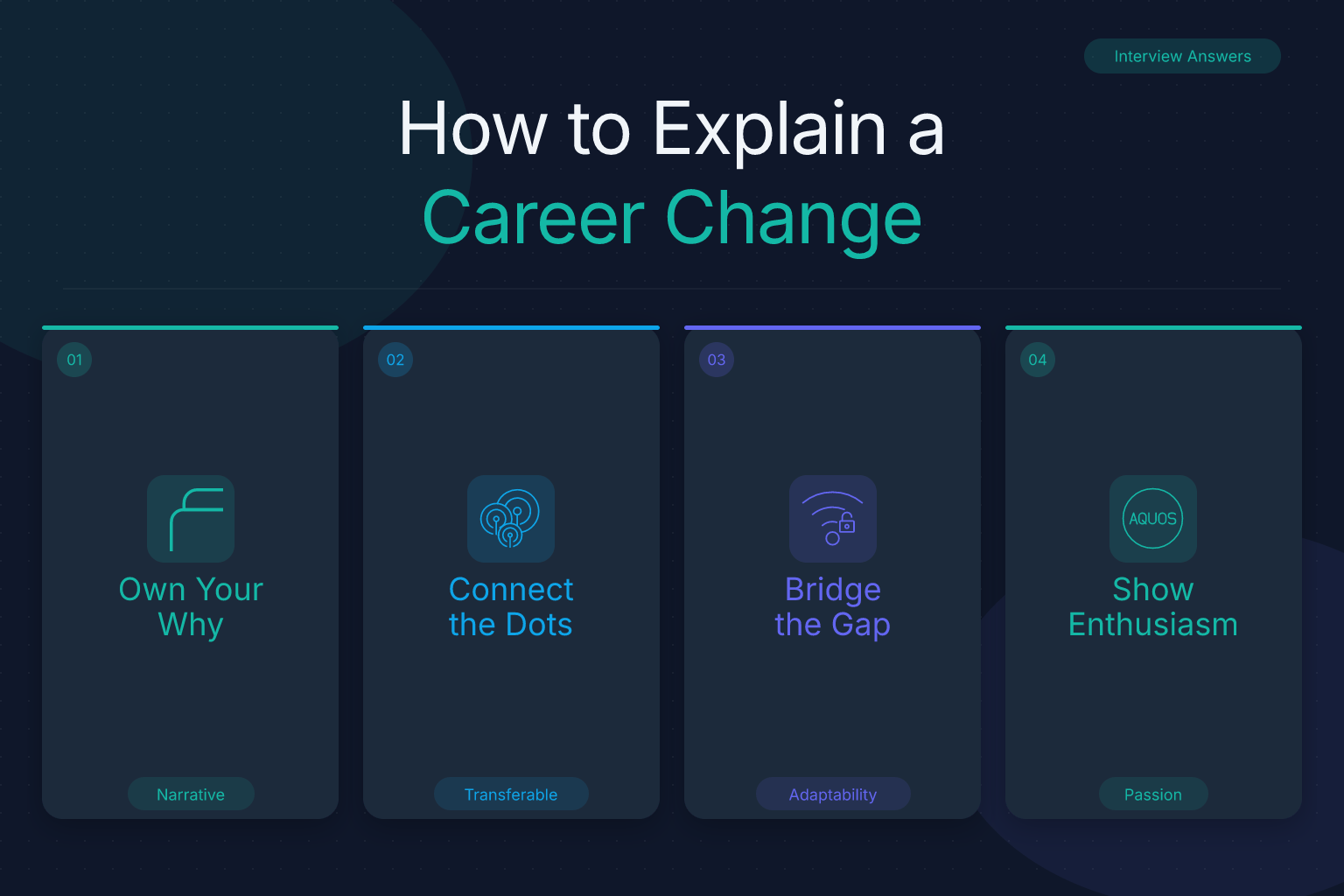
- Use a 3-part structure: briefly acknowledge your past, explain the pivot moment, and connect your transferable skills to the new role’s needs.
- Always tie your answer back to what you can do for the employer, not just what you want for yourself.
- Prepare for follow-up questions about gaps, salary expectations, and your commitment to the new field.
- A well-tailored resume that highlights transferable skills makes the interview conversation much easier.
Summary Table
| What to Do | Why It Matters | Time |
|---|---|---|
| Craft a 60-second career-change story using the Past-Pivot-Future framework | Gives the interviewer a clear, confident narrative instead of a rambling explanation | 15–20 min prep |
| Map 3–5 transferable skills from your old role to the new job description | Proves you’re not starting from zero and can contribute immediately | 10–15 min |
| Prepare a concise answer to “Why now?” that focuses on readiness, not frustration | Removes doubt about your motivation and shows you’ve thought it through | 5–10 min |
| Practice your answer out loud and record it | Catches filler words, nervous tangents, and helps you sound natural | 10 min per session |
| Update your resume to reflect the pivot before the interview | A consistent story across resume and interview builds trust | 30–60 min |
Why Interviewers Ask About Your Career Change (and What They’re Really Looking For)
When an interviewer asks, “Why are you changing careers?” or “I see you’ve been in marketing for eight years — why tech sales now?”, they aren’t just making conversation. They’re trying to answer three unspoken questions:
- Are you running away from something or running toward something? Hiring managers want to hire people who are excited about the new field, not people who are just burned out on the old one.
- Have you done your homework? A career change that’s backed by research, courses, side projects, or networking shows commitment. A vague “I just want to try something new” raises red flags.
- Can you actually do the job? They need to see a bridge between your past experience and the requirements of this role. If you can’t draw that bridge, they’ll assume you’re starting from scratch.
Understanding these underlying concerns lets you shape an answer that addresses them head-on. The goal isn’t to justify your past — it’s to show that your past makes you uniquely valuable in this new context.
The 3-Part Framework for Explaining a Career Change in an Interview
Most career changers make the mistake of either oversharing their entire life story or giving a one-sentence answer that leaves the interviewer with more questions. A structured framework keeps you on track and makes your answer memorable.
Use this Past – Pivot – Future structure every time you’re asked about your career change:
1. Past (15–20 seconds)
Acknowledge your previous career briefly and positively. Don’t complain about it. Instead, name one or two skills or experiences you gained that are relevant to the new direction.
Example: “I spent six years in retail management, where I learned how to lead teams through high-pressure seasons and use data to improve store performance.”
2. Pivot (20–30 seconds)
Explain the moment or realization that made you decide to switch. This is where you show self-awareness and intentionality. Mention any concrete steps you took — a course, a certification, a side project, volunteering, or informational interviews.
Example: “Over time, I realized the part of my job I loved most was analyzing sales trends and building reports — not the day-to-day operations. I started taking online courses in data analytics, completed a Google Data Analytics certificate, and built a portfolio of projects using real retail datasets.”
3. Future (20–30 seconds)
Connect your past skills and your new training directly to the role you’re interviewing for. Be specific about how you’ll contribute.
Example: “Now I’m looking for a junior data analyst role where I can combine my business understanding with technical skills. In this position, I’d be able to translate stakeholder questions into clear analyses — something I did daily as a manager, just with different tools.”
This framework works for any career change, whether you’re moving from teaching to instructional design, accounting to software development, or hospitality to customer success. The key is to keep the entire answer under 90 seconds and end with a forward-looking statement that invites the interviewer to ask about your skills, not your past.
How to Connect Your Previous Experience to the New Role (Even When It Feels Unrelated)
One of the biggest fears career changers have is, “My old job has nothing to do with this new field.” In most cases, that’s not true — you just need to reframe your experience in terms of transferable skills.
Transferable skills are abilities that apply across industries: communication, problem-solving, project management, data analysis, leadership, customer empathy, adaptability, and so on. The trick is to translate them into the language of the new industry.
Here’s a simple exercise:
- Pull up the job description for the role you’re interviewing for.
- Highlight every skill or qualification listed (e.g., “collaborate with cross-functional teams,” “manage multiple priorities,” “analyze customer feedback”).
- For each one, ask yourself: “When have I done something similar, even if the context was different?”
- Write a one-sentence example from your past that demonstrates that skill.
For instance, a former teacher applying for a project manager role might map it like this:
- Job requirement: “Manage timelines and deliverables for multiple projects.”
- Teacher’s experience: “Coordinated curriculum rollout across five grade levels, managing deadlines, resources, and stakeholder communication with department heads and parents.”
When you explain your career change in the interview, weave these connections into your answer. Instead of saying, “I don’t have direct experience,” say, “I haven’t held the title of project manager, but I’ve been managing complex projects with tight deadlines and multiple stakeholders for years. Here’s an example…”
If you’re struggling to identify your transferable skills, a tool like the ResumeMate resume score checker can help. Upload your existing resume and it will highlight which skills are coming through clearly — and which ones you might be underselling.
Addressing the “Why Now?” Question Without Sounding Negative
Interviewers often follow up with, “Why are you making this change now?” They want to know if there’s a compelling reason — or if you’re just reacting to a bad situation.
Avoid answers that focus on:
- Burnout or boredom (“I just couldn’t do it anymore”)
- A bad boss or toxic workplace
- Money as the primary driver (“I heard tech pays better”)
- Vague restlessness (“I needed a change”)
Instead, frame “why now” around readiness and opportunity. You’ve reached a point where you’ve built the skills, done the exploration, and are ready to commit. Some safe, honest angles:
- You discovered a passion through a side project or volunteer work. “I started helping a friend with their website and realized I loved UX design. I’ve been learning it for the past year and now I’m ready to do it full-time.”
- Your industry is changing and you want to get ahead of it. “I’ve seen how automation is reshaping my field, and I want to move into a role that’s more focused on strategy and human-centered work.”
- A life change gave you the push you needed. “After my youngest started school, I finally had the bandwidth to pursue the career I’ve always been curious about.”
Whatever your reason, tie it to a concrete action you’ve taken. That turns “why now” from a potential weakness into proof of your commitment.
Sample Answers for Different Career Change Scenarios
Here are three full sample answers using the Past-Pivot-Future framework. Adapt these to your own story.
Scenario 1: From Hospitality to Customer Success
“I spent five years in hotel management, where I learned how to handle high-stakes customer situations, de-escalate conflicts, and build loyalty with repeat guests. About two years ago, I started noticing how many of those skills overlapped with customer success roles in SaaS. I took a certification in customer success management, attended several industry webinars, and started following leaders in the space. Now I’m looking for a customer success role where I can use my relationship-building and problem-solving skills to help clients get real value from a product — and reduce churn. I’m especially drawn to your company because of your focus on proactive outreach, which is exactly what I did when I created a guest feedback system that improved our TripAdvisor rating by 20%.”
Scenario 2: From Accounting to UX Design
“I worked as an accountant for four years, and while I was good at it, I found myself gravitating toward the systems and processes we used — not the numbers themselves. I started learning UX design through online courses, then volunteered to redesign a nonprofit’s donation portal. That project confirmed this is what I want to do. My accounting background gave me a strong analytical mindset and experience working with complex data, which helps me approach design with a focus on user flows and measurable outcomes. I’m excited about this junior UX role because I can bring that analytical lens to your team while continuing to grow as a designer.”
Scenario 3: From Teaching to Corporate Training
“I taught high school English for seven years. In that time, I designed curriculum, facilitated workshops for other teachers, and learned how to engage an audience that didn’t always want to be there — which is great training for corporate learning and development. I completed an ATD certificate in instructional design last year and have been building a portfolio of e-learning modules. I’m looking for a training specialist role where I can apply my facilitation and curriculum design skills to help employees upskill and perform better. Your company’s focus on continuous learning really resonates with me.”
Notice that each answer ends with a specific connection to the company or role. That shows you’ve done your research and aren’t just giving a generic career-change speech.
Common Mistakes to Avoid When Explaining a Career Change
Even a well-prepared answer can fall flat if you stumble into these traps:
- Apologizing for your background. Never say, “I know I don’t have the right experience.” Instead, reframe: “I bring a different perspective that complements the team.”
- Oversharing personal details. You don’t need to mention a divorce, health crisis, or financial desperation. Keep the focus professional.
- Bashing your previous industry or employer. It makes you look negative and raises questions about your judgment. Even if your old job was terrible, find a neutral way to describe it.
- Giving a memorized, robotic answer. Practice until it feels natural, not scripted. Record yourself and listen for tone.
- Forgetting to connect to the company’s needs. Your answer should always end with what you can do for them, not just what you want for yourself.
How to Prepare for Follow-Up Questions After Your Career Change Explanation
Your initial answer will often trigger follow-ups. Be ready for these:
“What makes you think you’ll succeed in this new field?”
Point to the concrete steps you’ve taken — courses, projects, mentorship, networking — and the transferable skills you’ve already demonstrated. Then tie it back to the role: “I’ve already done X, Y, and Z, and I’m confident I can apply that here because…”
“How do we know you won’t change your mind again?”
This is a commitment check. Emphasize the research and self-reflection you’ve done. Mention that you’ve tested the waters through side projects or volunteering and that this isn’t a whim — it’s a deliberate, long-term decision.
“Are you willing to start at a lower level or take a pay cut?”
Be honest but strategic. If you’re open to it, say so and frame it as an investment in your new career. If you’re not, explain why your experience justifies a certain level. For more on navigating salary conversations, see our guide on how to negotiate PTO in a job offer — the same principles apply to salary discussions.
“Why not stay in your old field and pursue this as a hobby?”
This question tests your passion. Explain why the new field requires full-time immersion to make the impact you want, and why you’ve chosen to commit fully.
How to Use Your Resume to Support Your Career Change Story
Your interview answer doesn’t exist in a vacuum. The interviewer has your resume in front of them, and if that document doesn’t reflect your pivot, you’ll face an uphill battle.
Before the interview, make sure your resume:
- Uses a summary statement that frames your career change. Instead of an objective, write a 2–3 sentence summary that connects your past experience to your target role. For example: “Customer-focused professional with 5+ years in hospitality management, now transitioning into customer success. Skilled in relationship building, conflict resolution, and data-driven decision making.”
- Highlights transferable skills in a dedicated section. List skills that match the job description, even if you gained them in a different context.
- Reframes past job bullet points to emphasize relevant achievements. Use the language of the new industry. A teacher might write “Designed and delivered 200+ instructional sessions annually, achieving a 95% satisfaction rate in participant feedback” instead of “Taught English to 10th graders.”
- Includes any new training, certifications, or projects that demonstrate your commitment to the new field.
A clean, ATS-friendly resume also ensures your application gets seen in the first place. The ResumeMate free resume builder offers single-column templates that parse reliably in modern applicant tracking systems, so you can focus on content without worrying about formatting.
If you’re also writing a cover letter to accompany your application, pair it with a strong career-change cover letter. Our guide on how to write a career change cover letter includes examples and templates that complement the interview strategies here.
Bringing It All Together: Your Career Change Interview Cheat Sheet
Here’s a quick-reference checklist to run through before every interview:
- I have a 60–90 second Past-Pivot-Future story that sounds natural, not scripted.
- I’ve identified 3–5 transferable skills and have a specific example for each.
- I can answer “Why now?” with a positive, forward-looking reason.
- I’ve researched the company and can connect my answer to their specific needs.
- My resume and LinkedIn profile tell the same career-change story.
- I’ve practiced out loud and recorded myself at least once.
- I’m ready for common follow-up questions about commitment, salary, and experience.
When you prepare this way, the career-change question stops being a hurdle and becomes a chance to differentiate yourself. Most candidates with traditional backgrounds give predictable answers. Yours will be memorable — because it’s authentic, well-reasoned, and focused on what you can bring to the team.
For more help with common interview questions, check out our guides on how to answer “Tell me about yourself” and how to explain reasons for leaving a job.
FAQ
Q: How do you explain a career change in an interview?
A: Use a structured, positive narrative that briefly acknowledges your past, explains the pivot moment and the steps you took to prepare, and connects your transferable skills to the new role. Keep it under 90 seconds and always end with what you can contribute to the employer.
Q: What is the best answer for “Why do you want to change careers?”
A: The best answer focuses on a genuine interest you’ve explored through concrete actions — like courses, side projects, or volunteering — and ties that interest to the specific role. Avoid answers that center on burnout, money, or a bad boss. Instead, show that you’re running toward something, not away from something.
Q: How do I explain a career change when I don’t have direct experience?
A: Reframe your background around transferable skills. Identify 3–5 skills from the job description that you’ve demonstrated in a different context, and prepare a short example for each. Emphasize your ability to learn quickly and the fresh perspective you bring.
Q: Should I mention salary as a reason for my career change?
A: No. While better compensation may be part of your motivation, leading with money can make you seem less committed to the work itself. Focus on passion, skill alignment, and long-term fit. If salary comes up later in the process, you can negotiate from a position of demonstrated value.
Q: How do I explain a career change after a long time in one industry?
A: Frame your tenure as a strength — you’ve built deep expertise, reliability, and a strong work ethic. Then explain what sparked the change now (a new interest, industry shift, or personal growth) and the steps you’ve taken to prepare. Longevity can actually reassure employers that you’re not a job-hopper.
Q: What if I’m changing careers because I was laid off or fired?
A: Be honest but brief. You can say, “My previous role was eliminated due to restructuring, and it gave me the push I needed to pursue a field I’d been exploring on the side.” If you were fired, focus on what you learned and how you’ve grown, then pivot quickly to your readiness for the new career. For more detailed advice, read our guide on how to find a job after being fired.
Related articles:
- How to Research a Company Before an Interview
- How to Explain Being Laid Off Twice in an Interview
- How to Explain Being Fired for Performance in an Interview
Track Every Application While You Job Hunt
Stop losing track of where you’ve applied. The ResumeMate Job Tracker is a free Chrome extension that tracks every application, deadline, and follow-up in one place — right from your browser.