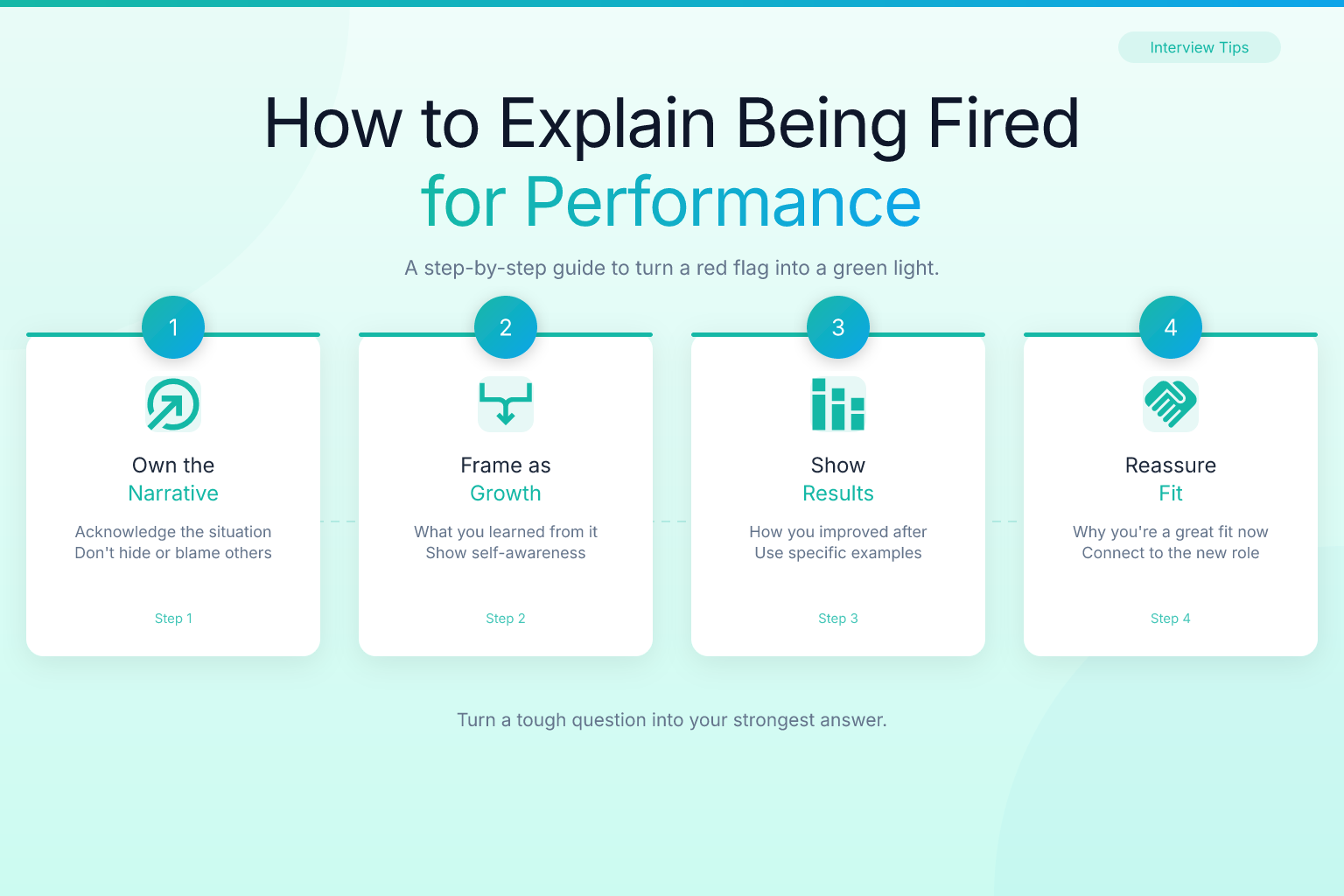
How to Explain Being Fired for Performance in an Interview
Talking about a past termination is one of the most nerve-wracking parts of any job search — especially when you were fired for performance. The good news: hiring managers ask about it not to shame you, but to see if you’ve learned from the experience and can succeed in the new role. With the right preparation, you can turn a potential dealbreaker into a moment that builds trust.
Key Takeaways
- Frame your performance-based firing as a specific mismatch or learning experience, not a blanket failure — and always own your part without self-flagellation.
- Prepare a concise, forward-looking answer that acknowledges what happened, what you learned, and how you’ve improved, all in under two minutes.
- Never lie, badmouth your former employer, or sound bitter; interviewers will check references and can sense deflection.
- Practice your explanation until it feels natural, so you can deliver it calmly and pivot quickly to your strengths.
- Use the rest of the interview to demonstrate the skills and self-awareness that make the past irrelevant to your future performance.
| What to Do | Why It Matters | Time |
|---|---|---|
| Reflect honestly on what went wrong | Helps you identify the real issue and avoid repeating it | 1–2 hours before interviews |
| Craft a 3-part answer: context, lesson, growth | Shows self-awareness and a forward-looking mindset | 30 minutes to draft and refine |
| Practice with a friend or record yourself | Builds confidence and smooths out nervous phrasing | 15–20 minutes per practice session |
| Pivot to your strengths and recent wins | Redirects the conversation to your value as a candidate | During the interview |
| Prepare for follow-up questions | Demonstrates you’ve truly processed the experience | During the interview |
Why Interviewers Ask About Being Fired for Performance
When an interviewer asks, “Why did you leave your last job?” or “Have you ever been fired?” they’re rarely trying to catch you out. They want to understand three things:
- Honesty and integrity — Will you own the situation or blame others?
- Self-awareness — Do you understand why your performance didn’t meet expectations?
- Growth and resilience — What did you learn, and how have you improved?
Performance-based terminations are common. Many companies have rigid performance improvement plans (PIPs) and metrics that don’t always reflect a person’s true potential. Interviewers know this. What they care about is whether you’ve turned the experience into a catalyst for growth — and whether the same issues might surface in their organization.
Step 1: Process the Experience Before the Interview
You can’t explain a firing convincingly if you’re still raw about it. Before you walk into any interview, do the emotional work:
- Separate facts from feelings. Write down exactly what happened: the feedback you received, the metrics you missed, the timeline. Then note how you felt. This helps you see the situation more objectively.
- Identify the root cause. Was it a skill gap? A poor culture fit? Unclear expectations? Burnout? Knowing the real reason lets you frame it honestly without oversharing.
- Reframe the narrative. Instead of “I was fired because I was bad at my job,” think “I was in a role that didn’t match my strengths, and I’ve since taken steps to build the skills I was missing.”
If you’re still struggling to process the termination, consider talking to a career coach or a trusted mentor. The goal is to reach a point where you can discuss the situation calmly, without defensiveness or shame.
Step 2: Craft Your Explanation Using the “Acknowledge, Reframe, Demonstrate” Framework
A strong answer to “Why were you fired?” follows a simple three-part structure:
- Acknowledge — Briefly state what happened without sugarcoating or over-explaining.
- Reframe — Explain what you learned and how you’ve grown.
- Demonstrate — Show how you’ve applied that lesson or built the missing skills.
This framework keeps your answer concise, honest, and forward-looking. It also signals emotional maturity — a quality every hiring manager values.
Sample Answer Using the Framework
“I was let go from my last role because I wasn’t meeting the sales targets they’d set. At the time, I was struggling to adapt to a new CRM and a much larger territory than I’d managed before. I take full responsibility for not asking for help sooner. Since then, I completed a certification in Salesforce, worked with a sales coach, and took a contract role where I exceeded quota by 20%. That experience taught me to be proactive about skill gaps and to communicate early when I need support.”
This answer acknowledges the firing, reframes it as a learning experience, and demonstrates concrete improvement. It’s honest without being self-destructive.
Step 3: Prepare a Concise, Honest Answer (With Scripts)
You don’t need to give a long backstory. A 60–90 second answer is enough. Below are scripts for common scenarios. Adapt them to your situation, but keep the core structure.
Script 1: Missed Performance Metrics
“My previous role had very specific quarterly KPIs, and I fell short for two consecutive quarters. I realized I was spending too much time on low-impact tasks and not enough on high-priority projects. After I left, I took a project management course and now use a strict prioritization framework. In my most recent freelance work, I delivered all projects on time and under budget.”
Script 2: Struggled with New Technology or Tools
“I was let go because I wasn’t picking up the new software platform fast enough. I underestimated the learning curve and didn’t take advantage of the training resources available. That was a wake-up call. I’ve since become certified in that platform and now help others onboard onto it in my current volunteer role.”
Script 3: Poor Fit for the Role or Culture
“The role required a lot of cold calling, which wasn’t a strength of mine. I tried to push through, but my numbers didn’t improve. I learned that I thrive in roles that are more relationship-based and consultative. That’s why I’m excited about this position — it aligns with how I work best.”
Each script follows the framework: acknowledge, reframe, demonstrate. Practice your version until it feels like a natural part of your story, not a rehearsed confession.
Step 4: Address the Performance Gap Head-On
If the firing was due to a specific skill gap, don’t try to hide it. Instead, show how you’ve closed that gap. This is where you can bring in evidence:
- Courses or certifications you’ve completed since leaving.
- Freelance, contract, or volunteer work where you applied the missing skill successfully.
- Mentorship or coaching you sought out.
- Tangible results from a new project or side hustle.
For example, if you were fired for poor writing skills, you might say: “I took a business writing course and now write a monthly newsletter for a nonprofit. My open rates have increased by 15%.”
If you haven’t had time to build new skills yet, be honest about your plan. “I’m currently enrolled in a data analysis program and expect to complete it next month. In the meantime, I’ve been practicing with public datasets and building a portfolio.”
Step 5: Pivot to Your Strengths and Future Value
Once you’ve addressed the firing, move the conversation forward. The best way to do that is to connect your answer to the job you’re interviewing for.
After your explanation, add a bridge like:
- “That experience taught me a lot about what I need to succeed, and I see this role as a place where I can apply those lessons.”
- “What I’m most excited about here is the chance to use my strengths in X and Y, which are exactly what this team needs.”
Then, steer the conversation toward your relevant accomplishments. If you’ve prepared well, you’ll have plenty of examples ready. For more on structuring those stories, see our guide on how to answer “tell me about yourself” in an interview.
What to Avoid Saying When Explaining a Performance-Based Firing
Even a well-intentioned answer can backfire if you fall into these traps:
- Blaming your manager or team. “My boss had it out for me” or “The team didn’t support me” makes you sound like a victim. Even if there’s truth to it, focus on what you could control.
- Oversharing personal details. “I was going through a divorce and couldn’t focus” is too much information. You can say “I was dealing with some personal challenges that affected my focus, and I’ve since put support systems in place.”
- Lying or omitting the firing. If a background check or reference call reveals the truth, you’ll lose the offer — and your credibility. Honesty is the only sustainable strategy.
- Sounding bitter or angry. Any hint of resentment will raise red flags. Practice until you can discuss the situation with neutral, professional language.
- Making excuses. “The goals were unrealistic” may be true, but it’s better to say “I learned that I need to negotiate clearer expectations upfront.”
How to Handle the “Have You Ever Been Fired?” Question on Applications
Some online applications ask directly: “Have you ever been terminated or asked to resign?” If you answer yes, you may worry your application will be filtered out. Here’s how to handle it:
- Answer truthfully. Lying on an application is grounds for termination later.
- Use the explanation box wisely. If there’s a text field, write a brief, professional summary: “Let go due to performance not meeting expectations. Since then, I’ve completed [training/certification] and achieved [result] in a subsequent role.”
- If there’s no space to explain, don’t panic. Many recruiters will still review your resume. Be ready to address it in the interview.
If you’re worried about gaps on your resume after a firing, our guide on how to write a cover letter for an employment gap can help you frame the time positively.
Turning the Experience Into a Strength
Being fired for performance can actually become a compelling part of your professional story — if you’ve genuinely grown from it. Many successful people have been fired at some point. What sets them apart is how they responded.
When you walk into an interview, remember: the firing is one data point in your career, not your entire identity. By preparing a thoughtful, honest answer, you demonstrate exactly the kind of resilience and self-awareness that employers value.
For a deeper dive into the full job search after a termination, read our step-by-step guide on how to find a job after being fired.
FAQ
Q: Should I bring up being fired if the interviewer doesn’t ask?
A: If the application or background check will reveal it, it’s better to address it proactively. You can say, “I want to be upfront about something you might see when checking references…” This builds trust and lets you control the narrative.
Q: Can I say I was laid off instead of fired for performance?
A: No. Lying about the reason for leaving is risky. Many employers verify the circumstances of departure during reference checks. If the truth comes out, you’ll lose the offer and damage your reputation.
Q: What if I was fired during a probation period?
A: Frame it as a mutual realization that the role wasn’t the right fit. “The role required a different skill set than what I was led to expect, and we both agreed it wasn’t working. I’ve since focused on roles that better match my strengths in X.”
Q: How do I explain a performance firing if I don’t have a new job yet?
A: Focus on what you’re doing to improve. “I’m using this time to upskill. I’m taking a course in [skill] and volunteering with [organization] to build hands-on experience. I’m confident I’ll bring much stronger performance to my next role.”
Q: Will a performance firing show up on a background check?
A: Most standard background checks verify dates of employment and job titles, not the reason for leaving. However, some employers may ask for the reason during reference calls. It’s best to assume they’ll find out and prepare accordingly.
Q: How do I answer “What’s your greatest weakness?” if I was fired for performance?
A: You can use the same framework. Choose a weakness related to the skill gap that led to the firing, but frame it as something you’ve actively improved. For more strategies, see our guide on how to answer “what are your weaknesses” in an interview.
Related articles:
- How to Explain Short Tenure Due to Bad Fit in an Interview
- Explaining Being Fired for Attendance Issues in Interview
- How to Explain Being Laid Off Twice in an Interview
Track Every Application While You Job Hunt
Stop losing track of where you’ve applied. The ResumeMate Job Tracker is a free Chrome extension that tracks every application, deadline, and follow-up in one place — right from your browser.