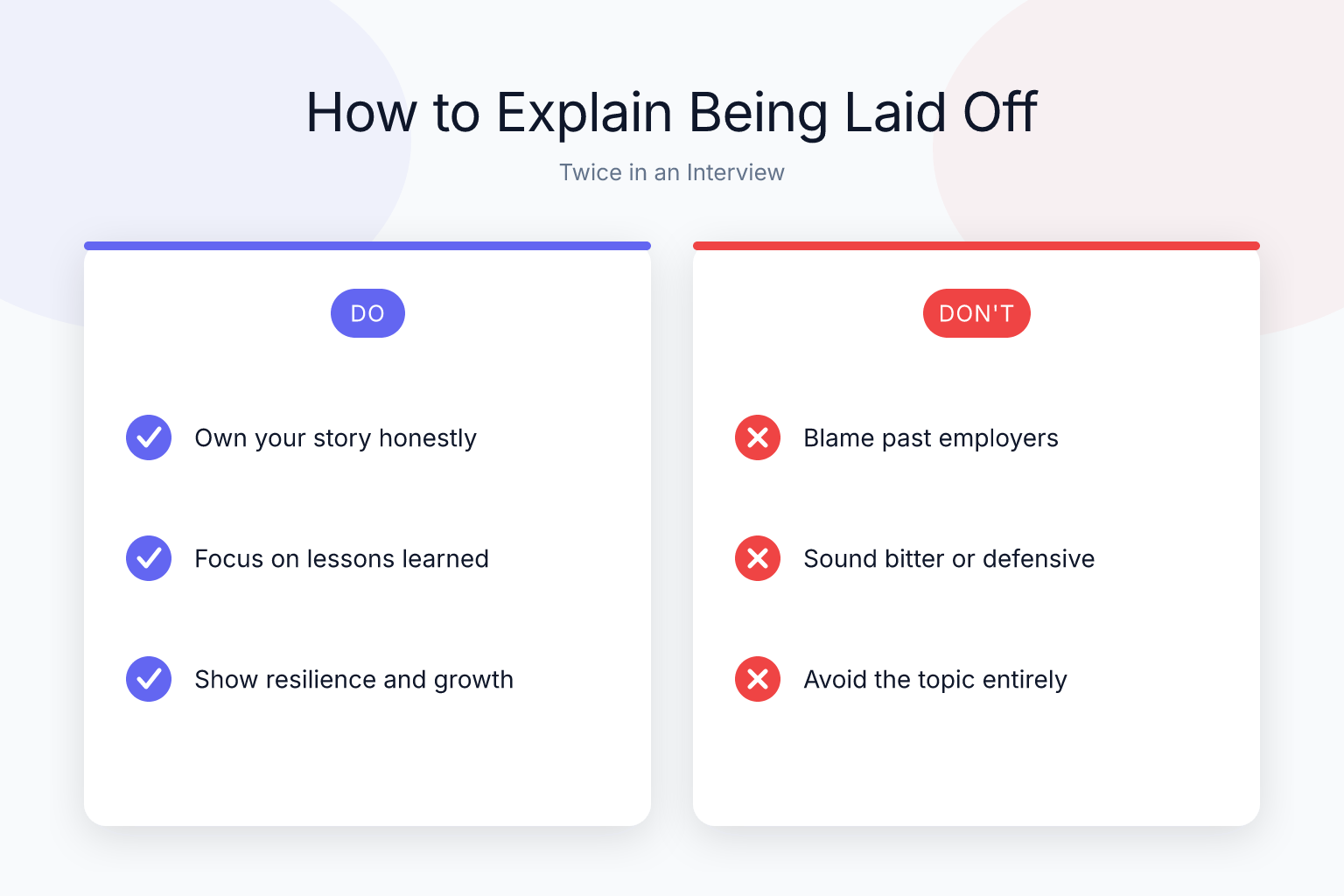
How to Explain Being Laid Off Twice in an Interview (With Sample Answers)
If you’re worried about how to explain being laid off twice in an interview, you’re not alone. Two layoffs in a row can feel like a scarlet letter on your resume, but hiring managers see layoffs far more often than you think. The key isn’t hiding the facts — it’s framing them as a normal part of your career story, not a pattern of failure. This guide gives you the exact words, mindset shifts, and preparation steps to walk into your next interview with confidence.
Key Takeaways
- Two layoffs are rarely a reflection of your performance; most stem from restructuring, funding changes, or economic shifts that are out of your control.
- Frame each layoff as a business decision, not a personal shortcoming, and immediately pivot to what you learned and how you’ve grown.
- Prepare a concise, forward-looking answer that connects both layoffs to why you’re now a stronger, more focused candidate.
- Never badmouth a former employer or overshare emotional details — keep the explanation brief, factual, and future-oriented.
- Use a free resume score checker to ensure your resume presents your experience as a cohesive story, not a series of gaps.
| What to Do | Why It Matters | Time |
|---|---|---|
| Acknowledge both layoffs upfront in one sentence | Shows honesty and prevents the interviewer from filling in the blanks with assumptions | 30 seconds |
| Attribute each layoff to a clear, verifiable business reason | Removes the stigma of performance issues and frames you as a professional who understands business realities | 1 minute |
| Bridge to what you learned and how you’ve applied it since | Shifts the conversation from “what happened to you” to “what you did about it” | 1–2 minutes |
| Practice your answer out loud until it sounds natural | Reduces anxiety and prevents rambling or defensive body language | 15 minutes |
| Follow up with a question about the company’s stability | Demonstrates strategic thinking and subtly signals you’re evaluating them too | 30 seconds |
Why Being Laid Off Twice Isn’t a Career Killer
Layoffs are a business tool, not a performance review. Companies restructure, lose funding, get acquired, or shift strategies — and entire teams get cut regardless of individual contributions. According to the U.S. Bureau of Labor Statistics, mass layoff events affect hundreds of thousands of workers every year, and many of those workers experience more than one layoff over a career. Recruiters know this.
When you’ve been laid off twice, the interviewer’s real concern isn’t the layoffs themselves — it’s whether you’ll be a reliable, engaged employee. They want to see that you’ve processed the experiences, learned from them, and aren’t carrying resentment or instability into the next role. Your job is to answer that unspoken question before it’s asked.
If you’ve also been fired for performance in the past, the approach is different. Read our guide on how to explain being fired for performance in an interview for a separate strategy.
How to Frame Your Layoffs Honestly and Positively
Your explanation needs three parts: the business reason, your response, and the bridge to the future. Never lead with emotion or self-doubt.
1. State the business reason clearly
Use neutral, factual language. Instead of “I got laid off,” say “The company eliminated my department after a merger” or “The startup lost its Series B funding and cut 40% of the team.” This immediately signals that the decision was structural, not personal.
2. Own your reaction without sounding like a victim
Briefly mention what you did next — upskilling, freelancing, volunteering, or even taking time to reassess your career direction. This shows agency. For example: “After the second layoff, I used the time to earn a certification in project management and took on a few contract gigs to stay sharp.”
3. Connect the dots to this role
End your answer by explaining why this particular job makes sense now. “Both experiences taught me I thrive in established teams with clear growth paths, which is exactly what I see in this position.”
Sample Answers for “Why Were You Laid Off Twice?”
Here are three scripts you can adapt. Practice them until they sound like you, not a rehearsed monologue.
Sample 1: Both layoffs were company-wide restructures
“Both layoffs were company-wide decisions. At my first role, the entire marketing division was eliminated when the company shifted to an outsourced model. At the second, the startup I joined lost its main investor and had to reduce headcount by half. In both cases, my managers gave me strong references — I can provide those. What I took away is that I want to build my career at a company with a stable growth trajectory, and that’s why I’m excited about this opportunity.”
Sample 2: One layoff was a restructuring, the other a pandemic or economic downturn
“The first layoff happened when my employer merged with a larger firm and consolidated departments. The second was during the broader tech slowdown in 2024, when my company cut 30% of staff across the board. I wasn’t singled out — my entire product team was let go. Since then, I’ve completed a data analytics certificate and have been consulting part-time. I’m now looking for a role where I can apply those new skills long-term, and this position aligns perfectly.”
Sample 3: You were a contractor or in a project-based role
“Both roles were tied to specific initiatives that ended. The first was a two-year project that wrapped up on schedule, and the second was a contract role that wasn’t renewed when the client’s budget shifted. I knew going in that both had defined end dates, so I treated them as opportunities to deliver high-impact work quickly. Now I’m ready for a permanent role where I can invest in long-term relationships and results.”
If you need help crafting a narrative that ties your whole career together, our post on how to explain a career change in an interview offers additional framing techniques.
How to Address the Layoffs in Your Resume and Cover Letter
Your resume doesn’t need to announce layoffs. Use years only (e.g., “2022–2024”) and focus on accomplishments. If there’s a gap between roles, fill it with any consulting, courses, or volunteer work you did. A gap looks worse than a layoff, so show you stayed active.
In your cover letter, you can proactively address the layoffs in one sentence, then pivot to value. For example: “After two company-wide restructures, I’m eager to bring my five years of sales leadership to a stable, growing team like yours.” This acknowledges the situation without making it the centerpiece. For more on handling gaps, see how to write a cover letter for an employment gap.
Before you apply, run your resume through a free resume score checker to make sure your experience reads as a cohesive story, not a series of unfortunate events. The tool flags formatting issues and gives you section-by-section feedback so recruiters see your strengths first.
What to Say When the Interviewer Presses for Details
Sometimes an interviewer will ask a follow-up like, “Was there any performance component to the layoffs?” or “Why do you think you were selected both times?” Stay calm. This isn’t an accusation — it’s a test of your composure.
If they ask about performance
“My performance reviews were consistently positive. I can share documentation if that’s helpful. The decisions were based on tenure and department elimination, not individual metrics.”
If they ask why you were chosen
“In the first case, I was the most recent hire, so I was let go based on seniority. In the second, the entire product team was cut — there was no selection process. I understand why it might raise a question, and I’m happy to provide references from both managers.”
Keep your tone matter-of-fact. The more comfortable you are, the less the interviewer will dwell on it.
How to Rebuild Confidence Before the Interview
Two layoffs can chip away at your self-worth, and that shows up in your voice, posture, and answers. Rebuilding confidence is as important as rehearsing your script.
- List your wins. Write down 10 specific accomplishments from your last two roles. Read them before the interview.
- Reframe the story. Instead of “I got laid off twice,” tell yourself “I survived two business closures and came back stronger.”
- Practice with a friend or use AI. Record yourself answering the layoff question. Listen for filler words, defensiveness, or rambling. You can also use ChatGPT interview prompts to simulate follow-up questions.
- Update your resume. A polished, ATS-friendly resume gives you a tangible confidence boost. Use the ResumeMate AI resume builder to create a clean, single-column PDF that highlights your achievements, not your gaps.
Common Mistakes to Avoid
Even a great answer can be undermined by these missteps.
- Blaming the company or manager. “They were terrible at planning” makes you sound bitter. Stick to neutral facts.
- Oversharing personal details. You don’t need to mention financial stress, anxiety, or how hard it was. Keep it professional.
- Lying or stretching the truth. If you were fired and are calling it a layoff, a background check can expose the discrepancy. Read our guide on how to prepare for an employment background check to understand what employers verify.
- Apologizing. Don’t say “I’m sorry, I know it looks bad.” You have nothing to apologize for. State the facts and move on.
- Making it the focus of the interview. Answer the question, then redirect to your qualifications. The layoffs are a footnote, not the headline.
Turning Two Layoffs Into a Strength
When you’ve been laid off twice, you’ve actually gained something most candidates haven’t: resilience, adaptability, and a clear-eyed view of what you want. Use that.
Frame your layoffs as proof that you can land on your feet. You’ve navigated uncertainty, rebuilt your network, and kept your skills current. That’s a story of grit, not failure. In your closing statement, you might say: “Going through two restructures taught me how to stay productive and positive in unpredictable environments. I’m not looking for a job — I’m looking for a place to build something lasting, and I believe this is it.”
That kind of answer makes a hiring manager lean in, not lean back.
FAQ
Q: Will being laid off twice automatically disqualify me?
A: No. Most hiring managers understand that layoffs are business decisions. What matters is how you talk about them. A calm, factual explanation that focuses on what you learned will rarely cost you an offer.
Q: Should I mention the layoffs before the interviewer asks?
A: Not unless there’s a glaring gap on your resume. If asked about your work history, address it then. Proactively bringing it up can make it seem like a bigger deal than it is.
Q: What if one of the layoffs was actually a firing?
A: Be honest but strategic. If you were fired for performance, frame it as a mismatch and focus on what you learned. Read our dedicated guide on explaining being fired for performance for a full strategy.
Q: How do I explain two layoffs in a short time frame, like within a year?
A: Acknowledge the unusual timing, then attribute it to external factors (e.g., a startup that folded quickly, followed by a contractor role that ended). Emphasize that you’re now targeting stable, long-term opportunities.
Q: Can I leave one of the layoffs off my resume?
A: You can omit very short roles (under three months) if they don’t create a large gap, but be aware that a background check may reveal them. It’s usually safer to include the role with a brief, neutral explanation.
Q: What if the interviewer seems skeptical or negative?
A: Stay calm and offer to provide references or performance reviews. A skeptical interviewer is often testing your reaction. If you remain confident and factual, you’ll pass the test.
Related articles:
- How to Explain Freelance Income Instability in Interviews
- How to Explain Short Tenure Due to Bad Fit in an Interview
- Explaining Being Fired for Attendance Issues in Interview
Track Every Application While You Job Hunt
Stop losing track of where you’ve applied. The ResumeMate Job Tracker is a free Chrome extension that tracks every application, deadline, and follow-up in one place — right from your browser.