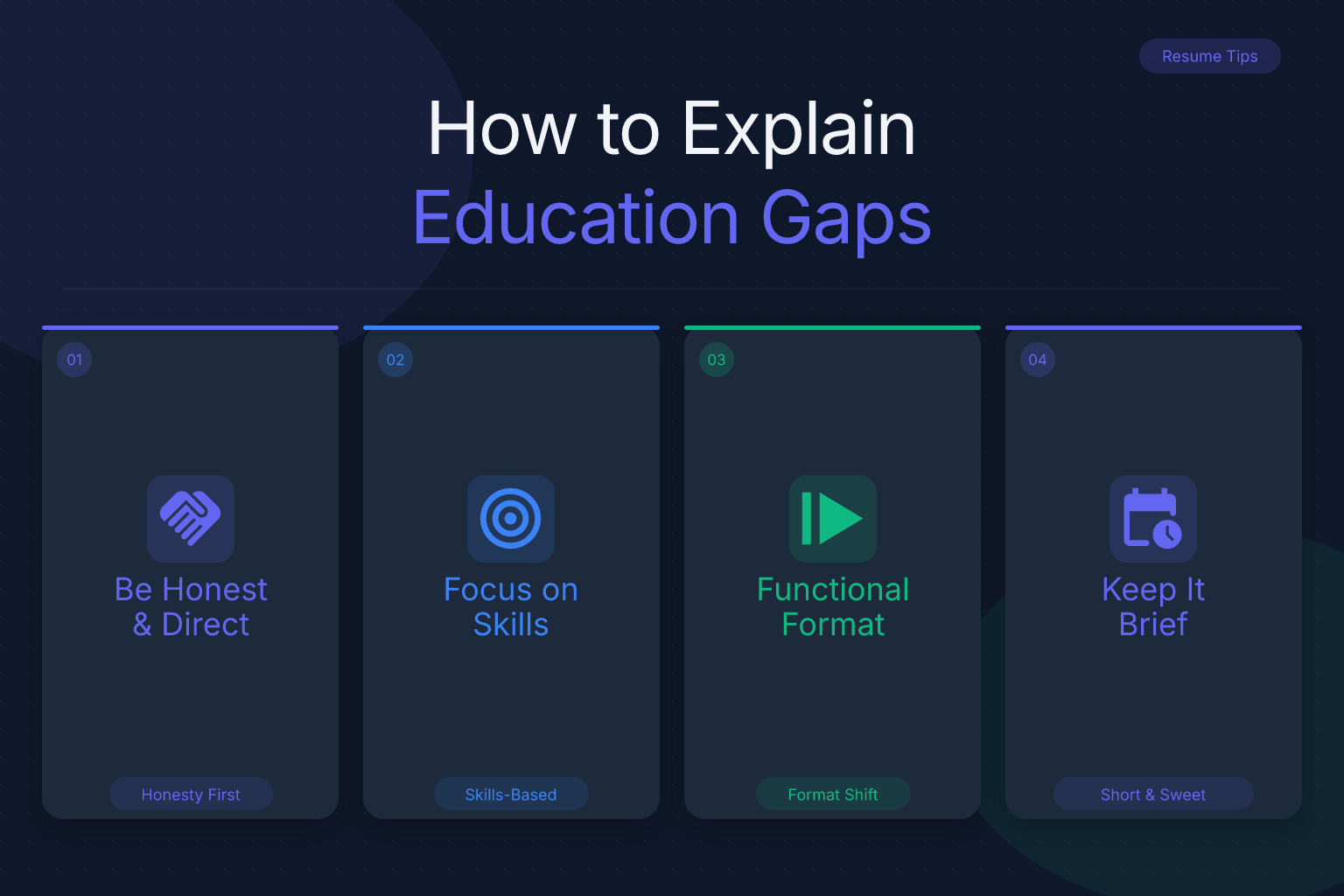
How to Explain Education Gaps on a Resume (Examples)
If you’re wondering how to explain a gap in education on a resume, you’re not alone — many job seekers have a break in their schooling, whether it’s a semester off, a few years between degrees, or an incomplete program. The good news: an education gap doesn’t have to derail your application. With the right framing, you can turn what feels like a red flag into a neutral — or even positive — part of your story.
Key Takeaways
- An education gap is any break in your formal schooling that shows up on your resume timeline, from a leave of absence to an unfinished degree.
- You can often minimize the gap by listing only the degree earned and omitting dates, especially if you’re several years into your career.
- When you do need to explain the gap, a brief, honest, and forward-looking statement in your cover letter or interview works better than hiding it.
- Use the gap period to highlight relevant skills, volunteer work, or self-directed learning that keeps your resume strong.
- Most employers care far more about what you can do now than about a break in your education years ago.
Summary Table
| What to Do | Why It Matters | Time to Implement |
|---|---|---|
| Omit education dates if you have a degree and the gap is old | Keeps the focus on your qualifications, not the timeline | 2 minutes |
| List incomplete education with relevant coursework | Shows you invested in learning, even without a diploma | 5 minutes |
| Add a brief explanation in your cover letter if the gap is recent | Prevents the recruiter from making negative assumptions | 10 minutes |
| Prepare a short, honest answer for interviews | Builds trust and shows you can handle tough questions | 15 minutes |
| Fill the gap with certifications, projects, or volunteer work | Demonstrates continuous growth and initiative | Varies |
What Counts as an Education Gap on a Resume?
An education gap is any period where your formal education was interrupted or didn’t follow a traditional timeline. This could mean:
- Taking a year off between high school and college.
- Withdrawing from a degree program and returning later.
- Starting a degree but never finishing it.
- A multi-year break between undergraduate and graduate studies.
- Leaving school due to financial, health, or family reasons.
Recruiters notice these gaps most when they create an unexplained hole in your resume’s chronology. For example, if you list high school ending in 2016 and a bachelor’s degree starting in 2022, that six-year gap raises questions. But if you’re 10 years into your career and your education section simply says “B.A. in Economics,” no one will ask about the exact years. The key is whether the gap appears as a missing block of time that a recruiter can’t account for. Gaps that are explained by work, travel, or caregiving are often viewed neutrally, while unexplained absences may raise concerns about reliability or commitment. However, even a long gap can be reframed as a period of growth if you can show what you learned or accomplished.
Should You Include Incomplete Education on Your Resume?
Yes — in most cases, you should include incomplete education if it’s relevant to the job or fills a timeline gap. Leaving it off entirely can create a bigger question mark than addressing it.
Here’s how to decide:
- If you’re currently enrolled and the degree is in progress, always list it with your expected graduation date.
- If you completed significant coursework but didn’t graduate, list the school, major, and relevant courses — especially if they relate to the job.
- If you left early in the program (e.g., one semester) and it’s not relevant, you can omit it.
- If the incomplete degree is your highest level of education, include it to show you have some college background.
For more on how to present your education, see our guide on how to list education on a resume by experience level.
How to Format Education with a Gap on Your Resume
The way you format your education section can make the gap nearly invisible. Here are three common scenarios and how to handle them.
1. You took a break but finished the degree
If you started college, took a few years off, and then graduated, list only the graduation year — not the start and end dates. This is standard practice and doesn’t hide anything; it simply presents the credential you earned.
Example:
Bachelor of Science in Computer Science
University of Texas at Austin — Graduated 2023
No one needs to know you started in 2015 and took a three-year break. The degree is what matters.
2. You’re currently taking a break and plan to return
If you’re in the middle of a gap and haven’t finished the degree, list it as “in progress” with an expected completion date. You can also add a brief note if the gap is obvious.
Example:
Bachelor of Arts in Psychology (In Progress)
Arizona State University — Expected 2027
Took a planned leave of absence from 2024–2025 to manage family responsibilities; resumed coursework in 2026.
This shows transparency and control over the situation.
3. You didn’t finish and don’t plan to return
List the school, your major, and any relevant coursework. You can use “Coursework toward B.A. in…” or simply state the years attended without claiming a degree.
Example:
Coursework toward B.S. in Biology
University of Florida — 2019–2021
Completed 60 credits including Genetics, Organic Chemistry, and Biostatistics.
This approach is honest and still shows you gained knowledge. If the coursework is directly relevant to the job, it can be a plus.
How to Address the Gap in a Cover Letter
Your cover letter is the best place to proactively explain a recent or significant education gap. You don’t need a long story — one or two sentences that state the reason and pivot to your readiness are enough.
Template you can adapt:
“You’ll notice I took a two-year break during my undergraduate studies. I used that time to work full-time and support my family, which taught me resilience and time management. I returned to complete my degree with a renewed focus, and I’m eager to bring that same determination to this role.”
Keep the tone matter-of-fact. Avoid over-apologizing. The goal is to answer the question before it’s asked, then move the conversation back to your strengths.
If the gap is old (5+ years ago) and you’ve built a solid career since, you can skip the cover letter explanation entirely. It’s no longer relevant.
How to Talk About an Education Gap in an Interview
If the gap comes up in an interview, your answer should be brief, honest, and forward-looking. Practice a 30-second response that covers:
- What happened (in one sentence).
- What you did during the gap (if it adds value).
- Why it’s no longer an issue (you’re ready and capable).
Example script for a health-related gap:
“I had to take a medical leave during my junior year. It was a difficult decision, but I focused on my recovery and came back stronger. I completed my degree the following year and have been working consistently since then.”
Example script for a financial gap:
“I paused my education to work and save money so I could finish without debt. During that time, I gained hands-on experience in customer service that actually shaped my career interests. I returned to school part-time and graduated in 2025.”
Never lie about the reason. If you were dealing with a personal issue, you can say “family responsibilities” or “a personal health matter” without oversharing. Most interviewers will respect your privacy and move on.
For more on handling tough interview questions, read our guide on how to explain a career change in an interview.
Resume Examples for Education Gaps
Here are two full education sections that handle gaps well.
Example 1: Gap between high school and college (early career)
Education
Bachelor of Arts in Marketing
University of Georgia — Graduated 2025
Took a two-year gap after high school to work and travel; returned to complete degree with honors.
Example 2: Incomplete degree with relevant coursework (mid-career)
Education
Coursework toward M.S. in Data Science
Georgia Tech — 2022–2023
Completed 18 credits including Machine Learning, Data Visualization, and Python for Analytics.
Paused program to accept a full-time data analyst role; plan to resume part-time in 2027.
Notice how both examples are concise and end on a positive note. They don’t dwell on the gap — they acknowledge it and move forward.
Common Mistakes to Avoid
Even a well-intentioned explanation can backfire if you make these errors.
- Over-explaining in the resume itself. Your resume is a marketing document, not a biography. Keep explanations to a minimum; save details for the cover letter or interview.
- Using negative language. Avoid words like “dropped out,” “failed,” or “couldn’t finish.” Frame it as a decision: “paused,” “took a leave,” “shifted focus.”
- Leaving a suspicious blank. If you omit education entirely and the job requires a degree, the ATS may filter you out. Always include something if you have any college experience.
- Lying about a degree. Never claim a degree you didn’t earn. Background checks will catch it, and it’s grounds for immediate termination.
- Forgetting to update your resume after returning to school. If you’re back in classes, update your resume immediately. An “in progress” degree is far better than a gap.
How to Strengthen Your Resume Despite the Gap
An education gap feels less significant when the rest of your resume is packed with relevant experience and skills. Here’s how to shift the focus.
Add certifications and online courses
If you took time away from formal education, show that you kept learning. Platforms like Coursera, edX, and LinkedIn Learning offer certificates you can complete in weeks. List them in a separate “Certifications” or “Professional Development” section.
Highlight volunteer work or side projects
Did you volunteer, freelance, or work on a personal project during your gap? That counts. Frame it as experience. For example, if you managed social media for a nonprofit while on a break from school, list it under a “Relevant Experience” section. See our guide on how to list volunteer work on a resume with no experience for formatting tips.
Use a skills-based resume format
If your education gap is recent and you lack work experience, a hybrid or functional resume can help. Lead with a strong skills summary and relevant projects, then place education toward the bottom. This keeps the reader focused on what you can do, not when you studied.
Run your resume through an ATS checker
Even a well-written education section can get mangled by applicant tracking systems if the formatting is off. Use a free tool like the ResumeMate resume score checker to see exactly how your resume parses and whether your education section is being read correctly.
FAQ
Q: Should I include dates on my education if I have a gap?
A: If you’ve already earned the degree and the gap is in the past, you can safely omit start dates and only list the graduation year. If you’re still in progress or the gap is recent, including dates with a brief note can prevent confusion.
Q: How do I explain dropping out of college on a resume?
A: List the school and coursework without claiming a degree. Use phrasing like “Coursework toward B.A. in…” and include relevant classes. In your cover letter or interview, briefly state the reason you left and what you gained from the experience.
Q: Will an education gap hurt my chances of getting hired?
A: Not necessarily. Most hiring managers care more about your skills and recent experience than a break in your education, especially if it was years ago. A gap only becomes a problem if you try to hide it or can’t explain it when asked.
Q: Can I leave my education off my resume entirely if I didn’t graduate?
A: If you have no college experience and the job doesn’t require a degree, you can omit it. But if you completed some college, it’s usually better to include it — even without a degree — because it shows you pursued higher education.
Q: What if my education gap was due to a health issue?
A: You can say “medical leave” or “health-related break” without sharing details. Employers are not entitled to your private medical history. Focus on your recovery and readiness to work.
Q: How do I explain a gap between my bachelor’s and master’s degree?
A: A gap between degrees is common and rarely questioned. If asked, you can say you wanted to gain work experience before committing to a graduate program. This is often seen as a mature, thoughtful decision.
Related articles:
Track Every Application While You Job Hunt
Stop losing track of where you’ve applied. The ResumeMate Job Tracker is a free Chrome extension that tracks every application, deadline, and follow-up in one place — right from your browser.