How to Explain Freelance Income Instability in an Interview (Confidently and Honestly)
If you’ve spent time freelancing, you know that freelance income instability is a real part of the gig economy — and it’s a topic that can come up in job interviews when you’re transitioning back to full-time work. Interviewers aren’t trying to shame you; they’re trying to figure out whether you’ll be reliable, committed, and financially motivated in a salaried role. The good news: you can turn this potential red flag into a story of adaptability, discipline, and clear intent. This guide gives you a step-by-step framework, sample answers, and practice strategies so you walk into the interview ready to address income variability head-on.
Key Takeaways
- Freelance income instability is a normal part of self-employment; interviewers ask about it to gauge your commitment to a full-time role, not to judge your past.
- Reframe income variability as evidence of adaptability, client management, and business acumen — not as a personal failure.
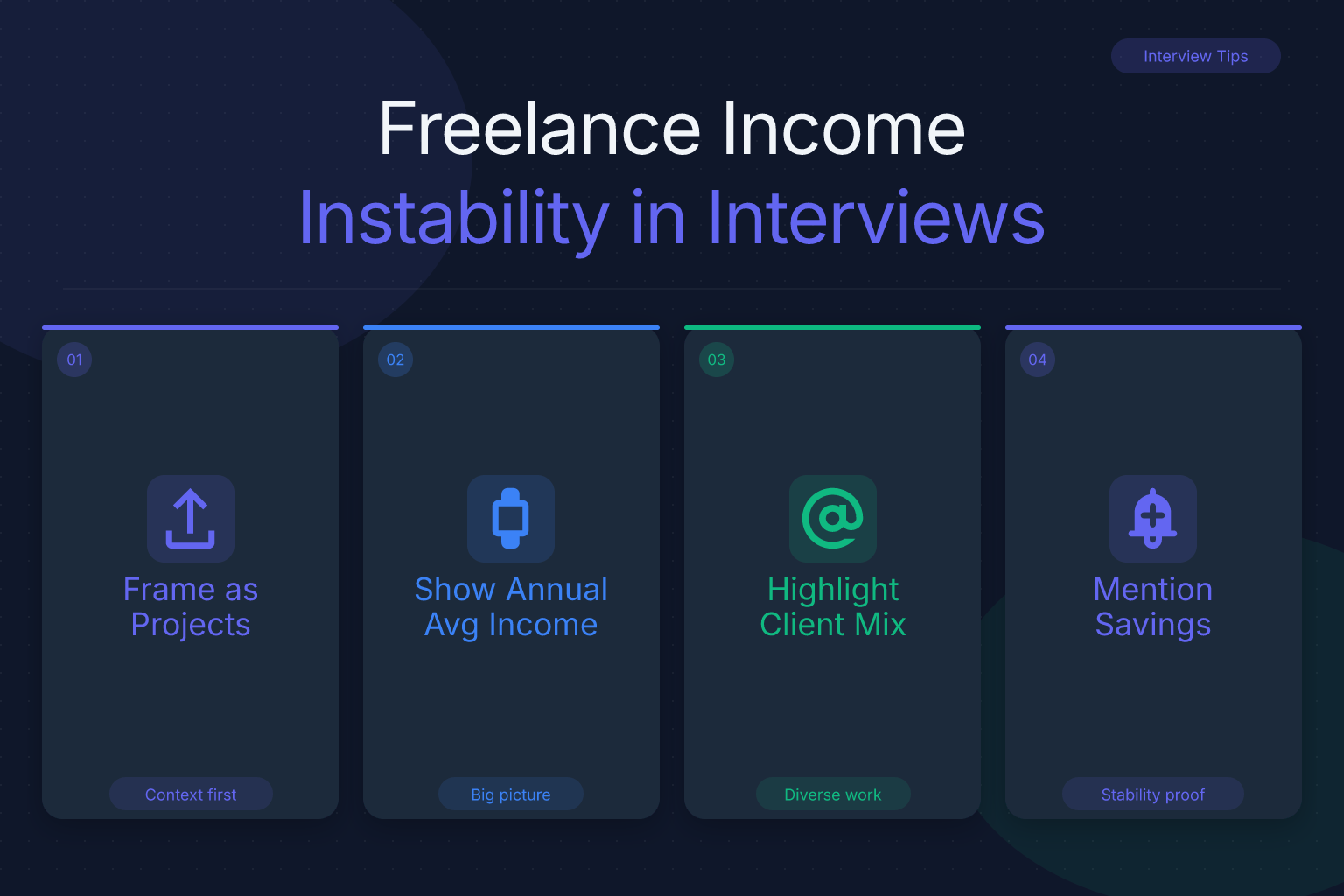
- Use specific numbers and context: show total annual income, average monthly income, or the percentage of months you met your target, rather than dwelling on low months.
- Be honest about why you’re seeking full-time work now: stability, team collaboration, or a desire to focus on one project — never say you “failed” at freelancing.
- Prepare a 60-second answer that connects your freelance experience to the value you’ll bring to the employer.
| What to Do | Why It Matters | Time |
|---|---|---|
| Reframe income variability as adaptability | Shows you can handle uncertainty and pivot | 5 min prep |
| Quantify your overall freelance earnings | Gives context beyond month-to-month dips | 10 min prep |
| Explain your motivation for full-time work | Reassures interviewer you won’t leave for freelance again | 5 min prep |
| Practice a concise, confident answer | Reduces nervousness and rambling | 15 min practice |
How to Explain Freelance Income Instability in an Interview: Start with the Right Frame
When you list freelance work on your resume, hiring managers see a period of self-employment and often wonder: Was this person just filling a gap? Will they bolt the moment freelance picks up again? Do they have the discipline for a structured 9-to-5? Income instability is a proxy for those deeper questions. The key is to address it proactively — not defensively — and to frame your freelance years as a deliberate, skill-building chapter, not a chaotic detour.
Many interviewers have worked with freelancers or hired them before. They understand that project-based work comes with ebbs and flows. What they need from you is reassurance that you can handle that variability without it affecting your performance in a full-time role. So when the topic comes up, don’t flinch. Acknowledge it briefly, then pivot to what you learned and why you’re here now.
For example, you might open with: “Freelancing definitely had its ups and downs, but that’s exactly what taught me to manage my time, prioritize high-value work, and communicate clearly with clients. I’m now looking for a role where I can apply those skills to a single team and a long-term product.” That one sentence does three things: it normalizes the instability, it highlights transferable skills, and it signals your commitment to full-time work.
Reframe the Narrative: From Instability to Adaptability
The single most powerful shift you can make is to stop thinking of income variability as a weakness and start presenting it as proof of resilience. Freelancers don’t just survive inconsistent income — they learn to forecast, negotiate, and diversify. Those are exactly the skills employers want in roles that involve project management, client relations, or cross-functional collaboration.
Instead of saying, “My income was all over the place,” say, “I managed a portfolio of clients and projects, which meant my monthly income varied. But over the course of a year, I consistently hit my revenue targets and built a repeat client base. That experience taught me to plan for uncertainty and stay calm under pressure.”
Here’s a before-and-after comparison:
Weak answer: “Yeah, freelancing was tough. Some months I barely made anything, and it was stressful not knowing when the next check would come.”
Strong answer: “Freelancing gave me the chance to work across three different industries, and while income fluctuated month to month, I averaged $6,500 per month over the last two years and maintained a 70% repeat client rate. The variability actually made me a better planner and communicator — skills I’m excited to bring to a full-time team.”
The difference is ownership. You’re not a victim of instability; you’re someone who thrived despite it. That’s the story you want to tell.
How to Answer “Why Was Your Freelance Income Inconsistent?” (Sample Scripts)
Different situations call for different nuances. Here are three sample answers you can adapt based on your own history. Always be truthful — never invent numbers or clients. The goal is to give context, not to hide the truth.
Scenario 1: You had a few low months but a solid overall year. “My income did fluctuate, especially in the first year as I built my client base. But over the last two years, I averaged $5,800 per month and worked with several repeat clients. The slow months taught me to manage cash flow and say no to low-value projects, which actually improved my overall earnings. I’m now looking for a full-time role where I can apply that client management experience to a single team.”
Scenario 2: You took time off for personal reasons (family, health, travel). “There were a couple of months where I intentionally scaled back to handle a family commitment. I used that time to earn a certification in [skill] and then came back with a stronger client pipeline. The flexibility of freelancing allowed me to do that, but now I’m ready for the stability and collaboration of a full-time role.”
Scenario 3: You were building your business from scratch. “The first six months were lean because I was investing in my own business — building a website, networking, and taking on smaller projects to build a portfolio. After that, my income stabilized and grew. That experience taught me how to sell, negotiate, and deliver under pressure, which I think translates directly to this role.”
In every case, end with a pivot to the value you bring and your interest in the specific job. That keeps the conversation moving forward instead of dwelling on the past.
Quantify Your Freelance Success Without Hiding the Gaps
Numbers are your best friend when explaining income instability. Instead of listing every monthly figure, present aggregate data that tells a positive story. Here’s what to calculate before the interview:
- Total annual income for each year you freelanced (or your best year).
- Average monthly income over a 12-month period, which smooths out peaks and valleys.
- Number of clients served, especially repeat clients.
- Repeat business rate (e.g., “60% of my clients came back for a second project”).
- Project completion rate or on-time delivery percentage.
If you had a genuinely bad month, contextualize it without oversharing. For example: “I had a slow March because two projects ended at the same time, but I used that downtime to update my portfolio and landed three new clients in April.” That shows initiative and problem-solving.
Your resume should support this story. Instead of listing freelance work as a series of gaps, format it as a cohesive block with a clear title like “Freelance Graphic Designer (2023–2025)” and bullet points that quantify results. For detailed formatting advice, see our guide on how to format freelance work on a resume with examples. A clean, ATS-friendly resume makes it easier for interviewers to see your freelance period as legitimate experience, not a red flag.
Address the Elephant: Why You Want a Full-Time Role Now
This is the question behind the question. Interviewers worry that you’ll miss the freedom of freelancing and leave after six months. You need a clear, positive, forward-looking reason for wanting full-time employment — and it should never sound like you’re running away from freelancing.
Good reasons to cite:
- Team collaboration: “I realized I do my best work when I’m bouncing ideas off colleagues and working toward a shared goal.”
- Deep focus: “Freelancing meant juggling five clients at once. I want to go deep on one product and see it through long-term.”
- Mentorship and growth: “I’m looking for a role where I can learn from senior leaders and grow within a company.”
- Stability for personal reasons: “I’m at a stage where predictable income and benefits matter for my family, and this role offers that.”
Avoid these phrases:
- “Freelancing was too hard.”
- “I couldn’t make enough money.”
- “Clients were unreliable.”
- “I got tired of the uncertainty.”
Those statements raise concerns about your resilience and judgment. Instead, frame it as a deliberate choice: “I enjoyed freelancing and learned a lot, but I’ve realized I want to contribute to a single team and build something over years, not months. This role is exactly that opportunity.” For more on positioning a career shift, read our guide on how to explain a career change in an interview.
Common Mistakes to Avoid When Explaining Freelance Income
Even well-intentioned candidates sabotage themselves with these missteps. Here’s what to avoid and what to do instead:
- Being defensive. If you bristle at the question, the interviewer will sense discomfort. Instead, smile and answer calmly — you’ve prepared for this.
- Oversharing financial struggles. You don’t need to reveal that you missed rent or maxed out a credit card. Keep the focus on professional outcomes, not personal hardship.
- Blaming clients or the economy. Saying “clients never paid on time” or “the market was terrible” makes you sound like a victim. Take ownership of what you learned.
- Saying you “failed” at freelancing. Even if you decided to stop because it wasn’t profitable, frame it as a strategic pivot: “I realized my strengths are better suited to a collaborative, full-time environment.”
- Giving vague answers. “It was fine, you know, ups and downs” doesn’t reassure anyone. Use specific numbers and a clear narrative.
- Lying about income. Never inflate your earnings or claim clients you didn’t have. Background checks and reference calls can expose this, and it destroys trust.
How to Prepare Your Resume and Portfolio to Support Your Story
Your interview answer is only as strong as the resume and portfolio that back it up. Before the interview, make sure your freelance experience is presented as a cohesive, professional chapter — not a scattered list of odd jobs.
- Use a single “Freelance [Your Role]” entry with start and end dates, even if you worked with multiple clients. Under it, list 3–5 bullet points that quantify results: “Increased client’s website traffic by 40% through SEO audits” or “Managed 12 concurrent projects with a 95% on-time delivery rate.”
- Create a simple portfolio or case study document that showcases 2–3 representative projects. You don’t need a fancy website; a PDF with screenshots and a short description works.
- Run your resume through an ATS checker to make sure it parses cleanly. A free tool like ResumeMate’s resume score checker can flag formatting issues that might cause your freelance section to be misread.
If you’re building your resume from scratch, use a free AI resume builder to create a clean, single-column PDF that presents your freelance work professionally. The goal is to make it easy for the interviewer to see your freelance period as legitimate, skill-building experience.
Practice Your Answer: Role-Play Scenarios
You can have the perfect script in your head and still fumble when the question comes. Practice is non-negotiable. Here’s a simple method:
- Write down your key points — the numbers, the reframe, the reason for full-time work — on a notecard.
- Record yourself answering the question out loud. Aim for 60–90 seconds. Listen for filler words, defensiveness, or rambling.
- Get feedback from a friend or mentor. Ask them: “Did I sound confident? Did I answer the question directly? Would you hire me?”
- Refine and repeat until the answer feels natural, not rehearsed.
Here’s a complete 60-second sample answer that ties everything together:
“Freelancing definitely had income variability, but that’s part of the job. Over the last two years, I averaged $6,200 per month and worked with 15 clients, 60% of whom came back for repeat projects. The slow months taught me to manage cash flow and prioritize high-value work. I’m now looking for a full-time role because I want to go deep on one product and collaborate with a team — and this position is exactly the kind of challenge I’m excited about.”
Notice how it acknowledges the instability, quantifies success, and pivots to the future. That’s the formula. For more on weaving this into your overall introduction, see our guide on how to answer “Tell me about yourself” in an interview.
FAQ
Q: How do I explain gaps in freelance income during an interview?
A: Focus on the overall trend, not individual months. Say something like, “My income varied month to month, but I averaged $X per month over the year and maintained a steady client base. The variability taught me to manage cash flow and prioritize high-value work.” Then pivot to why you want full-time work.
Q: What if my freelance income was very low some months?
A: Be honest but contextualize. Explain that you used slow periods for professional development, networking, or personal projects. For example, “I had a slow quarter when two contracts ended, but I used that time to earn a certification and landed three new clients the following month.” Never lie about numbers.
Q: Should I mention that I struggled financially as a freelancer?
A: Only if it’s relevant to your motivation for seeking full-time work, and frame it positively. Instead of “I couldn’t pay my bills,” say “I realized I wanted more predictable income and the stability of a full-time role, which is why I’m excited about this opportunity.” Avoid oversharing personal financial details.
Q: How do I transition from freelance to full-time in an interview?
A: Emphasize the skills you gained (client management, self-discipline, adaptability) and give a clear, positive reason for wanting full-time work, such as team collaboration or deep focus on one product. Connect your freelance experience directly to the job requirements.
Q: Can I say I was freelancing while looking for a full-time job?
A: Yes, but be careful. If you were actively job hunting while freelancing, you can say, “I took on freelance projects to stay sharp and keep my skills current while I searched for the right full-time role.” This shows initiative and honesty. Just make sure you don’t imply you’ll continue freelancing on the side if hired, unless the employer allows it.
Q: How do I answer “Why do you want to leave freelancing?”
A: Give a forward-looking answer: “I’ve enjoyed the variety of freelancing, but I’m at a point where I want to contribute to a single team and see a project through long-term. This role offers exactly that.” Avoid negative comments about freelancing or clients.
Track Every Application While You Job Hunt
Stop losing track of where you’ve applied. The ResumeMate Job Tracker is a free Chrome extension that tracks every application, deadline, and follow-up in one place — right from your browser.