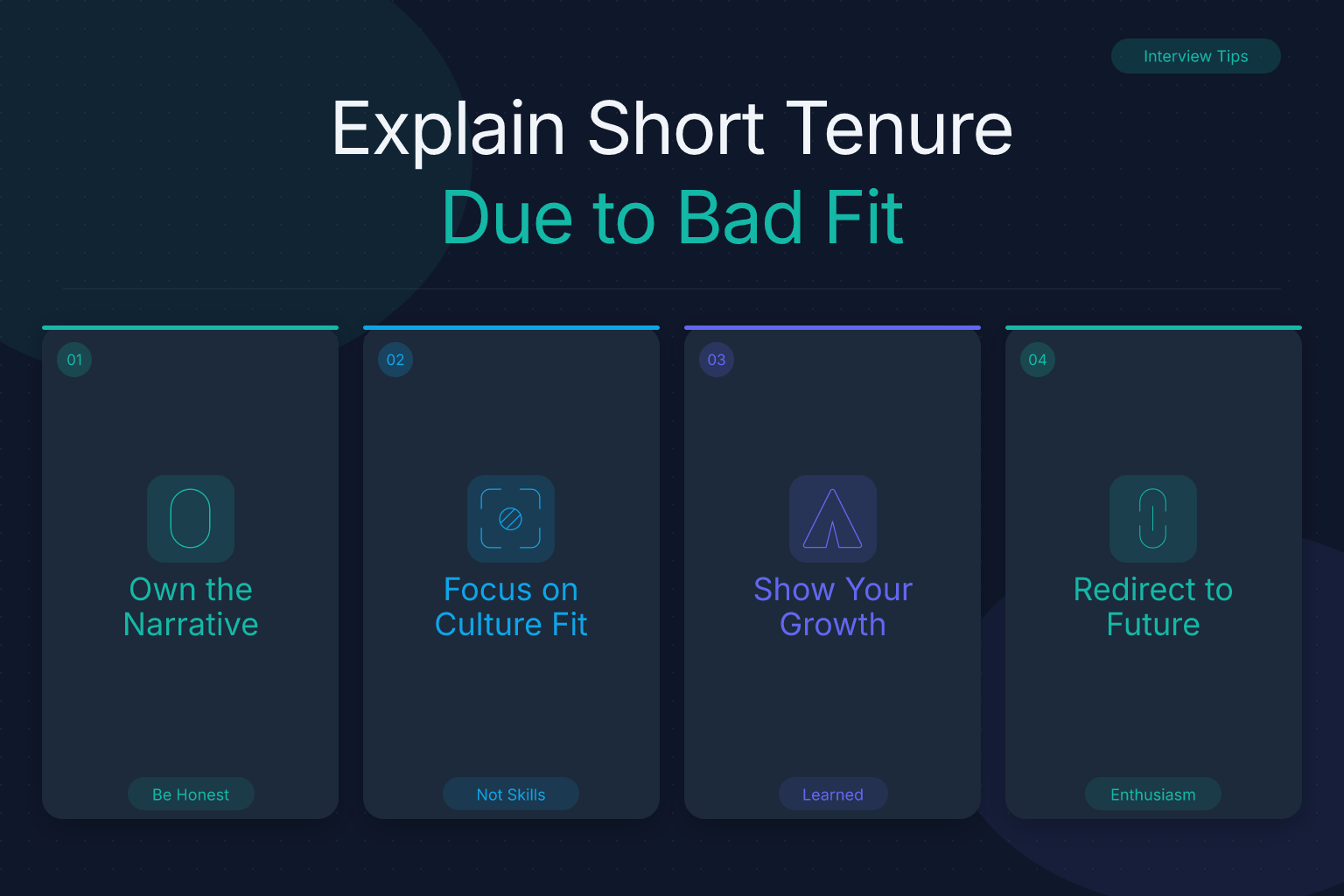
How to Explain Short Tenure Due to Bad Fit in an Interview
You left a job after only a few months because it was a bad fit — now you need to explain that short tenure in an interview without sounding flaky or negative. Hiring managers see short stints on a resume and immediately wonder: Will this person leave us too? Your job is to reframe the experience so it reads as a thoughtful, self-aware decision rather than a red flag.
A bad fit can mean many things: a mismatch in company culture, a role that didn’t match what was promised, a management style that clashed with how you work best, or values that didn’t align. Whatever the reason, you can address it honestly while keeping the focus on what you learned and why the new opportunity is a much better match.
Key Takeaways
- Frame a short tenure due to bad fit as a proactive decision to find the right alignment, not a failure or a sign of instability.
- Focus on what you learned about your work style, values, and ideal environment — then connect those insights directly to the role you’re interviewing for.
- Never badmouth the previous employer; keep the explanation professional, brief, and forward-looking.
- Prepare a 2-3 sentence answer that acknowledges the short stay, explains the mismatch without blame, and pivots to your enthusiasm for the new role.
- Practice your delivery so you sound calm and confident, not defensive, when the topic comes up.
Summary Table
| What to Do | Why It Matters | Time |
|---|---|---|
| Reframe the experience as a learning opportunity | Shows maturity and self-awareness instead of regret | 5–10 minutes to craft |
| Prepare a concise 2-3 sentence explanation | Keeps the answer brief and avoids rambling or oversharing | 15 minutes |
| Practice with a friend or record yourself | Builds confidence and smooth delivery under pressure | 20 minutes |
| Align your answer with the new role’s requirements | Demonstrates you’re a strong fit now, not a flight risk | 10 minutes |
Why ‘Bad Fit’ Is a Legitimate Reason for Leaving a Job
When you need to explain short tenure due to bad fit in an interview, the first step is recognizing that it’s a valid reason. Not every role works out, and most experienced hiring managers understand that. According to career coaches, a mismatch in culture, values, or working style is one of the most common causes of early departure — and it doesn’t automatically make you a job hopper.
What matters is how you talk about it. If you treat the short stint as a mistake you’re ashamed of, the interviewer will pick up on that discomfort. If you treat it as a data point that helped you refine what you’re looking for, you come across as intentional and self-aware.
A bad fit can look like:
- A role that was sold as strategic but turned out to be 90% administrative work.
- A company that claimed to value work-life balance but expected 60-hour weeks with no notice.
- A manager whose micromanagement style clashed with your need for autonomy.
- A team where collaboration was discouraged despite being promised a collaborative environment.
None of these are character flaws. They’re misalignments. Your goal in the interview is to show that you recognized the misalignment early, handled it professionally, and used the experience to get clearer on what you need to thrive.
How to Frame a Short Tenure as a Learning Experience
Instead of apologizing for the short stay, frame it as a period of rapid learning that sharpened your career direction. This shifts the narrative from “I made a bad choice” to “I gained clarity quickly.”
Start by identifying one or two specific things you learned about yourself during that time. For example:
- You discovered you do your best work in a fast-paced, iterative environment rather than a rigid, process-heavy one.
- You realized that having a manager who gives you autonomy is non-negotiable for your productivity.
- You learned that you need a role where you can see the direct impact of your work on customers, not just internal reports.
Then, connect those insights to the job you’re interviewing for. If the new role emphasizes ownership and quick decision-making, you can say: “That experience taught me that I thrive when I have ownership over projects from start to finish, which is exactly what this role offers.”
This approach does three things: it explains the departure without blame, it demonstrates self-awareness, and it reinforces why you’re a great fit for the current opportunity.
Sample Answers for Explaining Short Tenure Due to Bad Fit
Here are a few sample answers you can adapt. Notice how each one is brief, honest, and ends with a forward-looking statement.
Sample 1: Culture Mismatch “I joined the company excited about the product, but I quickly realized the work culture wasn’t the right fit for how I operate best. I thrive in environments that encourage open debate and quick experimentation, and that wasn’t the reality there. I decided to move on so I could find a team where that kind of collaboration is the norm — and from what I’ve read about your team, that seems to be a core part of how you work.”
Sample 2: Role Misalignment “The role was presented as a blend of strategy and execution, but in practice it was almost entirely execution with little room to influence direction. I’m at my best when I can help shape the ‘why’ behind the work, not just the ‘what.’ That experience clarified that I need a role with strategic ownership, which is why I’m so interested in this position.”
Sample 3: Management Style Clash “I learned a lot in those six months, but I also learned that I do my best work when I have a manager who trusts me to run with projects. The environment there was more hands-on than I expected, and I realized I’m more effective with a higher degree of autonomy. I left on good terms and have been looking for a role where I can take full ownership — like this one.”
Sample 4: Values Misalignment “The company’s values on paper were a great match, but in practice I found that decisions were often driven by short-term metrics at the expense of customer experience. That’s not how I like to work. I want to be somewhere that balances business goals with doing right by the user, and your company’s reputation for that balance is what drew me to apply.”
Each of these answers takes less than 30 seconds to deliver. That’s intentional — you don’t want to dwell on the past. Acknowledge it, share the insight, and pivot to the future.
What to Avoid Saying When You Left Because of a Bad Fit
Even when the departure was justified, certain phrases can raise red flags. Avoid these common mistakes:
- Badmouthing the company or manager. Saying “my boss was a nightmare” or “the company was a mess” makes you look difficult, not discerning. Keep it factual and neutral.
- Oversharing details. You don’t need to describe every frustrating meeting or policy. A high-level explanation is enough.
- Blaming others entirely. Even if the mismatch wasn’t your fault, taking some ownership of the learning shows maturity. Say “I realized I need X” rather than “they didn’t give me X.”
- Sounding uncertain or apologetic. If you deliver your answer with hesitation or shame, the interviewer will wonder what you’re hiding. Practice until you can say it calmly and confidently.
- Making it sound like a pattern. If you have multiple short tenures, avoid explaining each one as a bad fit. That can signal you’re the common denominator. Instead, look for a unifying theme — perhaps you were exploring different industries before finding your niche. (For more on handling multiple short stints, see our guide on how to explain being laid off twice in an interview — the framing principles overlap.)
How to Address Short Tenure on Your Resume Before the Interview
Your resume is the first place a recruiter notices a short stint. While you can’t hide it, you can present it in a way that minimizes concern.
- Use years only (optional). If the short tenure was, say, March to August 2025, you could list it as “2025” for both start and end. This softens the visual impact without lying. However, many ATS and recruiters prefer month-year format, so weigh the trade-off. If you’re unsure how your resume will parse, run it through a free resume score checker to see how an ATS reads your dates and formatting.
- Focus on achievements, not duration. Even in a few months, you likely accomplished something. List 2-3 bullet points that highlight results or skills gained. This shifts attention from “why so short?” to “what did they do?”
- Add a brief context line (if needed). For a very short role (under 6 months), you can add a one-line italicized note under the job title: “Role evolved away from strategic focus; left to pursue better-aligned opportunity.” This preempts the question and frames it on your terms.
- Group short contract or project work. If the bad-fit role was a contract or freelance gig, label it as such. That immediately explains the short duration.
Remember, the resume’s job is to get you the interview. The interview is where you’ll explain the story in person.
Preparing for Follow-Up Questions About Your Short Stay
Once you give your initial explanation, expect follow-up questions. Interviewers want to see if your story holds up under a little pressure. Prepare for these common ones:
“What specifically made it a bad fit?” Have one concrete, professional example ready. Avoid vague answers like “it just wasn’t right.” Instead: “I was hired to build a new customer onboarding process, but after I started, the company shifted priorities and the role became purely reactive support. I’m someone who thrives on building systems, so I knew I needed to find a role where I could do that.”
“Why didn’t you try to make it work longer?” This is a test of your problem-solving and commitment. Acknowledge that you did try — maybe you had conversations with your manager or sought additional projects — but ultimately the gap was too fundamental. “I did have a few conversations with my manager about taking on more strategic work, but the business need at the time was purely executional. I decided it was better for both sides if I moved on rather than stay and underperform in a role that didn’t play to my strengths.”
“How do we know you won’t leave us after a few months?” This is the core concern. Your answer should tie your learnings directly to the new role. “That experience taught me exactly what I need to do my best work — and everything I’ve learned about this role and your team tells me it’s a strong match. I’m not looking to make a move; I’m looking to build something long-term in the right environment.”
“What did you learn from that experience?” Have a crisp, positive takeaway. “I learned that I need a role where I can see the direct impact of my work on customers. That’s why I’m excited about this customer-facing product role — it’s exactly the kind of feedback loop I thrive on.”
Practicing these follow-ups out loud will make you sound prepared, not rehearsed.
Turning a Bad Fit into a Positive Narrative for Your Career
A short tenure due to bad fit can actually strengthen your candidacy if you position it as a turning point. Many successful professionals have a “course correction” story — a moment when they got clear on what they wanted and made a deliberate change.
To build that narrative:
- Identify the before-and-after. Before the short role, you might have been unsure about your ideal work environment. After it, you had clarity. Frame the short stint as the catalyst.
- Show how it led you to this opportunity. “That experience is what led me to be very intentional about my next move. I didn’t want to just take any job; I wanted to find a place where [specific value] is practiced, not just preached. That’s why I applied here.”
- Connect it to your long-term goals. If you’re making a broader career shift, the bad-fit role might have been a stepping stone. For more on weaving that into your story, read our guide on how to explain a career change in an interview.
When you tell this story well, the interviewer stops seeing a red flag and starts seeing someone who knows themselves — a trait that predicts long-term retention and performance.
Using the STAR Method to Explain a Bad Fit Situation
If an interviewer asks for a specific example of a time you faced a challenge related to fit, the STAR method (Situation, Task, Action, Result) keeps your answer structured and professional.
Here’s how to apply it to a bad-fit scenario:
- Situation: “In my last role, I was brought on to lead a new initiative, but within the first month it became clear that the company’s priorities had shifted and the role was no longer what we’d discussed.”
- Task: “I needed to decide whether to adapt to a role that didn’t match my strengths or make a change.”
- Action: “I had an open conversation with my manager about the misalignment and explored whether there was a path to reshape the role. When it became clear that wasn’t possible, I made the decision to leave on good terms, giving proper notice and documenting my work for a smooth handoff.”
- Result: “I left with a much clearer understanding of the kind of role and culture where I thrive. That clarity is what led me to apply here, where the emphasis on [specific value] aligns perfectly with how I work best.”
This approach shows you handled a difficult situation with professionalism and turned it into a growth moment. It also demonstrates the kind of communication and self-awareness that employers value.
If you’re also preparing for other common interview questions, our guides on how to answer ‘what motivates you’ and how to answer ‘tell me about yourself’ can help you build a cohesive, confident interview narrative.
FAQ
Q: How do I explain a short tenure due to bad fit without sounding negative?
A: Focus on what you learned about your work style and what you’re looking for now, rather than what was wrong with the previous company. Use neutral language like “I realized I thrive in environments that value X” instead of “they didn’t value X.” Keep the explanation brief and pivot quickly to why the new role is a great match.
Q: What if the bad fit was because of a toxic manager or culture?
A: Even in that case, avoid direct criticism. Frame it as a misalignment in working styles or values. For example, “I work best when there’s a high degree of trust and autonomy, and I found I needed an environment that supports that more fully.” This communicates the issue without naming names or sounding bitter.
Q: Should I mention the short tenure if the interviewer doesn’t ask about it?
A: If the short role is on your resume, it’s likely the interviewer has noticed. You don’t need to bring it up proactively in your “tell me about yourself” answer, but be prepared to address it if asked. If the interview is going well and the topic hasn’t come up, you can briefly address it when discussing why you’re interested in the new role — framing it as part of your journey to finding the right fit.
Q: How short is too short to list on a resume?
A: Generally, any role under 3 months can be omitted if it doesn’t leave a large gap and isn’t relevant to your target job. However, if it’s your most recent role or you gained valuable skills, include it and be ready to explain. A 4-6 month tenure is common enough that most recruiters won’t be alarmed if you have a solid explanation.
Q: Can I say I left for personal reasons instead of admitting it was a bad fit?
A: You can, but “personal reasons” can raise other questions and may sound evasive. A well-framed bad-fit explanation often comes across as more honest and self-aware. If the real reason is personal (health, family), that’s valid — but if it’s truly a fit issue, addressing it directly usually builds more trust.
Q: What if I have multiple short tenures on my resume?
A: If you have two or more short stints, look for a common thread. Maybe you were exploring different industries, or you took contract roles. If they were all due to bad fit, you’ll need to show that you’ve now identified exactly what you need and that this role meets those criteria. You might also consider grouping early short roles under a “Consulting” or “Project Work” section to reduce the visual impact.
Related articles:
Track Every Application While You Job Hunt
Stop losing track of where you’ve applied. The ResumeMate Job Tracker is a free Chrome extension that tracks every application, deadline, and follow-up in one place — right from your browser.