How to Format a Resume for a Career Break Due to Travel
If you’re wondering how to format a resume for a career break due to travel, you’re not alone. Taking months off to backpack, volunteer abroad, or pursue a long-term sabbatical is increasingly common — but it leaves a visible gap in your work history that can make you hesitate when updating your resume. The good news: a travel break doesn’t have to hurt your job search. With the right formatting, you can turn that gap into a compelling story of growth, adaptability, and real-world skills. This guide walks you through exactly how to structure your resume so the travel break reads as an asset, not a liability.
Key Takeaways
- You can format a travel career break as a dedicated “Travel Experience” or “Career Break” section, or list it as a job entry with a clear date range and description — both work if you’re transparent and positive.
- Focus on transferable skills gained while traveling — adaptability, cross-cultural communication, budgeting, problem-solving — and tie each one to the job you’re applying for.
- Use a single-column, ATS-friendly resume format and never hide the gap; recruiters prefer a clear explanation with a positive spin over a mysterious blank space.
- If you did any freelance, volunteer, or remote work during your travels, list it under your work experience to show professional continuity.
- A strong resume summary at the top can reframe the break as intentional and growth-oriented before a recruiter even asks about it.
| What to Do | Why It Matters | Time |
|---|---|---|
| Add a “Travel Experience” or “Career Break” section | Shows the break was intentional and skill-building, not a red flag | 15 min |
| Write a resume summary that mentions the break | Frames the gap positively before recruiters ask | 10 min |
| List freelance or volunteer work from your travels | Demonstrates you stayed professionally active | 20 min |
| Use a single-column ATS-friendly template | Ensures your resume parses correctly in applicant tracking systems | 5 min |
| Tailor travel skills to the job description | Connects your experience directly to employer needs | 15 min |
How to Format a Resume for a Career Break Due to Travel: Step-by-Step
The core principle is simple: be transparent, be positive, and be specific. Don’t try to hide the gap by leaving dates off or stretching employment periods — recruiters and ATS software will notice, and it erodes trust. Instead, treat the travel break as a legitimate entry in your professional timeline. The most effective approach is to add a clearly labeled section between your work experience and education, or to list the travel period as a job entry with a descriptive title like “Independent Traveler” or “Sabbatical.”
Formatting matters just as much as content. Use a clean, single-column layout with standard section headings (Work Experience, Skills, Education) so applicant tracking systems can parse your resume without errors. Most modern ATS platforms — Workday, Greenhouse, Lever, iCIMS — handle text-based PDFs reliably, so you don’t need to switch to a Word document. Just avoid scanned or image-based PDFs, tables, and graphics. If you’re building from scratch, ResumeMate’s free resume builder offers single-column templates that export as clean, ATS-safe PDFs.
Where to Put the Travel Break on Your Resume
You have three main options for placing the travel break, and the best choice depends on what you did during that time and how long the break lasted.
Option 1: Dedicated “Travel Experience” or “Career Break” section
Place this section after your work experience and before education. It works well if your travel was substantial (6+ months) and you want to highlight it as a deliberate growth period. Use a heading like “Travel Experience” or “Career Break — Independent Travel.” Under it, list the dates and 3–5 bullet points describing what you did and learned.
Option 2: List it as a job entry in your work history
If you prefer a strictly chronological resume, add the travel period as an entry with a job title like “Independent Traveler” or “Sabbatical — Southeast Asia.” This keeps your timeline unbroken and signals that you weren’t unemployed — you were doing something intentional. Include the same bullet points you would for any job.
Option 3: Fold it into freelance or volunteer work
If you did any paid or unpaid work while traveling — freelance writing, remote consulting, teaching English, volunteering with an NGO — list those as separate entries under work experience. Then add a brief line in your summary or a short note that the work occurred during a travel period. This is often the strongest option because it shows professional continuity. For guidance on formatting that freelance work, see our post on how to format freelance work on a resume with examples.
What to Write in the Travel Break Section
The content of your travel break section is where you turn a gap into a selling point. Avoid vague statements like “took time off to travel.” Instead, treat it like a job description: list concrete activities, quantify where possible, and connect each bullet to a transferable skill.
Here’s a sample block you can adapt:
Career Break — Independent Travel
January 2024 – August 2024
- Traveled through 12 countries across Southeast Asia and Europe, managing a daily budget of $50.
- Learned conversational Spanish and basic Thai, improving cross-cultural communication.
- Planned and executed a 3-month overland route, handling visas, accommodations, and logistics.
- Documented the journey through a blog with 5,000 monthly readers, developing content creation and SEO skills.
Notice how each bullet is specific and skill-oriented. “Managed a daily budget” shows financial discipline. “Learned conversational Spanish” shows adaptability and communication. “Planned a 3-month route” shows project management. “Documented through a blog” shows digital skills. If you volunteered, add a bullet like “Coordinated a team of 8 volunteers for a beach cleanup in Thailand, improving leadership and event planning.”
If your travel break was shorter (2–3 months), you can still include a section, but keep it to 2–3 bullets. The key is to show that the time was purposeful, not just a vacation.
How to Write a Resume Summary That Addresses the Gap
Your resume summary sits at the top of the page and is the first thing a recruiter reads. Use it to proactively frame the travel break as a positive. You don’t need to dwell on it — one sentence is enough — but mentioning it upfront prevents the gap from becoming an unspoken question.
Here’s a formula: [Job title] with [X years] of experience, returning from a [duration] travel sabbatical that strengthened [2–3 relevant skills]. Skilled in [core competencies].
Example for a marketing professional:
Marketing professional with 5 years of experience, returning from a 7-month travel sabbatical that strengthened adaptability, cross-cultural communication, and content creation. Skilled in SEO, email marketing, and campaign analytics.
Example for a software engineer:
Software engineer with 4 years of experience, recently returned from a 6-month travel break where I built a personal project and learned conversational Portuguese. Proficient in Python, React, and AWS.
If your travel inspired a career change, you can lean into that pivot. For more on writing a summary that bridges a gap and a new direction, read our guide on how to write a resume summary for a tech career pivot.
Skills to Highlight From Your Travel Experience
Travel develops a surprising number of skills that employers value. The trick is to name them explicitly and tie them to the job description. Here are the most common transferable skills from travel, with examples of how to phrase them on a resume:
- Adaptability and resilience: “Navigated unexpected border closures and flight cancellations, developing rapid problem-solving under pressure.”
- Cross-cultural communication: “Interacted daily with people from 10+ nationalities, improving verbal and non-verbal communication across language barriers.”
- Budgeting and financial management: “Managed a $15,000 travel budget over 8 months, tracking expenses and negotiating prices to stay under budget.”
- Planning and logistics: “Planned a multi-country itinerary including visas, transportation, and accommodations for 6 months of travel.”
- Language skills: “Achieved conversational fluency in Spanish (B1 level) through immersion and daily practice.”
- Digital and content skills: “Grew a travel Instagram account to 10,000 followers, learning social media strategy and audience engagement.”
- Independence and self-motivation: “Worked remotely for 3 months while traveling, maintaining consistent output without direct supervision.”
When tailoring your resume, scan the job posting for keywords like “adaptable,” “self-starter,” “cross-functional,” or “budget management,” and mirror those terms in your travel bullets. This helps both the ATS and the human recruiter see the connection.
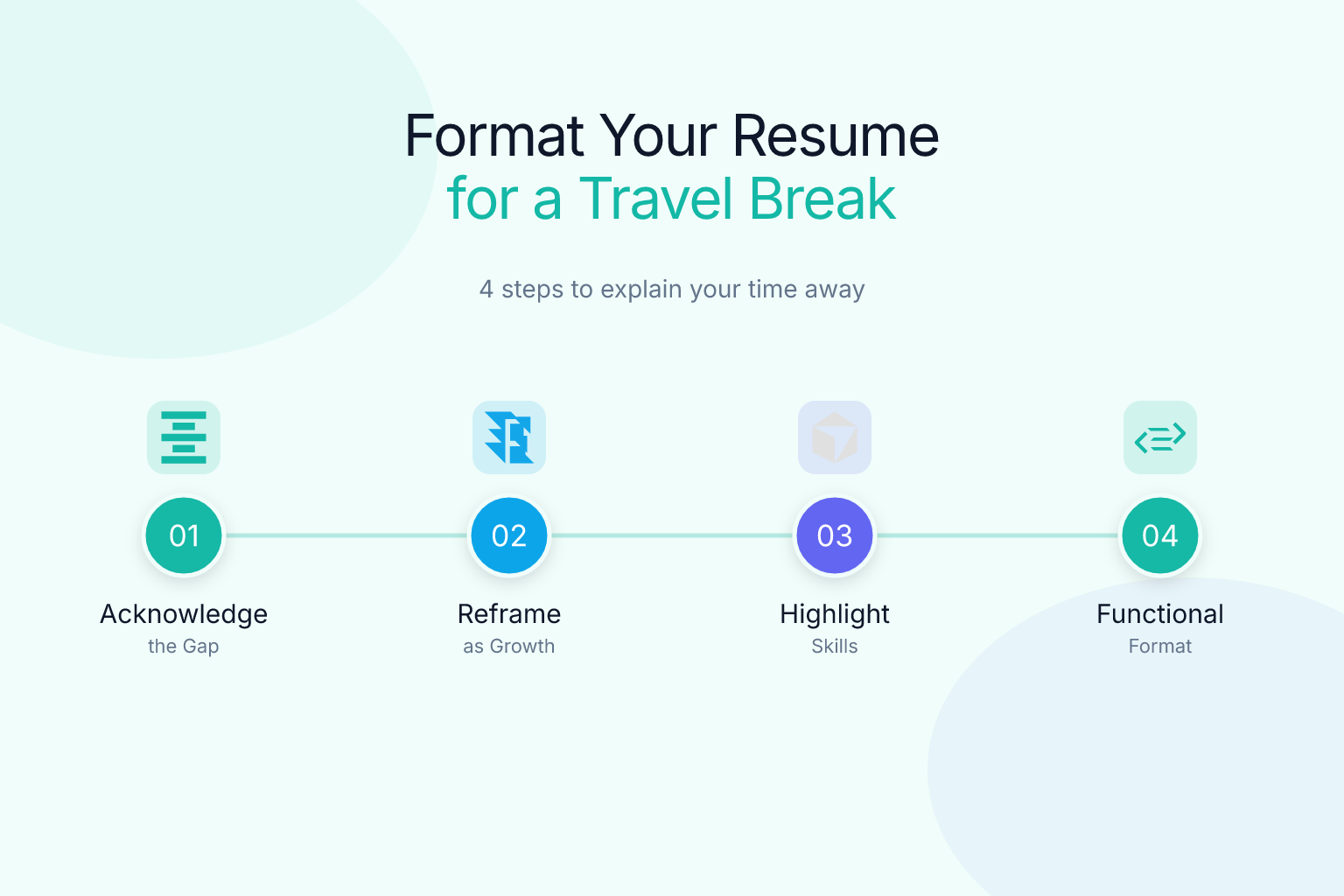
Should You Use a Functional Resume Format?
A functional resume (also called a skills-based resume) groups your experience under skill categories rather than listing jobs chronologically. Some job seekers consider it for hiding gaps, but we don’t recommend it for a travel break. Here’s why:
- ATS parsing issues: Many applicant tracking systems struggle with functional formats because they expect a reverse-chronological work history. Your resume may get scrambled or rejected before a human sees it.
- Recruiter suspicion: Hiring managers know that functional resumes are often used to hide gaps or job-hopping. It can raise more questions than it answers.
- Loss of context: A chronological or hybrid format lets you show the travel break as a deliberate entry, which is more transparent and credible.
Instead, use a reverse-chronological format with a clearly labeled travel section. If you’re worried about the gap, a hybrid format — where you lead with a skills summary and then list chronological experience — can work, but keep the dates visible. Most ResumeMate templates are single-column and ATS-friendly, so you don’t need to overthink the layout. After you’ve drafted your resume, run it through ResumeMate’s free score checker to see how an ATS reads it and get section-by-section feedback.
Common Mistakes to Avoid When Formatting a Travel Gap
Even with good intentions, it’s easy to make formatting errors that undermine your resume. Here are the most common mistakes and how to fix them:
- Leaving the gap unexplained. A blank space between jobs invites assumptions. Always include a travel entry or a note in your summary.
- Using vague language. “Took a break to travel” tells the recruiter nothing. Be specific about what you did, where you went, and what you learned.
- Overemphasizing the travel. Your travel break should support your professional story, not dominate it. Keep the travel section to 3–5 bullets and make sure your work experience still gets the most space.
- Using a two-column or graphic-heavy template. While some modern ATS can parse two-column resumes, single-column is the safest choice. Avoid images, tables, and text boxes that can confuse parsing software.
- Not tailoring skills to the job. A generic list of travel skills won’t help. Match each bullet to a requirement in the job description.
- Lying about dates. Never extend a previous job’s end date to cover the travel period. Background checks will catch it, and it’s an instant disqualifier.
For a different type of career break — such as time off to care for a family member — the formatting principles are similar, but the framing differs. See our step-by-step guide on how to format a resume for a career break due to illness for more context.
Resume Example for a Career Break Due to Travel
Here’s a condensed example of how a travel break might appear in a full resume, using a hybrid chronological format:
JORDAN LEE
Marketing Specialist | jordan.lee@email.com | (555) 123-4567 | LinkedIn: /in/jordanlee

SUMMARY
Marketing specialist with 5 years of experience, returning from a 7-month travel sabbatical that strengthened adaptability, cross-cultural communication, and content creation. Skilled in SEO, email marketing, and campaign analytics.

WORK EXPERIENCE
Marketing Coordinator — BrightWave Media, New York, NY
March 2021 – December 2023
- Managed email campaigns for 20+ clients, increasing average open rates by 15%.
- Analyzed campaign performance and presented monthly reports to stakeholders.
- Collaborated with design and sales teams to launch 3 new product lines.

Career Break — Independent Travel
January 2024 – July 2024
- Traveled through 10 countries in Southeast Asia and Europe, managing a daily budget of $60.
- Learned conversational Spanish and basic Thai, improving cross-cultural communication.
- Documented the journey through a blog with 4,000 monthly readers, developing SEO and content strategy skills.

Marketing Intern — Creative Co., Boston, MA
June 2020 – February 2021
- Assisted with social media scheduling and content creation.
- Conducted competitor research and compiled weekly reports.

SKILLS
SEO, Email Marketing (Mailchimp, HubSpot), Google Analytics, Content Creation, Cross-Cultural Communication, Budget Management, Spanish (Conversational)

EDUCATION
B.A. in Communications — University of Massachusetts, 2020
This example shows the travel break as a natural part of the timeline, with skills that directly support the marketing role. The summary addresses the gap upfront, and the travel bullets mirror the language of the job description.
FAQ
Q: Do I need to explain my travel break on my resume, or can I just leave the dates blank?
A: Always explain it. Leaving a gap unexplained invites negative assumptions. Add a travel entry or mention it in your summary so recruiters see the break as intentional and skill-building.
Q: How long of a travel break is too long to include on a resume?
A: There’s no hard cutoff, but any break longer than 2–3 months should be addressed. Even a 1-month gap can be left off if it’s between jobs, but anything longer deserves a brief note.
Q: Can I list travel as a job on my resume?
A: Yes. Use a job title like “Independent Traveler” or “Sabbatical” and include bullet points describing what you did and learned, just like any other position. This keeps your timeline unbroken.
Q: What if I didn’t do anything productive during my travel break?
A: Even leisure travel builds skills — budgeting, planning, adaptability, and independence. Frame those honestly. If you truly did nothing, keep the entry short and focus on your readiness to return to work.
Q: Should I use a functional resume to hide my travel gap?
A: No. Functional resumes often confuse ATS software and raise recruiter suspicion. Use a reverse-chronological format with a clearly labeled travel section instead.
Q: How do I mention travel in a cover letter?
A: Briefly reference the break in one or two sentences, focusing on what you gained and why you’re excited to return to work. Keep the tone positive and forward-looking.
Track Every Application While You Job Hunt
Stop losing track of where you’ve applied. The ResumeMate Job Tracker is a free Chrome extension that tracks every application, deadline, and follow-up in one place — right from your browser.