How to Handle Job Rejection and Ask for Feedback
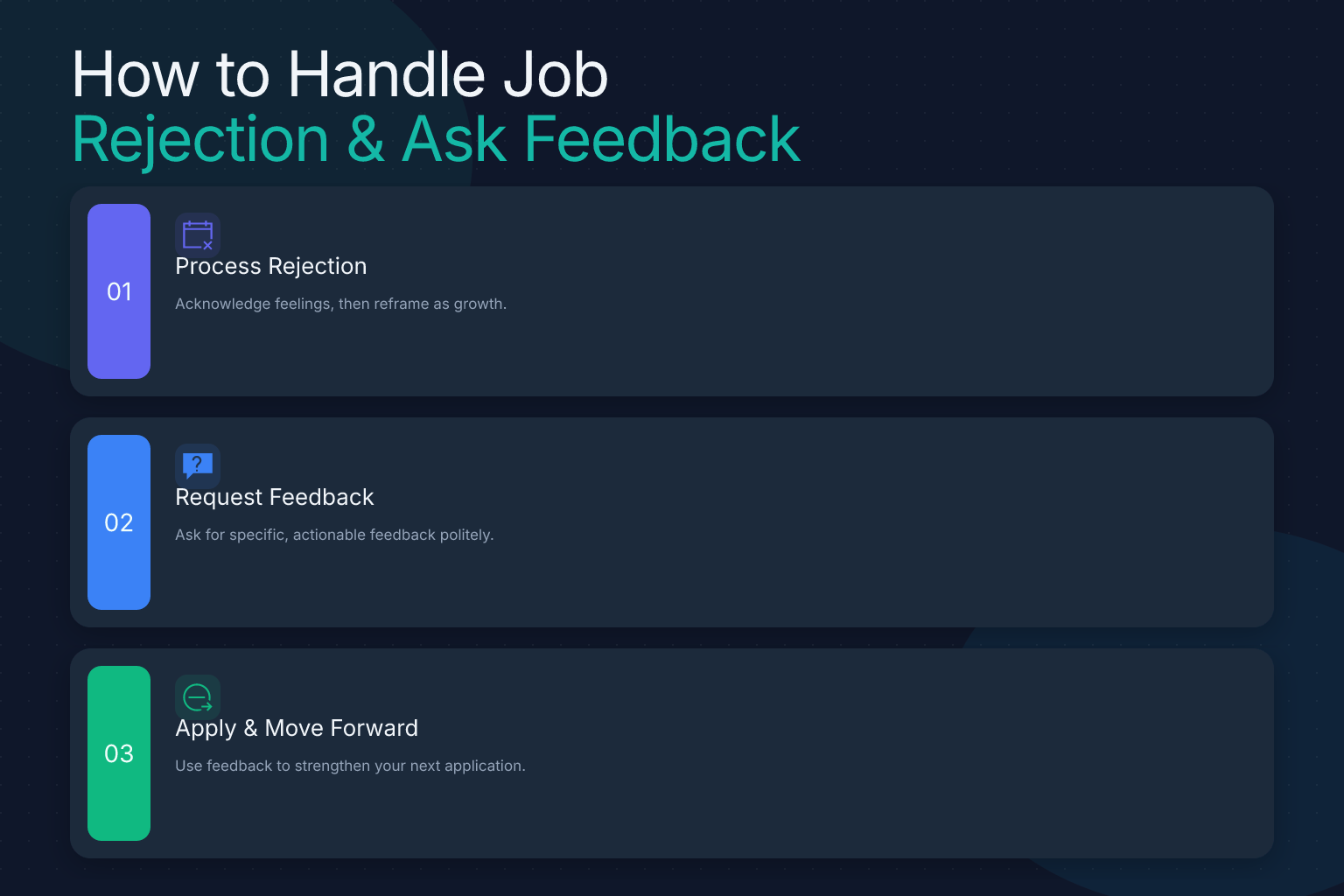
How to handle job rejection and ask for feedback is a skill every job seeker needs — because rejection is a numbers game, not a verdict on your worth. A single no can feel like a gut punch, but the way you respond determines whether that door stays closed or cracks open just enough to give you an edge next time. This guide walks you through processing the disappointment, crafting a feedback request that hiring managers actually answer, and using what you learn to strengthen your resume, interview skills, and overall approach.
Key Takeaways
- A rejection is rarely about you as a person — it’s usually about fit, timing, or an internal candidate you never knew existed.
- Asking for feedback within 24–48 hours with a short, specific, and gracious email dramatically increases your chances of getting a useful reply.
- Not every company will respond, and that’s okay — the act of asking still leaves a positive impression and keeps the door open for future roles.
- Use every rejection to audit your resume, cover letter, and interview answers so you’re measurably stronger for the next opportunity.
- Tracking your applications and outcomes reveals patterns (e.g., you get interviews but no offers) that tell you exactly where to improve.
Summary Table
| What to Do | Why It Matters | Time |
|---|---|---|
| Process the rejection without taking it personally | Separates emotion from action so you can respond professionally | 1–2 hours |
| Send a polite, specific feedback request | Increases the chance of getting actionable insights from the hiring team | 15 minutes |
| Analyze any feedback you receive and adjust your approach | Turns a no into a concrete improvement for your next interview or application | Ongoing |
| Track every application and its outcome | Reveals patterns — where you’re getting stuck and what’s working | 5 minutes per application |
| Keep applying and networking immediately | Maintains momentum and prevents one rejection from derailing your search | Daily |
Why Job Rejection Stings (and Why It’s Not Personal)
Rejection hurts because your brain processes it similarly to physical pain. But in hiring, a no is almost never a judgment of your value as a person. Most rejections come down to factors you can’t control: an internal candidate was already earmarked, the role was put on hold, or the team simply clicked better with someone else’s communication style. Even when you’re perfectly qualified, you’re competing against dozens or hundreds of applicants — many of whom are equally qualified.
Consider the numbers: the average corporate job opening attracts 250 resumes, and only 4–6 candidates get an interview. That means even a strong application faces long odds. According to industry data, roughly 75% of resumes are rejected by applicant tracking systems (ATS) before a human ever sees them. So if you’re not landing interviews, it’s often a formatting or keyword issue — not a reflection of your abilities.
Understanding this doesn’t erase the sting, but it helps you respond constructively. Instead of spiraling, you can treat the rejection as a data point. Did you get an interview? If not, your resume or application strategy might need work. If you made it to the final round, your interview skills are solid but you may need to sharpen how you present your fit. This kind of honest self-assessment is the first step in handling rejection well.
How to Respond to a Job Rejection Email (and Ask for Feedback)
When a rejection email lands, your first instinct might be to delete it or fire off a defensive reply. Neither helps. The best response is brief, gracious, and includes a clear ask for feedback. Here’s a step-by-step approach:
- Wait a few hours. Let the initial disappointment fade so you can write a level-headed message.
- Thank them. Acknowledge the time they invested in reviewing your application or interviewing you.
- Express continued interest. Mention that you remain interested in the company and would welcome future opportunities.
- Ask for feedback — specifically. Vague requests like “Can you tell me why I wasn’t selected?” rarely get answers. Instead, ask one or two pointed questions.
- Keep it short. Hiring managers are busy. A 4–5 sentence email is more likely to be read and answered than a long, emotional one.
Here’s a template you can adapt:
Subject: Thank you — [Job Title] position
Hi [Name],
Thank you for letting me know about the decision. While I’m disappointed, I appreciate the opportunity to interview and learn more about [Company Name].
If you have a moment, I’d be grateful for any brief feedback on my interview or application — specifically, was there a skill or experience you felt I was missing? I’m always looking to improve.
I’d love to be considered for future roles that might be a better fit. Thanks again for your time.
If you only made it to the application stage and never interviewed, adjust the ask:
…I’d be grateful for any feedback on my resume or application. Was there a particular qualification or experience that set other candidates apart?
This approach works because it’s respectful, specific, and easy for a recruiter to answer in two sentences. Avoid asking “Why didn’t I get the job?” — that puts the recruiter on the defensive. Instead, frame it as a request for improvement, which makes you look coachable and professional.
When You Should (and Shouldn’t) Ask for Feedback
Not every rejection warrants a feedback request. Here’s how to decide:
Ask for feedback when:
- You interviewed at least once (phone screen, video, or in-person).
- The rejection came from a human recruiter or hiring manager, not an automated no-reply address.
- You felt a genuine connection with the team and want to stay on their radar.
Skip the feedback request when:
- You were rejected by an automated system with no human contact.
- The job posting explicitly says “no feedback will be provided.”
- You’re still angry or upset — wait until you can write a professional note.
If you’re unsure, err on the side of sending a short, polite email. The worst that happens is you get no reply. The best case: you get a nugget of insight that changes your entire approach.
How to Ask for Feedback After a Job Rejection (Example Emails)
Different situations call for slightly different wording. Here are three templates for common scenarios.
After a Final-Round Interview Rejection
Subject: Thank you — [Job Title]
Hi [Name],
Thank you for the update and for the chance to meet the team. I really enjoyed our conversations and remain impressed by [Company Name].
If you’re open to it, I’d appreciate any feedback on my interview performance or areas where I could strengthen my candidacy for similar roles. I’m committed to improving and would value your perspective.
I hope we can stay in touch for future opportunities. Thanks again.
After a Phone Screen Rejection
Subject: Quick thank you — [Job Title]
Hi [Name],
Thanks for letting me know and for the time you spent speaking with me. I’d love to keep [Company Name] on my radar for the future.
If you have a moment, could you share what might have made my application stronger? I’m working on [specific skill, e.g., my project management examples] and would value any honest input.
After a Resume Rejection (No Interview)
Subject: Thank you — [Job Title] application
Hi [Name],
Thank you for reviewing my application. While I’m disappointed, I appreciate the opportunity.
If possible, I’d be grateful for any quick feedback on my resume or qualifications. I’m actively working to improve how I present my experience and would value your insight.
Responding to a Generic Rejection Letter
If you receive a standard “thanks but no thanks” email from a no-reply address, you can still try to find the recruiter’s contact on LinkedIn or the company website. Send a brief, polite message:
Subject: Quick note — [Job Title] application
Hi [Name],
I recently applied for the [Job Title] role and received a notification that I wasn’t selected. I completely understand, but if you have a moment, I’d be grateful for any quick feedback on my application. I’m always looking to improve and would appreciate any insight you can share.
These emails work because they’re low-pressure, specific, and show you’re coachable — a trait hiring managers notice.
What to Do If You Get No Response
Most feedback requests go unanswered. That’s normal. Recruiters are often prohibited from sharing detailed feedback by legal or HR policy, or they simply don’t have time. Don’t take silence as a second rejection.
Instead, treat the lack of response as a signal to self-audit. Review your resume, cover letter, and interview answers with fresh eyes. Run your resume through a free ATS score checker to see if formatting or keyword gaps are holding you back. If you’re consistently getting interviews but no offers, the issue is likely in how you’re answering behavioral questions or presenting your fit. If you’re not landing interviews at all, your resume and application strategy need attention.
You can also seek feedback elsewhere: a trusted mentor, a career coach, or even a former colleague who’s hired for similar roles. External perspectives often spot patterns you miss. And if you’re applying to dozens of roles without a single interview, it’s time to rebuild your resume from scratch — a clean, ATS-friendly template can make all the difference.
Turning Rejection Into a Better Application Next Time
Every rejection is free market research. Here’s how to extract value from it:
- Audit your resume against the job description. If you were rejected at the resume stage, your document likely didn’t make it past the ATS or the recruiter’s six-second scan. Use a tool like the ResumeMate resume builder to create a clean, single-column layout that highlights keywords from the posting. Then run it through the free resume score checker to see exactly what an ATS sees and where you’re falling short.
- Replay your interview answers. Write down the questions you were asked and how you answered. Were your examples specific and quantified? Did you clearly connect your experience to the company’s needs? If you struggled with a particular question, prepare a better answer now — you’ll likely hear it again.
- Identify skill gaps. If feedback (or your own analysis) points to a missing skill, invest a few hours in a free online course or a side project. Even partial progress gives you something concrete to mention in your next interview.
- Refine your target role. Sometimes a rejection reveals that you’re aiming too high, too low, or at the wrong type of company. Adjust your search criteria accordingly.
How to Keep Your Job Search Moving After a No
Momentum is your best defense against rejection fatigue. The day you get a no, do one small thing that moves you forward: apply to one new role, reach out to one contact on LinkedIn, or spend 15 minutes improving your resume. This rewires your brain to see rejection as a step, not a stop.
Use a job tracker to stay organized. The ResumeMate Job Tracker is a free Chrome extension that logs every application, deadline, and follow-up directly from your browser. When you can see all your active applications in one place, a single rejection feels less catastrophic — it’s just one row in a pipeline that’s still full. You can also browse the ResumeMate job board to find fresh opportunities that match your skills and location.
Also, diversify your approach. If you’re only applying through job boards, add networking to your routine. Reach out to people in your target industry for informational interviews. Many roles are filled before they’re ever posted, and a warm connection can bypass the resume pile entirely.
Using Rejection to Strengthen Your Resume and Interview Skills
Rejection often points to a gap between how you see yourself and how employers see you. Closing that gap is the fastest way to turn a no into a yes.
Start with your resume. If you’re not getting interviews, your resume is the bottleneck. Make sure it’s tailored to each role — generic resumes are the number one reason qualified candidates get filtered out. Learn how to tailor your resume to a job description so you’re always matching the keywords and priorities hiring managers care about.
For interview-stage rejections, practice is the fix. Record yourself answering common questions. Listen for filler words, rambling, or weak closings. Then rewrite your answers using the STAR method (Situation, Task, Action, Result) with specific numbers. If you’re unsure what interviewers are really looking for, review job interview statistics and trends to understand what moves the needle.
Finally, keep a rejection log. For each no, note the role, company, stage, and your best guess at why you were passed over. Over time, patterns emerge. Maybe you’re consistently losing out at the final round — that’s an interview problem. Maybe you’re not getting past the phone screen — that’s a resume or initial pitch problem. Data takes the emotion out of rejection and turns it into a roadmap.
FAQ
Q: How do I respond to a job rejection and ask for feedback?
A: Send a short, gracious email within 24–48 hours. Thank the person, express continued interest in the company, and ask one specific question — for example, whether there was a skill or experience you were missing. Keep it to 4–5 sentences so it’s easy for a busy recruiter to answer.
Q: Should you ask for feedback after a job rejection?
A: Yes, if you had at least one human interaction (phone screen, interview) and the rejection came from a real person. If it was an automated no-reply rejection with no prior contact, your request is unlikely to reach anyone who can help.
Q: How to ask for feedback after a job rejection example?
A: A good example: “Thank you for the update. If you have a moment, I’d appreciate any brief feedback on my interview or application — specifically, was there a skill or experience you felt I was missing? I’m always looking to improve.” This is specific, polite, and easy to answer.
Q: How to respond to a job rejection email and ask for feedback?
A: Reply to the rejection email directly if it came from a person. Use a subject line like “Thank you — [Job Title].” Open with gratitude, state that you remain interested, ask one clear question, and close warmly. Avoid defensiveness or long explanations.
Q: What if the company doesn’t provide feedback after I ask?
A: Most won’t, and that’s normal. Don’t follow up again. Instead, self-audit your resume and interview performance, seek input from a mentor, and use an ATS score checker to identify resume gaps. The silence itself is feedback — it means you need to diagnose the issue on your own.
Q: Can asking for feedback hurt my chances with that company in the future?
A: No, if you’re polite and professional. A thoughtful feedback request leaves a positive impression and can keep you on the recruiter’s radar for future roles. What hurts is arguing with the decision or sending a demanding message.
Q: How long should I wait before asking for feedback?
A: Send your request within 24–48 hours of receiving the rejection. This keeps you fresh in the hiring manager’s mind while still respecting their time. Waiting longer than a week reduces the chance they’ll remember enough detail to give useful feedback.
Q: How to respond to a job rejection email without asking for feedback?
A: If you prefer not to ask for feedback, a simple thank-you reply still leaves a positive impression. Example: “Thank you for letting me know. I appreciate the opportunity to learn about [Company] and wish you the best. Please keep me in mind for future roles.” This keeps the door open without any pressure.
Q: What is the best job rejection response?
A: The best response is brief, professional, and gracious. Acknowledge the decision, thank the recruiter for their time, and express interest in staying in touch. If you want feedback, add one specific question. Avoid emotional language or questioning the decision.
Q: How to reply to a job rejection letter?
A: If the letter came from a person, reply directly with a short email. If it’s a no-reply address, try to find the recruiter on LinkedIn and send a polite message there. Keep the tone appreciative and forward-looking.
Q: How to respond to not getting a job?
A: First, give yourself space to feel disappointed — it’s normal. Then, shift your focus to action: send a thank-you note if you interviewed, ask for feedback if appropriate, and immediately apply to at least one new role. Treating rejection as a step in the process helps you maintain momentum.
Q: What to do after a job application rejection?
A: If you were rejected at the application stage, audit your resume for ATS compatibility and keyword alignment. Tailor your resume more closely to each job description, and consider using a resume builder to ensure clean formatting. Then, keep applying — volume and consistency are key.
Track Every Application While You Job Hunt
Stop losing track of where you’ve applied. The ResumeMate Job Tracker is a free Chrome extension that tracks every application, deadline, and follow-up in one place — right from your browser.
Install ResumeMate Free on Chrome →
And if your resume needs a refresh, build a new one for free with the ResumeMate AI Resume Builder. It creates clean, ATS-friendly PDFs in minutes — so your next application starts stronger.