How to Highlight Soft Skills on a Resume Without Buzzwords
Most job seekers know they need to highlight soft skills on a resume without buzzwords, but few know how to do it convincingly. Phrases like “team player,” “hard worker,” and “excellent communicator” appear on nearly every resume, which means they no longer mean anything to a hiring manager. The solution isn’t to avoid soft skills altogether — it’s to replace empty adjectives with concrete proof of what you actually did. This guide shows you exactly how to turn vague claims into evidence that gets you noticed.
Key Takeaways
- Replace vague adjectives like “hardworking” or “detail-oriented” with specific examples of times you solved a problem, led a project, or improved a process.
- Use the STAR method (Situation, Task, Action, Result) to turn soft skills into measurable achievements that recruiters can verify.
- Tailor your soft skills to the job description by mirroring the language the employer uses, then attach a concrete outcome to each one.
- Place soft skills in your professional summary, experience bullets, and a skills section — but never as a bare list without context.
- Avoid overused buzzwords like “go-getter,” “self-starter,” and “results-driven”; instead, describe the behavior that produced the result.
| What to Do | Why It Matters | Time |
|---|---|---|
| Replace “team player” with a specific collaboration example (e.g., “coordinated with 5 departments to launch a product”) | Shows evidence, not claims | 10 min |
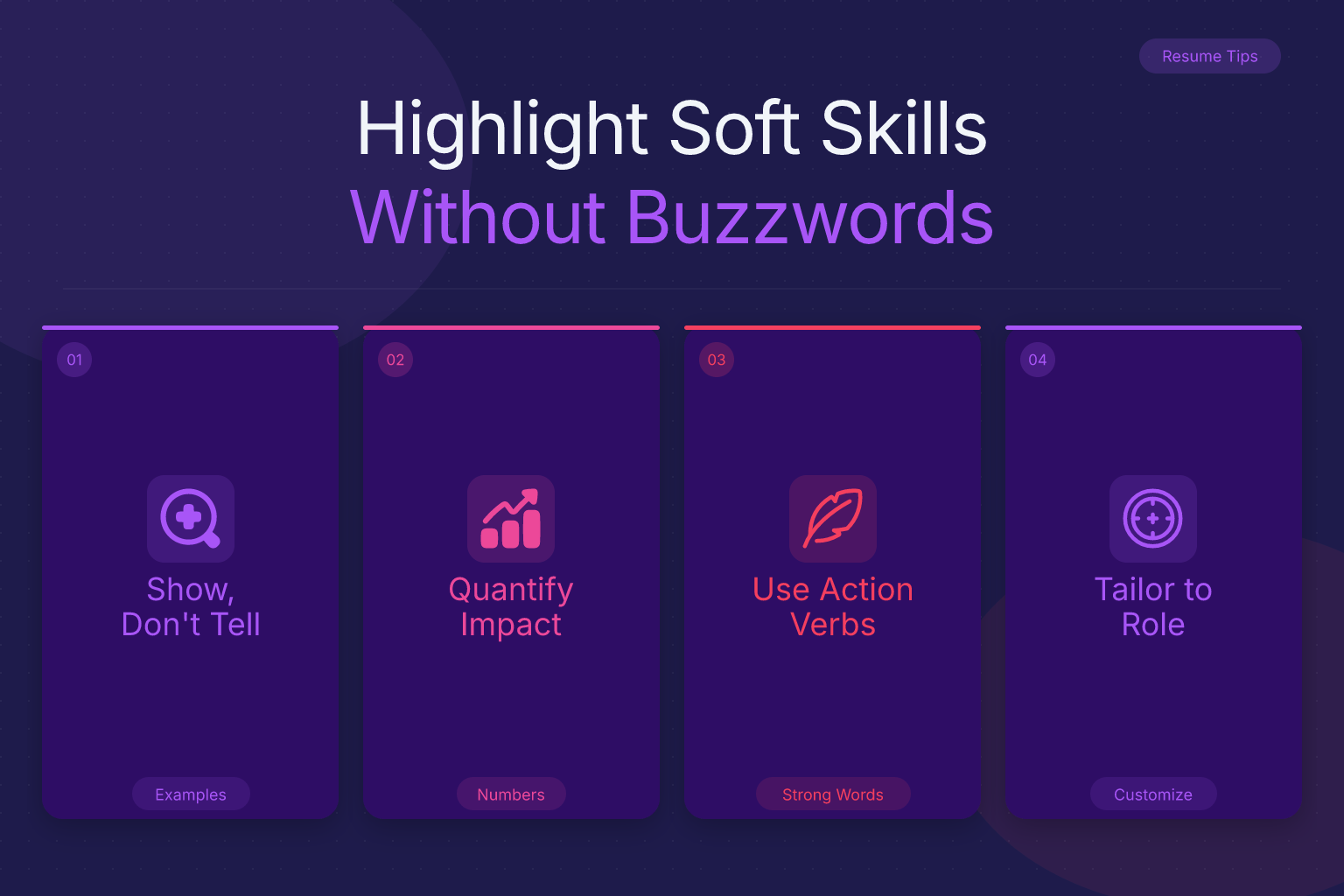
| Quantify the result of a communication or leadership skill (e.g., “reduced onboarding time by 20% through clearer documentation”) | Proves impact and makes the skill tangible | 15 min |
| Tailor soft skills to the job description by using the employer’s exact phrasing | Passes ATS filters and shows you read the posting | 20 min |
| Use action verbs and concrete nouns instead of adjectives (e.g., “negotiated,” “facilitated,” “resolved”) | Avoids vague language and sounds more professional | 5 min |
How to Highlight Soft Skills on a Resume Without Buzzwords: Start with the Job Description
The first step to highlighting soft skills without buzzwords is to stop guessing which ones matter. Every job posting tells you exactly what the employer values — you just need to read it carefully. Look for phrases like “collaborate with cross-functional teams,” “manage multiple priorities,” “communicate with stakeholders,” or “adapt to changing requirements.” These are soft skills in disguise, and they’re the ones you should prioritize.
Here’s a simple process:
- List every soft skill mentioned in the job description. Write down the exact words the employer uses, such as “collaboration,” “problem-solving,” “attention to detail,” or “customer focus.”
- For each skill, think of one specific time you demonstrated it. Don’t settle for a general feeling — recall a project, a conflict, a deadline, or a customer interaction.
- Write a bullet point that describes what you did and the outcome. Use the employer’s language, but add your own proof. For example, if the job asks for “strong communication skills,” write “Presented monthly performance reports to a 10-person leadership team, reducing follow-up questions by 30%.”
This approach does double duty: it shows the recruiter you have the soft skill, and it helps your resume pass applicant tracking systems (ATS) that scan for keywords. If you’re unsure whether your resume is ATS-friendly, you can check your resume’s ATS score free with ResumeMate’s score checker.
If you’re applying for a role in a specific field, tailoring becomes even more important. For example, an accounting resume needs to balance soft skills like attention to detail and communication with hard skills like GAAP knowledge. See our accountant resume examples with CPA and GAAP skills to learn how to weave both types of skills together effectively.
How to List Soft Skills on a Resume: A Step-by-Step Guide
Many job seekers ask “how to list soft skills on a resume” and end up with a generic bullet list that does nothing. The key is to integrate soft skills into your experience rather than isolating them. Follow these steps:
- Identify the top 3–5 soft skills the job requires. Use the job description as your guide. Don’t try to include every soft skill you possess — focus on the ones that matter most for this specific role.
- For each soft skill, find a concrete example from your past. Think of a time you used that skill to achieve a result. The example can come from work, school, volunteering, or even a personal project.
- Write a bullet point using the formula: action verb + specific task + measurable result. For example, instead of “good at teamwork,” write “Collaborated with a 5-person marketing team to launch a social media campaign that increased engagement by 40%.”
- Place the bullet in the most relevant section. If the skill is central to the role, put it in your professional summary or as the first bullet under the relevant job. If it’s secondary, include it in a skills section with a brief qualifier.
- Review for buzzwords. Read each bullet and ask: “Could a stranger verify this?” If the answer is no, rewrite it with more specific details.
This method ensures your soft skills are always backed by evidence, never just claimed.
Replace Adjectives with Evidence: The Core Technique
The biggest mistake job seekers make is using adjectives to describe soft skills. “Strong communication skills,” “proven leadership ability,” and “excellent teamwork” are all claims without evidence. A recruiter has no reason to believe them because every other candidate says the same thing.
The fix is simple: replace the adjective with a verb and a noun. Instead of saying you’re a “good communicator,” describe a time you communicated something and what happened as a result. Here are before-and-after examples for the most common soft skills:
| Buzzword | Proof-Based Alternative |
|---|---|
| “Team player” | “Collaborated with a 6-person engineering team to ship a feature 2 weeks ahead of schedule” |
| “Excellent communicator” | “Wrote and delivered a 20-minute training session for 30 new hires, reducing onboarding questions by 40%” |
| “Strong leader” | “Led a 4-person project team through a company-wide software migration with zero downtime” |
| “Problem solver” | “Diagnosed and fixed a recurring billing error that was costing the company $5,000 per month” |
| “Adaptable” | “Pivoted from in-person to virtual client meetings within one week, maintaining a 95% client satisfaction score” |
Notice that each alternative includes a specific action, a context, and a measurable or observable result. That’s what turns a soft skill into proof. If you’re struggling to find examples from paid work, remember that volunteer experience, school projects, and freelance gigs all count. For more on using non-traditional experience, see our guide on how to list volunteer work on a resume with no experience.
Use the STAR Method to Turn Soft Skills into Achievements
The STAR method is a structured way to describe any experience, and it’s especially powerful for soft skills because it forces you to include context and outcome. STAR stands for:
- Situation: What was the context or challenge?
- Task: What were you responsible for?
- Action: What specific steps did you take?
- Result: What happened as a result of your actions?
Here’s an example for the soft skill “conflict resolution”:
- Situation: Two team members disagreed on the design direction for a client project, and the deadline was two weeks away.
- Task: As the project lead, you needed to resolve the conflict without delaying the deliverable.
- Action: You scheduled a 30-minute meeting, listened to both perspectives, and proposed a compromise that incorporated elements from each design.
- Result: The team agreed on a final design within 24 hours, and the project shipped on time with positive client feedback.
Now turn that into a resume bullet:
“Resolved a design conflict between two team members by facilitating a structured discussion, resulting in an on-time project delivery and a satisfied client.”
That bullet demonstrates conflict resolution, leadership, and communication — without using any of those words. The STAR method works for any soft skill. For adaptability, describe a time you had to change course quickly. For time management, describe how you prioritized tasks under a tight deadline. The key is to always include the result, even if it’s qualitative (e.g., “received positive feedback from my manager” or “improved team morale”).
Where to Place Soft Skills on Your Resume
Soft skills shouldn’t live in a single isolated section. Instead, weave them throughout your resume in three places:
1. Professional Summary
Your summary is the first thing a recruiter reads, so use it to showcase one or two soft skills with proof. Instead of writing “Motivated professional with strong communication and leadership skills,” write:
“Customer success manager with 5 years of experience reducing churn by 15% through proactive communication and relationship building. Led a team of 4 support specialists and implemented a new onboarding process that cut time-to-first-value by 30%.”
This summary demonstrates communication, leadership, and problem-solving — all with concrete outcomes.
2. Experience Bullets
This is where most of your soft skills should appear. Every bullet in your work history should follow the formula: action verb + specific task + result. For example:
- “Facilitated weekly stand-up meetings for a 10-person team, improving cross-departmental alignment and reducing duplicate work by 25%.”
- “Mentored 3 junior developers through code reviews and pair programming, leading to two promotions within a year.”
These bullets show mentorship, collaboration, and communication without ever using those words.
3. Skills Section
A bare list of soft skills like “Communication, Teamwork, Leadership” is almost worthless because it provides no context. If you include a skills section, group soft skills with a brief qualifier or link them to an example. For instance:
- Communication: Presented to executive stakeholders; wrote technical documentation for non-technical audiences.
- Leadership: Managed a 5-person volunteer team; led a cross-functional project that saved $10,000 annually.
Alternatively, you can skip a separate soft skills section entirely and let your experience bullets do the talking. If you’re using ResumeMate’s free AI resume builder, you can choose a clean, single-column template that makes your experience bullets the star of the show.
Soft Skills Examples by Category (with Buzzword-Free Phrasing)
Here are concrete ways to phrase common soft skills without falling back on clichés. Use these as templates and adapt them to your own experience.
Communication
- “Wrote a 15-page user manual that reduced customer support tickets by 20%.”
- “Translated complex technical concepts into plain language for a non-technical sales team, improving cross-team collaboration.”
- “Presented quarterly business reviews to C-level executives, securing buy-in for a $200K budget increase.”
- “Drafted and sent a weekly internal newsletter to 500+ employees, increasing open rates from 20% to 45%.”
Teamwork
- “Partnered with marketing and design teams to launch a campaign that generated 500 new leads in one month.”
- “Stepped in to cover a colleague’s accounts during a medical leave, maintaining a 100% client retention rate.”
- “Co-led a cross-functional task force of 8 people to streamline the customer onboarding process, cutting time-to-first-value by 25%.”
Leadership
- “Organized a 10-person volunteer event that raised $5,000 for a local charity.”
- “Chaired a committee that redesigned the employee onboarding process, cutting ramp-up time from 6 weeks to 4.”
- “Mentored 5 new hires through their first quarter, resulting in a 100% retention rate for the cohort.”
Problem-Solving
- “Identified a bottleneck in the order fulfillment process and implemented a new workflow that reduced shipping errors by 35%.”
- “Created a troubleshooting guide for common software issues, reducing IT tickets by 25%.”
- “Analyzed customer churn data and proposed a retention strategy that reduced monthly churn by 10%.”
Adaptability
- “Learned a new project management tool in one week and trained 8 colleagues, ensuring a smooth transition during a company-wide software change.”
- “Shifted from in-person to remote client meetings during the pandemic, maintaining a 90% client satisfaction score.”
- “Took over a project mid-stream after a team member left, reorganized the timeline, and delivered the final product on schedule.”
Time Management
- “Managed 15 concurrent projects with competing deadlines, delivering all on time by using a priority matrix and weekly check-ins.”
- “Reduced meeting time by 30% by creating a shared agenda template and enforcing time limits.”
- “Prioritized a backlog of 50+ support tickets during a product launch, resolving critical issues within 24 hours.”
Attention to Detail
- “Caught a pricing error in a client contract that would have cost the company $12,000.”
- “Reviewed 200+ lines of code per week, identifying and fixing 3 critical bugs before release.”
- “Proofread all external communications for a 10-person team, reducing typos and errors to zero over six months.”
Customer Service
- “Resolved an average of 40 customer inquiries per day with a 98% satisfaction rating.”
- “De-escalated an angry customer by listening and offering a tailored solution, turning a potential cancellation into a renewed annual contract.”
- “Implemented a new feedback survey that increased response rates by 50% and led to three product improvements.”
These examples all follow the same pattern: a specific action, a context, and a result. If you’re applying for a remote role, check out our guide on remote work skills to put on a resume for more tailored examples.
Communication Skills Examples for Resume (Buzzword-Free)
Because “communication skills” is one of the most searched phrases related to soft skills, let’s dive deeper. Communication isn’t just about talking — it includes writing, presenting, listening, negotiating, and translating complex ideas. Here are specific communication skills and how to phrase them on a resume:
| Communication Skill | Buzzword-Free Resume Bullet |
|---|---|
| Written communication | “Authored a 30-page technical specification that reduced development rework by 20%.” |
| Verbal communication | “Delivered a 15-minute pitch to investors that secured $500K in seed funding.” |
| Presentation skills | “Created and presented monthly KPI dashboards to a 12-person leadership team, improving decision-making speed.” |
| Active listening | “Conducted 50+ customer discovery interviews, synthesizing feedback into 5 product improvements.” |
| Negotiation | “Negotiated vendor contracts that saved the company $30K annually without sacrificing service quality.” |
| Cross-cultural communication | “Facilitated collaboration between US and offshore teams across 3 time zones, reducing project delays by 15%.” |
| Public speaking | “Spoke at 2 industry conferences, generating 100+ qualified leads for the sales team.” |
| Technical communication | “Translated complex API documentation into user-friendly guides, reducing support tickets by 30%.” |
When writing your own communication bullets, always ask: What did I communicate, to whom, and what was the outcome? That structure turns a vague claim into proof.
Common Mistakes That Make Soft Skills Sound Like Buzzwords
Even well-intentioned job seekers fall into these traps. Avoid them to keep your resume credible.
Using adjectives without nouns. “Hardworking,” “motivated,” and “dedicated” are meaningless on their own. Always pair them with a specific action: “hardworking” becomes “worked 60-hour weeks during a product launch to meet a critical deadline.”
Listing soft skills in a separate section with no context. A section titled “Soft Skills” that just says “Communication, Teamwork, Leadership” tells the recruiter nothing. Either remove it or add a brief example for each skill.
Relying on clichés. Words like “go-getter,” “self-starter,” “results-driven,” and “synergy” are so overused that they’ve lost all meaning. Replace them with verbs: “initiated,” “led,” “improved,” “negotiated.”
Not tailoring to the job. If the job description emphasizes “attention to detail” and you write about “leadership,” you’re missing the mark. Always match your soft skills to what the employer actually wants.
Overusing the same words. If every bullet starts with “managed” or “led,” your resume becomes monotonous. Vary your action verbs and show different facets of your soft skills.
Forgetting the result. A soft skill without an outcome is just a claim. Always ask yourself: “What happened because I did this?” If you can’t answer, you need a stronger example.
How to Check If Your Soft Skills Come Through as Proof
After rewriting your resume, you need to verify that your soft skills actually read as evidence rather than buzzwords. Here are three ways to check:
Read each bullet and ask: “Can a stranger verify this?” If a bullet says “excellent communicator,” a stranger can’t verify it. If it says “presented to a 20-person executive team and received approval on the first draft,” they can. Rewrite any bullet that fails this test.
Use a resume score checker. ResumeMate’s free resume score checker analyzes your resume for ATS-readiness and gives section-by-section feedback, including whether your experience bullets demonstrate skills with concrete examples or just list adjectives. It’s a quick way to catch buzzwords you might have missed.
Ask someone else to identify your soft skills. Give your resume to a friend or mentor and ask them to list the top three soft skills they think you’re trying to convey. If they can’t name them, or if they name different ones than you intended, your proof isn’t clear enough.
Remember that highlighting soft skills without buzzwords is a skill in itself. It takes practice, but once you get the hang of turning claims into evidence, your resume will stand out for all the right reasons. And if you’re also working on showing career progression, see our guide on how to show career growth on a resume without promotions for related strategies.
FAQ
Q: What are soft skills vs hard skills?
A: Hard skills are teachable, measurable abilities like coding, data analysis, or foreign language proficiency. Soft skills are interpersonal and behavioral traits like communication, teamwork, and adaptability. On a resume, hard skills are often listed in a skills section, while soft skills should be demonstrated through examples in your experience bullets.
Q: Can I list soft skills in a separate section on my resume?
A: You can, but it’s rarely effective. A bare list of soft skills provides no evidence and takes up space. If you include a skills section, group soft skills with a brief example or qualifier, such as “Communication: presented to executive stakeholders” instead of just “Communication.” Better yet, weave soft skills into your experience bullets where they have context.
Q: How do I show soft skills if I have no work experience?
A: Use non-work experiences like volunteer work, school projects, internships, or extracurricular activities. For example, “Organized a 20-person fundraising event for a student club, raising $3,000” demonstrates leadership and teamwork. Our guide on how to list volunteer work on a resume with no experience has more examples. If you’re targeting an entry-level accounting role, see our accounting resume examples for landing your first internship for field-specific soft skill phrasing.
Q: What are the most overused soft skill buzzwords?
A: The most overused include “team player,” “hard worker,” “go-getter,” “self-starter,” “results-driven,” “detail-oriented,” “excellent communicator,” and “people person.” These phrases appear on so many resumes that they no longer differentiate candidates. Replace them with specific actions and outcomes.
Q: How many soft skills should I include on a resume?
A: Focus on 3-5 soft skills that are most relevant to the job you’re applying for. Trying to include every soft skill dilutes your message. Read the job description, identify the top soft skills the employer wants, and provide one strong example for each.
Q: Do ATS systems scan for soft skills?
A: Yes, many ATS systems scan for keywords, including soft skills mentioned in the job description. However, simply listing “communication” won’t help if the ATS is looking for context. Use the exact phrasing from the job posting and attach a concrete example to each soft skill to improve both ATS compatibility and human readability.
Q: What are some communication skills examples for a resume?
A: Communication skills include written communication (e.g., “authored a technical manual that reduced support tickets by 20%”), verbal communication (e.g., “delivered a pitch that secured $500K in funding”), presentation skills, active listening, negotiation, and cross-cultural communication. Always pair the skill with a specific action and result. See the “Communication Skills Examples for Resume” section above for a full table.
Q: How do I list soft skills on a resume without sounding generic?
A: Avoid adjectives and use action verbs with measurable outcomes. Instead of “strong communication skills,” write “Presented monthly reports to a 10-person leadership team, reducing follow-up questions by 30%.” Tailor each bullet to the job description and always include a result. If you’re unsure, run your resume through a free ATS score checker to see if your bullets read as proof or buzzwords.
Q: Where should I put soft skills on my resume?
A: Soft skills should appear in three places: your professional summary (1–2 skills with proof), your experience bullets (the majority of your soft skills, each with a concrete example), and optionally a skills section with brief qualifiers. Avoid a standalone “Soft Skills” section that just lists words without context.
Related articles:
Track Every Application While You Job Hunt
Stop losing track of where you’ve applied. The ResumeMate Job Tracker is a free Chrome extension that tracks every application, deadline, and follow-up in one place — right from your browser.