How to List an Incomplete Degree on a Resume (2026 Guide with Examples)
If you’re wondering how to list an incomplete degree on a resume, you’re not alone. Millions of job seekers have started a degree program without finishing it — and many worry that an unfinished credential will hurt their chances. The truth is, an incomplete degree doesn’t have to be a liability. When you format it honestly and strategically, it can still show employers that you have relevant knowledge, discipline, and momentum.
This guide walks you through exactly how to present an incomplete or in-progress degree, with examples you can copy, placement tips, and ATS-friendly formatting advice.
Key Takeaways
- You should list an incomplete degree if it’s relevant to the job, especially if you’re still enrolled or completed substantial coursework.
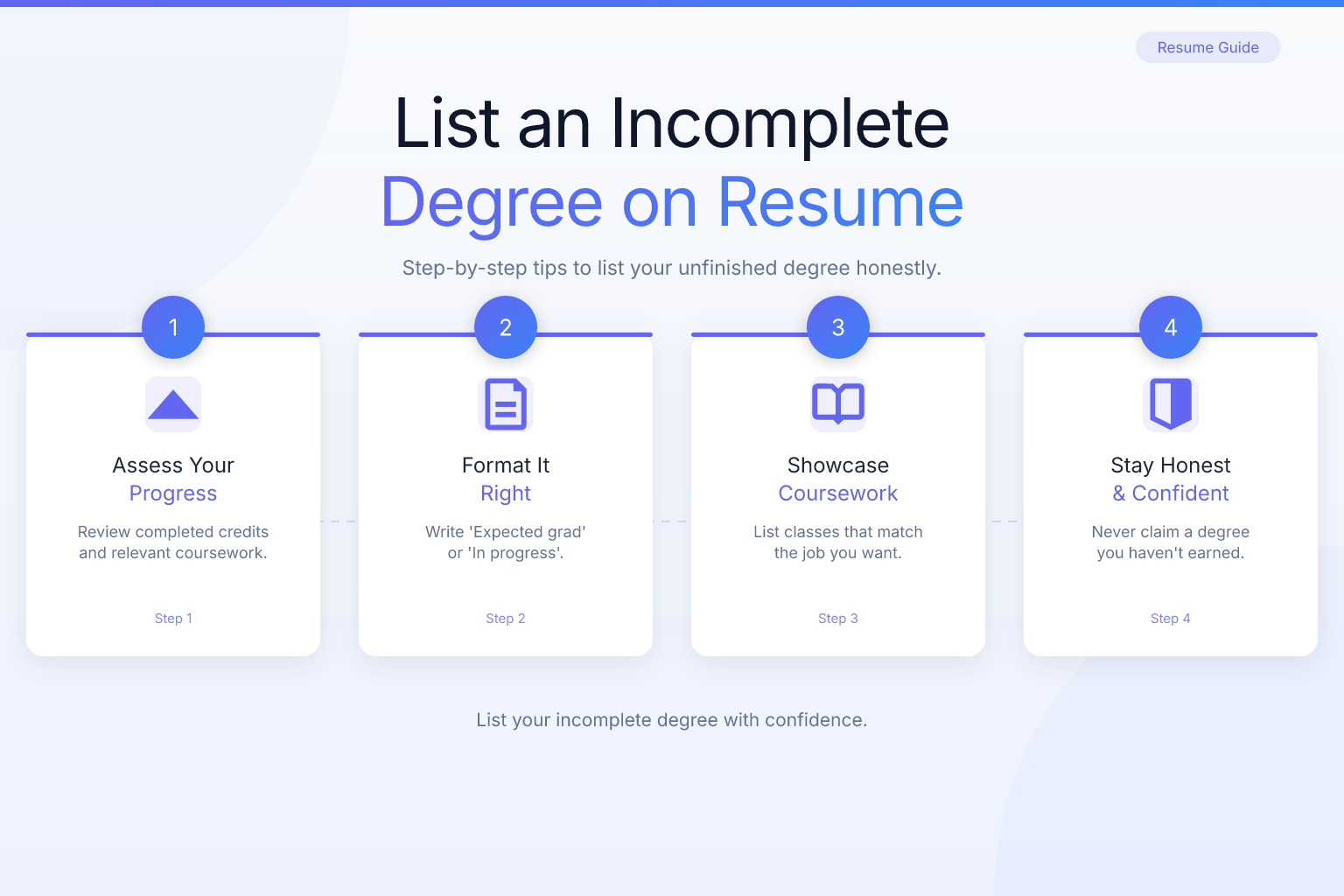
- Use clear wording like “In Progress,” “Expected [date],” or “Completed X credits toward [degree]” — never imply you earned the degree.
- Place the education section after experience if you have work history, or near the top if you’re a current student or recent graduate.
- Pair an incomplete degree with relevant coursework, certifications, or online courses to show current skills.
- Keep the format single-column and ATS-friendly so applicant tracking systems parse your education correctly.
| What to Do | Why It Matters | Time |
|---|---|---|
| List the degree as “In Progress” with an expected completion date | Shows you’re actively working toward a credential | 5 min |
| Include relevant coursework if you haven’t finished | Demonstrates job-relevant knowledge now | 10 min |
| Never write “Bachelor’s Degree” if you haven’t earned it | Avoids misrepresentation and background-check issues | 2 min |
| Add certifications or online courses to fill the gap | Strengthens your education section | 15 min |
| Use a single-column, text-based PDF format | Ensures ATS can parse your education section | 5 min |
Should You List an Incomplete Degree on Your Resume?
In most cases, yes — you should list an incomplete degree if it’s relevant to the job you’re targeting. Here’s when it makes sense to include it:
- You’re still enrolled. If you’re actively working toward the degree, listing it with an expected completion date shows employers you’re building skills right now.
- You completed substantial coursework. Even if you stopped out, 60 or 90 credits toward a degree represent real learning. That’s worth showing.
- The degree is directly related to the role. An unfinished computer science degree is highly relevant for a junior developer or IT support job.
- You plan to finish. If returning to school is on your roadmap, an “In Progress” or “On Hold” entry signals forward momentum.
There are also times when you can leave it off:
- You took only a few unrelated classes years ago and they don’t add value.
- The incomplete degree distracts from stronger, more recent qualifications.
- You’re applying for a role where education is not a factor and you have extensive experience.
Honesty matters here. Background checks can verify enrollment and degrees, and most hiring managers would rather see a transparent entry than a suspicious gap. An incomplete degree, framed well, is almost always better than pretending the education never happened.
How to List an Incomplete Degree on a Resume: 3 Formats
There are three common scenarios, and each has a slightly different format.
1. In-Progress Degree (Currently Enrolled)
If you’re still taking classes, list the degree name, school, and an expected completion date. Use “In Progress” or “Expected” so there’s no ambiguity.
Example:
Bachelor of Science in Computer Science
State University | In Progress, Expected May 2027
You can also write “Candidate for Bachelor of Arts in Psychology, Expected Graduation: December 2026.” The key is to include a future date so the reader knows you haven’t finished yet.
2. Completed Coursework but No Degree (Stopped Out)
If you left the program and don’t plan to return, focus on the credits and coursework you completed. Avoid a future date.
Example:
Completed 90 credits toward a Bachelor of Business Administration
University of Texas | 2021–2023
Relevant coursework: Accounting, Business Law, Marketing
This format shows substance without implying you earned the degree.
3. Degree Started but Not Finished, No Clear Return
If you started a program, transferred, or paused indefinitely, you can list the program and dates with a brief note.
Example:
Pursued Bachelor of Science in Biology
City College | 2019–2021 (transferred)
Coursework: Genetics, Organic Chemistry, Statistics
Or, if you only completed a handful of classes:
Coursework toward an Associate of Applied Science in IT
Community College | 2019–2020
Completed 30 credits including Networking Fundamentals and Intro to Programming
In-Progress Degree vs. Abandoned Degree: What’s the Difference?
This distinction changes how you write the entry.
- In-progress degree means you are actively enrolled and working toward completion. You should include an expected graduation date. This signals to employers that you’re currently building skills and will soon have the credential.
- Abandoned degree means you are no longer enrolled and have no immediate plan to finish. You should not include a future date. Instead, list the credits or relevant coursework you completed and let the skills speak for themselves.
If you plan to return to school but aren’t currently enrolled, you can write “On Hold” or “Planned completion 2027,” but only if that’s genuinely your plan. Don’t invent a timeline to make the entry look better — it can backfire in an interview or background check.
Examples of Incomplete Degree Resume Entries
Here are several ready-to-use examples for different situations.
Current student with limited work experience:
Bachelor of Science in Marketing
State University | Expected May 2027
Relevant coursework: Consumer Behavior, Digital Marketing, Data Analysis
Stopped out with significant credits:
Completed 75 credits toward a Bachelor of Arts in English
City College | 2021–2023
Coursework: Technical Writing, Editing, Rhetoric
Incomplete master’s degree:
Master of Business Administration (In Progress)
Online University | Expected December 2026
Concentration: Finance
Some college, no degree:
Coursework toward an Associate of Applied Science in IT
Community College | 2019–2020
Completed 30 credits including Networking Fundamentals, Intro to Programming
Incomplete degree with a completed certification:
Completed 60 credits toward a Bachelor of Science in Nursing
State University | 2020–2022
Certified Nursing Assistant (CNA), 2023
Notice that none of these examples say “Bachelor’s Degree” without a qualifier. That’s the most important rule: never claim a credential you haven’t earned.
Where to Place an Incomplete Degree on Your Resume
Placement depends on your experience level.
- Current students or recent graduates with little work history: Put education near the top, right after your summary. Your incomplete degree is likely your strongest qualification, so it should be visible immediately.
- Professionals with relevant work experience: Place education below your experience section. Your work history carries more weight, and the incomplete degree becomes supporting evidence rather than the headline.
- If you have a completed degree and an incomplete higher degree: List the completed degree first, then the incomplete one. For example, a completed bachelor’s degree goes above an in-progress master’s.
Use reverse chronological order within the education section — most recent or most relevant first.
Common Mistakes to Avoid
- Writing “Bachelor’s Degree” without a qualifier. This is misrepresentation. Always add “In Progress,” “Expected,” or “Completed X credits toward.”
- Using “Some College” as a standalone line. It’s vague and undersells what you actually learned. Be specific about credits and coursework.
- Listing an expected graduation date that has already passed. If your timeline changed, update the date or remove it. An outdated date looks careless.
- Including irrelevant coursework that clutters the section. Choose 3–5 courses that directly relate to the job.
- Hiding the incomplete degree entirely when it’s relevant. A gap in education can raise more questions than an honest entry.
- Using tables, graphics, or multi-column layouts for the education section. These can confuse applicant tracking systems. Before you submit, run your resume through a free ATS score checker to see how your education section parses.
How to Strengthen Your Education Section Without a Completed Degree
An incomplete degree doesn’t have to stand alone. Pair it with other credentials to show you’re still learning and growing.
- Add certifications. A completed certification in your field can carry as much weight as a degree for some roles. List it directly under your incomplete degree.
- Include online courses and MOOCs. If you’ve taken relevant courses on platforms like Coursera, edX, or LinkedIn Learning, list them. For formatting guidance, see how to list online courses and MOOCs on a resume.
- Highlight projects or volunteer work. Real-world projects demonstrate applied skills. If you’re light on experience, listing volunteer work can fill the gap.
- Explain the gap if needed. If your incomplete degree left a noticeable time gap, address it briefly in your summary or cover letter. For more on this, read how to explain education gaps on a resume.
Using a clean, single-column template makes all of this easier. The free ResumeMate resume builder formats your education section correctly and exports a text-based PDF that modern ATS can read.
ATS Tips for Listing Incomplete Education
Applicant tracking systems parse your resume to extract education, skills, and experience. Here’s how to make sure your incomplete degree doesn’t get lost or misread.
- Use a standard section heading. Label the section “Education” — not “Academic Background” or “My Studies.” ATS look for the standard term.
- Avoid tables, text boxes, and graphics. These can break parsing. Stick to simple lines of text.
- Use a single-column layout. While many modern ATS can handle two-column resumes, single-column is the safest choice and ensures nothing gets jumbled.
- Export as a text-based PDF. Modern ATS like Workday, Greenhouse, and Lever parse clean, text-based PDFs reliably. Problems come from scanned or image-based PDFs, not from the PDF format itself. If a specific portal explicitly requests a DOCX, use that — but otherwise, a clean PDF is fine.
- Keep dates consistent. Use the same date format throughout (e.g., “May 2027” or “05/2027”) so the ATS can read them correctly.
FAQ
Q: Should I list an incomplete degree on my resume?
A: Yes, if it’s relevant to the job and you either are still enrolled or completed substantial coursework. It shows progress and skills. Omit it only if it’s unrelated and from long ago with little value.
Q: How do I list an in-progress degree on a resume?
A: Write the degree name, school, and “In Progress” or “Expected [Month Year].” Example: “Bachelor of Science in Nursing — In Progress, Expected May 2027.” Include relevant coursework if you have limited work experience.
Q: How do I list unfinished college on a resume?
A: Use “Completed X credits toward [degree]” or “Coursework in [field]” with the school and dates. Avoid implying you earned the degree. Example: “Completed 60 credits toward a BA in History, State University, 2020–2022.”
Q: Should I include an incomplete degree if I dropped out years ago?
A: Only if the coursework is relevant to the job or you plan to finish. If it’s unrelated and you have stronger qualifications, you can leave it off. If you include it, focus on skills and credits, not the fact that you left.
Q: How do I list an incomplete master’s degree?
A: Similar to a bachelor’s: “Master of Business Administration (In Progress), Expected December 2026” or “Completed 18 credits toward an MS in Data Science.” If you’re no longer pursuing it, list relevant graduate coursework without a future date.
Q: Can I write “some college” on a resume?
A: It’s better to be specific. “Completed 45 credits toward a Bachelor of Arts in Communications” is stronger than “Some college.” Specific credits and coursework show what you actually learned.
Q: How do I explain an incomplete degree in an interview?
A: Be honest and brief. Explain why you paused (financial, family, career change) and what you gained. Emphasize skills and your plan, if any, to finish. Never lie about having a degree.
Related articles:
- List Self-Taught Coding Skills on a Resume Without a Degree
- How to List an Unpaid Internship on a Resume (Examples)
Track Every Application While You Job Hunt
Stop losing track of where you’ve applied. The ResumeMate Job Tracker is a free Chrome extension that tracks every application, deadline, and follow-up in one place — right from your browser.