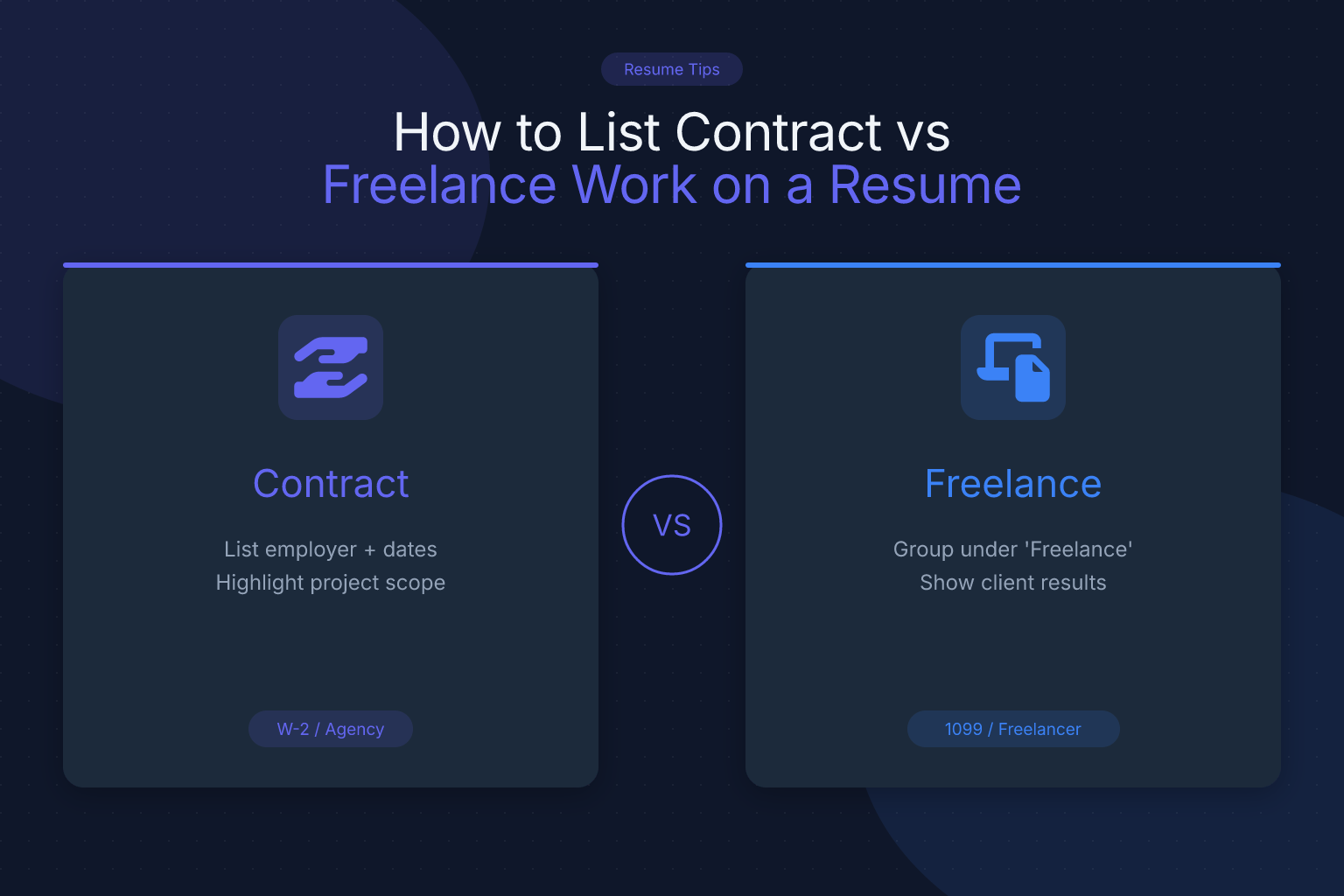
How to List Contract vs Freelance Work on a Resume
If you’ve ever wondered how to list contract work on resume vs freelance without confusing recruiters or selling yourself short, you’re not alone. Many professionals have a mix of W-2 contract roles, 1099 freelance projects, and permanent positions, and presenting them clearly can feel like a puzzle. The good news: with the right structure and language, you can turn this varied experience into a compelling story that hiring managers understand instantly.
Key Takeaways
- Label short-term W-2 contract roles with ‘(Contract)’ in the job title and list the staffing agency as the employer to prevent recruiters from misinterpreting them as job-hopping.
- Group all freelance projects under a single self-employment heading (e.g., ‘Freelance Graphic Designer’) with a continuous date range, then highlight 3–5 relevant projects as bullet points.
- Write achievement-focused bullets for both contract and freelance roles, quantifying results (e.g., ‘Increased conversion rate by 22%’) to show impact despite short tenures.
- Avoid vague labels like ‘Self-Employed’; use specific titles such as ‘Independent Marketing Consultant’ to signal professionalism and skills.
- Use a clean, single-column resume layout and incorporate keywords from the job description to ensure both ATS and human recruiters can parse your experience quickly.
Contract vs Freelance: Key Differences and When to Use Each Label
Before you decide how to list contract work on resume vs freelance, you need to understand the fundamental distinction. The terms are often used interchangeably, but they signal different employment relationships to recruiters and applicant tracking systems (ATS).
Contract work usually means you were a W-2 employee of a staffing agency or consulting firm, placed at a client site for a fixed period. You received a regular paycheck, had taxes withheld, and may have had benefits through the agency. The client company directed your day-to-day work, but your legal employer was the agency. Examples include a 6-month IT contract through Robert Half, a 12-month marketing role via Aquent, or a 3-month accounting assignment through Accountemps.
Freelance work means you operated as an independent business. You found your own clients, set your own rates, invoiced for your services, and handled your own taxes (typically as a sole proprietor or LLC). You likely worked on specific projects with defined deliverables rather than filling an ongoing staff role. Freelance designers, writers, developers, and consultants fall into this category.
Why does this distinction matter on a resume? Recruiters scan for patterns. A string of short-term roles without context can look like job-hopping. A block of freelance work without structure can look like a gap. By labeling each experience correctly, you control the narrative and show intentional career choices. For a deeper dive into formatting freelance work specifically, check out our guide on how to format freelance work on a resume with examples.
When to Label Work as “Contract”
Use the “Contract” label when you were a W-2 employee of a staffing agency or consulting firm, working on a temporary assignment at a client site. This label immediately tells a recruiter that the short duration was by design, not a red flag.
How to format a contract role:
- List the staffing agency as the employer, not the client company. For example: “Robert Half (contracted to XYZ Corp)” or “Aquent (on-site at Google).”
- Add “(Contract)” after your job title. Example: “Senior Financial Analyst (Contract).”
- Include the dates of the assignment. If you had multiple contracts through the same agency, you can group them under one agency heading with sub-entries for each client.
- In bullet points, mention the client context if it adds credibility: “Managed a $2M budget for a Fortune 500 retail client during a system migration.”
Example:
Robert Half — San Francisco, CA Senior Financial Analyst (Contract) | Jan 2025 – Jun 2025
- Built financial models for a SaaS client’s Series B fundraising, directly contributing to a $15M raise.
- Automated monthly reporting, cutting close time by 3 days for a team of 12.
This approach makes it clear you weren’t fired after six months — the role was always temporary. It also shows you can adapt quickly to new environments, a trait many employers value.
When to Label Work as “Freelance”
Freelance work belongs under a self-employment heading when you operated as an independent contractor, found your own clients, and managed your own business. This is common for creatives, consultants, developers, and writers.
How to format freelance experience:
- Create a single “Freelance Consultant” or “Independent Contractor” entry that spans the entire period you were self-employed, even if you had gaps between projects.
- Under that heading, list 3–5 of your most relevant projects or clients as bullet points or sub-entries. Focus on those that align with the job you’re targeting.
- Use a title like “Freelance Graphic Designer” or “Independent Marketing Consultant” rather than a vague “Self-Employed.”
- If you worked with well-known clients, name them (with permission). If not, describe the industry or project type: “Designed brand identity for a DTC e-commerce startup.”
Example:
Freelance Web Developer — Remote Jan 2024 – Present
- Built a custom Shopify store for a health & wellness brand, increasing conversion rate by 22%.
- Developed a React-based dashboard for a logistics startup, reducing manual data entry by 15 hours/week.
- Migrated a legacy WordPress site to a headless CMS for a nonprofit, improving page load speed by 40%.
If you need to keep client names confidential, we have a dedicated post on listing freelance projects on a resume without client names.
How to Format Contract Work on a Resume (Step by Step)
Now that you know when to use each label, let’s walk through the exact formatting for contract roles. The goal is to make your resume ATS-friendly while clearly communicating the temporary nature of the work.
- Choose the right employer name. Always list the staffing agency or consulting firm that issued your W-2. If you worked directly for the client on a fixed-term W-2 (rare but possible), list the client and add “(Contract)” to the title.
- Add “(Contract)” to your job title. This small addition prevents the “job hopper” assumption. Example: “Project Manager (Contract).”
- Include dates as you would for any job. Use month/year format. If you had back-to-back contracts with the same agency, you can combine them under one entry with a total date range and list each client as a sub-bullet.
- Write achievement-focused bullets. Even short contracts should show results. Instead of “Responsible for social media,” write “Grew Instagram following by 8,000 in 3 months through a targeted content strategy.”
- Consider a “Contract Experience” section. If you have more than three contract roles, you might create a separate section titled “Contract Experience” to group them, followed by a “Permanent Experience” section. This works well for career changers or people returning to permanent work.
For more on tailoring your resume to different employment types, see our guide on contract vs permanent resume: how to tailor your CV.
How to Format Freelance Work on a Resume (Step by Step)
Freelance experience requires a slightly different structure because you’re the business owner, not an employee. Here’s how to present it powerfully:
- Create a business entity heading. Use “Freelance [Your Title]” or “[Your Name] Consulting.” This looks more professional than “Self-Employed” and signals you took your freelance work seriously.
- Set a date range that covers your entire freelance period. Even if you had months with no projects, the continuous date range shows you were actively running a business, not unemployed.
- Select 3–5 projects that match the job you want. You don’t need to list every client. Curate the list to demonstrate skills relevant to the target role. For each project, include a one-line description and a measurable result.
- Use bullet points that read like mini case studies. Structure: Client/Industry → Challenge → Action → Result. Example: “Redesigned checkout flow for a mid-market e-commerce site, reducing cart abandonment by 18% and recovering an estimated $120K in annual revenue.”
- Add a “Key Clients” line if impressive. If you worked with recognizable brands, you can add a line: “Clients included: Nike, Adobe, and three YC-backed startups.”
If you’re concerned about ATS parsing, run your resume through a free score checker. The ResumeMate resume score checker gives you section-by-section feedback on how well your resume will be read by systems like Workday and Greenhouse, including whether your freelance section is being parsed correctly.
Hybrid Approach: Listing Both Contract and Freelance Experience
Many professionals have a mix of contract W-2 roles and freelance 1099 projects. The key is to separate them clearly so a recruiter can see the distinction at a glance.
Option 1: Separate sections. Create a “Contract Experience” section and a “Freelance Experience” section. This works best when you have substantial experience in both categories and want to highlight each.
Option 2: Chronological with clear labels. Keep a single “Experience” section in reverse chronological order, but label each entry consistently: “(Contract)” for W-2 roles and “Freelance” or “Independent” in the title for self-employment. This is simpler and works well for most resumes.
Option 3: Group by function. If you’re targeting a specific role, you might create a “Relevant Experience” section that pulls the most applicable contract and freelance projects together, with a separate “Additional Experience” section for everything else. This is a more advanced strategy but can be effective for career changers.
Whichever approach you choose, consistency is critical. If you label one contract role “(Contract),” label all of them that way. If you use “Freelance Consultant” for one period, use the same phrasing for any other freelance periods.
Common Mistakes to Avoid
Even experienced professionals make these errors when listing contract and freelance work. Avoid them to keep your resume sharp.
- Omitting the contract label. Without “(Contract),” a 6-month role looks like you were fired or quit. Always add the label.
- Listing the client as the employer for W-2 contract work. This can cause issues during background checks when the employer name doesn’t match payroll records. List the agency.
- Using “Self-Employed” as a job title. It’s vague and does nothing to sell your skills. Use a specific title like “Freelance Content Strategist.”
- Listing every single freelance gig as a separate job. This creates a cluttered, job-hopper appearance. Group them under one freelance heading.
- Writing task-based bullets instead of results. “Created social media posts” is weak. “Developed a social media campaign that generated 2,500 leads in 6 weeks” shows impact.
- Ignoring ATS formatting. Multi-column layouts, tables, and graphics can confuse older ATS. Stick to a clean, single-column design. Most modern ATS parse PDFs fine, but if a specific portal requests a Word document, follow that instruction. For a guaranteed ATS-safe layout, use the free ResumeMate resume builder, which exports clean, text-based PDFs.
How to Tailor Your Resume for ATS and Recruiters
Your formatting choices matter, but so does how you describe your work. Recruiters spend an average of 6–7 seconds on an initial resume scan, according to a study by TheLadders. You need to make those seconds count.
Use keywords from the job description. If the posting asks for “stakeholder management,” and you did that as a contractor, use that exact phrase. ATS software scans for keyword matches, and human recruiters look for familiar terms.
Lead with relevance. If you’re applying for a permanent role but have mostly contract experience, place your most relevant permanent or contract role first, even if it’s not the most recent. You can use a “Relevant Experience” section to do this without breaking chronological order elsewhere.
Explain gaps proactively. If you have a gap between contracts or freelance projects, fill it with something: a brief note about skills development, a volunteer role, or even a line like “Independent study in machine learning.” This prevents the gap from looking like unemployment. For more on handling gaps, see our guide on how to list layoffs on your resume without stigma.
Test your resume with an ATS score checker. Before you submit, upload your resume to a tool like the ResumeMate score checker. It will flag formatting issues, missing keywords, and sections that might confuse parsing software. You’ll get a score and actionable feedback in under a minute.
FAQ
Q: Can I list contract work as freelance on my resume?
A: It’s not recommended. Contract work typically means you were a W-2 employee of an agency, while freelance means you were self-employed. Mislabeling can cause issues during background checks when employment verification doesn’t match. Instead, label the role as “(Contract)” and list the staffing agency as the employer.
Q: Should I include contract work dates on my resume?
A: Yes, always include dates for contract roles, just as you would for permanent positions. Use month/year format. If you had multiple short contracts with the same agency, you can group them under one date range to avoid a fragmented look.
Q: How do I explain gaps between contracts on my resume?
A: If the gap is a few months, you don’t necessarily need to explain it. For longer gaps, add a brief line about what you were doing: “Completed Google Data Analytics Certificate” or “Freelance consulting projects (see Freelance section).” This shows you were productive. Avoid leaving unexplained blank spaces.
Q: Is it better to group freelance work under one heading or list each project separately?
A: Grouping under one heading is almost always better. It presents your freelance period as a cohesive self-employment phase rather than a series of disconnected gigs. List individual projects as bullet points or sub-entries under that heading.
Q: What if my contract role was extended multiple times?
A: List the total duration you worked at the client, even if it was through multiple contract extensions. You can note the original contract length and extensions in the description if it adds context, but the date range should reflect the full period. Example: “Originally a 6-month contract, extended to 18 months due to project scope.”
Q: How do I handle a mix of contract, freelance, and permanent roles on one resume?
A: Use clear, consistent labels for each: “(Contract)” for W-2 contract roles, “Freelance” or “Independent” for self-employment, and no label for permanent roles. Keep everything in reverse chronological order, or create separate sections if the mix is extensive. The key is to make the employment type immediately obvious to the reader.
Q: Will ATS systems penalize me for having contract or freelance work?
A: No, ATS systems don’t penalize employment type. They parse dates, job titles, and keywords. The risk is in how you format the information. Avoid graphics, tables, and multi-column layouts that can confuse parsing. A clean, single-column PDF works well with modern ATS. If you’re unsure, use a resume builder that exports ATS-friendly PDFs.
Related articles:
Track Every Application While You Job Hunt
Stop losing track of where you’ve applied. The ResumeMate Job Tracker is a free Chrome extension that tracks every application, deadline, and follow-up in one place — right from your browser.