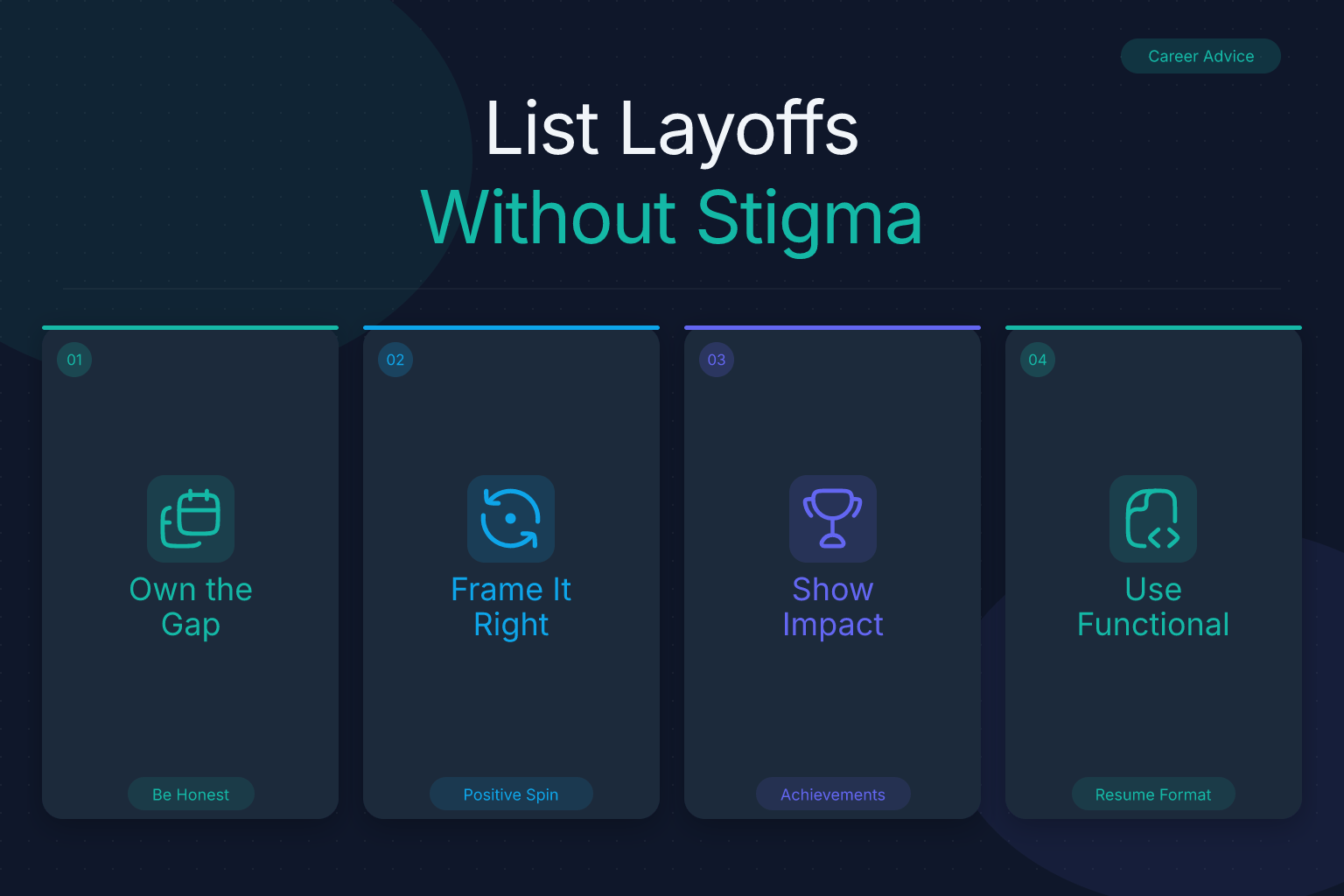
How to List Layoffs on Your Resume Without Stigma
If you’re wondering how to list layoffs on your resume without stigma, you’re not alone. Layoffs happen to talented, hardworking people every day — and in 2026, most recruiters understand that a layoff is rarely a reflection of your performance. The challenge is presenting that career interruption in a way that keeps the focus on your value, not the circumstances of your departure. This guide shows you exactly how to frame a layoff on your resume, cover letter, and LinkedIn profile so you can move forward with confidence.
Key Takeaways
- You do not need to write “laid off” on your resume; simply list the end date and let the interview provide context.
- Frame the layoff as a company-wide event (e.g., “department eliminated”) to remove personal stigma immediately.
- Fill any employment gap with contract work, volunteering, or upskilling — and list it on your resume to show continuous growth.
- Use a clean, single-column resume format to ensure ATS readability and keep the focus on your achievements.
- Practice a neutral, forward-looking explanation for the layoff so you sound confident in interviews.
Summary Table
| What to Do | Why It Matters | Time |
|---|---|---|
| List the job with standard dates and no mention of layoff | Recruiters scan for skills, not reasons for leaving | 5 minutes |
| Add a brief “Reason for Leaving” note only if the application requires it | Keeps the explanation factual and unemotional | 2 minutes |
| Fill gaps with freelance, volunteer, or learning experiences | Shows continuous engagement and closes resume gaps | 1–2 hours to update |
| Use a single-column, ATS-friendly resume template | Ensures your resume is parsed correctly by modern ATS | 10 minutes |
| Prepare a neutral layoff explanation for interviews | Removes awkwardness and keeps the conversation on your strengths | 30 minutes |
Why the Stigma Around Layoffs Is Fading
A decade ago, a layoff on your resume might have raised eyebrows. Today, hiring managers have seen mass layoffs across tech, finance, retail, and even healthcare. According to the U.S. Bureau of Labor Statistics, layoffs and discharges have been a regular feature of the labor market, with millions of workers affected annually during economic shifts. Recruiters know that layoffs are often about restructuring, budget cuts, or offshoring — not individual performance.
What matters now is how you frame the experience. If you treat a layoff as a shameful secret, it can undermine your confidence. If you present it as a business decision that gave you an opportunity to grow, you’ll sound resilient and self-aware. The key is to remove any hint of stigma from your resume itself, then handle the conversation with poise.
How to List a Layoff on Your Resume Without Drawing Attention
Your resume is a marketing document, not a legal record. You don’t need to explain why you left any job. Simply list the company, your job title, and the dates of employment — exactly as you would for any other role.
Example:
Senior Marketing Manager
XYZ Corp, New York, NY
March 2021 – November 2025
There’s no need to add “(laid off)” or “position eliminated.” If the end date is recent, a recruiter may ask about it during a phone screen. That’s the right time to give a brief, neutral explanation — not on the resume itself.
If you’re concerned about a short tenure, you can use years only (e.g., “2021–2025”) to soften the visual impact. This is a common formatting choice and doesn’t misrepresent your experience. Just be consistent across all entries.
How to Frame a Layoff in Your Bullet Points
Your resume’s bullet points should focus on achievements, not circumstances. A layoff doesn’t change what you accomplished in the role. Lead with results, metrics, and specific contributions.
Instead of:
- Remained in role until department was eliminated due to budget cuts.
Write:
- Led a cross-functional team of 8 to deliver a $2M product launch, exceeding revenue targets by 15%.
If you want to subtly acknowledge the end of the role without sounding defensive, you can use a bullet like:
- Managed team through company-wide restructuring, ensuring smooth transition of all projects.
This shows you handled the situation professionally without making the layoff the headline.
How to Handle Employment Gaps After a Layoff
A gap of a few months is common and rarely questioned. If your gap extends beyond six months, fill it with meaningful activity. Recruiters don’t expect you to sit idle — they want to see that you stayed engaged.
Options to fill the gap:
- Freelance or contract work: List it as “Independent Consultant” with 2–3 bullet points describing projects.
- Volunteering: Especially valuable if it’s skills-based (e.g., building a website for a nonprofit). You can list it in a “Volunteer Experience” section. For guidance, see our post on how to list volunteer work on a resume.
- Learning and certifications: Completed a Google Career Certificate, learned Python, or earned a PMP? Add a “Professional Development” section with dates.
- Freelance or consulting: Even one small project lets you list a current role and close the gap.
If you did none of these, you can still frame the gap honestly. In a cover letter or interview, say: “I used the time to carefully evaluate my next career move and upskill in [area].” For more strategies on addressing gaps, read our guide on how to explain employment gaps on a resume.
Resume Formats That Minimize Layoff Stigma
A clean, single-column resume format is the safest choice for ATS and human readers alike. Most modern ATS (Workday, Greenhouse, Lever) parse text-based PDFs without issue, but complex multi-column layouts, tables, and graphics can cause parsing errors. By using a straightforward, single-column design, you ensure your content is read correctly — and the reader’s eye flows naturally to your achievements, not your employment dates. For a deeper dive into formatting, check out our ATS resume formatting tips.
ResumeMate’s free AI resume builder offers ATS-optimized templates that keep the focus on your skills. You can also run your finished resume through the resume score checker to see exactly how an ATS interprets your employment history and whether any gaps or formatting issues might raise flags.
If you’re worried about a short tenure standing out, a hybrid resume format (combining chronological and functional elements) can help. Lead with a “Professional Summary” and a “Core Competencies” section, then list your experience. This front-loads your skills so the reader sees your value before they see dates.
Addressing the Layoff in Your Cover Letter
Your cover letter is the place to proactively address a layoff — but only if it strengthens your story. You don’t need to mention it at all if the layoff was part of a large, well-known reduction. If you do address it, keep it to one sentence and pivot immediately to what you learned and why you’re excited about the new role.
Example:
“After my role was impacted by a company-wide restructuring, I took the opportunity to earn my Salesforce Administrator certification and have since been consulting for small businesses. I’m now eager to bring that expanded skill set to a full-time role at a growth-focused company like yours.”
This approach acknowledges the layoff without dwelling on it, and it demonstrates initiative.
How to Talk About a Layoff in an Interview
When the interviewer asks, “Why did you leave your last job?” or “Can you tell me about the gap on your resume?”, your answer should be brief, neutral, and forward-looking. Practice it out loud until it feels natural.
A strong formula:
- State the fact neutrally: “My position was eliminated as part of a broader company restructuring.”
- Add context if it helps: “The company laid off 15% of its workforce that quarter.”
- Pivot to the positive: “I used the time to [upskill/consult/volunteer], and I’m now looking for a role where I can apply my expertise in [skill].”
Never badmouth your former employer, even if the layoff was handled poorly. It will only reflect negatively on you.
Updating Your LinkedIn Profile After a Layoff
Your LinkedIn profile should mirror your resume’s approach. List the role with standard dates and no mention of the layoff. In the “About” section, you can subtly address the transition if you wish:
“Experienced project manager currently seeking a new opportunity after a company-wide reduction. Recently completed a Lean Six Sigma Green Belt and eager to apply process improvement skills in a manufacturing environment.”
Use LinkedIn’s “Open to Work” feature strategically. You can set it to be visible only to recruiters, which avoids broadcasting the layoff to your entire network while still signaling availability.
Beyond the basics, take a few extra steps to strengthen your profile. Add a “Featured” section that showcases a portfolio piece, a case study, or a link to a project you completed during your gap. Request recommendations from former colleagues or managers — a strong endorsement can counter any unspoken concerns about your departure. Finally, stay active on the platform by sharing industry articles, commenting on posts, or writing your own short updates. This keeps you visible and demonstrates that you’re still engaged in your field, even between roles.
How to Address Layoffs in Job Applications
Many online applications include an optional field for “Reason for Leaving.” If it’s not required, leave it blank. If it is mandatory, choose the most neutral option available — “position eliminated,” “company restructuring,” or “reduction in force” are all acceptable. Avoid “laid off” if possible, as it can carry a slightly negative connotation in some systems.
If the application asks you to explain a gap, use the same forward-looking language you would in an interview. For example: “After my role was eliminated in a company-wide restructuring, I dedicated time to earning a certification in digital marketing and completing several freelance projects. I’m now fully focused on returning to a permanent role where I can apply my expanded skill set.” This turns a potential red flag into a story of growth.
How ResumeMate Helps You Rebound After a Layoff
Building a resume after a layoff can feel overwhelming, but you don’t have to do it alone. ResumeMate’s AI resume builder walks you through each section, suggesting bullet points that emphasize achievements over tenure. The builder can even tailor your bullet points to specific job descriptions, helping you highlight the skills that matter most for each application.
Once your resume is ready, the free ATS score checker gives you a detailed report on how your resume will perform in real applicant tracking systems — so you can fix any issues before you hit submit. If you’re applying to multiple roles, the ResumeMate Job Tracker Chrome extension keeps every application, deadline, and follow-up organized right from your browser. No more spreadsheets or forgotten follow-ups. And when you need a cover letter that addresses your layoff gracefully, the built-in AI cover letter generator can craft a draft in seconds, which you can then personalize.
FAQ
Q: Should I put “laid off” on my resume?
A: No. Your resume is a summary of your skills and achievements, not a record of why you left. Simply list the employment dates. If an application form specifically asks for a reason for leaving, you can write “position eliminated” or “company restructuring.”
Q: How do I explain a layoff in a job interview?
A: Keep it brief and neutral. Say something like, “My role was eliminated during a company-wide restructuring. I used the time to earn a certification in data analytics, and I’m excited to apply that skill here.” Then pivot to why you’re a great fit for the role.
Q: Will a layoff hurt my chances of getting hired?
A: In most cases, no. Recruiters understand that layoffs are common and often unrelated to performance. What matters more is how you present your experience and whether you’ve stayed productive during any gap.
Q: How long of an employment gap is too long after a layoff?
A: There’s no hard rule, but gaps longer than 6–12 months may raise questions. Fill the gap with freelance work, volunteering, or learning, and be ready to explain how you stayed engaged.
Q: Can I leave a short-term job off my resume if I was laid off?
A: You can, but be cautious. A gap may be more noticeable than a short tenure. If the role lasted less than 3 months and adds little value, omitting it is acceptable. For anything longer, include it and focus on achievements.
Q: How do I handle multiple layoffs on my resume?
A: If you’ve been laid off more than once, you may worry about a pattern. Frame each as a business decision, and emphasize the skills and results you delivered in each role. A strong summary at the top of your resume can tie your diverse experience together into a cohesive narrative.
Related articles:
- How to List Speaking Engagements on Your Resume
- List Side Hustles on Resume Without Looking Unfocused
- How to Add Numbers to Your Resume When You Don’t Have Data
- How to Network on LinkedIn Without Being Awkward: Steps
- How to Indicate Visa Sponsorship Needed on Resume (2026)
Track Every Application While You Job Hunt
Stop losing track of where you’ve applied. The ResumeMate Job Tracker is a free Chrome extension that tracks every application, deadline, and follow-up in one place — right from your browser.