How to List Startup Experience on a Resume When the Company Closed (2026)
You poured months or years into a startup that eventually shut down. Now you’re updating your resume and wondering: how to list startup experience on resume when company closed — without it looking like a failure or a gap. The good news is that startup experience is highly valued by many employers, even when the venture didn’t survive. You just need to present it the right way.
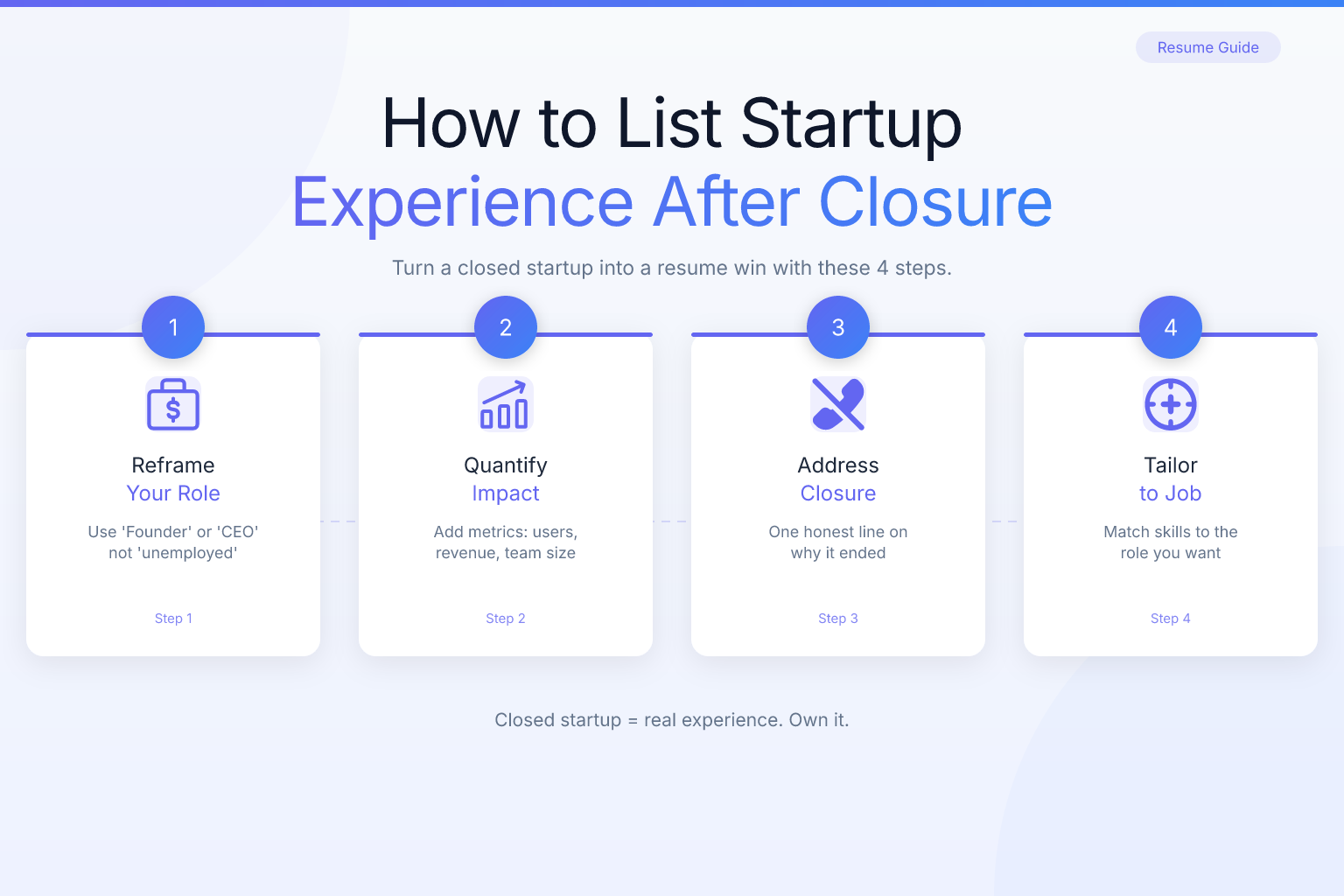
Key Takeaways
- List the startup just like any other job — company name, your title, dates, and bullet points — because the closure doesn’t erase the skills you built.
- Focus your bullet points on what you accomplished, not on the company’s fate; use metrics and specific contributions wherever possible.
- Never hide the startup or leave a gap; instead, frame the experience as a period of intense learning, ownership, and adaptability.
- If the closure left a resume gap, fill it with consulting, freelancing, or skill-building activities to show continuous growth.
- In interviews, explain the closure factually and pivot quickly to what you achieved and how it makes you a stronger candidate.
| What to Do | Why It Matters | Time |
|---|---|---|
| List the startup like any other job with company name, title, and dates | Shows continuity and avoids a suspicious gap | 5 minutes |
| Write bullet points focused on your contributions, not the company’s outcome | Proves your value regardless of the business result | 20–30 minutes |
| Quantify achievements using estimates, percentages, or scope | Gives recruiters concrete evidence of your impact | 15 minutes |
| Prepare a brief, positive explanation for interviews | Turns a potential red flag into a story of resilience | 10 minutes |
| Fill any employment gap with freelance, courses, or projects | Demonstrates initiative and keeps your skills current | Varies |
How to List Startup Experience on a Resume When the Company Closed: Start with the Basics
When a startup shuts down, your first instinct might be to downplay the role or leave it off entirely. Don’t. The company’s closure doesn’t invalidate the work you did. Recruiters and hiring managers care about your skills, not the startup’s ultimate fate. List the experience exactly as you would any other job:
- Company name – Use the startup’s legal name, even if it’s no longer active.
- Your title – Keep it accurate. If you were a co-founder, say so. If you held multiple roles, pick the one most relevant to the job you’re targeting now.
- Dates of employment – Month/year to month/year. If the company closed and you stayed until the end, list the final month.
- Location – City and state (or “Remote”).
Example:
Co-Founder & Head of Product
Nexa Systems (acquired IP, ceased operations) | San Francisco, CA
March 2023 – November 2025
You can optionally add a brief note in parentheses after the company name — “(acquired)”, “(ceased operations)”, or “(shut down)” — but it’s not required. Many candidates skip it on the resume and address the closure only in the interview. If you do include it, keep it neutral. Avoid words like “failed” or “went under.”
How to Frame Your Role and Achievements Without a Company to Verify
One of the biggest worries with a closed startup is that no one can confirm your employment. But background checks for most roles only verify dates and titles if the company still exists. When a company is defunct, many employers will accept alternative proof — pay stubs, tax documents, or references from former colleagues. So don’t let verification fears stop you from claiming the experience.
To make your bullet points credible without a live company website, focus on:
- Specific projects you led – “Built a customer onboarding flow that reduced churn by 18% in three months.”
- Skills you developed – “Managed a remote team of five engineers across three time zones.”
- Scope and scale – “Grew the user base from 0 to 12,000 through organic content and referral programs.”
If you lack hard numbers, use estimates and frame them honestly. For example, “Increased demo requests by an estimated 40% after redesigning the landing page.” This is far better than leaving the bullet vague. For more on quantifying when data is scarce, read our guide on how to add numbers to your resume when you don’t have data.
Handling the “Closed” Status: What to Say and What to Avoid
You have three options for addressing the closure on the resume itself:
- Say nothing on the resume – List the company and your role normally. This works well if the startup had a neutral name and you’re not worried about a recruiter Googling it. Many startups disappear without a trace, and that’s fine.
- Add a brief parenthetical – “(ceased operations 2025)” or “(acquired, product sunset)” after the company name. This preempts questions and shows transparency.
- Use a functional or hybrid resume format – If you held multiple roles or the startup was very short-lived, group your experience under a “Startup & Entrepreneurial Experience” section. This is especially useful if you’ve worked at several startups.
What to avoid:
- Don’t use words like “failed,” “bankrupt,” or “went under” on the resume.
- Don’t try to hide the experience by omitting dates or using a vague title like “Consultant” if you were a full-time employee.
- Don’t badmouth the founders or investors in writing or in interviews.
Quantifying Impact When the Startup Had No Revenue or Users
Many early-stage startups never reach revenue or significant user numbers. That doesn’t mean you have nothing to show. Recruiters understand that pre-revenue companies measure success differently. Focus on:
- Processes you built – “Designed and implemented the company’s first agile development workflow, cutting sprint cycle time by 30%.”
- Fundraising or partnerships – “Supported a $1.2M seed round by building the investor pitch deck and financial model.”
- Product milestones – “Shipped MVP in 14 weeks, securing 200 beta testers and a 4.8-star rating on Product Hunt.”
- Team building – “Recruited and onboarded the first five engineers, establishing the engineering culture and code review standards.”
If you truly have no numbers, use comparisons or scope: “Developed the entire front-end architecture from scratch using React and Node.js, serving as the sole front-end engineer.” That tells a story of ownership and technical depth.
Addressing Employment Gaps After a Startup Closure
A startup closure often leaves a gap — sometimes weeks, sometimes months — while you figure out your next move. Here’s how to handle it:
- Fill the gap with something productive – Even if you weren’t employed, you can list freelance projects, consulting, open-source contributions, or courses. A line like “Independent Product Consultant (Jan 2026 – Present)” with a few bullet points shows you stayed active.
- Use a “Career Break” entry if needed – If you took time off to travel, care for family, or simply recharge, you can list it transparently. Example: “Career Break — Professional Development & Relocation (Dec 2025 – Mar 2026).” This is increasingly accepted.
- Don’t stretch dates – Never extend your startup employment dates to cover the gap. Background checks that verify dates through tax records or references can catch this, and it’s a fast way to lose an offer.
If the gap is only a month or two, most recruiters won’t even notice. For longer gaps, a brief, honest explanation in the cover letter or interview is enough.
How to Explain the Closure in Interviews (Not on the Resume)
The resume is for facts; the interview is for context. When asked why you left the startup, have a concise, forward-looking answer ready. A strong formula:
- State the fact neutrally – “The company ceased operations in November 2025 after our Series A didn’t close.”
- Acknowledge what you learned – “It was a tough but invaluable experience. I learned how to build product from zero, manage a lean team, and make decisions with limited data.”
- Pivot to the future – “I’m now looking for a role where I can apply that builder mindset to a larger-scale product, which is why I’m excited about this opportunity.”
Never blame individuals. Even if the failure was due to founder mismanagement, keep it classy: “The market shifted faster than we could adapt” is better than “The CEO made terrible decisions.”
If you’re worried about the stigma of a failed startup, remember that many hiring managers — especially at other startups or innovative companies — see it as a badge of honor. You took a risk, you built something, and you learned. That’s often more compelling than a safe, predictable career path. For more on framing difficult situations, see our post on how to list layoffs on your resume without stigma.
Resume Examples: Before and After for a Closed Startup
Let’s look at a real-world transformation. Suppose you were the first marketing hire at a fintech startup that shut down after 18 months.
Before (vague, outcome-focused):
Marketing Manager
PayFlow (failed startup) | Jan 2024 – Jun 2025
- Tried to grow user base but company ran out of money
- Managed social media accounts
- Worked on content and email campaigns
After (achievement-focused, specific):
Marketing Manager
PayFlow (ceased operations 2025) | Remote
Jan 2024 – Jun 2025
- Grew organic website traffic from 0 to 15,000 monthly visits through SEO and content marketing, generating 800+ beta sign-ups
- Built and managed a $3,000/month paid acquisition budget across Meta and Google, achieving a 2.8x ROAS
- Developed the company’s go-to-market playbook, including positioning, messaging, and a 30-day launch plan adopted by the founding team
- Led a freelance designer and two content writers, producing 40+ blog posts and 12 email sequences
Notice how the second version makes you look like a high-impact marketer, regardless of the company’s outcome. That’s the goal.
Using the ResumeMate Score Checker to Test Your Startup Resume
Once you’ve drafted your resume, run it through an ATS-friendly score checker to see how it holds up. The ResumeMate Score Checker gives you a section-by-section breakdown — personal info, experience, education, skills — and flags formatting issues that could trip up applicant tracking systems. It’s free and takes less than a minute.
This is especially useful for startup resumes because you may have unconventional titles or a mix of responsibilities. The score checker will tell you if your bullet points are too vague, if you’re missing key skills, or if your formatting could cause parsing errors. You can then tweak your resume until it’s recruiter-ready.
If you’re starting from scratch, the ResumeMate AI Resume Builder offers single-column templates that are ATS-safe and let you export a clean PDF — no design guesswork needed.
FAQ
Q: Should I mention the startup closed on my resume?
A: It’s optional. You can add a brief parenthetical like “(ceased operations 2025)” after the company name, but many candidates leave it off and address it only in the interview. If you do include it, keep the language neutral — avoid “failed” or “bankrupt.”
Q: How do I list a startup that failed on LinkedIn?
A: Use the same approach as your resume. List the company, your title, and dates. In the description, focus on your achievements. LinkedIn doesn’t require a company page to be active, so you can still add the experience even if the page no longer exists. If the company page is gone, you can create a new entry with just the name.
Q: What if the startup closed before I could achieve measurable results?
A: Focus on the work you did, the skills you used, and the scope of your responsibilities. Even without revenue or user numbers, you can describe processes you built, problems you solved, and the speed at which you worked. For example, “Shipped a functional MVP in 8 weeks using React and Firebase” is a strong bullet.
Q: Can I still use the founder title if the company no longer exists?
A: Yes. If you were a founder or co-founder, use that title. It signals ownership, leadership, and the ability to build from scratch — qualities many employers value. Just be prepared to explain your specific role and contributions, as “founder” can mean anything from CEO to solo developer.
Q: How do I handle a gap after the startup closed?
A: Fill the gap with any productive activity — freelance work, consulting, courses, or even a structured job search project. List it on your resume as a separate entry (e.g., “Independent Consultant” or “Career Break — Skill Building”). This shows you didn’t just wait around. If the gap is only a month or two, it’s usually not a concern.
Q: Will a closed startup hurt my background check?
A: Not if you’re honest. Most background checks verify employment through the company’s HR or payroll records. If the company no longer exists, the check may come back as “unable to verify.” In that case, employers often accept alternative proof like W-2s, pay stubs, or references from former managers. Be upfront if asked, and have documentation ready.
Q: Should I include a startup that only lasted a few months?
A: If you gained relevant skills or it fills a gap, yes. Short stints at startups are common and not seen as job-hopping when the context is clear. Frame it as a project-based role: “Joined pre-launch to build the MVP; company ceased operations after 4 months due to funding.” That tells a complete story.
Related articles:
- Explain Short Tenure Due to Company Closure (Samples)
- Acting Role on Resume: How to List Interim Titles (Examples)
Track Every Application While You Job Hunt
Stop losing track of where you’ve applied. The ResumeMate Job Tracker is a free Chrome extension that tracks every application, deadline, and follow-up in one place — right from your browser.