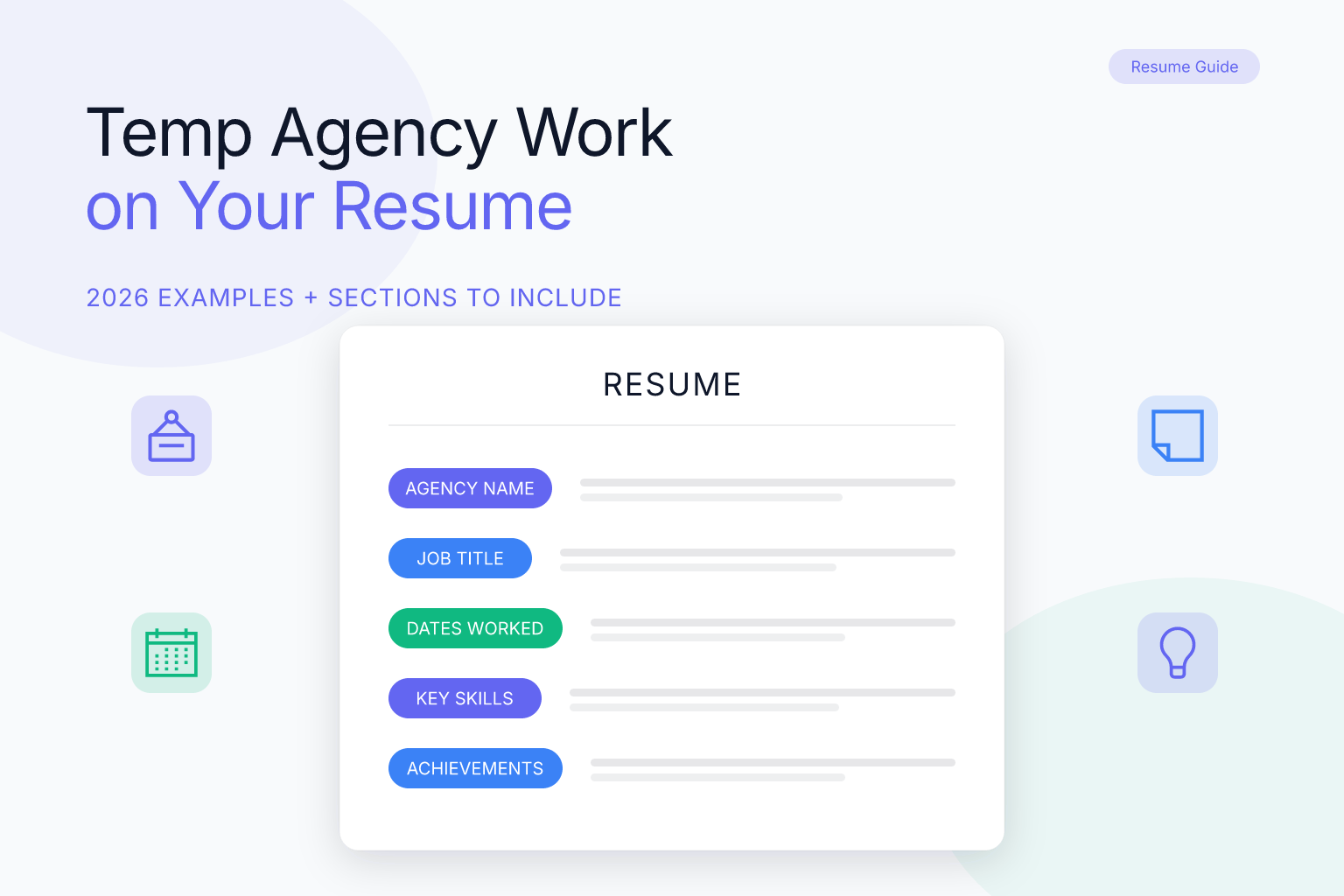
How to List Temp Agency Work on a Resume (2026 Examples)
If you’ve ever wondered how to list temp agency work on a resume without confusing recruiters or looking like a job hopper, you’re not alone. Temp and contract roles through staffing agencies are a legitimate, often impressive part of a career — but the formatting can trip people up. Do you list the agency or the client company? How do you handle three different assignments in six months? This guide walks you through every scenario with concrete examples you can copy.
Key Takeaways
- List the staffing agency as the employer, then add the client company name in the job title or first bullet (e.g., “Administrative Assistant — via Adecco at Acme Corp”).
- Group multiple short assignments under one agency entry with a summary line like “Completed 5 contract assignments across 3 client sites” to avoid a fragmented work history.
- Write bullet points that focus on measurable results and transferable skills, not just daily duties — temp work often builds speed, adaptability, and software proficiency faster than permanent roles.
- Never hide temp work or leave a gap; frame it as intentional flexibility and breadth of experience across industries.
- If a temp assignment converted to permanent, list the client company as the employer for that period and note the conversion in a bullet point.
| What to Do | Why It Matters | Time |
|---|---|---|
| List agency as employer, client in title | Clarifies the employment relationship for background checks and reference calls | 5 min |
| Group short assignments under one agency entry | Prevents your resume from looking like you can’t hold a job | 10 min |
| Quantify achievements in each bullet | Shows impact beyond task completion — recruiters skim for numbers | 15 min per assignment |
| Add a “Contract/Temp” label next to dates | Sets expectations and highlights your adaptability | 2 min |
| Use a clean, single-column template | Ensures ATS software parses your temp history correctly | 5 min |
How to List Temp Agency Work on a Resume: Agency vs. Client Company
The first decision is whether to list the staffing agency or the client company as your employer. The short answer: list the staffing agency as the employer, because that’s who actually paid you and who a background check will verify. But you should also name the client company so recruiters understand the context of your work.
Here’s the standard format:
Staffing Agency Name — City, State
Administrative Assistant (Contract via Acme Corp)
March 2025 – August 2025
- Managed calendars and travel for a 12-person sales team at Acme Corp, reducing scheduling conflicts by 30%
- Processed 50+ invoices weekly using QuickBooks, cutting payment turnaround from 10 days to 4 days
This approach works because it’s honest, ATS-friendly, and gives the recruiter both pieces of information at a glance. If you list only the client company, a background check may flag a discrepancy when the agency’s name appears on your employment records. If you list only the agency, the recruiter can’t tell what industry or role you actually worked in.
Exception: If the temp assignment converted to a permanent role at the client company, list the client company as the employer for that entire period. Add a bullet like “Promoted from contract to full-time after 4 months based on performance.” This shows career progression and avoids splitting one continuous job into two confusing entries.
Formatting Options for Temp Agency Experience (With Examples)
There are three common ways to format temp work, depending on how many assignments you’ve had and how long each lasted.
Option 1: One Entry per Assignment (Best for 1–2 longer assignments)
If you had one or two temp assignments that each lasted 3+ months, list them as separate entries under the agency name. This gives you room to describe each role in detail.
Example:
Randstad — Remote
Customer Support Specialist (Contract via TechSolutions Inc.)
January 2025 – June 2025
- Resolved 40+ inbound tickets daily with a 95% customer satisfaction score
- Documented 20+ troubleshooting guides that reduced repeat tickets by 15%
Data Entry Clerk (Contract via Midwest Logistics)
July 2025 – October 2025
- Entered 500+ shipment records per week with 99.8% accuracy
- Flagged 12 data discrepancies that prevented $8,000 in billing errors
Option 2: Grouped Entry (Best for 3+ short assignments)
If you’ve had many short assignments — say, three different 2-week gigs in a quarter — listing each one separately will make your resume look cluttered and job-hoppy. Instead, group them under one agency entry with a summary line and a few representative bullets.
Example:
Kelly Services — Chicago, IL
Contract Administrative Professional (5 assignments across 3 client sites)
February 2025 – December 2025
- Completed 5 short-term assignments in healthcare, legal, and manufacturing offices
- Adapted to new software systems (Epic, Clio, SAP) within 1–2 days per assignment
- Received positive feedback from 4 of 5 client managers; one assignment extended twice
This format shows breadth and reliability without overwhelming the reader. If one assignment was particularly relevant to the job you’re applying for, you can break it out as a separate entry and group the rest.
Option 3: Skills-Based Section (Best for career changers or very fragmented history)
If your temp work spans many unrelated roles and you’re pivoting to a new field, consider a “Relevant Experience” section that pulls out only the temp assignments related to your target job. List the agency as the employer but focus bullets on transferable skills. For more on this approach, see our guide on how to list contract vs. freelance work on a resume.
How to Handle Multiple Short-Term Assignments Without Looking Job-Hoppy
Recruiters understand that temp work is inherently short-term, but a resume with 10 different employers in 12 months can still raise red flags. The fix is to group assignments under the agency name and use a summary line that frames the variety as a feature, not a bug.
Here’s a step-by-step approach:
- List the agency once as the employer, with the full date range of all assignments (e.g., “March 2025 – Present”).
- Write a summary line that quantifies the scope: “Completed 7 contract assignments across 4 industries, including healthcare, finance, and retail.”
- Choose 3–5 bullets that highlight your most impressive or relevant achievements across all assignments. Don’t try to describe every single gig.
- Add a note about availability if you’re still temping: “Open to permanent opportunities; available for immediate start.”
This method keeps your resume to one page (or two, if you have extensive experience) and tells a coherent story: you’re a flexible, reliable worker who can hit the ground running anywhere.
If you’re worried about employment gaps between assignments, don’t hide them. A one-week gap between temp gigs is normal and doesn’t need explanation. For longer gaps, see our guide on how to list layoffs on your resume without stigma — the same principles apply to gaps between temp assignments.
What to Write in the Job Description for Temp Work
The biggest mistake people make with temp work is writing bullets that sound like a job posting instead of an accomplishment list. “Answered phones, filed documents, scheduled meetings” tells a recruiter nothing about whether you were good at it.
Instead, follow this formula for every bullet:
Action verb + specific task + measurable result or impact
Here are before-and-after examples:
Weak: “Responsible for data entry”
Strong: “Entered 300+ customer records per day with 99.5% accuracy, reducing duplicate entries by 20%”
Weak: “Helped with event planning”
Strong: “Coordinated logistics for a 200-person client conference, managing vendor contracts and a $15,000 budget”
Weak: “Worked in a warehouse”
Strong: “Picked and packed 150+ orders per shift in a fast-paced fulfillment center, maintaining a 98% order accuracy rate”
Even if you don’t have exact numbers, estimate conservatively. “Processed 50+ invoices weekly” is better than “processed invoices.” If you genuinely don’t know the numbers, describe the scope: “Supported a team of 8 sales reps” or “Managed calendars for 3 executives.”
Temp work often builds skills faster than permanent roles because you’re thrown into new environments constantly. Highlight that: “Learned new CRM software (Salesforce, HubSpot) within 2 days per assignment” is a powerful bullet that shows adaptability.
How to Explain Temp Work in a Resume Summary or Cover Letter
Your resume summary is the first thing a recruiter reads, so use it to frame your temp experience positively. Instead of saying “temp worker,” use phrases like “adaptable administrative professional with experience across 5 industries” or “contract specialist who delivers results in fast-paced environments.”
Example summary:
“Administrative professional with 3+ years of contract experience across healthcare, legal, and tech sectors. Known for learning new systems quickly and maintaining 95%+ client satisfaction scores. Seeking a permanent role where I can apply my adaptability and process-improvement skills.”
In a cover letter, you can be more explicit: “My experience as a temp through Adecco gave me exposure to three different ERP systems and taught me to build rapport with new teams within days. I’m now looking for a permanent home where I can deepen my expertise.”
Never apologize for temp work. It’s a legitimate career path that demonstrates resilience, flexibility, and a strong work ethic — qualities every employer wants.
Common Mistakes to Avoid When Listing Temp Agency Work
Even well-intentioned job seekers make these errors. Avoid them:
- Listing only the client company — This creates a background check mismatch and can look like you’re hiding the agency relationship.
- Listing only the agency — Recruiters can’t tell what you actually did or in what industry, so your experience looks vague.
- Using a different format for each assignment — Inconsistent formatting confuses ATS software and human readers. Pick one format and stick with it.
- Writing duty-based bullets — “Answered phones” tells nothing. Always include a result or scope.
- Leaving out the “Contract” or “Temp” label — If you don’t label it, a recruiter may assume you were fired from a permanent job after 3 months. Add “(Contract)” or “(Temp)” next to the dates.
- Including every single assignment — If you had 12 one-week gigs, group them. Your resume is a highlight reel, not a complete work history.
- Using a multi-column or heavily designed template — Some ATS systems struggle with tables and graphics. A clean, single-column layout is safest. You can check your resume’s ATS score free to see if your formatting passes.
Temp-to-Perm and Long-Term Assignments: Special Cases
Not all temp work is short-term. Here’s how to handle two common scenarios:
Temp-to-perm conversion: If a temp assignment turned into a permanent job at the client company, list the client company as the employer for the entire period. Add a bullet like “Converted from contract to full-time after 3 months based on performance.” This shows you impressed the client enough to hire you permanently — a strong signal to future employers.
Long-term contract (6+ months): If you worked at one client site for 6 months or more through an agency, treat it like a regular job. List the agency as the employer, the client in the title, and write detailed bullets. You can even add a second line under the agency name: “Long-term contract assignment at [Client Company].”
Multiple agencies: If you’ve worked through several different staffing agencies, list each agency as a separate employer entry, even if the client companies were similar. Group assignments under each agency as described above.
Use ResumeMate to Format Temp Work Cleanly
Formatting temp work by hand in Word or Google Docs can get messy, especially when you’re grouping multiple assignments. ResumeMate’s free AI resume builder lets you create a clean, ATS-safe resume in minutes. You can add a “Contract/Temp” label to any entry, group assignments under one employer, and export a polished PDF that parses correctly in Workday, Greenhouse, and other applicant tracking systems.
Before you submit, run your resume through the resume score checker to see how well your temp work section reads to both ATS software and human recruiters. It flags formatting issues, missing keywords, and weak bullet points — so you can fix them before a recruiter sees them.
FAQ
Q: Do I put a temp agency on my resume?
A: Yes, list the temp agency as the employer because that’s who paid you and who a background check will verify. Then add the client company name in the job title or first bullet (e.g., “Administrative Assistant — via Adecco at Acme Corp”). This gives recruiters both pieces of information without creating a discrepancy.
Q: How do I put agency work on my resume if I had many short assignments?
A: Group all assignments under one agency entry with a summary line like “Completed 6 contract assignments across 3 industries.” Then write 3–5 bullets highlighting your most impressive achievements across all assignments. Don’t list each short gig separately — it makes you look job-hoppy.
Q: How do I list a staffing agency on my resume example?
A: Here’s a clean example:
Kelly Services — Chicago, IL
Contract Administrative Professional (5 assignments across 3 client sites)
February 2025 – December 2025
- Completed 5 short-term assignments in healthcare, legal, and manufacturing offices
- Adapted to new software systems (Epic, Clio, SAP) within 1–2 days per assignment
- Received positive feedback from 4 of 5 client managers; one assignment extended twice
Q: How do I list temp jobs on a resume without looking like a job hopper?
A: Use the grouped format: list the agency once with the full date range, add a summary line quantifying the number of assignments, and write bullets that focus on results and adaptability. Label the entry as “Contract” or “Temp” so recruiters understand the short durations were intentional, not a sign of instability.
Q: Should I list the client company or the staffing agency on my resume?
A: List the staffing agency as the employer, but include the client company name in the job title or first bullet. If the assignment converted to permanent, list the client company as the employer for that period and note the conversion in a bullet.
Q: How do I explain temp work in a resume summary?
A: Frame it as a strength: “Adaptable administrative professional with 3+ years of contract experience across healthcare, legal, and tech sectors. Known for learning new systems quickly and maintaining 95%+ client satisfaction scores.” Never use the word “temp” in a summary — use “contract” or “project-based” instead.
Q: What if I’m still working temp jobs while applying for permanent roles?
A: List your current agency as “Present” and add a bullet or note: “Open to permanent opportunities; available for immediate start.” This shows you’re actively employed and serious about finding a long-term role.
Related articles:
- How to List Expiring Certifications on a Resume (Examples)
- How to List Hackathons on a Resume (With Examples)
- How to List a GitHub Profile on Your Resume (With Examples)
- How to List an Unpaid Internship on a Resume (Examples)
- How to List an Incomplete Degree on a Resume (With Examples)
Track Every Application While You Job Hunt
Stop losing track of where you’ve applied. The ResumeMate Job Tracker is a free Chrome extension that tracks every application, deadline, and follow-up in one place — right from your browser.