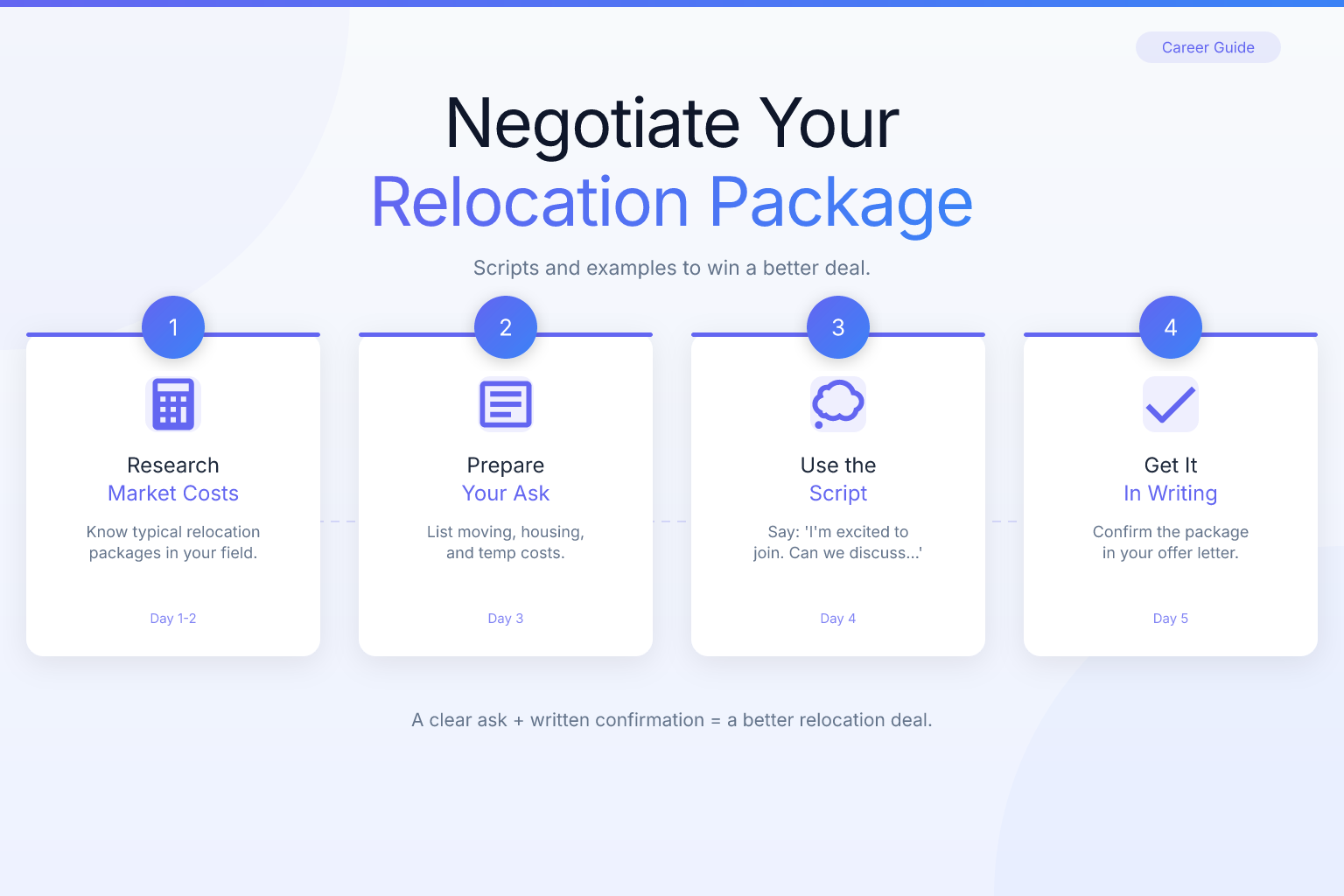
How to Negotiate a Relocation Package: Examples and Scripts
Learning how to negotiate relocation package examples can turn a stressful cross-country move into a financially smooth transition. Most job seekers accept the first relocation offer they receive, leaving thousands of dollars on the table. Relocation packages are negotiable — just like salary, PTO, and signing bonuses — but you need to know what to ask for, when to ask, and how to frame your request. This guide walks you through real examples, word-for-word scripts, and the mistakes that cost candidates money.
Key Takeaways
- Relocation packages typically cover moving costs, temporary housing, and sometimes home sale or purchase assistance, but the exact components vary widely by company and role level.
- You can negotiate relocation even if the initial offer doesn’t include it, especially if you have a competing offer, unique skills, or a long-distance move.
- Asking for a lump sum instead of a managed relocation gives you flexibility, but you need to understand the tax implications before you choose.
- Always get the relocation package in writing and clarify what’s reimbursable, what’s capped, and what happens if you leave the company within a certain period.
- Use a specific cost breakdown and a polite, data-driven script to increase your chances of a yes — vague requests get vague answers.
| What to Do | Why It Matters | Time |
|---|---|---|
| Research typical relocation costs for your specific move | Gives you a concrete number to anchor your request instead of guessing | 1–2 hours |
| Ask about relocation early in the process (after offer, before acceptance) | Shows you’re serious and gives you leverage while the company is still selling you on the role | 15 minutes |
| Prepare a written cost breakdown with real quotes | Makes your request credible and easy for HR to approve | 30 minutes |
| Negotiate for a lump sum or specific benefits rather than accepting the default | Maximizes flexibility and total value | 1–2 conversations |
| Get everything in writing before you sign | Protects you from surprise expenses or clawback clauses later | 10 minutes |
How to Negotiate Relocation Package Examples: What to Ask For
Before you can negotiate, you need to know what a relocation package can include. The phrase “relocation package” means different things at different companies. At a startup, it might be a $3,000 check. At a Fortune 500 company hiring a director, it could be a full-service move with home sale assistance and a year of temporary housing.
Here are the most common components you can ask for, with examples of how they show up in real offers:
- Moving company services: Packing, loading, transporting, and unpacking your household goods. Some companies use a managed relocation vendor; others reimburse you for a moving company you choose.
- Temporary housing: A furnished apartment or hotel for 30–90 days while you find a permanent home. This is common for mid-level and senior roles.
- Home finding trip: One or two paid trips to your new city to look at neighborhoods and houses before you move.
- Home sale assistance: Coverage of real estate agent commissions, closing costs, or a guaranteed buyout if your home doesn’t sell within a certain time. This is usually reserved for executives or homeowners with significant equity.
- Home purchase assistance: Help with closing costs, mortgage points, or a down payment loan for buying a new home.
- Spousal or partner job assistance: Career coaching, resume help, or job placement services for your partner. This is a differentiator for senior roles.
- Tax gross-up: The company pays the taxes on your relocation benefits so you don’t owe a surprise bill at tax time. Without this, relocation benefits are often taxable income.
- Miscellaneous allowance: A lump sum for expenses like utility deposits, new driver’s license, pet shipping, or temporary storage.
When you negotiate, you don’t need to ask for all of these. Pick the two or three that matter most for your situation. For example, if you’re renting and moving across the country, temporary housing and a moving company might be your top priorities. If you own a home, home sale assistance could be worth more than everything else combined.
What’s Typically Included in a Relocation Package
Relocation packages fall into three broad tiers, and knowing which tier you’re in helps you set realistic expectations.
Entry-level and individual contributor roles often receive a small lump sum — anywhere from $1,000 to $5,000 — to cover a DIY move. You rent a truck, pack your own boxes, and keep whatever is left over. Some companies offer nothing at all for entry-level roles, especially if the role is remote-friendly or the move is optional.
Mid-level and manager roles typically get a managed move. The company hires a relocation vendor to handle packing, shipping, and sometimes temporary housing for 30–60 days. You might also get a home finding trip and a miscellaneous allowance. The total value often ranges from $10,000 to $30,000, though companies rarely state it that way.
Senior and executive roles receive full-service packages. This can include home sale assistance, home purchase assistance, spousal job support, tax gross-up, and extended temporary housing. The total value can exceed $100,000 for a cross-country executive move, but these packages are highly customized and negotiated individually.
These tiers aren’t rigid. A startup might offer a senior engineer a $10,000 lump sum, while a large bank might offer a mid-level analyst a full managed move. The key is to ask what’s included rather than assuming based on title.
When to Bring Up Relocation in the Hiring Process
Timing matters. You don’t want to ask about relocation in the first interview — that signals you’re more interested in the perks than the work. But you also don’t want to wait until after you’ve accepted the offer, because your leverage disappears the moment you sign.
The right time to negotiate relocation is after you receive a written offer but before you accept it. At that point, the company has decided they want you, and they’re invested in closing the deal. This is the same window when you’d negotiate salary or PTO — and the same principles apply. If you’re new to offer negotiation, read our guide on how to negotiate PTO in a job offer for scripts that transfer directly to relocation.
If the job posting says “relocation assistance available,” you can ask for details during the interview process — just frame it as logistics, not negotiation. For example: “I noticed the posting mentions relocation assistance. Could you share what that typically includes for this role?” This gives you information without committing to a number.
If the posting doesn’t mention relocation, you can still ask after the offer. Many companies have a relocation policy they don’t advertise, and they’ll extend it if a candidate asks. The worst they can say is no.
One more timing note: if you’re currently employed and need to give notice, factor relocation into your start date. A cross-country move takes weeks, not days. If you need to negotiate a later start date, our guide on how to answer what is your notice period can help you frame that conversation.
How to Calculate Your Relocation Costs (Step-by-Step)
A vague request — “Can you help with relocation?” — gets a vague answer. A specific request with a cost breakdown gets a yes more often, because it’s easy for HR to approve a concrete number.
Here’s how to calculate your relocation costs in five steps:
- Get three quotes from moving companies. Use a site like Moving.com or get direct quotes from United Van Lines, Mayflower, or a local company. For a 1,000-mile move of a two-bedroom apartment, quotes often range from $3,000 to $8,000 depending on whether you pack yourself or hire full service.
- Estimate temporary housing. If you need a place to stay before finding a permanent home, look up monthly furnished apartment rates in your new city. In a mid-sized city, that might be $1,500–$2,500 per month. In a major metro, it could be $3,000+.
- Add travel costs. Flights or gas for you and your family, plus hotel stays along the way. A family of four flying cross-country might spend $1,000–$2,000 on flights alone.
- Include miscellaneous expenses. Utility deposits, new driver’s license and registration, pet shipping, storage unit rental, and the cost of eating out while your kitchen is packed. These add up fast — often $500–$1,500.
- Total it up and round to a clean number. If your total is $11,200, ask for $12,000. A round number is easier to approve and leaves a small buffer.
Here’s an example breakdown for a single person moving from Austin to Seattle for a mid-level software engineering role:
- Full-service moving company: $5,500
- Temporary housing (one month): $2,200
- Flight and hotel during move: $600
- Miscellaneous (utilities, license, pet shipping): $800
- Total: $9,100
When you present this to HR, you’re not asking for a favor — you’re asking them to cover the actual cost of accepting their offer. That’s a much stronger position.
Scripts for Negotiating Relocation (with Examples)
Here are four scripts you can adapt. Replace the bracketed text with your specifics.
Script 1: Initial request when the offer doesn’t mention relocation
“Thank you for the offer — I’m excited about the role. I noticed the offer doesn’t include relocation assistance. Since I’d be moving from [current city] to [new city], I’d like to discuss adding a relocation package. I’ve researched the costs and can share a breakdown if that’s helpful. Is relocation something we can include?”
Script 2: Counter with a specific cost breakdown
“I’ve reviewed the offer and I’m ready to accept, with one adjustment. The relocation support isn’t quite enough to cover my actual moving costs. I’ve gathered quotes and the total comes to [$X], which includes [moving company, temporary housing, travel]. Could we increase the relocation package to [$X]? I’m happy to provide the quotes for your records.”
Script 3: Asking for a lump sum instead of managed relocation
“I appreciate the managed relocation package, but I’d prefer a lump sum so I can handle the move myself and keep costs down. Would you be open to converting the relocation benefits to a cash payment of [$X]? I’m comfortable managing the logistics and it would give me more flexibility.”
Script 4: Asking for additional benefits beyond the standard package
“The relocation package covers the move itself, but I have one additional need. My partner will be relocating with me and will need to find a new job. Would it be possible to include spousal job assistance or a small allowance for their job search? I know this isn’t standard, but it would make a big difference in our decision.”
Notice what these scripts have in common: they’re polite, specific, and framed as a collaborative problem rather than a demand. They also give the recruiter a clear next step — review the numbers, check with the hiring manager, or approve a specific amount.
If you’re negotiating multiple parts of an offer at once, read our guide on how to ask about benefits package before job offer to sequence your requests effectively.
Common Relocation Package Examples by Role Level
To give you a concrete sense of what to expect, here are three realistic examples based on common scenarios. These aren’t guarantees — every company is different — but they illustrate the range.
Example 1: Entry-level marketing coordinator moving from Chicago to Denver
- Offer: $55,000 salary, no relocation mentioned
- Negotiated: $3,000 lump sum for moving expenses
- How: The candidate asked after receiving the offer, explained they’d be renting a U-Haul and driving themselves, and provided a rough cost estimate of $2,800. HR approved $3,000 without pushback.
Example 2: Mid-level product manager moving from New York to San Francisco
- Offer: $140,000 salary, standard relocation package (managed move, no temporary housing)
- Negotiated: Added 60 days of temporary housing and a $2,000 miscellaneous allowance
- How: The candidate pointed out that San Francisco rents are high and finding an apartment takes time. They asked for temporary housing as a bridge and got 60 days approved.
Example 3: Senior director moving from Dallas to New York with a family
- Offer: $220,000 salary, full-service relocation (moving, home finding trip, 90 days temp housing)
- Negotiated: Added home sale assistance and spousal job support
- How: The candidate owned a home in Dallas and explained that selling it would take months. They asked for coverage of real estate commissions and got a capped home sale benefit plus a $5,000 spousal job search allowance.
These examples show that the more senior the role, the more room there is to negotiate. But even entry-level candidates can get something if they ask.
Mistakes to Avoid When Negotiating Relocation
Even well-intentioned candidates make mistakes that cost them money or credibility. Here are the most common ones:
- Not asking at all. The biggest mistake is assuming the offer is final. Relocation is one of the most commonly negotiated benefits, and many companies expect you to ask.
- Accepting the first offer without details. “We’ll cover relocation” means nothing until you know what’s covered, what’s capped, and what’s reimbursable. Ask for a written policy or a breakdown.
- Ignoring taxes. Relocation benefits are often taxable income unless the company grosses up. A $10,000 package might only be worth $7,000 after taxes. Ask about tax treatment before you accept.
- Forgetting about clawback clauses. Many companies require you to repay relocation costs if you leave within 12–24 months. Read the fine print and negotiate the clawback period if it’s unreasonable.
- Negotiating too early. Bringing up relocation in the first interview makes you look entitled. Wait until you have an offer.
- Being vague. “Can you help with moving?” is easy to dismiss. “I need $8,500 to cover a full-service move and one month of temporary housing” is hard to ignore.
- Not considering your partner or family. If you’re moving with a partner who will need to find a new job, that’s a real cost. Ask for spousal assistance or a larger lump sum to cover the gap.
What to Do If the Company Says No
Sometimes the answer is no — the company has a strict policy, a tight budget, or a hiring freeze on relocation benefits. That doesn’t mean the conversation is over. Here are four fallback options:
- Ask for a signing bonus instead. A signing bonus is often easier to approve than a relocation package because it comes from a different budget line. A $10,000 signing bonus can cover your moving costs and then some.
- Negotiate a later start date. If you can’t get money, get time. A start date six weeks out gives you time to plan a budget move, find housing, and avoid paying for expedited shipping.
- Ask for a remote start. Some companies will let you work remotely for the first 30–60 days while you arrange your move. This reduces the pressure and lets you spread out expenses.
- Revisit after a year. If the company won’t budge now, ask if relocation assistance becomes available after a certain tenure or performance review. You might be able to move later on the company’s dime.
If you signaled relocation willingness early in your job search — for example, by noting it on your resume — you may have more leverage. Our guide on how to indicate relocation willingness on a resume header explains how to position yourself as a flexible candidate from the start.
FAQ
Q: What is a typical relocation package?
A: A typical relocation package for a mid-level role includes a managed move (packing, shipping, and unpacking), 30–60 days of temporary housing, and a miscellaneous allowance of $1,000–$3,000. Entry-level roles often receive a lump sum of $1,000–$5,000, while senior roles may include home sale assistance and spousal job support. The exact components vary by company, so always ask for a written breakdown.
Q: Can I negotiate relocation if it wasn’t offered?
A: Yes. Many companies have a relocation policy they don’t advertise, and they’ll extend it if a candidate asks after receiving an offer. Frame your request around the actual cost of moving and provide a specific breakdown. If the company truly can’t offer relocation, ask for a signing bonus or a later start date as alternatives.
Q: How much should I ask for relocation?
A: Ask for the actual cost of your move, rounded up to a clean number. Get quotes from moving companies, estimate temporary housing, and add travel and miscellaneous expenses. For a cross-country move of a one-bedroom apartment, $5,000–$10,000 is common. For a family with a house, $15,000–$30,000 is not unreasonable. The key is to back your number with real quotes.
Q: Is relocation assistance taxable?
A: In most cases, yes. Relocation benefits are considered taxable income unless the company provides a tax gross-up, which means they pay the taxes on your behalf. Without a gross-up, a $10,000 package might only be worth $7,000 after federal and state taxes. Ask about tax treatment before you accept, and negotiate a gross-up if possible.
Q: What if I don’t want to relocate but the job requires it?
A: If the job requires relocation and you’re not willing to move, that’s a dealbreaker — no negotiation will fix it. But if you’re open to relocating and just want more support, use the scripts in this guide to ask for a better package. If the company won’t budge, consider whether the role is worth the out-of-pocket cost.
Q: Can I get a lump sum instead of managed relocation?
A: Yes, many companies will convert a managed relocation package to a lump sum if you ask. This gives you flexibility to handle the move yourself and keep any leftover money. However, a lump sum is often smaller than the total value of a managed package, and you’ll be responsible for taxes unless the company grosses up. Weigh the tradeoffs before you choose.
Track Every Application While You Job Hunt
Stop losing track of where you’ve applied. The ResumeMate Job Tracker is a free Chrome extension that tracks every application, deadline, and follow-up in one place — right from your browser.