How to Network on LinkedIn Without Being Awkward: Step-by-Step
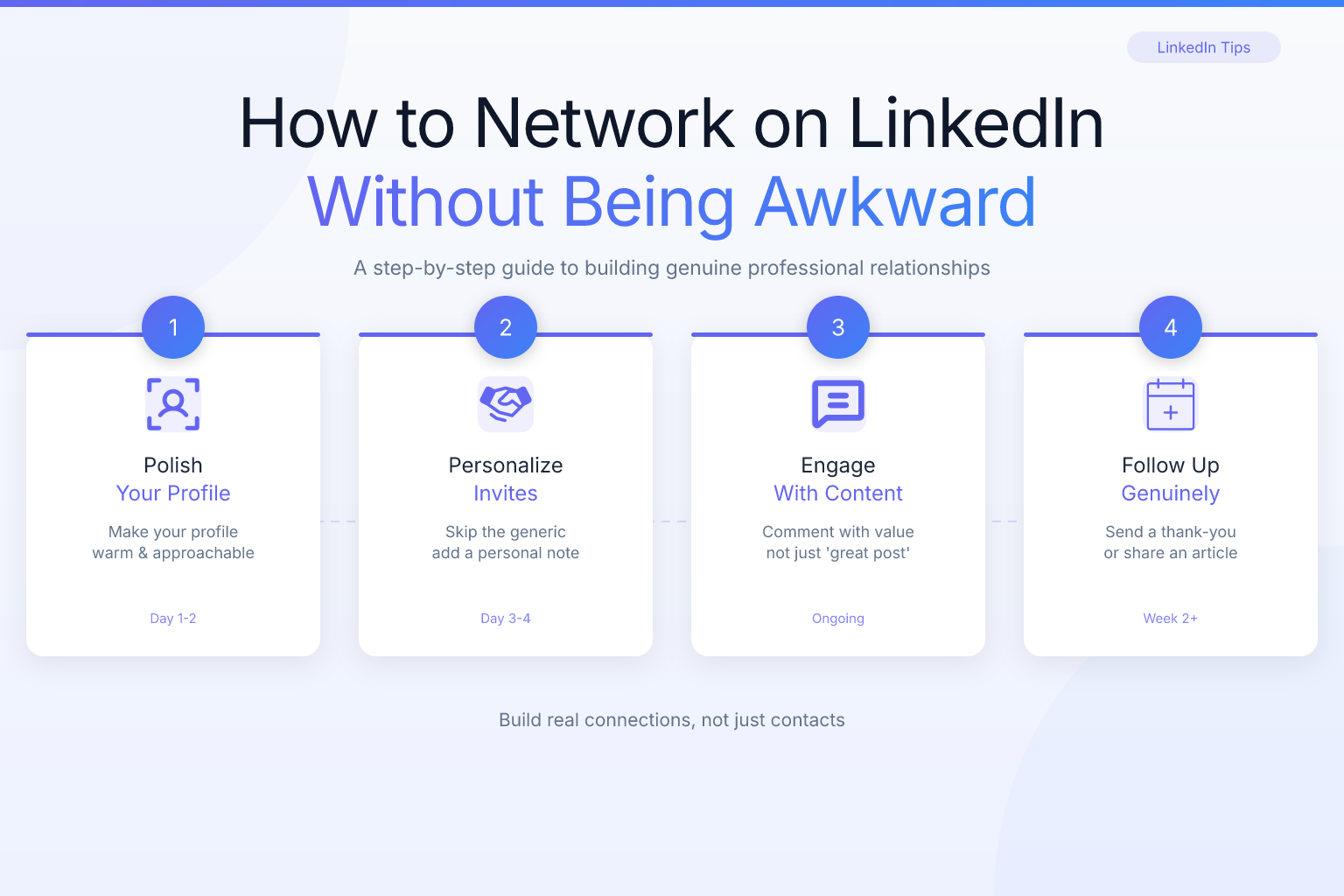
Networking on LinkedIn without being awkward is a skill anyone can learn — and it’s one of the most effective ways to uncover job opportunities, get referrals, and build a professional community that supports your career. The problem is that most people treat LinkedIn like a digital rolodex, firing off generic connection requests and immediately asking for favors. That approach feels transactional because it is. Genuine networking, on the other hand, is about building relationships before you need them. This guide gives you a repeatable, low-pressure system for reaching out to strangers, engaging with your network, and asking for help — all without feeling like you’re imposing.
Key Takeaways
- Most LinkedIn networking feels awkward because people ask for too much too soon. Build rapport first by engaging with content and offering value.
- Personalize every connection request with a specific, honest reason — mention a shared group, article, or mutual contact.
- Use the “advice, not a job” framework when reaching out to someone you admire; it lowers pressure on both sides.
- Follow up after connecting with a short, helpful message that keeps the door open without asking for anything.
- Track every new connection, conversation, and follow-up so you never lose momentum — the free ResumeMate Job Tracker makes this easy.
| What to Do | Why It Matters | Time |
|---|---|---|
| Personalize your connection request | Generic invites get ignored; a specific note shows genuine interest | 2 minutes |
| Engage with their content before connecting | They’ll recognize your name when the request arrives | 5–10 minutes |
| Send a warm follow-up after they accept | Keeps the conversation alive without asking for a favor | 3 minutes |
| Ask for advice, not a job | Lowers their guard and often leads to referrals anyway | 10 minutes to craft |
| Track every interaction | You’ll know when to follow up and never lose a lead | 1 minute per contact |
Why LinkedIn Networking Feels Awkward (and How to Fix It)
Most people dread networking on LinkedIn because they associate it with cold, unsolicited messages that scream “I want something from you.” The awkwardness comes from a mismatch: you’re reaching out to a stranger, but you’re using the language of a close colleague. You wouldn’t walk up to someone at a conference and immediately ask for a job referral, yet that’s exactly what many LinkedIn messages do.
The fix is to treat LinkedIn networking like real-world relationship building. That means:
- Start with context. Mention how you found them, why you’re interested, and what you have in common.
- Give before you ask. Comment on their posts, share their content, or offer a useful resource before making a request.
- Respect their time. Keep messages short and make it easy for them to say yes — or no — without pressure.
When you shift your mindset from “What can I get?” to “How can I connect genuinely?”, the awkwardness disappears. If you’re an introvert, LinkedIn’s asynchronous nature is actually an advantage — you can take your time crafting thoughtful messages without the pressure of a live conversation.
Optimize Your Profile Before You Reach Out
Your LinkedIn profile is your digital handshake. If someone receives your connection request and clicks on your profile, what they see determines whether they accept. A sparse, outdated, or unprofessional profile makes you look like a spammer — even if your intentions are good.
Before you send a single request, make sure your profile passes the five-second test:
- Professional headshot: A clear, friendly photo where your face takes up 60% of the frame. No selfies, no group shots.
- Headline that says what you do: Instead of just your job title, use the 220-character headline to describe your value. Example: “Data Analyst | SQL, Python, Tableau | Helping teams make data-driven decisions.” Avoid generic phrases like “Looking for opportunities.”
- About section with personality: Write a short narrative about what you do, who you help, and what you’re passionate about. End with a call to action like “Always open to connecting with fellow analysts and learning about new opportunities.”
- Featured section: Pin a portfolio piece, a case study, or even a post you’re proud of. This gives visitors an immediate sense of your work.
- Activity visible: Make sure your activity feed shows you engaging with content. An empty feed signals a dormant account.
If you’re actively job searching, you’ll also want a resume that matches your LinkedIn story. After you’ve updated your profile, run your resume through a free ATS resume checker to make sure it’s ready when a connection asks for it.
How to Send a Connection Request That Gets Accepted
The difference between an accepted request and an ignored one often comes down to the 300-character note. Here’s a simple formula that works:
Context + Commonality + Low-Pressure Close
Examples:
“Hi [Name], I saw your comment on [Industry Leader]’s post about supply chain trends — really resonated with your point on nearshoring. I’m also in logistics and would love to connect and follow your work.”
“Hi [Name], I’m a fellow [University] alum and noticed you’re in product management at [Company]. I’m transitioning into PM and would be grateful to stay connected and learn from your experience. No pressure at all.”
“Hi [Name], I just read your article on [Topic] and it clarified a challenge I’ve been facing in my own role. I’d love to connect with others in the [Industry] space. Thanks for sharing your insights.”
Avoid these common mistakes:
- The blank request: Always add a note. Without one, you’re just a name.
- The pitch immediately: Don’t ask for a job, referral, or phone call in the connection request. That’s for later.
- The copy-paste: If your note could be sent to anyone, it will be ignored. Personalize it.
Pro tip: Before sending a request, spend a week engaging with the person’s posts. Leave thoughtful comments that add value. When your request arrives, they’ll recognize your name and be far more likely to accept.
The Art of the Follow-Up Message (Without Being Pushy)
Once someone accepts your request, you have a small window to turn a connection into a relationship. But most people either say nothing or jump straight to “Can you refer me?” Both are mistakes.
Instead, send a warm follow-up within 24–48 hours. The goal is to thank them and open a door — not to ask for anything.
Templates:
If they accepted your request:
“Thanks for connecting, [Name]. I’ve been following your work on [Topic] and really appreciate the insights you share. Looking forward to learning from your posts. Have a great week!”
If you want to start a conversation:
“Thanks for connecting, [Name]. I noticed you’ve been at [Company] for [X] years — that’s impressive. If you ever have a spare 10 minutes, I’d love to hear how you got started in [Field]. No worries if not!”
If you have a specific question:
“Thanks for connecting, [Name]. I’m currently exploring a move into [Industry] and your career path really stands out. If you’re open to it, I’d be grateful for any advice you’d share with someone starting out. Totally understand if you’re busy.”
Notice the pattern: you’re asking for advice, not a job. This is the “advice, not a job” framework, and it works because people love to talk about themselves and help others — as long as it doesn’t feel like a burden. If you’re shy, these templates take the pressure off; just customize a few words and hit send.
How to Ask for a Referral or Introduction (Without Cringing)
At some point, you’ll want to move from casual connection to a specific ask — usually a referral, an introduction, or insight about a job opening. The key is to make the ask so easy and low-pressure that saying yes feels effortless.
Step 1: Do your homework first. Before you ask for a referral, check if the person’s company has open roles that match your skills. If you’re asking for an introduction, know exactly who you want to be introduced to and why.
Step 2: Frame the ask as a small favor. Use language that gives them an easy out.
Template for a referral request:
“Hi [Name], I hope you’re doing well. I noticed that [Company] is hiring for a [Role] that aligns closely with my background in [Skill/Industry]. If you’re comfortable with it, would you be open to referring me? I’ve attached my resume and a few bullet points on why I think I’d be a fit. No pressure at all if you’re not able to.”
Template for an introduction request:
“Hi [Name], I saw that you’re connected to [Target Person] at [Company]. I’m really interested in learning more about their work in [Area]. If you feel comfortable, would you be willing to make a quick introduction? I’d be happy to send over a short blurb you can forward. Totally understand if not.”
Step 3: Make it easy for them to say yes. Attach a pre-written blurb they can forward, or include a link to your LinkedIn profile and a one-paragraph summary of your background. The less work they have to do, the more likely they’ll help.
For a deeper dive on crafting referral requests that get results, read our guide on how to ask for a LinkedIn referral with templates that work.
How to Maintain Relationships After the First Message
Networking isn’t a one-and-done activity. The most successful networkers nurture relationships over months and years, so when an opportunity arises, they’re top of mind.
Here’s a simple maintenance system:
- Engage with their content regularly. A quick comment or like every few weeks keeps you visible.
- Send a value-first message every 2–3 months. Share an article they might find interesting, congratulate them on a work anniversary, or mention a podcast episode that reminded you of them. No ask — just value.
- Keep a lightweight CRM. You don’t need a fancy tool. A spreadsheet or the free ResumeMate Job Tracker can log when you last contacted someone, what you talked about, and when to follow up. This prevents relationships from going cold.
- Offer help before you need it. If you see a job posting that fits a connection, send it their way. If you can make an introduction, do it. Generosity builds reciprocity.
Avoid these common pitfalls:
- Networking only when you need something. The best time to build your network is before you’re desperate. Start today.
- Ghosting a new connection. If someone replies, respond within 24 hours. Silence burns bridges.
- Asking for too much too soon. Don’t request a 30-minute call in your first message. Start small.
- Forgetting to update your profile. If your profile says you’re still at a job you left two years ago, you lose credibility. Keep it current.
For introverts, maintaining relationships can be as simple as liking a post or sending a short, genuine message every couple of months. Consistency matters more than volume.
FAQ
Q: How do I network on LinkedIn if I don’t know anyone in my target industry?
A: Start by following companies and hashtags in that industry. Engage with posts from people who work there. After a week or two of thoughtful comments, send a connection request referencing a specific post. You can also join LinkedIn groups related to the industry and participate in discussions — group members are often more open to connecting.
Q: What should I say in a LinkedIn message to someone I admire?
A: Be specific about what you admire and keep the ask small. For example: “Hi [Name], I’ve been following your career in renewable energy and was really inspired by your talk at [Event]. I’m exploring a similar path and would be grateful for any advice you’d share with someone starting out. No pressure at all.” This approach is flattering and low-stakes.
Q: Is it okay to connect with recruiters on LinkedIn?
A: Yes, but do it thoughtfully. Personalize your request by mentioning the industry or role you’re targeting. Once connected, don’t immediately ask for a job. Instead, engage with their content and, after a few weeks, send a message like: “Hi [Name], I’ve been following your posts on [Industry] hiring trends. I’m currently exploring [Role] opportunities and would love to stay on your radar if anything opens up.”
Q: How often should I follow up with a LinkedIn connection?
A: After the initial follow-up, reach out every 2–3 months with something of value — an article, a congratulations, or a relevant question. Avoid checking in just to “touch base.” If you’re actively job searching and they’ve offered to help, a gentle nudge after 2–3 weeks is fine: “Hi [Name], just wanted to circle back on our conversation about [Topic]. No rush at all — just keeping you in the loop.”
Q: What if someone ignores my connection request or message?
A: Don’t take it personally. People are busy, and LinkedIn messages get buried. If they don’t accept your request, move on. If they accepted but didn’t reply to your follow-up, wait a few weeks and try one more time with a different angle — perhaps a comment on their recent post. If there’s still no response, focus your energy elsewhere. Persistence is good; pestering is not.
Q: How do I handle employment gaps when networking?
A: Be honest and forward-looking. If a gap comes up, frame it as a period of growth or transition. For example, “I took some time to upskill in data analytics and am now excited to bring that to a new role.” Your LinkedIn profile and resume should tell a consistent story. For more detailed guidance, read our article on how to list layoffs on your resume without stigma.
Related articles:
Track Every Application While You Job Hunt
Stop losing track of where you’ve applied. The ResumeMate Job Tracker is a free Chrome extension that tracks every application, deadline, and follow-up in one place — right from your browser.