How to Pass Probation Period at New Job: A Complete Checklist
How to pass probation period at new job checklist is a question every new hire should ask before day one. A probation period—typically 3 to 6 months—is your employer’s way of evaluating whether you’re the right long-term fit. It’s also your chance to prove you made the right decision. The good news: most people who fail probation do so not because they lack skills, but because they miss clear expectations, under-communicate, or wait too long to course-correct. This checklist breaks down exactly what to do in your first 90 days so you can pass probation with confidence.
Key Takeaways
- A probation period is a two-way evaluation: your employer assesses your performance, and you assess whether the role and company meet your expectations.
- The single most important action in week one is to clarify your manager’s definition of success—specific goals, metrics, and deadlines—in writing.
- Document your wins weekly, even small ones, so you have concrete evidence of your contributions when your probation review happens.
- Ask for feedback at least every two weeks, not just at the end, and act on it visibly to show you’re coachable.
- Avoid common probation killers like missing deadlines, staying silent when stuck, or ignoring company culture norms.
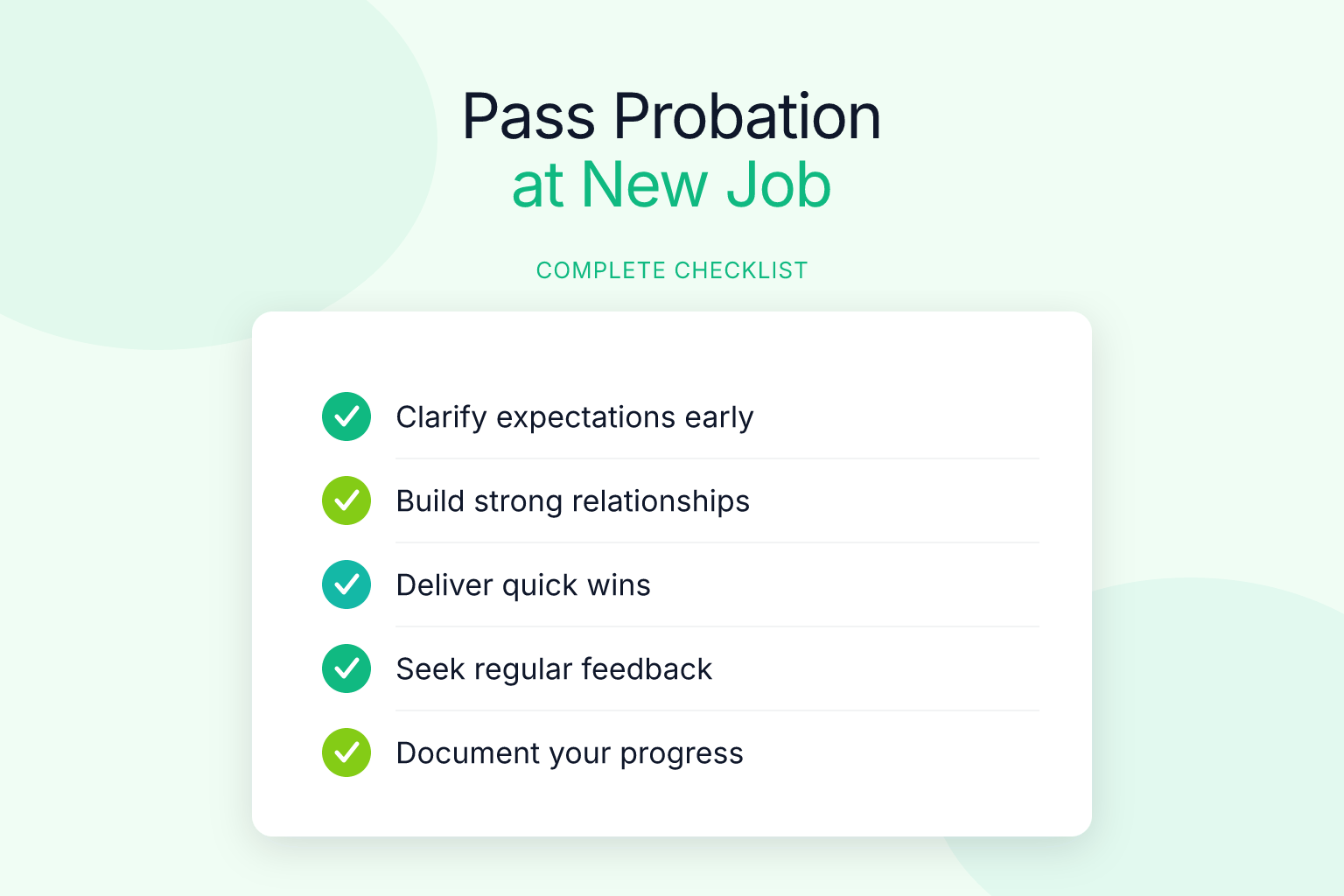
| What to Do | Why It Matters | Time |
|---|---|---|
| Clarify expectations and success metrics with your manager | Prevents misalignment and gives you a clear target | Week 1 |
| Build relationships with your team and key stakeholders | Makes you a trusted collaborator, not an outsider | Weeks 1–4 |
| Master your core responsibilities and deliver early wins | Proves competence and builds momentum | Weeks 2–6 |
| Document your progress and achievements weekly | Gives you evidence for your probation review | Ongoing |
| Seek feedback and adjust your approach | Shows coachability and prevents small issues from becoming big ones | Every 2 weeks |
How to Pass Probation Period at a New Job: Your 30-60-90 Day Checklist
Your probation period is not a passive waiting game. Treat it like a project with clear milestones. The 30-60-90 day framework is a proven way to structure your first three months. Here’s what to focus on at each stage.
Days 1–30: Learn, Connect, and Clarify
Your first month is about absorbing information and building a foundation. Don’t try to overhaul processes or prove you’re a genius on day one. Instead:
- Schedule a one-on-one with your manager in the first week. Ask directly: “What does success look like for me at the 30, 60, and 90-day marks?” Write down the answers and confirm them in a follow-up email.
- Read all onboarding materials and internal documentation. Understand your team’s goals, key projects, and how your role fits into the bigger picture.
- Introduce yourself to every person you’ll work with regularly. A 15-minute coffee chat or virtual intro goes a long way. Ask what they need from you and how you can make their job easier.
- Identify your top three priorities. Based on your manager’s input, list the three most important deliverables or outcomes for your first 90 days. Keep this list visible.
Days 31–60: Deliver and Adjust
By month two, you should be contributing independently. This is when you prove you can do the job, not just learn about it.
- Complete at least one meaningful project or task end-to-end. Choose something that has visible impact, even if it’s small. For example, if you’re in marketing, draft a campaign brief; if you’re in engineering, fix a bug or ship a small feature.
- Ask for feedback after each deliverable. Don’t wait for a formal review. A simple “How did that go? What could I do better next time?” shows initiative.
- Track your progress against the 30-day goals you set. If you’re behind, figure out why and adjust. If you’re ahead, ask for more responsibility.
- Observe company culture and adapt. How do people communicate? What’s the unspoken rule about meetings, email, or Slack? Fitting in culturally is often as important as technical skill.
Days 61–90: Consolidate and Plan Ahead
The final stretch is about demonstrating consistency and readiness for the long term.
- Take on a stretch assignment or cross-functional project. This shows you’re not just meeting expectations but exceeding them.
- Prepare a summary of your contributions. List every project, result, and piece of positive feedback. Bring this to your probation review meeting.
- Ask your manager directly: “Is there anything that would prevent me from passing probation?” This gives you a chance to fix any issues before the formal decision.
- Start thinking about your next 90 days. What do you want to learn or achieve after probation? Showing forward-thinking ambition signals you’re invested in the role.
Clarify Expectations in Week One
The fastest way to fail probation is to assume you know what your manager wants. Every manager has a slightly different definition of “good performance.” Some care about speed, others about thoroughness. Some want daily updates, others prefer weekly summaries. You won’t know unless you ask.
During your first week, schedule a dedicated meeting with your manager and ask these five questions:
- What are the top three outcomes you want me to achieve in my first 90 days?
- How will you measure my success? (e.g., specific metrics, project completion, client feedback)
- What does a typical week look like in terms of priorities and communication?
- What are the biggest challenges or pitfalls new hires in this role usually face?
- How often would you like me to check in, and in what format (email, Slack, in-person)?
After the meeting, send a follow-up email summarizing what you heard. This creates a written record and gives your manager a chance to correct any misunderstandings. If you’re still weighing multiple offers, check our guide on how to decide between two job offers to make sure you’re committing to the right role before probation starts.
Build Relationships with Your Manager and Team
Probation is not just about your individual output. It’s about whether you fit into the team. Hiring managers often say they’d rather work with a slightly less skilled person who’s easy to collaborate with than a brilliant jerk. So invest in relationships from day one.
- Learn your manager’s communication style. Do they prefer detailed reports or quick bullet points? Do they want to be copied on every email or only major decisions? Adapt to their style, not yours.
- Be reliable and responsive. Answer messages promptly, show up on time, and follow through on every commitment, no matter how small. Reliability builds trust faster than any grand gesture.
- Offer help to teammates. If you finish your work early, ask if anyone needs support. This shows you’re a team player, not just focused on your own tasks.
- Find a mentor or buddy. Many companies assign an onboarding buddy. If not, identify a senior colleague you respect and ask for informal guidance. A mentor can give you candid feedback your manager might soften.
Master Your Core Responsibilities Quickly
You were hired to do a specific job. The faster you become competent at that job, the safer your position. Here’s how to accelerate your learning curve:
- Create a skills inventory. List every task or responsibility in your job description. Rate your current proficiency for each (beginner, intermediate, advanced). Focus your learning on the areas where you’re weakest but the role demands strength.
- Shadow a high performer. Ask a colleague who excels at your role if you can observe them for a few hours. Watch how they prioritize, handle difficult situations, and communicate.
- Use the 80/20 rule. Identify the 20% of tasks that produce 80% of the value in your role. Master those first. For example, if you’re in sales, the core skill is closing deals—not perfecting your CRM data entry.
- Ask for a checklist or SOP. Many teams have standard operating procedures. If not, create your own based on what you learn. This shows initiative and helps you avoid mistakes.
Document Your Wins and Progress
When your probation review comes, you need evidence, not just feelings. Keep a running log of everything you accomplish, no matter how small. This serves three purposes:
- It gives you concrete talking points for your review. Instead of saying “I worked hard,” you can say “I completed X project, which resulted in Y outcome.”
- It helps you spot patterns. If you notice you’re consistently struggling with a certain type of task, you can address it early.
- It protects you if expectations change. If your manager suddenly says you’re not meeting goals, you can point to your documented progress and ask for clarification.
Create a simple spreadsheet or document with columns for date, task, result, and any feedback received. Update it every Friday afternoon. This takes 10 minutes but pays off enormously.
Seek Feedback Early and Often
Waiting until the end of probation to find out you’re underperforming is a recipe for failure. Instead, ask for feedback at least every two weeks. Here’s how to do it without seeming needy:
- After completing a task or project, ask: “What did I do well? What could I improve?” This is specific and actionable.
- In your regular one-on-ones, ask: “Is there anything I should be doing differently?” This opens the door for honest conversation.
- If you receive negative feedback, don’t get defensive. Say “Thank you for telling me. Can you give me an example so I understand better?” Then act on it immediately and follow up to show you’ve improved.
If you’re struggling and worried about failing probation, it’s better to address it head-on. Ask your manager for a mid-probation check-in. Say something like: “I want to make sure I’m on track. Is there anything I should focus on more?” This shows maturity and a growth mindset. If the worst happens and you don’t pass, learn how to handle job rejection and ask for feedback so you can improve for your next role.
Avoid Common Probation Mistakes
Many new hires sabotage themselves without realizing it. Here are the most common probation killers and how to avoid them:
- Missing deadlines without communicating. If you’re going to be late, tell your manager as soon as you know. Silence is worse than the delay itself.
- Staying stuck instead of asking for help. No one expects you to know everything. Asking a smart question after trying to solve the problem yourself is a sign of strength, not weakness.
- Ignoring company culture. If everyone works through lunch, you don’t have to, but be aware of the norms. Dressing too casually, using inappropriate humor, or being late to meetings can hurt you even if your work is good.
- Overpromising and underdelivering. It’s tempting to say yes to everything to impress. But if you can’t deliver, you’ll lose trust. Be realistic about what you can accomplish.
- Being negative or complaining. Your first 90 days are not the time to criticize company processes or colleagues. If you see a problem, frame it as a suggestion: “I noticed X. Would it be helpful if I tried Y?”
What to Do If You’re Struggling
If you’re halfway through probation and feel like you’re not meeting expectations, don’t panic. Take these steps:
- Schedule a candid conversation with your manager. Say: “I want to make sure I’m on track. Based on what you’ve seen so far, what should I focus on improving?”
- Create a 30-day improvement plan. Based on the feedback, list specific actions you’ll take, with deadlines. Share this plan with your manager and ask for their input.
- Increase your visibility. If your manager doesn’t see your work, they can’t evaluate it fairly. Send weekly progress updates, even if they don’t ask.
- Ask for a mentor or additional training. Sometimes you need more support than the standard onboarding provides. Be proactive about getting it.
- Consider whether the role is the right fit. Probation is a two-way street. If you’re miserable or the job is fundamentally different from what was described, it’s okay to walk away. But make that decision with full information, not out of fear.
FAQ
Q: How long is a typical probation period?
A: Most probation periods last 3 to 6 months, with 90 days being the most common. Some companies use 30 or 60 days for contract or entry-level roles, while senior positions may have a 6-month probation. Always check your employment contract for the exact length.
Q: What happens if I fail probation?
A: If you fail probation, your employer will typically terminate your employment with little or no notice, often without severance. However, many companies will give you a warning or a performance improvement plan before making a final decision. If you’re let go, ask for specific feedback so you can improve in your next role.
Q: Can I negotiate my probation period?
A: In some cases, yes. If you have a strong track record or the employer is eager to hire you, you can ask for a shorter probation period or a guaranteed review at the midpoint. However, most companies have standard policies, so this is more common for senior or specialized roles.
Q: What should I do in the first week of a new job?
A: In your first week, focus on three things: clarify expectations with your manager, introduce yourself to your team, and learn the basics of your role. Schedule a one-on-one with your manager, read all onboarding materials, and ask what success looks like at 30, 60, and 90 days.
Q: How do I ask for feedback during probation without seeming insecure?
A: Frame feedback requests around specific tasks or projects. After completing something, ask: “What did I do well? What could I improve?” This shows you’re focused on growth, not seeking validation. Also, ask in your regular one-on-ones: “Is there anything I should be doing differently?”
Q: What are signs I might not pass probation?
A: Warning signs include: your manager avoids giving you feedback or seems distant, you’re excluded from key meetings or projects, you receive repeated criticism on the same issue, or your workload suddenly decreases. If you notice these, schedule a candid conversation with your manager immediately.
Q: Is probation period the same as a trial period?
A: Yes, “probation period” and “trial period” are often used interchangeably. Both refer to an initial period of employment where the employer evaluates your performance and fit before confirming you as a permanent employee. The terms and length vary by company and country.
Track Every Application While You Job Hunt
Stop losing track of where you’ve applied. The ResumeMate Job Tracker is a free Chrome extension that tracks every application, deadline, and follow-up in one place — right from your browser.