How to Prepare for a Group Interview: 7 Steps to Stand Out
If you’ve been invited to a group interview, you’re probably wondering how to shine when you’re being evaluated alongside several other candidates. Group interviews are common in retail, hospitality, graduate programs, and consulting—and they test a different set of skills than a one-on-one conversation. The good news: with the right preparation, you can walk into that room (or Zoom call) knowing exactly how to contribute, collaborate, and get noticed for the right reasons.
Key Takeaways
- A group interview assesses your teamwork, communication, and leadership style—not just your answers to questions.
- Research the company’s values and the role’s requirements so you can tie your contributions to what they care about most.
- Practice active listening and build on others’ ideas; dominating the conversation is a common reason candidates get eliminated.
- For retail group interviews (Aldi, Burlington, etc.), expect hands-on team activities and customer-service scenarios.
- For graduate school and case interviews, prepare to discuss ideas collaboratively and think out loud under pressure.
- Dress one step above the company’s everyday attire, and always send a personalized follow-up within 24 hours.
| What to Do | Why It Matters | Time |
|---|---|---|
| Research the company, role, and recent news | Lets you contribute relevant ideas and shows genuine interest | 2–3 hours |
| Prepare 3–4 stories about teamwork and leadership | Gives you concrete examples to draw on during group exercises | 1–2 hours |
| Practice active listening and building on others’ points | Demonstrates collaboration—the top trait evaluators look for | Ongoing |
| Plan your outfit and logistics | Reduces stress on the day and ensures you make a professional first impression | 1 hour |
| Send a personalized thank-you note after the interview | Keeps you top-of-mind and reinforces your interest | 15 minutes |
How to Prepare for a Group Interview: 7 Steps to Walk in Confident
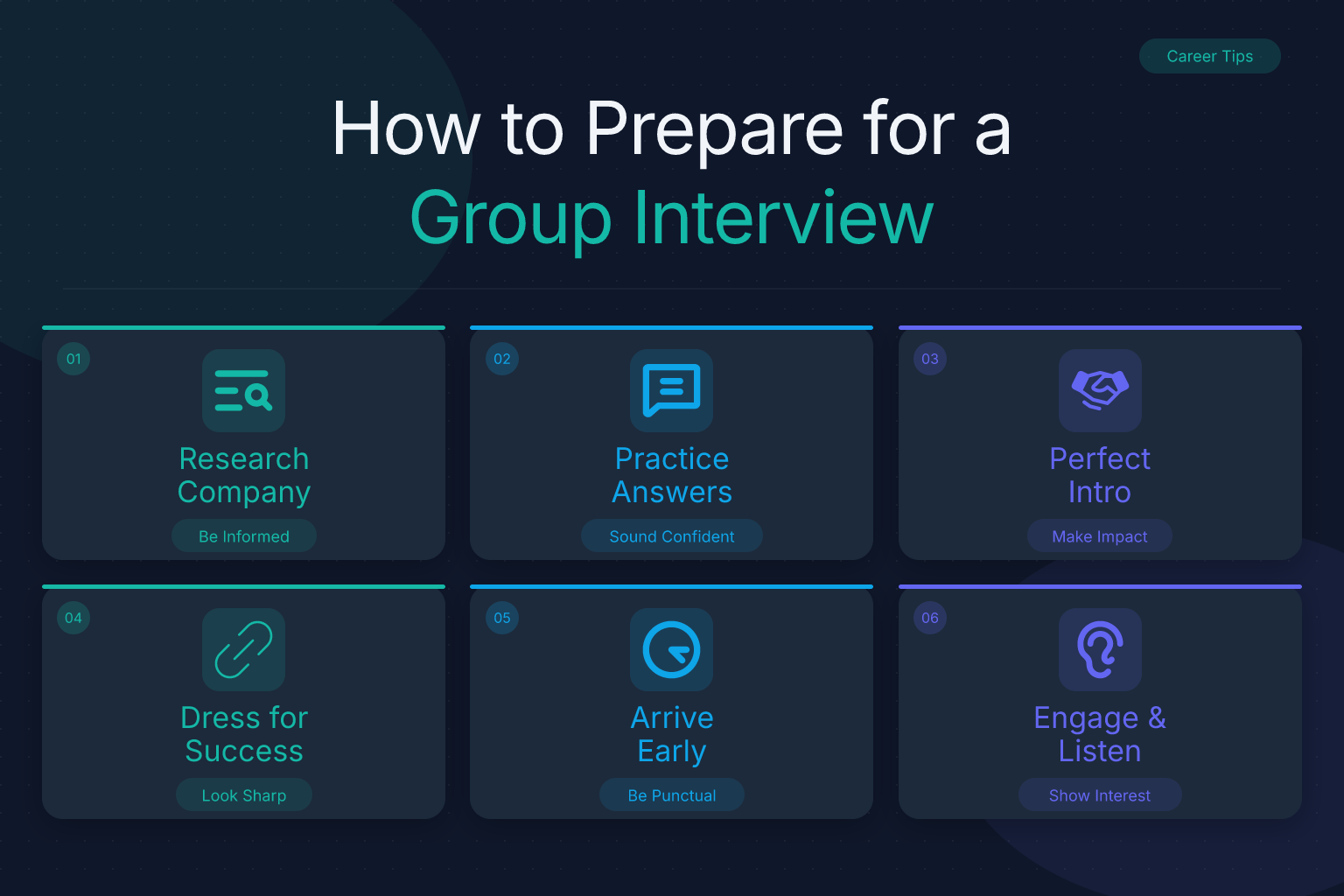
A group interview isn’t just about answering questions—it’s a live demonstration of how you work with others. Use these seven steps to build a preparation routine that covers everything from research to follow-up.
1. Research the Company and the Role Inside Out
Start by digging into the company’s website, social media, and recent news. Look for their mission statement, core values, and any initiatives they’re proud of. If you’re interviewing at Aldi, for example, you’ll notice they emphasize efficiency, teamwork, and a no-frills approach. At Burlington, customer service and a fast-paced environment are central. Knowing these details lets you frame your contributions in their language.
Next, study the job description. Highlight the key skills and traits they want—things like “collaborative,” “adaptable,” or “customer-focused.” During group activities, you’ll have opportunities to demonstrate those exact qualities. If the role requires problem-solving, be ready to suggest practical solutions when the group gets stuck.
2. Polish Your Resume and Bring Copies
Even in a group setting, your resume matters. Before the interview, make sure it’s tailored to the job and free of errors. Use a clean, ATS-friendly format—single-column layouts are the safest bet for both human readers and applicant tracking systems. If you need a quick refresh, the free ResumeMate resume builder helps you create a professional PDF in minutes. You can also check your resume’s ATS score to catch formatting issues before the interview.
Bring at least three printed copies—one for yourself and extras in case an interviewer or facilitator asks for one. Having a crisp resume in hand signals that you’re organized and serious about the opportunity.
3. Prepare Your 60-Second Introduction
Most group interviews kick off with a round of introductions. You’ll typically have 30 to 60 seconds to say who you are, what you’re doing now, and why you’re excited about the role. Write out your intro and practice it until it sounds natural, not rehearsed. Keep it concise: name, current situation (student, recent grad, career changer), one relevant strength, and a sentence about why this company appeals to you.
For example: “I’m Alex, a recent marketing graduate with a passion for data-driven storytelling. I’ve been following your brand’s community campaigns, and I’d love to bring my analytics and creative skills to a team that values both.”
4. Practice Common Group Interview Questions
While group interviews include collaborative exercises, you’ll still face direct questions. Prepare answers for classics like:
- “Tell me about a time you worked successfully in a team.”
- “How do you handle conflict or disagreement?”
- “Why do you want to work here?”
- “What would you do if a teammate wasn’t pulling their weight?”
Use the STAR method (Situation, Task, Action, Result) to structure your responses. Since you’ll be answering in front of others, keep your stories tight—aim for 60 to 90 seconds. If you want to practice with AI feedback, these ChatGPT interview prompts can simulate a group interview and help you refine your delivery.
5. Plan How You’ll Demonstrate Teamwork and Leadership
Evaluators aren’t just listening to your answers; they’re watching how you interact. In almost every group interview, they want to see that you can:
- Listen actively and acknowledge others’ ideas (“That’s a great point, and building on it…”)
- Include quieter group members (“What do you think, Sam?”)
- Keep the group focused on the task without steamrolling
- Offer constructive feedback without being critical
Decide ahead of time which behaviors you’ll lean into. If you’re naturally talkative, challenge yourself to pause and invite others in. If you’re more reserved, set a goal to speak up early in the exercise so your voice is heard.
6. Prepare Thoughtful Questions to Ask
At some point, the interviewer will likely ask if you have any questions. Having two or three ready shows engagement. Avoid questions about salary or benefits at this stage. Instead, ask about the team culture, what success looks like in the first 90 days, or how the company supports professional development. In a group setting, your question can also be an opportunity to demonstrate curiosity—just make sure it’s relevant to everyone, not just your own interests.
7. Nail the Logistics and Your Outfit
Confirm the time, location (or video link), and format. If it’s online, test your camera, microphone, and internet connection the day before. Choose a quiet, well-lit space with a neutral background. For in-person interviews, plan your route and aim to arrive 10–15 minutes early.
What you wear depends on the industry. For most group interviews, business casual is a safe baseline—but when in doubt, dress one step above what employees wear daily. We’ll cover attire in detail later in this guide.
What to Expect in a Group Interview: Common Formats and Activities
Group interviews vary widely, but most fall into one of these formats:
- Q&A roundtable: The interviewer asks a question, and each candidate answers in turn. This tests your ability to think on your feet and articulate ideas concisely.
- Group discussion or debate: You’re given a topic or problem and asked to discuss it as a team. Evaluators watch how you contribute, listen, and build consensus.
- Team task or simulation: You might be asked to build a structure from limited materials, solve a puzzle, or role-play a customer service scenario. This is common in retail and hospitality interviews.
- Case study (group): Popular in consulting and some graduate programs, you’ll analyze a business problem and present recommendations as a group.
Regardless of the format, the underlying goal is the same: assess how you function in a team under pressure.
How to Stand Out in a Group Interview Without Dominating
Striking the right balance between contributing and collaborating is the single biggest challenge of a group interview. Here’s how to get it right:
- Be the connector, not the controller. Instead of trying to lead every discussion, focus on connecting ideas. Say things like, “I think Maria’s point about X ties into what Jake said earlier about Y. What if we combined those?”
- Use names. Referring to fellow candidates by name shows you’re paying attention and builds rapport.
- Take notes. Jotting down key points signals engagement and helps you summarize later—a valuable skill evaluators notice.
- Manage time gently. If the group is going off track, you can say, “We have about five minutes left—should we prioritize the top two ideas?”
- Stay positive, even under stress. If someone disagrees with you, respond with curiosity, not defensiveness. “That’s an interesting perspective—can you tell me more about why you see it that way?”
Remember, the person who gets hired is rarely the loudest. It’s the one who makes the group better.
Preparing for Different Group Interview Scenarios
Group interviews take many forms, and tailoring your approach to the specific setting gives you a clear edge. Below, we break down how to prepare for the most common scenarios.
Online Group Interviews
Virtual group interviews add a layer of complexity: you have to convey warmth and collaboration through a screen. Here’s how to adapt your preparation:
- Master the tech. Use a laptop rather than a phone, and close unnecessary tabs to avoid distractions. If the platform allows, use a virtual background only if it’s professional and not distracting.
- Look at the camera, not the screen. When you’re speaking, direct your gaze at the camera to simulate eye contact. When others are speaking, nod and smile to show you’re listening.
- Mute when not speaking. Background noise can derail a group discussion. Unmute only when you’re ready to contribute.
- Use the chat strategically. If the facilitator allows, drop a supportive comment or a relevant link in the chat—but don’t overdo it.
- Practice with a friend. Do a mock online group interview to get comfortable with the flow and timing.
Retail Group Interviews (Aldi, Burlington, and More)
Retail group interviews are fast-paced and heavily focused on teamwork, customer service, and energy. Aldi, for example, is known for group activities like building a tower from spaghetti and marshmallows—a test of collaboration, creativity, and problem-solving under time pressure. Burlington often uses role-play scenarios where you handle a difficult customer or work together to organize a display.
To prepare:
- Expect to be on your feet. Wear comfortable, professional shoes. You may be moving around during activities.
- Show enthusiasm. Retail employers want to see energy and a positive attitude, even during mundane tasks.
- Demonstrate customer-first thinking. In any role-play, prioritize the customer’s experience. Use phrases like, “I’d first apologize for the inconvenience, then…”
- Be ready for physical tasks. You might be asked to lift, sort, or arrange items. Approach these with a can-do attitude.
- Research the brand’s service style. Aldi values efficiency and simplicity; Burlington emphasizes treasure-hunt shopping and friendly service. Let that knowledge shape your contributions.
Graduate School Group Interviews
Graduate programs—especially in healthcare, business, and education—often use group interviews to see how candidates interact with peers and faculty. You might be asked to discuss a case study, debate an ethical issue, or collaborate on a mini-project. The stakes are high because programs are looking for students who will enrich the cohort, not just excel individually.
Key preparation tips:
- Review the program’s mission and values. Tie your comments to their emphasis on interprofessional collaboration, research, or community service. For example, if a medical school highlights patient-centered care, reference that when discussing a case.
- Prepare to think out loud. Faculty want to see your reasoning process, not just your final answer. Practice articulating your thought process with a study partner, especially for ethical dilemmas where there’s no single right answer.
- Show intellectual humility. It’s okay to say, “I hadn’t considered that angle—thank you for bringing it up.” Graduate programs value candidates who can learn from others and adapt their thinking.
- Ask insightful questions. In a Q&A portion, ask about research opportunities, mentorship, or how the program fosters collaboration across disciplines. This shows you’re already thinking like a graduate student.
- Practice with sample prompts. Many programs provide case materials ahead of time. If not, find generic graduate-level discussion topics and practice forming evidence-based arguments while inviting others’ perspectives.
Group Case Interviews
Consulting firms and some corporate roles use group case interviews to evaluate analytical thinking, teamwork, and communication. You’ll receive a business problem and work as a team to structure an approach, analyze data, and present recommendations.
To prepare:
- Practice case frameworks. Familiarize yourself with profitability analysis, market entry, and other common frameworks, but be ready to adapt them to the specific problem.
- Drive the process, not the solution. The best group case performers focus on structuring the discussion: “Let’s start by clarifying the objective, then break down the key drivers.”
- Synthesize regularly. Periodically summarize what the group has agreed on and what still needs to be decided. This keeps everyone aligned and shows leadership.
- Use whiteboard or screen-share tools effectively. In virtual cases, offer to take notes on a shared document or whiteboard—it’s a visible way to add value.
- Be okay with ambiguity. Group cases often have incomplete information. Acknowledge assumptions and move forward rather than getting stuck.
What to Wear and How to Follow Up After a Group Interview
The final details—your appearance and your post-interview communication—can tip the scales in your favor. Here’s how to handle both with confidence.
What to Wear to a Group Interview
Your outfit should match the company culture while erring on the side of professionalism. For corporate or consulting group interviews, business formal (suit and tie or equivalent) is standard. For retail, startups, or creative roles, business casual is usually appropriate—think slacks or a skirt with a blouse or collared shirt. Avoid jeans, sneakers, and anything too flashy. When in doubt, ask the recruiter about the dress code.
Beyond the clothes themselves, pay attention to grooming and accessories. Keep jewelry minimal, ensure shoes are clean and polished, and avoid strong fragrances. Your goal is to look put-together without distracting from what you say. If you’re interviewing in a creative field, you can show personality through a subtle accessory, but always lean toward the professional side. For a deeper dive, read our complete guide on what to wear to an interview.
After the Group Interview: Follow-Up That Gets You Noticed
Within 24 hours, send a thank-you email to the interviewer or coordinator. If you don’t have their contact information, ask for a business card at the end of the session or email the recruiter who scheduled the interview.
Your follow-up should:
- Thank them for the opportunity
- Reference a specific moment from the interview that excited you about the role (e.g., “I especially enjoyed the team exercise where we tackled the customer retention challenge”)
- Reiterate one strength you’d bring to the team, tying it back to something you observed or discussed
- Keep it brief—three to four sentences max
A well-crafted follow-up does more than show manners; it reinforces the positive impression you made and keeps you top-of-mind as the hiring team debriefs. If you’re juggling multiple applications, the ResumeMate Job Tracker can help you log each interview, set follow-up reminders, and never lose track of where you stand.
Frequently Asked Questions
Q: What is a group interview?
A: A group interview is a hiring method where multiple candidates are evaluated at the same time, often through collaborative activities, discussions, or Q&A rounds. Employers use it to assess teamwork, communication, and how you perform in a group setting.
Q: How is a group interview different from a panel interview?
A: In a group interview, you’re assessed alongside other candidates. In a panel interview, you’re the only candidate, but you face multiple interviewers at once. For more on panel formats, read our guide to panel interview questions.
Q: What do employers look for in a group interview?
A: Employers look for collaboration, active listening, clear communication, problem-solving, and the ability to include others. They also note who dominates, who stays silent, and how candidates handle disagreement.
Q: How can I stand out in a group interview without being aggressive?
A: Focus on building on others’ ideas, using names, and keeping the group on track. Ask quiet members for their input and summarize progress. These behaviors demonstrate leadership without steamrolling.
Q: What should I wear to a group interview?
A: Dress one level above the company’s daily attire. For corporate roles, business formal is safe; for retail or startups, business casual usually works. Avoid jeans and sneakers unless the recruiter explicitly says otherwise.
Q: How do I prepare for a group interview at Aldi?
A: Research Aldi’s emphasis on efficiency and teamwork. Expect hands-on group activities like building challenges. Show enthusiasm, a can-do attitude, and a focus on collaboration over individual heroics.
Q: How do I prepare for a group case interview?
A: Practice case frameworks, but focus on structuring the group’s discussion rather than solving the case alone. Synthesize regularly, use a whiteboard or shared doc, and be comfortable with ambiguity.
Q: What questions are asked in a group interview?
A: Common questions include “Tell me about a time you worked in a team,” “How do you handle conflict?” and “Why do you want to work here?” You may also face situational questions like “What would you do if a teammate wasn’t contributing?”
Related articles:
- How to Set Up Lighting for a Video Interview at Home
- How to Deal with a Difficult Coworker Interview Question
- Older Workers Resume Tips: Stand Out, Don’t Hide
Track Every Application While You Job Hunt
Stop losing track of where you’ve applied. The ResumeMate Job Tracker is a free Chrome extension that tracks every application, deadline, and follow-up in one place — right from your browser.