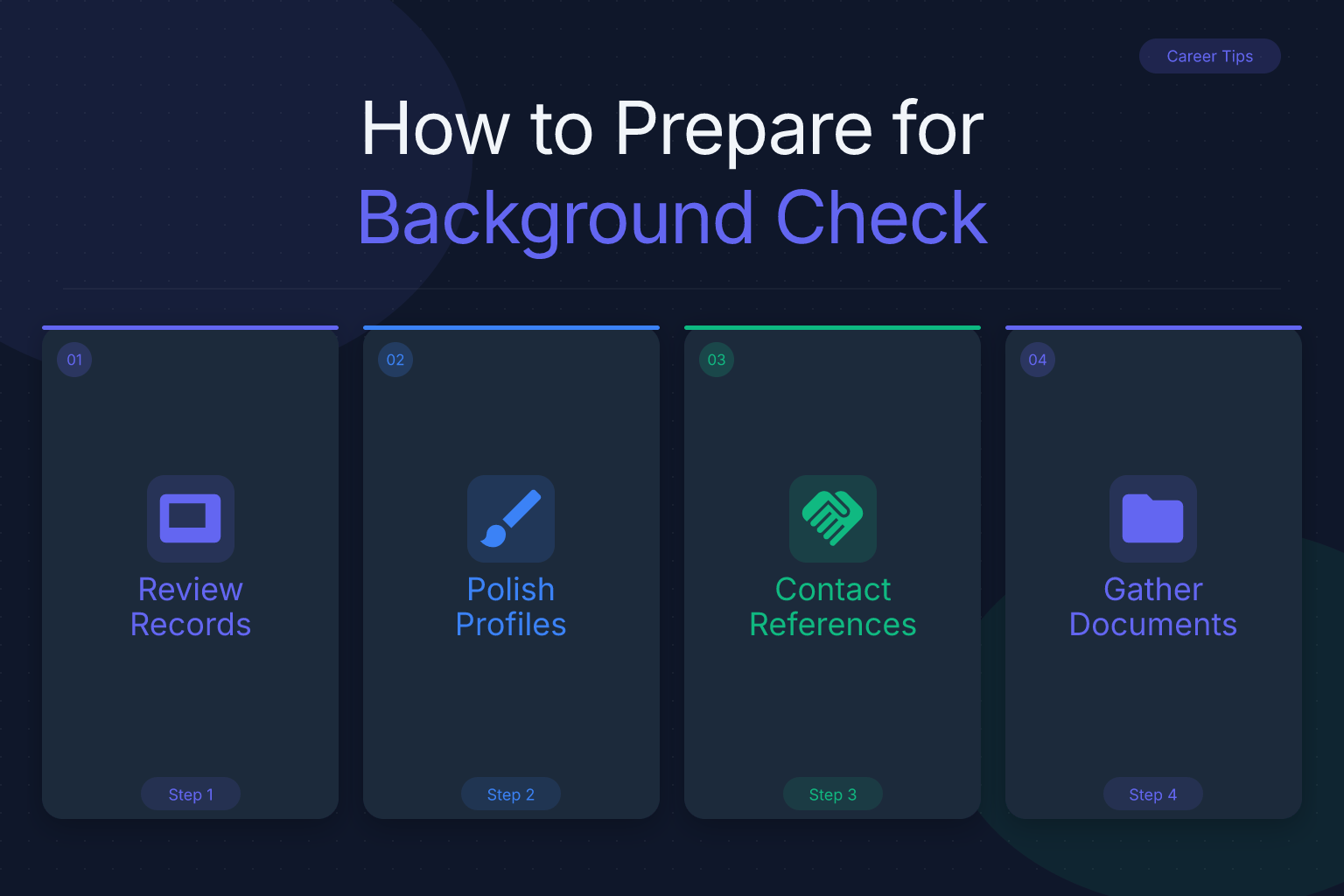
How to Prepare for an Employment Background Check
You’ve aced the interviews, and now the offer is near—but first, a background check. Don’t panic. This guide shows what employers verify and how to get your records in order.
Key Takeaways
- Most checks verify identity, employment, education, criminal records, and sometimes credit/driving. Review those records yourself.
- Discrepancies between your resume and the check are the top reason offers get delayed. Double-check every date, title, and degree.
- You have FCRA rights: see your report, dispute errors before adverse action.
- If a red flag exists, address it proactively with the employer.
- Checks take 2–10 business days; have documents ready to speed verification.
Summary Table: Preparing for a Background Check at a Glance
| What to Do | Why It Matters | Time Needed |
|---|---|---|
| Review your own background report | See what employers see, fix errors | 1–2 hours |
| Audit your resume for accuracy | Mismatched dates/titles flag dishonesty | 30–60 min |
| Gather supporting documents | W-2s, pay stubs, diplomas resolve discrepancies | 1–2 hours |
| Notify references and past employers | Prevents delays when screening calls | 15–30 min |
| Address red flags proactively | Builds trust, avoids surprises | Varies |
What Is an Employment Background Check?
An employment background check is a review of your personal, professional, and sometimes financial history, conducted before finalizing a job offer. Employers use third-party consumer reporting agencies (CRAs) to pull records from public databases, past employers, schools, and credit bureaus. The goal: confirm you meet the role’s requirements and assess risk. Checks vary by industry—financial services dig deeper into credit, hospitals verify licenses, remote roles may only check identity.
Types of Background Checks Employers Run
- Identity verification: Confirms name, DOB, SSN.
- Employment history: Verifies job titles, dates, sometimes salary.
- Education: Checks degrees, diplomas, certifications.
- Criminal history: Searches county, state, federal databases; state laws limit lookback.
- Credit history: For financial roles; shows debt, bankruptcies, not score.
- Driving record: For driving jobs; license status, violations.
- Drug screening: Often alongside.
- Professional license verification: Confirms licenses are current.
How Far Back Do Background Checks Go?
The lookback period depends on the type of check and your location. Under the FCRA, criminal convictions can be reported indefinitely, but many states restrict reporting of arrests not leading to conviction to seven years. Some states, like California and New York, limit reporting of older offenses or certain misdemeanors. Employment and education verifications typically cover your entire history, though employers often focus on the last 7–10 years. Credit history checks under the FCRA generally report negative items for seven years and bankruptcies for up to ten years. Additionally, many states have “ban-the-box” laws that restrict when employers can ask about criminal history, and some jurisdictions seal juvenile records or allow expungement. Employers may also have internal policies that only consider recent convictions. If you’re concerned about older items, check your state’s specific regulations and consider consulting a legal aid organization. Understanding these limits can help you prepare and know what to expect.
Step-by-Step: How to Prepare for an Employment Background Check
1. Run a Background Check on Yourself
Order your own report from a reputable CRA (under $30). Also pull your free annual credit report from AnnualCreditReport.com. Review for errors—criminal records, employment, education, credit. Dispute inaccuracies immediately; it can take 30+ days.
2. Audit Your Resume for Accuracy
This is critical. Compare resume claims to what employers will verify. Check job titles (use exact official title), dates (month/year), education (list degree exactly as on diploma; if not completed, say “coursework toward”). For gaps, be ready to explain. If you used a resume builder, update and export a clean PDF.
3. Gather Supporting Documents
Create a folder with W-2s/pay stubs (past 7–10 years), diplomas/transcripts, performance reviews, contact info for former managers. If a past employer is unresponsive, these documents can verify your history and keep your offer from stalling.
4. Notify References and Past Employers
Send a quick email to former managers and HR: let them know a background check company may contact them, confirm their contact info. This prevents delays.
5. Address Potential Red Flags Proactively
If you know a negative item will appear (conviction, termination, unfinished degree), have a brief, honest conversation with the recruiter after the conditional offer. Frame it as: “I want to be upfront about something that may come up.” State facts without over-explaining. Many employers appreciate honesty. If you’ve prepared thoroughly for the interview, you’ll have the confidence to handle this conversation calmly.
6. Understand Your Rights Under the FCRA
Key rights: written consent required; if adverse action is considered, you get a copy of the report and a summary of rights before final decision; you can dispute errors with the CRA (investigation within 30 days); if adverse action taken, you receive notice with CRA contact info. Knowing these rights lets you push back on mistakes.
Common Red Flags and How to Address Them
- Criminal Record: Not all disqualify. Research ban-the-box laws, expungement. If old/minor, explain what you learned.
- Employment Gaps: A gap isn’t a red flag if explained. Have a short, positive reason (caregiving, freelancing). If you’re returning after raising children, see our guide for returning to work.
- Job Title/Date Discrepancies: Update resume to match official records. If title was functionally different, explain in interview but keep background check accurate.
- Education Mismatches: Never claim a degree you didn’t earn. If short a few credits, be transparent; some employers will accept a completion plan.
- Bad Credit: If role requires credit check, pull report early, fix errors. If poor, explain steps taken to improve (payment plan, etc.).
What to Do If You Fail a Background Check
Don’t panic. “Fail” is misleading—the employer decides. If you get a pre-adverse action notice, read the report, gather evidence to dispute errors (W-2s, pay stubs), respond in writing with proof, and ask for a second review. If the issue is accurate and offer rescinded, ask about reapplying later.
How to Keep Your Background Check-Ready Year-Round
- Keep a file of performance reviews, pay stubs, offer letters.
- Maintain a LinkedIn profile matching your resume.
- Check your own background report annually.
- Stay on good terms with former managers.
- Be honest on every application.
FAQ
Q: How long does a background check take?
A: 2–10 business days. Delays often from unresponsive past employers. Have your documents ready to speed verification.
Q: Can I start work before the check is complete?
A: Some employers allow conditional starts, but rare in licensed/security roles. Employment remains contingent.
Q: Will a background check show if I was fired?
A: Standard verification confirms titles, dates, sometimes rehire eligibility. Reason for leaving usually not disclosed unless employer volunteers. Address proactively if you were fired for cause.
Q: Do background checks look at social media?
A: Some include social media screening separately. Review privacy settings and clean public content.
Q: What if someone else’s record appears due to a common name?
A: Provide full name, DOB, previous addresses to CRA. Dispute errors immediately under FCRA.
Q: Can an employer run a check without permission?
A: Under FCRA, written consent required for third-party checks. In-house checks vary by state, but reputable employers ask.
Q: How do I explain a background check issue in an interview?
A: Wait until conditional offer, then brief, honest conversation with recruiter. Focus on lessons learned. For more strategies, see our complete interview preparation guide.
Related articles:
Track Every Application While You Job Hunt
Stop losing track of where you’ve applied. The ResumeMate Job Tracker is a free Chrome extension that tracks every application, deadline, and follow-up in one place — right from your browser.