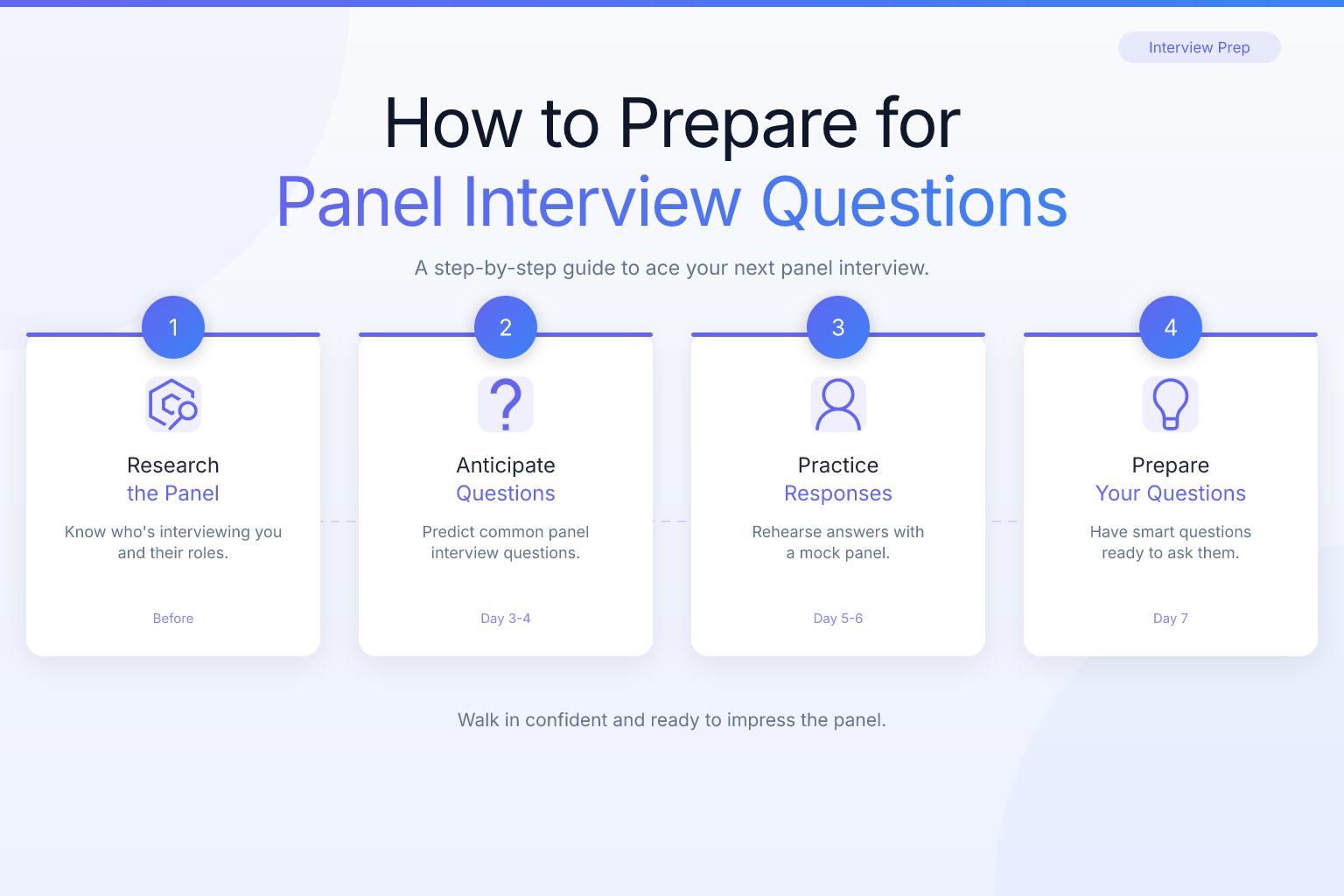
How to Prepare for Panel Interview Questions: A Step-by-Step Guide
Facing a room full of interviewers can feel intimidating, but with the right preparation, you can turn a panel interview into a powerful opportunity to showcase your fit for the role. Unlike a one-on-one conversation, a panel interview puts you in front of multiple decision-makers at once — each with their own priorities, questions, and evaluation criteria. This guide breaks down exactly how to prepare for panel interview questions, from researching the panel to mastering your answers and following up with impact.
Key Takeaways
- Panel interviews are designed to let multiple stakeholders assess you simultaneously, so your answers must address diverse perspectives.
- Research each panelist’s role and background to tailor your responses and build rapport.
- Use the STAR method to structure behavioral answers, and practice delivering them to a group.
- Engage every interviewer through eye contact, inclusive language, and balanced attention.
- Follow up with personalized thank-you notes that reference specific points from the conversation.
| What to Do | Why It Matters | Time |
|---|---|---|
| Research each panelist’s role and recent work | Shows you’ve done your homework and helps you connect your experience to their priorities | 1–2 hours before the interview |
| Prepare 5–7 STAR stories that highlight key competencies | Gives you flexible, structured answers for behavioral questions | 2–3 hours of practice |
| Practice answering questions out loud to a mock panel | Builds confidence speaking to multiple people and reduces filler words | 30–45 minutes per session |
| Prepare 3–5 thoughtful questions for the panel | Demonstrates engagement and helps you evaluate the team and company | 30 minutes of research |
| Send personalized thank-you notes within 24 hours | Reinforces your interest and keeps you top of mind with each interviewer | 20–30 minutes |
What Is a Panel Interview and How to Prepare for Panel Interview Questions
A panel interview involves two or more interviewers questioning you at the same time. Companies use this format to see how you handle pressure, communicate with multiple stakeholders, and align with different perspectives in a single session. It’s common in academia, healthcare, tech, and leadership roles where cross-functional collaboration is essential.
Preparing for panel interview questions requires a shift in mindset. Instead of building rapport with one person, you need to connect with several people simultaneously — each with their own agenda. The panel might include a hiring manager, a peer from the team, a direct report, and someone from HR. Your answers must resonate with all of them.
Start by understanding the format. Some panels are highly structured, with each interviewer asking a set of predetermined questions. Others are conversational, with interviewers jumping in as they see fit. Ask the recruiter or coordinator what to expect so you can tailor your preparation.
How Panel Interviews Differ from One-on-One Interviews
Panel interviews aren’t just longer versions of a one-on-one. They test skills that individual interviews can’t easily measure.
Multiple perspectives in one room. Each panelist evaluates you through a different lens. The hiring manager cares about your ability to deliver results. A potential peer wants to know if you’ll be collaborative. HR assesses culture fit and logistics. Your answers need to address all these angles without sounding scattered.
Group dynamics matter. Interviewers watch how you handle the room. Do you make eye contact with everyone? Do you acknowledge each person’s question, or do you only focus on the most senior person? These subtle cues signal your emotional intelligence and teamwork style.
Less time to build individual rapport. In a one-on-one, you can spend a few minutes on small talk to establish a connection. With a panel, you have to build credibility quickly and maintain it across multiple interactions. That means your opening and closing statements carry extra weight.
Questions may overlap or build on each other. One panelist might ask about a project, and another might follow up with a deeper technical question. You need to stay flexible and avoid repeating yourself while still giving each person a complete answer.
Common Panel Interview Questions You’ll Face
Panel interviews often mix behavioral, situational, and role-specific questions. Here are the categories you’re most likely to encounter, along with examples.
Behavioral questions. These ask about past experiences to predict future performance. Expect questions like:
- “Tell me about a time you led a cross-functional project.”
- “Describe a situation where you had to influence a stakeholder who disagreed with you.”
- “Give an example of a mistake you made and how you handled it.”
Situational questions. These present hypothetical scenarios to test your problem-solving. For example:
- “How would you prioritize tasks if you had conflicting deadlines from two senior leaders?”
- “What would you do if a key team member quit in the middle of a critical project?”
Role-specific and technical questions. Depending on the job, you might get case studies, coding challenges, or questions about industry trends. The panel may include a subject-matter expert who dives deep into your technical skills.
Questions about you. Standard interview questions still appear, but you’ll answer them to a group:
- “Walk us through your resume.”
- “Why do you want to work here?”
- “Where do you see yourself in five years?”
For a deeper dive into answering common interview questions, check out our guide on interview questions and best answers.
Research the Panel Members Before the Interview
One of the most effective ways to prepare for panel interview questions is to research each person who will be in the room. This isn’t just about memorizing names — it’s about understanding what each panelist cares about so you can tailor your responses.
Find out who will be there. Ask the recruiter for the names and titles of all panelists. If they can’t share the full list, ask about the roles represented (e.g., “Will there be someone from the engineering team and someone from product?”).
Look them up on LinkedIn. Review their career history, current role, and any shared connections or interests. Note how long they’ve been at the company and what projects they’ve worked on. This helps you anticipate their perspective.
Read their published content. If a panelist has written blog posts, given conference talks, or contributed to the company’s thought leadership, read or watch it. Referencing their work during the interview — when relevant — shows genuine interest and preparation.
Understand their stake in the hire. A direct manager wants someone who can execute. A peer wants a collaborator who won’t create more work. An HR representative cares about culture, compensation, and retention. Frame your answers to address what each person is evaluating.
Prepare a question for each panelist. During the Q&A portion, ask a specific question that shows you’ve researched their background. For example: “I saw you led the migration to the new CRM last year. How did that change the way the sales team works day-to-day?”
Master the STAR Method for Behavioral Questions
Behavioral questions are the backbone of most panel interviews. The STAR method — Situation, Task, Action, Result — gives you a clear structure that keeps your answers focused, even when you’re nervous.
Situation: Set the scene with just enough context. “In my last role, we were rolling out a new inventory system, and the warehouse team was resistant because they’d been burned by a previous implementation.”
Task: Explain your responsibility. “I was the project lead, and my job was to get buy-in from the warehouse manager and his team of 15.”
Action: Describe what you did, using “I” statements. “I scheduled a series of listening sessions to understand their concerns, then worked with the vendor to customize the interface based on their feedback. I also created a one-page cheat sheet and held hands-on training sessions.”
Result: Share the outcome, ideally with numbers. “Adoption hit 90% within the first month, and inventory accuracy improved by 22%. The warehouse manager later told me it was the smoothest rollout he’d experienced.”
When answering to a panel, the STAR method keeps you from rambling. It also makes it easy for each interviewer to extract the information they need — the hiring manager hears the result, the peer hears the collaboration, and HR hears the leadership.
For a complete walkthrough of the STAR method, read our guide on mastering the STAR method for behavioral interview questions.
Practice Your Answers Out Loud — and With a Mock Panel
Reading sample questions in your head isn’t enough. You need to practice speaking your answers out loud, ideally to more than one person.
Record yourself. Use your phone to record answers to common panel interview questions. Listen for filler words (“um,” “like”), pacing, and clarity. Are you making a clear point, or are you circling around it? Adjust and re-record.
Assemble a mock panel. Ask two or three friends, mentors, or colleagues to act as interviewers. Give them a list of questions in advance, or have them improvise. The goal is to get comfortable with multiple people looking at you while you think and speak.
Practice shifting eye contact. In a panel, you should address the person who asked the question, but also glance at the others to keep them engaged. During your mock session, consciously move your gaze from one person to another as you speak. It will feel awkward at first, but it becomes natural with repetition.
Time your answers. Aim for 90 seconds to two minutes per behavioral answer. If you go much longer, you risk losing the panel’s attention. If you’re too brief, you might not provide enough evidence. Use a timer during practice.
Get feedback on content and delivery. Ask your mock panel: Did my answer make sense? Did I seem confident? Did I address the question fully? Use their input to refine your stories.
If you want to use AI to generate practice questions and get feedback, see our post on ChatGPT interview prompts.
How to Engage Multiple Interviewers During the Panel
Engaging a group is a skill you can learn. Here’s how to make every panelist feel included and respected.
Start with a strong, inclusive greeting. When you enter the room (or join the video call), smile, make eye contact with each person, and say something like, “It’s great to meet all of you. Thanks for making the time.” If you’re in person, shake hands with everyone if that’s culturally appropriate.
Use names. When answering a question, address the person who asked it by name: “That’s a great question, Sarah.” Then, as you wrap up, you might add, “I think that also speaks to what Mark mentioned earlier about cross-team collaboration.” This shows you’re listening and connecting the dots.
Balance your attention. It’s natural to focus on the most senior person or the one who seems friendliest. Consciously spread your eye contact. A good rule of thumb: spend about 60% of your eye contact on the person who asked the question, and distribute the remaining 40% among the others.
Acknowledge non-verbal cues. If you notice someone frowning or looking confused, you can say, “I see a question forming — please jump in.” This invites engagement and shows you’re attuned to the room.
Bridge between panelists. If one interviewer asks a question that relates to something another panelist said earlier, make that connection explicit. “That ties back to what Alex asked about stakeholder management. In that situation, I used a similar approach…”
Ask the panel questions that involve everyone. Instead of directing a question to one person, ask something that invites multiple perspectives: “I’d love to hear from each of you — what’s the biggest challenge the team is facing right now?”
What to Bring and How to Follow Up After a Panel Interview
Your preparation doesn’t end when the interview does. What you bring and how you follow up can set you apart.
Bring these items to the interview:
- Copies of your resume. Bring enough for each panelist, plus one extra. Even if they have digital copies, a printed resume shows foresight. Make sure your resume is ATS-friendly and up to date. You can check your resume’s ATS score for free before the interview.
- A notepad and pen. Jot down names, key points, and questions that come up. It shows you’re engaged and gives you material for your follow-up notes.
- A list of your prepared questions. Having them written down ensures you don’t forget to ask something important, even if nerves kick in.
- A portfolio or work samples. If relevant to your role, bring a few printed examples or have a digital portfolio ready to share on screen.
Send personalized thank-you notes within 24 hours. A generic “thanks for your time” won’t cut it. Write a separate, brief email to each panelist. Reference something specific they said or asked. For example:
“Hi Sarah, thank you for the question about leading cross-functional projects. I enjoyed sharing how we streamlined the product launch, and your point about stakeholder communication resonated with me. I’m excited about the possibility of bringing that approach to your team.”
If you don’t have everyone’s email, ask the recruiter to forward your notes or provide addresses. This small effort signals professionalism and genuine interest.
Reflect on what you learned. After the interview, write down the questions that stumped you, the moments you felt strong, and any insights about the team. This reflection will sharpen your performance for future interviews.
For more comprehensive interview preparation tips, read our complete guide to preparing for an interview.
Frequently Asked Questions
Q: How do I prepare for a panel interview if I don’t know who will be on the panel?
A: Ask the recruiter for the roles represented (e.g., hiring manager, peer, direct report). Research the department and company priorities instead of individuals. Prepare questions that work for any audience, and practice addressing a generic group.
Q: What questions are asked in a panel interview?
A: Panel interviews typically include behavioral questions (past experiences), situational questions (hypothetical scenarios), role-specific technical questions, and standard questions about your background and motivation. The mix depends on the job and the panel composition.
Q: How long does a panel interview usually last?
A: Most panel interviews run 45 to 90 minutes. The length depends on the number of panelists and the depth of questions. Ask the coordinator for the expected duration so you can pace yourself.
Q: How do I handle a panelist who seems disengaged or hostile?
A: Stay professional and don’t take it personally. They may be testing your composure or simply having a bad day. Continue to include them with eye contact and brief acknowledgments. If they ask a challenging question, take a breath and answer calmly.
Q: Should I bring copies of my resume to a panel interview?
A: Yes. Bring at least one copy for each panelist, plus an extra. It’s a small gesture that shows preparation and makes it easy for them to reference your experience during the conversation.
Q: How do I follow up after a panel interview?
A: Send a personalized thank-you email to each panelist within 24 hours. Mention something specific they said or asked. If you don’t have their contact information, ask the recruiter to forward your notes.
Q: What’s the difference between a panel interview and a group interview?
A: In a panel interview, multiple interviewers question one candidate. In a group interview, multiple candidates are interviewed together, often with group activities. The preparation strategies are different; this guide focuses on panel interviews.
Related articles:
- Software Engineer Behavioral Interview: How to Prepare
- Second Interview Questions and How to Answer Them
- Technical Interview for Non-Coding Roles: How to Prepare
Track Every Application While You Job Hunt
Stop losing track of where you’ve applied. The ResumeMate Job Tracker is a free Chrome extension that tracks every application, deadline, and follow-up in one place — right from your browser.