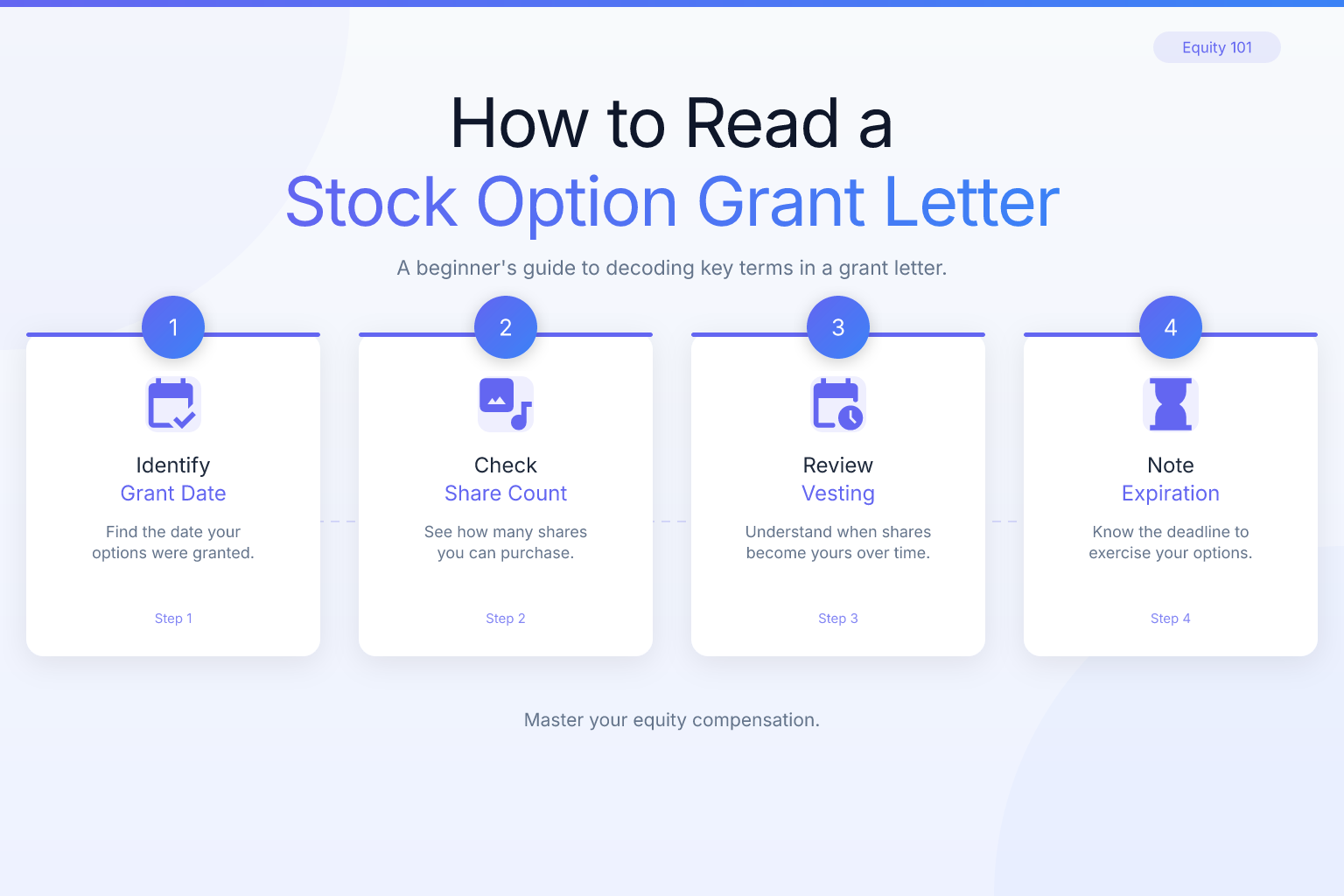
If you’ve just received a job offer that includes equity, learning how to read a stock option grant letter for beginners is the first step to understanding what you’re actually being offered. A grant letter can look like a wall of legal jargon, but it contains a few key numbers and dates that determine the real value of your compensation. This guide breaks down every section in plain English, so you can evaluate your offer with confidence.
Key Takeaways
- A stock option grant letter’s most important details are the grant date, number of shares, strike price, vesting schedule, and expiration date; locate these first to understand your equity offer.
- The strike price is usually set at the fair market value of the company’s common stock on the grant date via a 409A valuation, so your options start at the money and only gain value if the stock price rises.
- Vesting typically includes a one-year cliff, meaning you earn no options until your first anniversary, after which 25% vests and the rest vests monthly or quarterly over the following three years.
- You do not own any stock until you exercise your options and pay the strike price; before that, you only have the right to buy shares under the grant’s terms.
- Most options expire 10 years from the grant date, and if you leave the company, you usually have only 90 days to exercise vested options or lose them, so check the post-termination exercise window.
Key Takeaways:
- A stock option grant letter tells you how many shares you can buy, at what price (the strike price), and when you can buy them (the vesting schedule).
- The strike price is usually set at the fair market value of the stock on the grant date, so your options start “at the money.”
- Vesting typically includes a one-year cliff, meaning you earn nothing until your first anniversary, then a portion vests monthly or quarterly.
- You don’t own any stock until you exercise your options and pay the strike price; until then, you only have the right to buy.
- Most options expire 10 years after the grant date, and if you leave the company, you usually have 90 days to exercise vested options or lose them.
| What to Do | Why It Matters | Time |
|---|---|---|
| Find the grant date and number of shares | Determines your potential ownership stake and the start of your vesting clock | 5 min |
| Check the strike price and compare to the latest 409A valuation | Tells you whether your options are currently “in the money” | 10 min |
| Read the vesting schedule, including any cliff | Shows when you actually earn the right to buy shares | 15 min |
| Note the expiration date and post-termination exercise window | Prevents you from losing vested options if you leave the company | 5 min |
| Identify whether options are ISOs or NSOs | Affects how and when you’ll be taxed | 20 min |
How to Read a Stock Option Grant Letter: Basics and Key Terms
A stock option grant letter is a formal document from your employer that outlines the terms of the stock options you’ve been awarded. It’s usually sent after you sign your offer letter, often as part of an equity package or a separate communication from the company’s stock plan administrator. The letter is not the stock itself—it’s a promise that you have the right to buy a certain number of shares at a fixed price, under specific conditions.
For beginners, the most important thing to understand is that a grant letter contains five core pieces of information:
- Grant date – the day your options are officially awarded.
- Number of shares – how many shares you have the right to purchase.
- Strike price (exercise price) – the fixed price you’ll pay per share when you exercise.
- Vesting schedule – the timeline over which you earn the right to exercise.
- Expiration date – the deadline by which you must exercise or lose the options.
For example, a grant letter might state: “You are granted 20,000 options on June 1, 2026, with a strike price of $1.50 per share, vesting over four years with a one-year cliff, and expiring on June 1, 2036.” That single sentence contains all five core elements.
Everything else in the letter—legal definitions, tax language, plan rules—supports these five elements. Once you can locate and interpret these, you’ve read 90% of the letter.
Before you dive into the details, familiarize yourself with the vocabulary. Here are the terms that appear in almost every stock option grant letter:
- Grant date: The date the options are awarded. Your vesting schedule starts from this date, not from your hire date (unless the letter says otherwise).
- Number of shares: The total options granted. This is not the same as the number of shares you currently own—it’s the maximum you could own if you exercise all vested options.
- Strike price (exercise price): The price you’ll pay per share when you exercise. It’s typically set at the fair market value (FMV) of the common stock on the grant date, determined by a 409A valuation.
- Vesting schedule: The timeline that determines when you earn the right to exercise. Common structures include a one-year cliff followed by monthly or quarterly vesting over four years.
- Cliff: A period (usually one year) during which no options vest. If you leave before the cliff, you forfeit all unvested options.
- Expiration date: The last day you can exercise vested options. For most plans, this is 10 years from the grant date.
- Exercise: The act of buying shares at the strike price. You don’t own stock until you exercise.
- ISO (Incentive Stock Option): A type of option that can qualify for favorable tax treatment if you meet holding requirements.
- NSO (Non-qualified Stock Option): A type of option that is taxed as ordinary income at the time of exercise.
- 409A valuation: An independent appraisal of the company’s common stock fair market value, used to set the strike price.
Step-by-Step: How to Read Your Grant Letter
Follow these steps to decode your grant letter in under 30 minutes.
Step 1: Find the grant date and number of shares
The grant date is usually in the first paragraph or a table near the top. The number of shares is often listed as “Number of Shares Subject to Option” or similar. Write both down. The grant date starts your vesting clock, and the share count determines your potential ownership.
Example: “You are granted 10,000 options on March 15, 2026.”
Step 2: Locate the strike price
Look for “Exercise Price per Share” or “Strike Price.” This is the price you’ll pay per share when you exercise. Compare it to the company’s latest 409A valuation (you can ask HR or check your equity portal). If the strike price is $1.00 and the current 409A is $5.00, your options are $4.00 “in the money” on paper.
Step 3: Understand the vesting schedule
The vesting schedule is often written as a fraction or a sentence. A typical schedule: “25% of the shares vest on the first anniversary of the grant date, and the remaining 75% vest in equal monthly installments over the following 36 months.” That means a one-year cliff, then 1/48th of the total vests each month for three years.
Step 4: Check the expiration date
Most grant letters state that options expire 10 years from the grant date. But also look for a “post-termination exercise period”—the window you have to exercise vested options after leaving the company. Many companies give 90 days; some give longer. If you leave and don’t exercise within that window, you lose the options.
Step 5: Identify the option type (ISO vs NSO)
The letter will specify whether the options are Incentive Stock Options (ISOs) or Non-qualified Stock Options (NSOs). This matters for taxes. ISOs can offer tax advantages if you hold the shares long enough, but they also trigger alternative minimum tax (AMT) considerations. NSOs are taxed as ordinary income when you exercise.
Step 6: Look for special clauses
Some letters include early exercise rights (allowing you to exercise unvested options), acceleration on change of control (vesting speeds up if the company is acquired), or repurchase rights. These can significantly affect the value of your options, so read them carefully.
Understanding Vesting Schedules
Vesting is the process by which you earn the right to exercise your options over time. It’s designed to incentivize you to stay with the company. The most common structure is a four-year vesting schedule with a one-year cliff.
How a typical schedule works:
- Year 1 (cliff): No options vest. If you leave before your first anniversary, you get nothing.
- After the cliff: 25% of your total options vest at once.
- Months 13–48: The remaining 75% vests in equal monthly installments (1/48th per month) or quarterly installments (1/16th per quarter).
Example: You’re granted 10,000 options with a one-year cliff and monthly vesting over four years. After 12 months, 2,500 options vest. Each month after that, 208.33 options vest (10,000 ÷ 48). After four years, all 10,000 are vested.
Some companies use different schedules: three-year vesting, quarterly vesting without a cliff, or performance-based vesting. Always check the exact terms in your letter.
What happens if you leave?
- Before the cliff: You forfeit all options.
- After the cliff but before full vesting: You keep only the vested portion. You typically have 90 days to exercise those vested options or lose them.
- After full vesting: You can exercise at any time before the expiration date, subject to the post-termination window if you leave.
Strike Price and Fair Market Value: What They Mean
The strike price is the price you’ll pay per share when you exercise your options. It’s set on the grant date and usually equals the fair market value (FMV) of the company’s common stock, as determined by a 409A valuation. A 409A valuation is an independent appraisal that private companies must obtain to set option strike prices in compliance with IRS rules.
Why the strike price matters:
- If the company’s value increases, your options become “in the money”—the difference between the current FMV and your strike price is your paper profit.
- If the company’s value stays flat or decreases, your options may be “underwater” (strike price above current FMV), making them worthless unless the company recovers.
Important distinction: The 409A valuation is not the same as the price investors paid in the last funding round (the preferred price). Preferred stock often has additional rights and a higher price. Your options are for common stock, so the 409A is usually lower than the preferred price. Don’t assume your options are worth the preferred price per share.
Example: A startup raised a Series B at $10 per share (preferred). The 409A valuation for common stock is $2 per share. Your strike price is $2. If the company later goes public at $20 per share, your options are worth $18 per share on paper (before taxes and dilution).
Tax Implications: ISO vs NSO
Taxes on stock options are complex, and this is not tax advice. But understanding the basic difference between ISOs and NSOs will help you read your grant letter with clearer eyes.
- Incentive Stock Options (ISOs): If you hold the shares for at least one year after exercise and two years after the grant date, you may qualify for long-term capital gains tax on the profit. However, exercising ISOs can trigger alternative minimum tax (AMT) in the year of exercise, even if you don’t sell. ISOs are only available to employees, not contractors or advisors.
- Non-qualified Stock Options (NSOs): When you exercise, the difference between the strike price and the fair market value is taxed as ordinary income in that year. When you later sell the shares, any additional gain is taxed as capital gains. NSOs are simpler but often result in a higher immediate tax bill.
Example: You exercise 5,000 NSOs when the strike price is $1.00 and the fair market value is $4.00. You’ll owe ordinary income tax on $15,000 ($3.00 spread × 5,000 shares) in that year. If they were ISOs and you held the shares for the required periods, that $15,000 might eventually be taxed as long-term capital gains instead.
According to the IRS, the tax treatment depends on the type of option and your holding period. Always consult a tax professional before exercising, especially if you have ISOs and might owe AMT.
Common Mistakes Beginners Make
Avoid these pitfalls when reading your first grant letter:
- Ignoring the letter entirely – Some people sign the offer and never read the grant letter. You could be leaving money on the table or missing critical deadlines.
- Assuming options equal stock – Options are the right to buy, not ownership. You don’t own anything until you exercise and pay the strike price.
- Not understanding the cliff – If you plan to leave before the one-year mark, your options are worth zero. Factor that into your decision.
- Forgetting the expiration date – Options don’t last forever. If you leave the company and miss the 90-day exercise window, you lose vested options.
- Ignoring taxes – Exercising options can trigger a large tax bill, especially with NSOs or ISOs subject to AMT. Plan ahead.
- Not asking questions – If any term is unclear, ask HR or the stock plan administrator. It’s your compensation; you have the right to understand it.
Example: Imagine you’re granted 8,000 options with a one-year cliff. If you leave after 10 months, you forfeit all 8,000 options—even if the company’s value has doubled. That’s a $0 equity outcome despite a promising grant.
What to Do After You Read Your Grant Letter
Once you’ve decoded the key terms, take these next steps:
- Ask for clarification – If the vesting schedule, strike price, or expiration date is unclear, email HR. A good company will explain it in plain English.
- Compare with other offers – If you’re weighing multiple job offers, calculate the potential value of each equity package. Remember that startup equity is risky; a higher salary might be worth more than a larger option grant.
- Consider the total compensation – Stock options are just one part of your pay. Factor in base salary, bonus, benefits, and growth potential. If you’re negotiating, read our guide on how to ask for a raise after six months to understand how to approach compensation conversations.
- Update your career documents – If this is your first equity offer, you’re likely in a tech or startup role. Make sure your resume reflects your skills and achievements for future opportunities. Check out how to write a resume summary for a tech career pivot if you’re transitioning into tech.
Example: If your grant letter shows 12,000 options at a $2.00 strike price and the latest 409A valuation is $6.00, your paper gain is $48,000. Use that number when comparing offers, but remember it’s not cash until you exercise and sell.
Reading a stock option grant letter doesn’t require a finance degree. Focus on the five core elements—grant date, share count, strike price, vesting schedule, and expiration date—and you’ll understand 90% of what matters. The rest is details you can clarify with your employer.
FAQ
Q: What is a stock option grant letter?
A: A stock option grant letter is a document from your employer that outlines the terms of the stock options you’ve been awarded, including the number of shares, strike price, vesting schedule, and expiration date. It’s your official record of the equity portion of your compensation.
Q: What is the difference between a grant letter and an option agreement?
A: A grant letter is a summary of the key terms, while an option agreement is the full legal contract that incorporates the company’s stock plan. The grant letter is easier to read, but the option agreement contains all the fine print, including tax language and plan rules.
Q: What does “vesting” mean in a stock option grant letter?
A: Vesting is the process by which you earn the right to exercise your options over time. A typical schedule includes a one-year cliff (no vesting for the first year) followed by monthly or quarterly vesting over three to four years. You only own vested options.
Q: What is a strike price, and how is it determined?
A: The strike price (or exercise price) is the fixed price you’ll pay per share when you exercise your options. It’s usually set at the fair market value of the company’s common stock on the grant date, as determined by a 409A valuation.
Q: What happens to my stock options if I leave the company?
A: If you leave, you typically have a limited window (often 90 days) to exercise any vested options. Unvested options are forfeited. If you don’t exercise within the window, you lose the vested options as well. Check your grant letter for the exact post-termination exercise period.
Q: Do I have to pay taxes when I receive a stock option grant?
A: No, you generally don’t owe taxes when you receive the grant. Taxes are triggered when you exercise the options (for NSOs) or when you sell the shares (for ISOs, subject to holding periods). However, exercising ISOs can trigger alternative minimum tax (AMT) in the year of exercise.
Q: How do I know if my options are “in the money”?
A: Compare your strike price to the current fair market value (409A valuation) of the company’s common stock. If the current value is higher than your strike price, your options are in the money. If it’s lower, they’re underwater.
Track Every Application While You Job Hunt
Stop losing track of where you’ve applied. The ResumeMate Job Tracker is a free Chrome extension that tracks every application, deadline, and follow-up in one place — right from your browser.