How to Research a Company Before an Interview
How to research a company before an interview is the first step to walking into the room prepared, not like showing up to a test without studying. This checklist walks you through exactly what to look for, where to find it, and how to turn that research into confident answers and smart questions.
Key Takeaways
- Research the company’s products, customers, competitors, and recent news before any interview.
- Use the company’s own website, LinkedIn, Glassdoor, and news sources to build a complete picture.
- Prepare at least three specific questions that show you’ve done your homework.
- Tailor your answers to the company’s stated values and current challenges.
- Avoid relying on a single source; cross-check information to avoid embarrassing mistakes.
Summary Table
| What to Do | Why It Matters | Time |
|---|---|---|
| Review the company’s “About” page and mission statement | Shows you understand their purpose | 15 min |
| Read 3–5 recent news articles or press releases | Keeps you current on challenges and wins | 20 min |
| Check employee reviews on Glassdoor or Comparably | Reveals culture and potential red flags | 15 min |
| Look up your interviewers on LinkedIn | Helps you find common ground and tailor answers | 10 min |
| Prepare 3 questions based on your research | Demonstrates genuine interest and critical thinking | 10 min |
How to Research a Company Before an Interview: A Step-by-Step Checklist
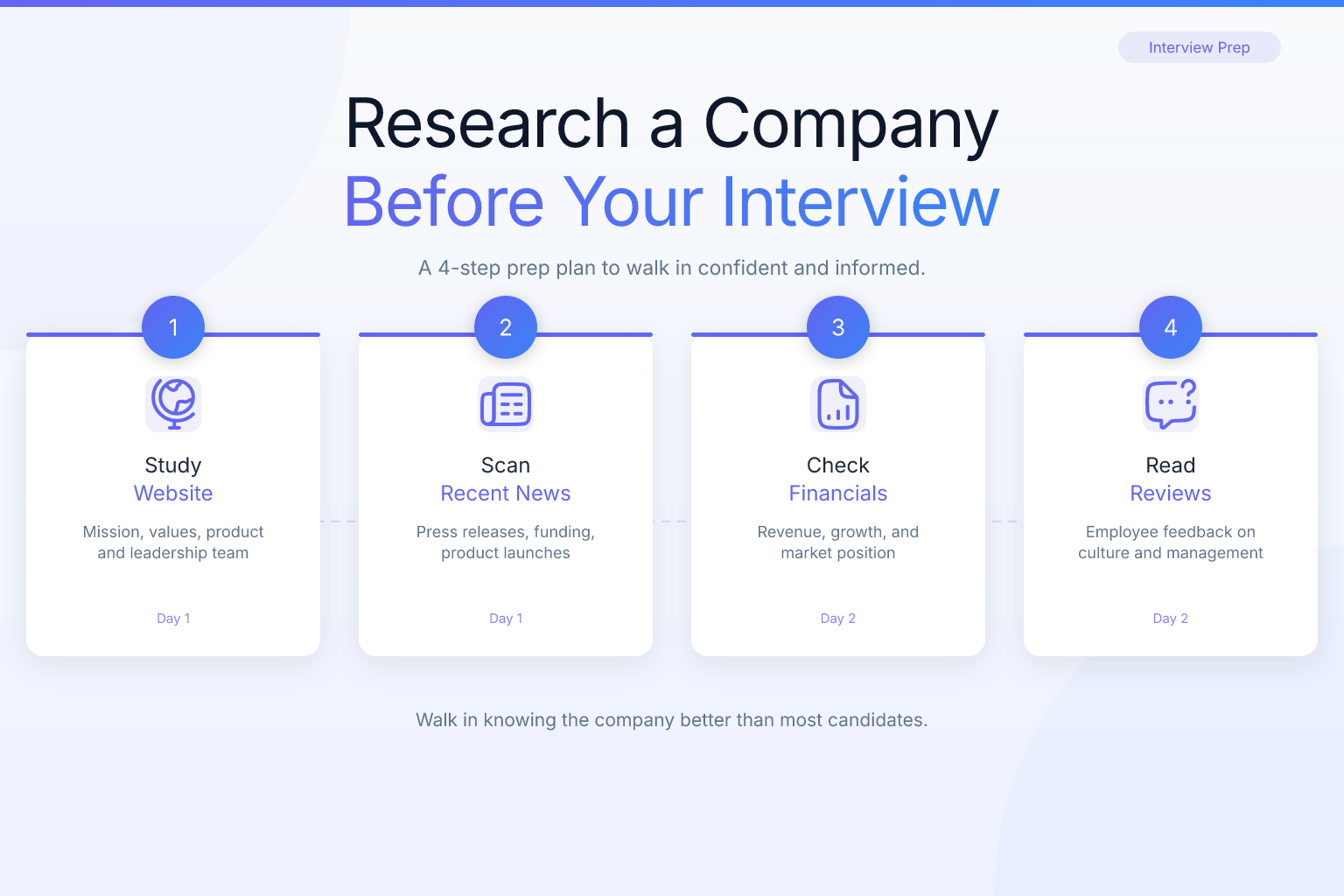
Start with a structured approach so you don’t waste time scrolling randomly. Follow this order:
- Company website – Read the About page, mission/vision, products or services, and the Careers page. Note the language they use to describe themselves. Example: If the About page says “we’re customer-obsessed,” write that phrase down and use it when answering “Why do you want to work here?”
- Recent news – Search the company name on Google News or a business news site. Look for product launches, leadership changes, funding rounds, or controversies from the last 6–12 months. Example: If you’re interviewing at a retail chain and they just announced store closures, that’s a key topic to address.
- LinkedIn company page – Check employee count, recent posts, job openings, and any articles they’ve shared. See who works there and what they talk about. Example: If the company page recently posted about a new office in Austin, you can mention it as a sign of growth.
- Employee reviews – Visit Glassdoor, Indeed, or Comparably. Read at least 10 reviews, focusing on themes about management, work-life balance, and growth opportunities. Example: If 7 out of 10 reviews mention “unlimited PTO but no one takes it,” that’s a culture signal.
- Your interviewers – Find each person on LinkedIn. Note their background, tenure, and any shared connections or interests. Example: If your interviewer previously worked at a competitor, you can ask how that experience shapes their approach.
- Financial health (if applicable) – For public companies, read the latest quarterly report on SEC EDGAR. For startups, check Crunchbase for funding and investors. Example: A public company with three straight quarters of declining revenue is a red flag; a startup with no new funding since 2021 may be running low on cash.
- Competitors and market position – Identify 2–3 direct competitors and understand what makes this company different. Example: If you’re interviewing at a project management tool, know how it differs from Asana or Trello.
Keep your notes in one place. If you’re interviewing at multiple companies, a simple spreadsheet or a tool like the ResumeMate Job Tracker can help you organize research per application.
Where to Find Reliable Company Information
Not all sources are equal. Use a mix of primary and secondary sources to get a balanced view.
- Company website – The most accurate for products, values, and official statements, but it’s marketing material. Treat it as the company’s self-portrait. Example: A company’s “About” page might say “we value work-life balance,” but Glassdoor reviews may tell a different story.
- LinkedIn – Great for seeing current employees, recent hires, and company updates. Follow the company page and look at posts from employees in your target department. Example: If you’re applying for a marketing role, see what the marketing team members share and comment on.
- Glassdoor, Indeed, Comparably – Employee reviews give you a sense of culture, but remember that disgruntled employees are more likely to leave reviews. Look for patterns, not isolated complaints. Example: One negative review about a bad manager is noise; ten reviews mentioning the same manager is a pattern.
- News outlets and press releases – Use Google News, industry publications, and the company’s own press page. This is where you’ll find recent wins, challenges, and strategic shifts. Example: A tech company announcing a new AI partnership is a great conversation starter.
- SEC EDGAR (sec.gov/edgar) – For public companies, the 10-K annual report and 10-Q quarterly reports contain detailed financials, risk factors, and management discussion. This is the most authoritative source for financial health. Example: Reading Apple’s 10-K will show you their revenue breakdown by product line.
- Crunchbase – For startups and private companies, Crunchbase shows funding rounds, investors, and key hires. It’s especially useful when the company has little public presence. Example: A Series B startup that raised $20 million last year is in a different position than one that hasn’t raised since 2020.
- Social media – Twitter/X, Instagram, and even TikTok can reveal brand voice, customer sentiment, and recent campaigns. Check how the company responds to customers. Example: If a company’s Twitter replies are defensive or rude, that’s a red flag about customer service culture.
Cross-check any surprising claim. If a review says “mass layoffs last month” but you find no news coverage, dig deeper before bringing it up in an interview.
What to Look For: Products, Services, and Market Position
You need to understand what the company actually does and how it makes money. This is the foundation for every answer you give.
- Core products or services – Can you explain what they sell in one sentence? If not, keep reading until you can.
- Target customers – Are they B2B or B2C? Who is their ideal customer? What problem do they solve?
- Competitors – Name at least two direct competitors. What does this company do better or differently?
- Recent product launches or pivots – Check the news and blog for anything from the last year. A new product line or a shift in strategy is a great conversation starter.
- How your role fits – If you’re applying for a marketing role, know their latest campaign. If it’s engineering, understand their tech stack or product roadmap. Connect your skills to their current needs.
For example, if you’re interviewing at a SaaS company that just launched an AI feature, mention that you read about the launch and ask how the team is handling adoption. That shows you’re already thinking like an employee.
Understanding Company Culture and Values
Culture is often the deciding factor in whether you’ll enjoy the job. Research it deliberately.
- Mission, vision, and values – Read these on the company website. Note the specific words they use: “innovation,” “transparency,” “customer obsession.” You’ll want to echo these in your answers. Example: If the values page says “we move fast and break things,” be prepared to discuss how you handle rapid iteration.
- Employee reviews – Look for repeated themes. Do people praise flexible hours but complain about micromanagement? That’s a signal. Do they mention “fast-paced” a lot? That could mean long hours. Example: If reviews consistently say “great people, terrible processes,” ask about process improvement in the interview.
- Social media and blog – How does the company talk about its employees? Do they highlight team events, volunteer work, or professional development? That reveals what they value publicly. Example: A company that posts weekly employee spotlights likely values recognition.
- Leadership style – Check the CEO’s or founder’s posts on LinkedIn or Twitter. Their tone often trickles down. Example: If the CEO posts about “radical transparency” but Glassdoor reviews say management hides information, that’s a contradiction to probe.
- Red flags – High turnover in reviews, multiple mentions of “no work-life balance,” or a pattern of negative comments about leadership should make you pause. You don’t need to avoid the company, but be ready to ask about these areas in the interview. Example: If 20% of reviews mention layoffs in the last year, ask about team stability.
Use this research to tailor your answers. If the company values “ownership,” share a story where you took initiative. If they emphasize “collaboration,” highlight a team win.
Researching Your Interviewers and Team
Knowing who you’ll talk to gives you a huge advantage. Spend 10–15 minutes per interviewer.
- Find them on LinkedIn – Look at their current role, how long they’ve been at the company, and their previous experience. A long tenure suggests they’re invested in the company’s success. Example: If your interviewer has been at the company for 8 years, they likely value loyalty and institutional knowledge.
- Look for common ground – Shared alma mater, previous employer, or industry background can be a natural icebreaker. Don’t force it, but if you see a genuine connection, mention it briefly. Example: “I noticed you also worked at Acme Corp—how did that experience prepare you for this role?”
- Understand their role – If you’re interviewing with a hiring manager, they care about team fit and output. If it’s a peer, they care about collaboration. If it’s an executive, they care about strategic alignment. Example: For a peer interview, emphasize teamwork and how you support colleagues; for an executive, tie your answers to company goals.
- Check their posts or activity – Have they shared articles about a specific topic? That tells you what’s on their mind. Example: If the hiring manager recently shared an article about AI in marketing, bring up that topic if relevant.
- If you know the team – Research other team members’ projects or achievements. Mentioning a specific project shows you’ve done deep homework. Example: “I saw your team launched the mobile app last year—what was the biggest challenge?”
This research also helps you prepare for panel interviews. If you know you’ll face multiple people with different priorities, you can tailor your answers accordingly. For more on that, see our guide on how to prepare for panel interview questions.
Analyzing Financial Health and Stability
You don’t need to be a financial analyst, but a basic check can save you from joining a company that’s about to downsize.
- Public companies – Read the latest 10-Q or earnings call summary. Look for revenue growth or decline, profit margins, debt levels, and any mention of layoffs or restructuring. The “Risk Factors” section of the 10-K is especially revealing. Example: If a company’s 10-Q shows revenue down 10% year-over-year and they mention “cost optimization,” that’s a signal of potential layoffs.
- Startups – Check Crunchbase for total funding, last round date, and investors. A startup that hasn’t raised money in 3+ years may be running low on cash. Look for news about runway or profitability. Example: A startup that raised a $50 million Series B in 2024 is in a stronger position than one whose last round was a $2 million seed in 2021.
- Nonprofits – Review their annual report or IRS Form 990 (available on ProPublica’s Nonprofit Explorer). Look at revenue trends and program spending. Example: If a nonprofit’s Form 990 shows declining donations for three years, ask about funding stability.
- Why it matters – You’re evaluating a long-term commitment. If the company is struggling, you might face layoffs, frozen salaries, or a chaotic work environment. If it’s thriving, you’ll have more growth opportunities. Example: Joining a company that just announced record profits is safer than one that just missed earnings expectations.
This research also helps if you’re weighing multiple offers. Understanding a company’s financial trajectory can tip the scales. For a deeper dive on comparing offers, see how to decide between two job offers.
Preparing Questions to Ask Based on Your Research
The best interview questions come directly from your research. They show you’ve done the work and you’re thinking critically.
- Ask about recent news – “I saw you launched a new product last quarter. How has the team adapted to that shift?”
- Ask about values in action – “Your values mention transparency. Can you share an example of how that plays out in day-to-day decisions?”
- Ask about challenges – “I noticed you’re expanding into a new market. What’s the biggest obstacle the team is facing right now?”
- Ask about the role’s impact – “Based on the job description, this role will support the new initiative. How will success be measured in the first six months?”
- Avoid questions answered on the website – Never ask “What does your company do?” or “Who are your main competitors?” That signals zero preparation.
Aim for 3–5 questions. You won’t have time for more, and you want to leave room for follow-ups based on the conversation.
Common Mistakes to Avoid When Researching a Company
Even well-intentioned candidates make these errors. Steer clear.
- Relying only on the company’s marketing materials – The website is polished. Employee reviews and news articles give you the unvarnished truth. Example: A company’s website might say “great culture,” but Glassdoor reviews might say “high turnover and burnout.”
- Skipping recent news – A major scandal, lawsuit, or layoff could change the entire context of the interview. Check news from the last 30 days. Example: If a company just announced a data breach, you need to know about it before the interview.
- Memorizing facts without understanding context – Knowing the CEO’s name is useless if you can’t explain why their recent strategy shift matters. Focus on the “why,” not just the “what.” Example: Don’t just say “I know you acquired Company X”—explain how that acquisition fits their growth strategy.
- Asking questions that reveal zero research – “What does your company do?” is an instant disqualifier. If you’re unsure, spend 15 more minutes on the website. Example: Instead of asking “What are your main products?”, ask “I saw you launched Product Y last quarter—how has the team adapted?”
- Over-researching to the point of paralysis – You don’t need to read every Glassdoor review or every earnings transcript. Set a time limit: 60–90 minutes total for a standard interview. Depth on a few key areas beats breadth on everything. Example: Spending 3 hours reading every review won’t help if you can’t articulate the company’s main product.
- Not organizing your notes – If you’re interviewing at five companies, you’ll mix up details. Keep a simple document or use a tool like the ResumeMate Job Tracker to store research per company. Example: Create a folder per company with notes on products, news, and interviewers.
FAQ
Q: How long should I spend researching a company before an interview?
A: Aim for 60–90 minutes for a standard interview. Spend 15 minutes on the website, 20 minutes on news and reviews, 15 minutes on your interviewers, and 10–15 minutes preparing questions. For senior roles or final rounds, double that time.
Q: What are the most important things to research about a company?
A: Focus on four areas: what the company does (products, customers, competitors), recent news and challenges, company culture and values, and the people you’ll interview with. These four give you enough to answer questions confidently and ask smart ones.
Q: Where can I find information about a company’s culture?
A: Start with the company’s mission and values page, then read employee reviews on Glassdoor and Comparably. Look for repeated themes in reviews, and check the company’s social media for how they talk about employees and team events.
Q: Should I research the interviewer before the interview?
A: Yes. Spend 10–15 minutes per interviewer on LinkedIn. Note their background, tenure, and any shared connections or interests. This helps you build rapport and tailor your answers to what they care about.
Q: What questions should I ask the interviewer based on my research?
A: Ask about recent news (“I saw you launched X—how is the team adapting?”), values in action (“How does transparency show up in daily decisions?”), and challenges (“What’s the biggest obstacle in the new market?”). Avoid questions answered on the website.
Q: How do I research a startup company with little public information?
A: Check Crunchbase for funding and investors, read the founders’ LinkedIn posts, look at the company’s blog and social media, and search for any press coverage. If the startup is very early, focus on the founders’ backgrounds and the problem they’re solving.
Q: Can I use the company’s social media for research?
A: Absolutely. Social media reveals brand voice, customer sentiment, and recent campaigns. Check how the company responds to customer complaints—that tells you a lot about their values. Just cross-check with other sources, since social media is curated.
Related articles:
Track Every Application While You Job Hunt
Stop losing track of where you’ve applied. The ResumeMate Job Tracker is a free Chrome extension that tracks every application, deadline, and follow-up in one place — right from your browser.