Knowing how to respond to a lowball job offer email is critical when you open an offer email and the number is far below what you expected. A lowball offer is rarely a final answer — most employers expect a counter, and how you frame your response sets the tone for the entire negotiation. This guide walks you through exactly what to do, what to say, and when to walk away.
Key Takeaways
- A lowball offer is often an opening position, not a final answer — most hiring managers expect you to counter with a specific, data-backed number.
- Respond within 24–48 hours to show professionalism and keep the hiring process moving; silence reads as disinterest or indecision.
- Anchor your counter with market data from sources like Glassdoor, Payscale, or the U.S. Bureau of Labor Statistics — not just your current salary or a gut feeling.
- Use a polite, collaborative tone that frames the counter as a shared problem to solve, which preserves the relationship even if you ultimately decline.
- If the offer is far below your walk-away number and the employer won’t budge, it’s acceptable to decline respectfully — no bridge-burning required.
Key Takeaways and Summary Table
- A lowball offer is often an opening position, not a final answer — most hiring managers expect you to counter with a specific, data-backed number.
- Respond within 24–48 hours to show professionalism and keep the hiring process moving; silence reads as disinterest or indecision.
- Anchor your counter with market data from sources like Glassdoor, Payscale, or the U.S. Bureau of Labor Statistics — not just your current salary or a gut feeling.
- Use a polite, collaborative tone that frames the counter as a shared problem to solve, which preserves the relationship even if you ultimately decline.
- If the offer is far below your walk-away number and the employer won’t budge, it’s acceptable to decline respectfully — no bridge-burning required.
| What to Do | Why It Matters | Time |
|---|---|---|
| Assess the full package (salary, benefits, PTO, remote work, bonus) | A low base salary may be offset by other perks you value | 30 minutes |
| Research market rates for your role, location, and experience level | Gives you concrete data to justify your counter | 1–2 hours |
| Decide your walk-away number before responding | Prevents accepting an offer you’ll regret out of pressure | 15 minutes |
| Draft a counter email with a specific number and rationale | Shows you’re serious, prepared, and professional | 45 minutes |
| Send your response within 48 hours | Keeps momentum and signals continued interest | 5 minutes |
How to Respond to a Lowball Job Offer Email: Step-by-Step
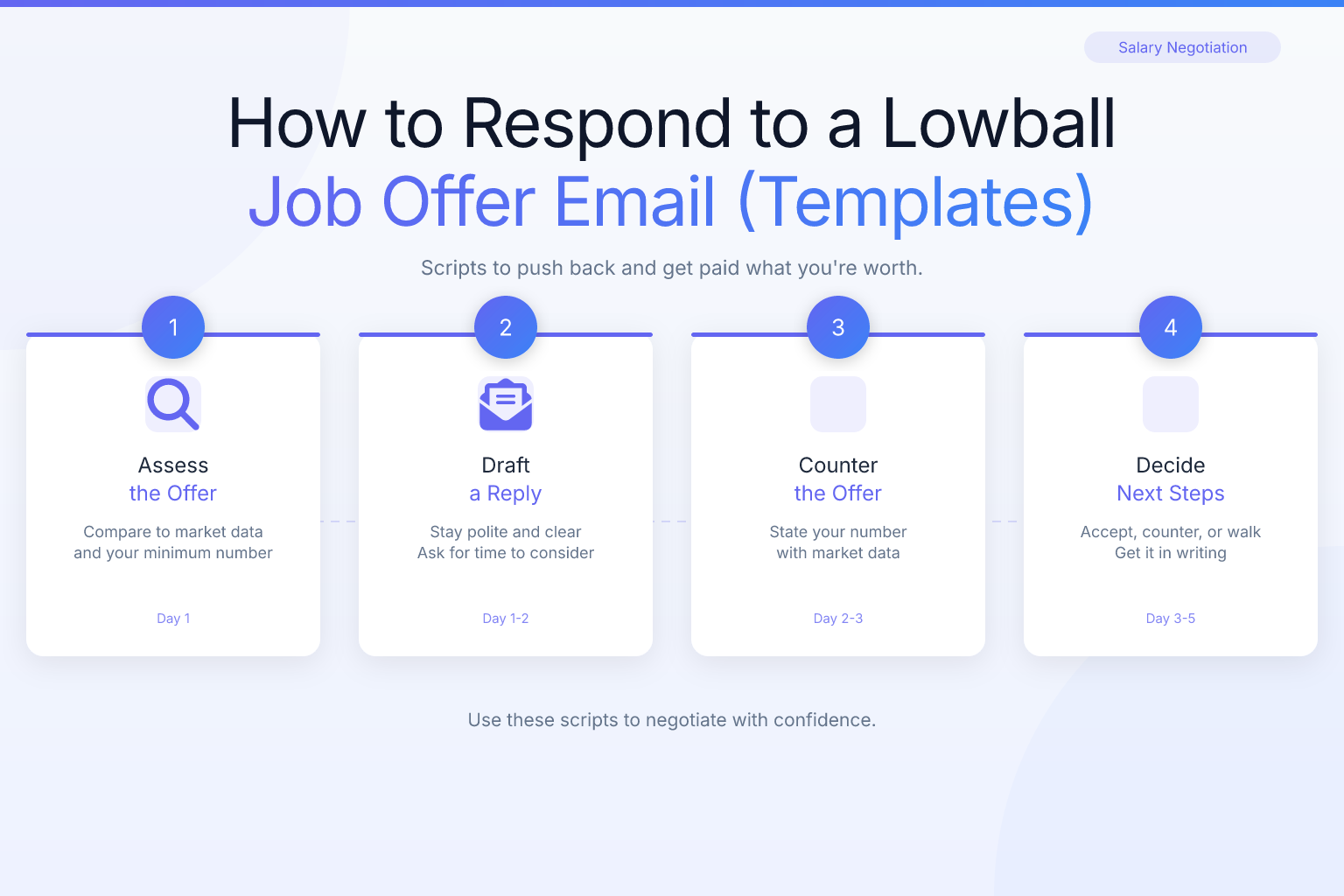
Responding to a lowball offer isn’t about firing off an angry reply. It’s a structured process that starts before you type a single word. Follow these steps in order.
Step 1: Pause and Don’t React Immediately
A lowball offer can trigger frustration, especially after multiple interview rounds. But an emotional response — even a polite one sent too quickly — can undermine your position. Take at least a few hours, ideally overnight, to process. This gives you time to research and craft a measured reply. Most employers won’t rescind an offer because you took 24 hours to respond; they expect you to think it over.
Step 2: Evaluate the Entire Compensation Package
Base salary is only one piece. A $60,000 offer with 4 weeks of PTO, fully paid health insurance, a 10% annual bonus, and remote work may actually beat a $70,000 offer with minimal benefits and a long commute. List every component: base pay, bonus structure, equity or stock options, 401(k) match, health/dental/vision premiums, PTO, sick days, parental leave, remote or hybrid flexibility, professional development stipends, and any signing bonus. Assign a rough dollar value to the ones that matter most to you. If the total package still falls short, you have a clear case for a counter.
Step 3: Research Market Rates for Your Role
You need data, not feelings. Use three sources to triangulate a fair range:
- Glassdoor, Payscale, and Levels.fyi for role-specific salary reports filtered by city and years of experience.
- The U.S. Bureau of Labor Statistics Occupational Outlook Handbook for median wages by occupation and region.
- Your own network — ask former colleagues or mentors in similar roles what they’d expect for this position.
For example, if you were offered $55,000 for a marketing coordinator role in Austin, Texas, and Glassdoor shows a median of $68,000 with a range of $60,000–$75,000, you have a 20% gap to point to. That’s a concrete, defensible anchor.
Step 4: Decide Your Walk-Away Number
Before you respond, know the lowest total compensation you’d accept. This is your floor. If the employer can’t meet it after negotiation, you walk. Write it down. This prevents you from accepting a bad offer out of fatigue or fear. Your counter should be above this number — typically 10–20% above the initial offer if the gap is reasonable, or closer to the market median if the offer is egregiously low.
Step 5: Draft and Send a Professional Counter Email
Your email should do four things: thank them for the offer, express genuine enthusiasm for the role, state your counter with a specific number and a brief rationale, and invite further discussion. Keep it under 200 words. Avoid ultimatums unless you’re truly ready to walk. We’ll cover exact templates below.
Is the Offer Actually Lowball? (Assess the Package and Research Market Rates)
What Counts as a Lowball Offer?
A lowball offer is one that falls meaningfully below the market rate for your role, experience, and location — typically 10% or more below the median. But context matters. A startup with limited cash may offer a lower base but significant equity. A nonprofit may pay below market but offer mission alignment and flexibility. A company in a low-cost-of-living area may legitimately pay less than a coastal city for the same title.
Signs you’re being lowballed:
- The offer is 15%+ below the market median for your role and location.
- The salary is lower than what you currently earn, with no offsetting benefits.
- The employer can’t explain how they arrived at the number when asked.
- The offer ignores your stated salary expectations from earlier conversations.
If you’re unsure whether the offer is truly low or just lower than you hoped, run the numbers. A 5% gap is often negotiable; a 25% gap may signal a fundamental mismatch.
Before You Respond: Assess the Full Package
Many candidates fixate on base salary and miss the bigger picture. A lowball base can be offset by:
- Signing bonus — a one-time payment that bridges the gap for the first year.
- Performance bonus — a guaranteed or likely annual bonus that adds 10–20% to total cash.
- Equity — stock options or RSUs that could be worth significant money if the company grows.
- Benefits — employer-paid health premiums can be worth $5,000–$10,000 per year.
- Flexibility — remote work saves commuting time and money; some people value that at $10,000+ annually.
- PTO and leave — extra vacation days or parental leave have real financial value.
If the total package still falls short, you have a stronger case for a counter. If the package is actually competitive despite a lower base, you may decide the offer isn’t lowball after all. For a deeper dive on evaluating benefits before you respond, see our guide on how to ask about benefits package before a job offer.
Research Market Rates to Anchor Your Counter
Your counter is only as strong as the data behind it. Here’s how to build a bulletproof case:
- Identify your exact role and level. “Software engineer” is too broad. “Mid-level software engineer, 4 years experience, Python/React stack” is specific.
- Filter by location. Remote roles often pay based on the company’s HQ or a national band. Check both.
- Use three sources minimum. Glassdoor, Payscale, and the BLS are free and credible. For tech roles, Levels.fyi is excellent. For creative roles, check AIGA or industry salary surveys.
- Document the range. Note the 25th, 50th, and 75th percentiles. Your counter should land between the 50th and 75th percentile if you’re a strong candidate.
- Factor in your unique value. If you have a rare certification, a track record of revenue growth, or a security clearance, you can justify the higher end.
Example: You’re offered $72,000 for a project manager role in Denver. BLS data shows a median of $85,000 for project managers in the Denver metro. Glassdoor shows a range of $78,000–$95,000. Your counter: $88,000, citing the median and your 6 years of experience managing $2M+ budgets.
Writing Your Counter Offer Email (With Template)
Here’s a template you can adapt. Replace the bracketed sections with your specifics.
Subject: Re: Job Offer – [Your Name]
Dear [Hiring Manager Name],
Thank you so much for the offer to join [Company Name] as a [Job Title]. I’m genuinely excited about the role and the team, and I’ve enjoyed learning more about [specific project or team detail].
After reviewing the full compensation package, I’d like to discuss the base salary. Based on my research into market rates for this role in [location] — including data from [source 1] and [source 2] — the median salary is around $[X]. Given my [X years] of experience in [relevant skill or industry] and my track record of [specific achievement], I was expecting a base salary closer to $[Y].
I’m confident I can deliver significant value in this role, and I’d love to find a number that works for both of us. Is there flexibility on the base salary, or could we discuss a signing bonus or additional PTO to bridge the gap?
Thank you again for the opportunity. I’m looking forward to your thoughts.
Best, [Your Name]
Why this works: It thanks them, shows enthusiasm, anchors with data, states a specific number, and opens the door to creative solutions — without sounding demanding.
If the offer is so low that you’re not willing to negotiate, skip the counter and go straight to a polite decline. See our guide on how to decline a job offer politely without burning bridges for a template.
What If the Employer Won’t Budge?
Sometimes the answer is no. The employer may have a fixed budget, a salary band they can’t exceed, or internal equity constraints. When that happens, you have three options:
- Negotiate non-salary items. Ask for a signing bonus, more PTO, a flexible schedule, a guaranteed performance review at 6 months with a raise, a professional development budget, or a title bump. These often come from different budget pools and are easier to approve. For scripts on negotiating PTO specifically, see how to negotiate PTO in a job offer.
- Accept with a plan. If you need the job and the total package is livable, accept — but set a reminder to revisit compensation at your first performance review. Document your contributions from day one.
- Walk away. If the offer is below your walk-away number and the employer shows no flexibility, declining is the right call. A job that underpays you from day one rarely gets better.
When to Walk Away From a Lowball Offer
Walking away is hard, especially after a long job search. But accepting a severely lowball offer can cost you tens of thousands of dollars over a few years and set a low anchor for future raises. Walk away when:
- The offer is 20%+ below market and the employer won’t negotiate at all.
- The total package is lower than your current compensation, and you’re not desperate.
- The employer is dismissive, disrespectful, or pressures you to accept immediately.
- You have another offer or strong pipeline of interviews.
- The role would require a relocation or lifestyle change that the salary can’t support.
If you do walk away, do it gracefully. Thank them for the opportunity, state that the compensation doesn’t align with your expectations and market data, and leave the door open for future roles. You never know when paths will cross again.
Common Mistakes, Sample Responses, and FAQ
Common Mistakes to Avoid When Responding
Even well-intentioned candidates sabotage their own negotiation. Avoid these:
- Responding in anger. A snarky email burns the bridge and gets screenshotted. Stay professional.
- Countering without data. “I just feel like I’m worth more” is weak. Bring numbers.
- Accepting on the spot out of fear. You almost always have 24–48 hours to respond. Use them.
- Negotiating every single line item. Pick your top two or three priorities. Asking for a higher salary, more PTO, a signing bonus, and a title change all at once can seem unreasonable.
- Using your current salary as your only anchor. If you’re underpaid now, that’s not a reason to stay underpaid. Anchor to market data.
- Ghosting the employer. If you decide to decline, send a polite email. Silence is unprofessional and can hurt your reputation.
Sample Responses for Different Scenarios
Scenario 1: The offer is 10% below your target, and you’re excited about the role. Use the counter template above. Ask for a specific number 5–10% above the offer, anchored to market data. Express enthusiasm and flexibility.
Scenario 2: The offer is 25% below market, and you suspect the employer is lowballing you. Be direct but polite: “I appreciate the offer, but based on my research, the market rate for this role is $[X]–$[Y]. I’d need a base salary of at least $[Z] to move forward. Is that within your range?” If they say no, walk away.
Scenario 3: The base is low, but the total package is competitive. Acknowledge the full package: “Thank you for the detailed offer. The benefits and bonus structure are attractive. However, the base salary of $[X] is below my expectations. Could we discuss a signing bonus or a higher base to bring the total closer to $[Y]?”
Scenario 4: You’ve decided to decline. “Thank you for the offer and for the time you’ve invested in this process. After careful consideration, I’ve decided to decline, as the compensation doesn’t align with my expectations and the market rate for this role. I’ve really enjoyed getting to know the team and hope our paths cross again.”
FAQ
Q: How do you politely respond to a lowball job offer? A: Thank the employer for the offer, express genuine enthusiasm for the role, then state that the base salary is below your expectations based on market data. Propose a specific counter number and invite discussion. Keep the tone collaborative, not confrontational.
Q: Should I accept a lowball offer if I need a job? A: If you’re unemployed or facing financial pressure, accepting a lowball offer may be the right short-term move. But negotiate first — even a small bump or a signing bonus helps. If you accept, set a plan to revisit compensation at your first performance review and document your contributions from day one.
Q: How long should I wait to respond to a lowball offer? A: Respond within 24–48 hours. Taking a day to research and craft a thoughtful counter is fine and expected. Waiting longer than 48 hours can signal disinterest and may cause the employer to move on to another candidate.
Q: What if the employer says the salary is non-negotiable? A: Ask if there’s flexibility on other components: signing bonus, PTO, remote work, professional development, or a guaranteed raise at 6 months. If the answer is still no, decide whether the total package meets your walk-away number. If not, decline politely.
Q: Can I negotiate a lowball offer via email or should I call? A: Email is usually better for a counter offer because it gives you time to craft your message and creates a written record. If you have a strong rapport with the hiring manager, a phone call can feel more personal, but follow up with an email summarizing the agreed terms.
Q: What is a reasonable counter offer percentage? A: A reasonable counter is typically 10–20% above the initial offer if the offer is within 10% of market. If the offer is 20%+ below market, counter at the market median or slightly above, and be prepared to walk if they won’t meet you.
Q: How do I know if an offer is actually a lowball or just lower than I hoped? A: Compare the offer to market data from at least three sources (Glassdoor, Payscale, BLS) for your role, location, and experience level. If the offer is within 5–10% of the median, it’s likely negotiable but not a true lowball. If it’s 15%+ below median, it’s a lowball.
Track Every Application While You Job Hunt
Stop losing track of where you’ve applied. The ResumeMate Job Tracker is a free Chrome extension that tracks every application, deadline, and follow-up in one place — right from your browser.