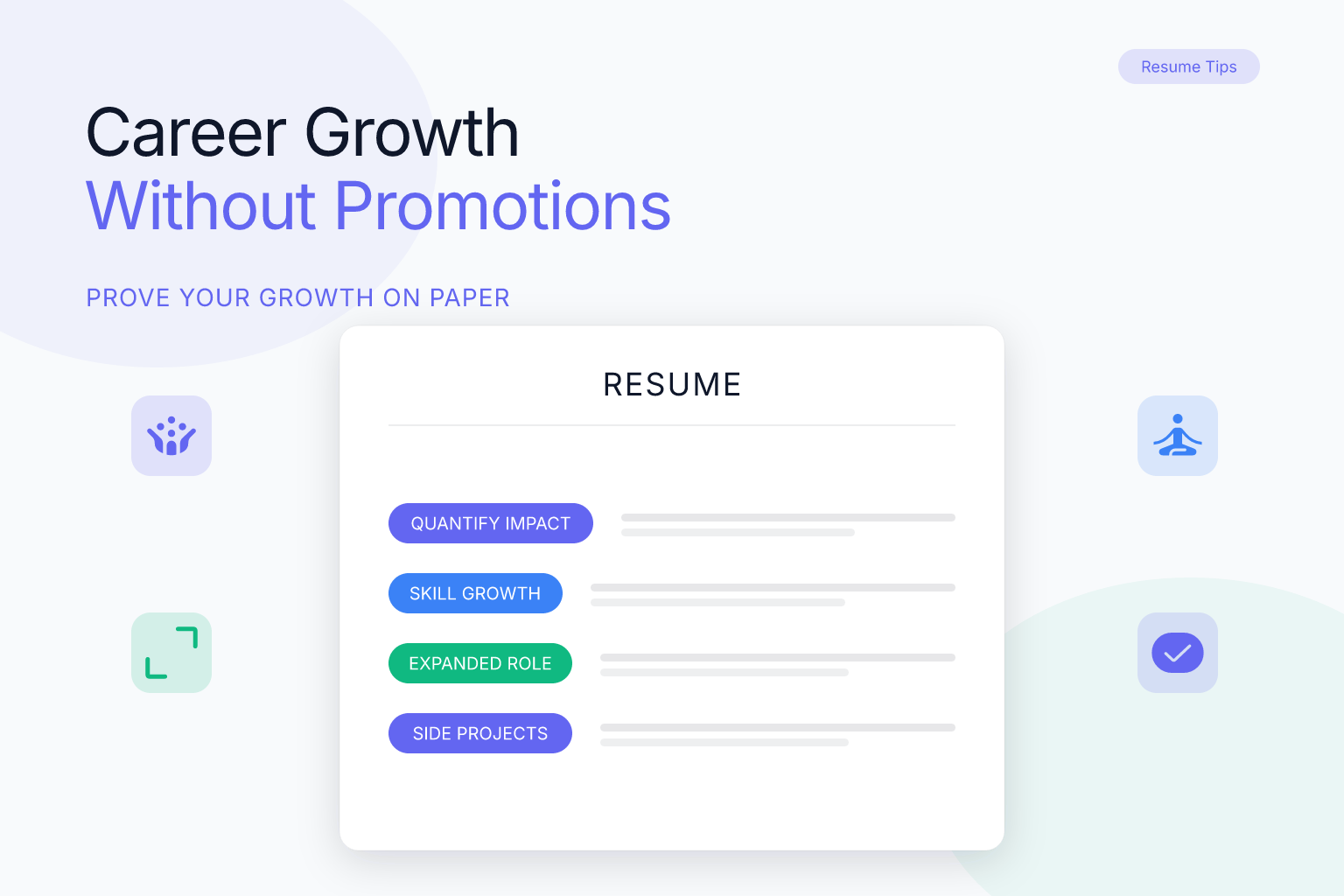
How to Show Career Growth on a Resume Without Promotions
You’ve been in the same role for years, but your responsibilities, skills, and impact have grown significantly. How to show career progression on a resume without promotions is a challenge many job seekers face — especially in flat organizations, small companies, or during hiring freezes. A static job title doesn’t mean your career has stalled. Recruiters look for evidence of growth, not just a ladder of new titles. This guide shows you exactly how to frame your experience so that a lateral move reads like a clear upward trajectory.
Key Takeaways
- Career progression is about expanding scope, not just title changes — highlight increased responsibilities, larger budgets, and broader influence.
- Quantify your impact with before-and-after metrics to make growth tangible, even within the same role.
- Use a “functional subheading” format to break a long tenure into distinct phases of increasing complexity.
- Leverage performance reviews, awards, and internal recognition as concrete proof of advancement.
- Tailor your resume to each job by mapping your growth story to the new role’s requirements.
| What to Do | Why It Matters | Time |
|---|---|---|
| Split a long role into 2-3 sub-roles with different focus areas | Shows increasing responsibility without a title bump | 15 minutes |
| Add a “Key Achievements” section under each role | Draws attention to results over tenure | 10 minutes |
| Include internal awards, special projects, and mentoring | Demonstrates leadership and trust without a management title | 5 minutes |
| Use a resume score checker to test ATS readability | Ensures your growth story isn’t lost to parsing errors | 2 minutes |
| Tailor the resume to the job description | Aligns your progression with the employer’s needs | 15 minutes per application |
Why Career Progression Matters Even Without a Title Change
Hiring managers don’t just look at job titles — they look for increasing responsibility, complexity, and impact. A lateral move or a long tenure in the same role can actually be a strength if you frame it correctly. It shows loyalty, deep expertise, and the ability to grow within constraints. The problem is that most resumes hide this growth behind a single job title and a list of repetitive duties.
When you stay in the same position for several years, you likely took on more complex projects, trained new hires, improved processes, or stepped up during a team member’s absence. These are all forms of progression. The key is to make them visible. Recruiters spend an average of 6-7 seconds scanning a resume before deciding whether to read further. If your resume looks like you did the same thing for five years, they’ll assume you stagnated — even if you didn’t.
In fact, a 2023 survey by Jobvite found that 62% of recruiters consider “career progression” a top factor when evaluating candidates, regardless of title changes. They want to see that you’ve taken on more, learned new skills, and delivered greater results over time. A static title doesn’t mean a static career — it’s your job to prove otherwise.
How to Show Growth in Flat or Small Organizations
Flat organizations and startups often lack formal promotion tracks, but they offer abundant opportunities to grow. In these environments, you might wear multiple hats, lead initiatives without a title, or step into gaps when the team is lean. Here’s how to capture that on a resume:
- Highlight cross-functional work: “Collaborated with product, engineering, and marketing to launch a customer feedback loop, reducing churn by 18%.”
- Show ownership: “Owned the end-to-end client onboarding process for 50+ accounts, a responsibility typically handled by a senior team member.”
- Mention scope creep: “Originally hired to manage social media; expanded role to include content strategy, email marketing, and analytics within 18 months.”
These details signal that you thrived in an environment where growth was self-directed — a quality many employers value highly.
Break a Single Role into Phases of Increasing Responsibility
One of the most effective techniques is to split a long-held position into two or three sub-sections, each with its own heading and bullet points. This visually creates the impression of multiple roles and makes it easy for a recruiter to see your trajectory at a glance.
For example, instead of:
Software Developer | ABC Corp | 2019–2024
- Developed features for the company’s main product
- Collaborated with the QA team
- Wrote documentation
You could structure it as:
ABC Corp | 2019–2024
Senior-Level Responsibilities (2022–2024)
- Led a team of 4 developers to redesign the payment module, reducing transaction failures by 30%
- Mentored 3 junior developers through onboarding and code review
- Initiated and managed migration to a microservices architecture, improving deployment frequency by 50%
Core Developer (2019–2022)
- Built and maintained 12 features for the flagship product, serving 2M+ users
- Collaborated with QA to reduce bug resolution time by 25%
- Authored internal documentation adopted company-wide
This approach immediately shows progression without a single title change. The reader sees a clear shift from execution to leadership and strategic impact. If you’ve held an acting role or interim title, you can list it similarly — see our guide on how to list an acting role on a resume for formatting tips.
Quantify Your Impact to Show Growth Over Time
Numbers are the universal language of progression. Even if your job title stayed the same, your results likely improved year over year. Use metrics to demonstrate that you handled more complexity, larger budgets, or bigger teams.
Examples of metrics that signal growth:
- Scale: “Managed a portfolio of 10 accounts in Year 1, growing to 35 accounts by Year 3.”
- Efficiency: “Reduced average project turnaround time from 14 days to 7 days through process improvements.”
- Revenue: “Increased territory sales from $500K to $1.2M over three years without a territory expansion.”
- Team influence: “Trained and onboarded 8 new team members, reducing their ramp-up time by 40%.”
If you don’t have exact numbers, use conservative estimates based on your memory. The point is to show a trend. Place these metrics in the bullet points under each phase or in a dedicated “Key Achievements” section.
Demonstrate Skill Growth and Leadership
Acquiring new skills and stepping into informal leadership roles are powerful forms of career progression that don’t require a promotion. If you learned a new programming language, earned a certification, or mastered a complex tool, that’s growth. List these in a dedicated “Skills” section, but also weave them into your experience bullets to show application.
For instance:
- “Earned AWS Solutions Architect certification and subsequently led cloud migration for 3 legacy applications.”
- “Completed a 12-week data analytics course and built a dashboard that reduced reporting time by 10 hours per week.”
This demonstrates that you’re proactive about your development and that your capabilities expanded over time. If you’re in a field like accounting, certifications are especially powerful — see our accountant resume examples for how to showcase CPA or GAAP skills as growth markers. If you’re concerned about ATS compatibility, you can run your resume through a free resume score checker to ensure these keywords are parsed correctly.
You don’t need a “Lead” or “Manager” title to demonstrate leadership. Leading a project, coordinating across departments, or representing your team in company-wide initiatives all count. These experiences show that you were trusted with responsibilities beyond your core role.
How to frame it:
- “Selected to lead a cross-functional task force of 6 members from engineering, marketing, and sales to launch a new feature, resulting in a 15% increase in user engagement.”
- “Served as the department’s representative on the company’s diversity and inclusion council, helping to implement a mentorship program for 50+ employees.”
If you’ve done any volunteer work that involved leadership, you can also include that. For more on that, see our guide on how to list volunteer work on a resume with no experience.
Leverage Projects, Side Initiatives, and Cross-Functional Work
Sometimes the clearest evidence of growth comes from work outside your official job description. Special projects, process improvements, or cross-departmental collaborations often carry more weight than day-to-day duties because they show initiative and the ability to operate beyond your immediate role.
What to include:
- Internal projects: “Designed and implemented a new inventory tracking system that reduced stock discrepancies by 40%.”
- Process improvements: “Streamlined the client reporting process, cutting delivery time from 5 days to 2 days.”
- Cross-functional teams: “Partnered with IT and HR to roll out a company-wide onboarding portal, used by 200+ new hires annually.”
- Side initiatives: “Launched a monthly knowledge-sharing session for the department, increasing team skill adoption by 30%.”
These examples prove you didn’t just do your job — you made the organization better. They also give you concrete, measurable results to discuss in interviews.
Prove Growth with Performance Reviews and Resume Structure
Your annual performance reviews are gold mines for evidence of progression. Look for phrases like “exceeded expectations,” “took initiative,” or “became the go-to person for X.” You can translate these into resume bullets.
Example:
- Performance review note: “Sarah consistently goes above and beyond her core duties, often volunteering to train new hires and improve documentation.”
- Resume bullet: “Recognized for exceptional initiative; volunteered to train 5 new hires and overhauled internal documentation, reducing onboarding time by 20%.”
Awards, even informal ones like “Employee of the Month” or a shout-out in a company newsletter, also serve as third-party validation of your growth. Include them in a dedicated “Awards & Recognition” section or under the relevant role.
Beyond the content, the overall structure of your resume should guide the reader’s eye toward progression. Here’s a layout that works well for showing growth without promotions:
- Professional Summary: A 2-3 sentence overview that explicitly states your career trajectory. Example: “Customer success professional with 6 years of experience progressing from handling SMB accounts to managing enterprise-level strategic partnerships, consistently exceeding retention targets.”
- Core Competencies: A keyword-rich list of skills that have expanded over time.
- Professional Experience: Use the phased approach described earlier. For each role, include a brief context line (e.g., “Promoted twice in 4 years” or “Expanded scope to include team leadership without title change”).
- Key Achievements (optional): A separate section highlighting 3-4 standout accomplishments with metrics.
- Education & Certifications: Show continuous learning.
If you’re using a resume builder, choose a clean, single-column template that’s ATS-friendly. Most modern ATS parse single-column layouts reliably. You can build and download a free, ATS-optimized PDF using ResumeMate’s AI resume builder.
Use a Summary Section to Connect the Dots
A well-written professional summary can immediately frame your entire resume as a story of progression. Instead of a generic objective, write a summary that highlights your growth arc.
Weak: “Hardworking professional seeking a challenging position.” Strong: “Operations specialist who advanced from managing a single warehouse shift to overseeing logistics for 3 regional distribution centers, improving on-time delivery by 22% — without a formal promotion.”
This tells the recruiter upfront that you’ve grown, even if your titles don’t show it. It also sets the context for the rest of the resume.
Tailor Your Resume for Each Application
Your growth story should align with the job you’re targeting. If you’re applying for a senior role, emphasize the leadership and strategic aspects of your experience. If you’re pivoting to a new field, highlight transferable skills and the progression of those skills.
Use the job description as a checklist. For each requirement, find a corresponding example from your career that shows you’ve done it at an increasing level of responsibility. This is where a resume tailoring strategy becomes essential — it ensures your resume passes both human and ATS screening.
Common Mistakes to Avoid When Showing Progression Without Promotions
- Listing the same bullet points for every year: This screams stagnation. Even if your duties were similar, find different angles or results to highlight.
- Over-inflating your role: Don’t claim a title you didn’t have. Instead, describe the responsibilities you actually performed. “Acted as team lead” is fine; “Team Lead” as a fake title is not.
- Ignoring soft skills: Growth in communication, conflict resolution, or client management is real progression. Include examples where you mediated disputes, presented to executives, or managed difficult clients.
- Using a cluttered template: Multi-column resumes with graphics can confuse ATS. Stick to a clean, single-column format. If you’re unsure, check your resume’s ATS score to see how it parses.
- Forgetting to update your LinkedIn profile: Your resume and LinkedIn should tell the same story. Use the same phased approach in your LinkedIn experience section.
- Neglecting the “why” behind your growth: Don’t just list new responsibilities — explain the impact. Instead of “Took over social media,” say “Assumed ownership of social media strategy, growing engagement by 45% in 6 months.”
- Omitting context for lateral moves: If you moved to a different department or team, briefly note the reason (e.g., “Requested transfer to Product to deepen technical expertise”). This turns a lateral move into a deliberate growth step.
Frequently Asked Questions
Q: Can I show career progression if I’ve been in the same role for 10 years?
A: Absolutely. Break that decade into 2-3 distinct phases based on major projects, skill acquisition, or expanded scope. Use metrics to show how your impact grew over time. A long tenure can be a powerful signal of reliability and deep expertise if framed correctly.
Q: What if my responsibilities didn’t change much?
A: Look for subtle shifts — did you train anyone? Improve a process? Handle more complex cases? Even small changes can be framed as progression. If truly nothing changed, focus on consistency and mastery: “Maintained 99.5% accuracy over 5 years while processing 20% higher volume.”
Q: Should I include a “Career Progression” section on my resume?
A: Not as a separate section. Instead, weave progression into your experience entries and summary. A dedicated section can feel forced. The phased sub-heading approach is more natural and scannable.
Q: How do I handle a lateral move to a different department?
A: Treat it as a promotion in terms of growth. Highlight the new skills, broader business knowledge, and increased versatility. Use a format like “Transitioned to [New Department] to broaden expertise in [area], while retaining [previous responsibilities].”
Q: Is it okay to mention that I didn’t get a promotion due to a hiring freeze?
A: You don’t need to explain why you weren’t promoted. Focus on what you did achieve. If asked in an interview, you can mention external factors, but on the resume, let your accomplishments speak for themselves.
Q: Can I use the same resume for internal promotions and external applications?
A: For internal promotions, you may need to emphasize company-specific contributions and cultural fit. For external roles, focus on transferable skills and industry-wide impact. Our guide on writing an internal promotion resume has more tailored advice.
Q: How do I show a promotion on my resume if I did get one?
A: List each title as a separate entry under the same company, with its own dates and bullet points. For example:
ABC Corp | 2019–2024 Senior Software Engineer (2022–2024)
- …
Software Engineer (2019–2022)
- …
This format clearly shows upward movement. For more detailed examples, see our guide on internal promotion resumes.
Q: What if I’m in a completely flat organization with no titles at all?
A: Focus on the evolution of your work. Use the phased approach based on project complexity, team size, or business impact. You can also add a brief note in your summary like “Operated in a flat structure where growth was measured by scope, not titles.” Recruiters in startups and agile companies will understand this context.
Related articles:
- Hyperlinks on Resume: How to Format & Track Clicks (2026)
- How to Highlight Soft Skills on a Resume Without Buzzwords
- How to Explain a Maternity Leave Gap on Your Resume
- How to Indicate Relocation Willingness on a Resume Header
- List Side Hustles on Resume Without Looking Unfocused
- Explain Job Hopping on a Resume Without Sounding Unreliable
Track Every Application While You Job Hunt
Stop losing track of where you’ve applied. The ResumeMate Job Tracker is a free Chrome extension that tracks every application, deadline, and follow-up in one place — right from your browser.