How to Spell Resume: Résumé, Resumé, or Resume? (The Correct Spelling for Job Applications)
If you’ve ever paused mid-sentence wondering how to spell resume for a job application, you’re not alone. The word appears in three common forms — resume, resumé, and résumé — and each one has its defenders. The good news: for most job seekers in English-speaking countries, the simplest version is also the most widely accepted. This guide clears up the confusion, shows you exactly which spelling to use, and explains how to type the accented versions when you need them.
| What to Do | Why It Matters | Time |
|---|---|---|
| Use “resume” (no accents) for job applications in the U.S., U.K., and Australia | It’s the standard, ATS-friendly, and avoids confusion with the verb | Instant |
| Use “résumé” (two accents) when you want to be precise or apply in Canada | It’s the original French spelling and shows attention to detail | A few seconds to type |
| Avoid “resumé” (one accent) — it’s non-standard | It can look like a typo to recruiters and style guides | N/A |
| For the verb meaning “to continue,” always spell “resume” without accents | Accents would be incorrect; the meaning is different | Instant |
The Three Spellings: Resume, Resumé, and Résumé
When you search for how to spell resume, you’ll quickly run into three variations. Here’s what each one means and where it came from.
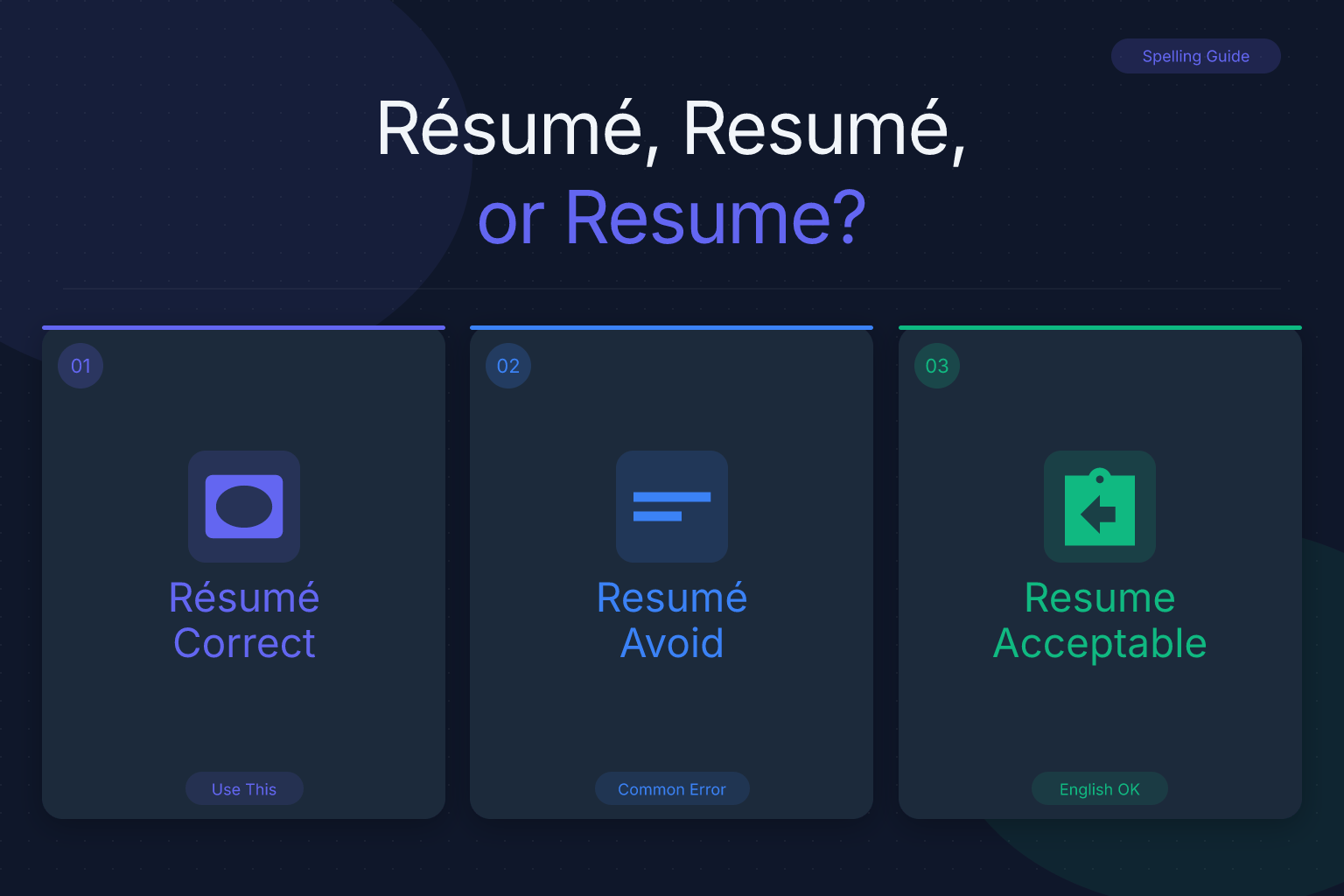
- Resume (no accents): The most common spelling in American and British English. It’s a direct borrowing from the French word résumé, but English dropped the accents over time — just like we did with cafe (from café) and fiance (from fiancé). In a job-search context, “resume” is universally understood as the document that summarizes your work history and skills.
- Résumé (two accents): The original French spelling, where both e’s carry an acute accent (accent aigu). In French, résumé means “summary.” Many style guides — including The Chicago Manual of Style and The Associated Press Stylebook — still recommend “résumé” for formal writing. You’ll see it in academic settings, publishing, and Canadian job postings, where bilingual norms keep the accents alive.
- Resumé (one accent): A hybrid that shows up occasionally, but it’s not recognized as correct by any major dictionary or style authority. Think of it as a halfway attempt that usually signals a typo. If you’re going to use accents, use both.
In practice, the version you choose depends on context. A hiring manager at a U.S. tech company won’t blink at “resume.” A Canadian government job might expect “résumé.” But no recruiter will reject you because you left off an accent — they’re far more interested in what’s on the page.
Which Spelling Should You Use on a Job Application?
For 99% of job applications in the United States, United Kingdom, and Australia, “resume” (no accents) is the safe, professional choice. Here’s why.
- Recruiters expect it. Most job portals, email subject lines, and LinkedIn profiles use “resume.” When a recruiter searches their inbox for “resume,” they’re not typing “résumé.”
- ATS systems parse plain text reliably. Applicant tracking systems (ATS) like Workday, Greenhouse, and Lever read the content of your resume, not the accents in the file name or heading. A plain “resume” won’t cause any parsing errors. If you’re worried about how your resume performs in an ATS, you can check your resume’s ATS score free and get section-by-section feedback.
- It matches your file name. You’ll likely name your file something like
John_Doe_Resume.pdf. Keeping the spelling consistent between the file name and the document heading looks polished. For more on file naming, see our guide on how to name your resume file for ATS and recruiters. - Resume builders default to it. When you use a tool like the free ResumeMate AI resume builder, the template headings already say “Resume” — no accents, no guesswork. You can export a clean, ATS-safe PDF in minutes.
If you’re applying in Canada or to a role where language precision matters (editing, academia, translation), “résumé” with both accents is a thoughtful touch. But even then, “resume” is rarely considered wrong. The content of your resume — your accomplishments, skills, and measurable results — carries infinitely more weight than an accent mark.
How to Type Résumé with Accents (Windows, Mac, Mobile)
If you decide to use “résumé,” you don’t need to copy-paste it every time. Here’s how to type the é character on any device, plus a few extra tricks to make it even easier.
On Windows:
- Hold the
Altkey and type0233on the numeric keypad, then releaseAlt. This produces é. - Alternatively, press
Ctrl+'(apostrophe), then release and typee. This works in many applications like Word and Outlook. - If you don’t have a numeric keypad, you can open the Character Map app, search for “é,” and copy it. You can also set up an autocorrect rule in Word to replace “resume” with “résumé” automatically.
On Mac:
- Press
Option+e, then release and typeeagain. The first combination sets the acute accent; the second places it on the letter. - You can also hold down the
ekey until a small menu of accented options appears, then select é with the mouse or arrow keys.
On iPhone / Android:
- Hold your finger on the
ekey. A pop-up menu appears with accented options — slide to é and release.
On Chromebook:
- Press
Ctrl+Shift+u, then type00e9and pressEnterorSpace.
If keyboard shortcuts slow you down, just type “resume.” No hiring decision has ever hinged on an accent mark. Many job seekers simply add “résumé” as a heading once and then never worry about it again. The tiny effort of typing an accent is far less important than the hours you’ll spend tailoring your bullet points.
Resume vs. Résumé: The Verb and the Noun
A big part of the “how to spell resume” confusion comes from the fact that the same letters form two different words with different pronunciations and meanings. Understanding this distinction will help you never second-guess your spelling again.
- Resume (verb): Pronounced ri-ZOOM. It means to begin again after a pause. Example: “We’ll resume the interview after a short break.” You might also say, “She resumed her duties after maternity leave,” or “The conference will resume at 1 p.m.” The verb never takes an accent.
- Résumé (noun): Pronounced REZ-oo-may (or REZ-uh-may). It means a summary, specifically a document outlining your career. Example: “I tailored my résumé to the marketing manager role.” In a sentence like “Please send your résumé by Friday,” the meaning is unmistakable.
In writing, context almost always makes the meaning clear. If you’re emailing a recruiter, “I’ve attached my resume” can only mean the document. The accents exist partly to signal the noun form, but English has largely absorbed the word without them. You’ll never need to accent the verb — “résume” isn’t a word.
A simple memory trick: the noun “résumé” has two accents, just like a summary has two key parts — your experience and your education. The verb “resume” has none, because you just continue straight ahead. If you’re still unsure, read the sentence aloud. If it sounds like “ri-ZOOM,” it’s the verb. If it sounds like “REZ-oo-may,” it’s the job document.
Common Spelling Mistakes and How to Avoid Them
Even careful writers slip up. Here are the most frequent errors people make when spelling “resume” — and how to steer clear.
- “Resum” (missing the final e). This is a simple typo, but it stands out. Double-check your email subject lines and file names. A quick fix: type “resume” slowly or let spell-check catch it.
- “Resúmé” or “résumè” (wrong accent direction or placement). The acute accent (é) points upward and to the right. A grave accent (è) points the other way and changes the pronunciation. Stick to é for both accented positions.
- “Resumé” (only one accent). As mentioned, this hybrid isn’t standard. If you accent the first e, accent the second one too — or don’t accent either.
- Using “resume” when you mean “CV.” In the U.S. and Canada, a resume and a CV are different documents. In the U.K. and Europe, “CV” is the more common term for what Americans call a resume. If you’re applying internationally, check the local terminology. Our guide on graduate CV vs. resume breaks down the differences.
- Inconsistent spelling across materials. If your resume heading says “Résumé” but your cover letter and LinkedIn profile say “Resume,” it can look sloppy. Pick one spelling and use it everywhere.
A practical tip: when you build your resume with a template, the heading is pre-set. The ResumeMate resume builder uses “Resume” as the default heading, so you never have to second-guess the spelling.
Does Spelling Affect ATS Parsing?
A common worry: will an ATS choke on “résumé” and miss my application? The short answer is no — modern ATS platforms handle accented characters without trouble. The é is a standard Unicode character, and systems like Greenhouse, Lever, and iCIMS parse it just like an unaccented e. In fact, most ATS software is built to process multilingual text, so an accent mark won’t cause your resume to be rejected or scrambled.
That said, a few older or poorly configured systems might convert “résumé” into garbled text like “résumé.” This is rare in 2026, but if you want to eliminate even a 0.1% risk, use “resume.” The ATS cares about the keywords in your experience section, not the accent on your document title. Even if the heading gets slightly mangled, the body of your resume — where your skills and achievements live — will still be parsed correctly.
A better focus: make sure your file name is clean and your content is keyword-rich. For example, naming your file John_Doe_Resume.pdf rather than Résumé_final_v2.pdf helps both ATS and recruiters. If you’re curious how your resume scores right now, upload it to the free ResumeMate score checker. It analyzes your resume’s ATS readiness and gives you actionable feedback on every section — personal info, experience, skills, and more.
How to Spell Resume in Different English-Speaking Countries
Job searching across borders? Here’s a quick reference for which spelling is most common, along with a few additional regions you might encounter.
| Country | Preferred Spelling | Notes |
|---|---|---|
| United States | Resume | Overwhelmingly dominant; “résumé” appears in formal publishing but rarely in job applications |
| Canada | Résumé or Resume | Bilingual influence keeps “résumé” common, especially in government and Quebec; “resume” is also widely accepted |
| United Kingdom | CV (not resume) | In the UK, the document is called a CV; if you do use the word “resume,” spell it without accents |
| Australia | Resume | Follows U.S. convention; “résumé” is rare |
| New Zealand | Resume or CV | Both terms used; “resume” is typically unaccented |
| Ireland | CV or Resume | “CV” is more traditional, but “resume” (unaccented) is understood in multinational companies |
| South Africa | CV | “CV” is the standard term; “resume” is occasionally used in tech or international firms, always without accents |
| India | Resume | Follows U.S. usage; “résumé” is extremely rare outside academic circles |
If you’re applying to a Canadian employer, you might lean toward “résumé” to align with local norms. For more on Canadian expectations, read our Canadian resume format guide. For everywhere else, “resume” is the safe bet. When in doubt, check the job posting itself — if the employer uses “résumé,” you can mirror that; if they use “resume” or “CV,” follow their lead.
When in Doubt, Keep It Simple
You’ve probably spent more time reading about how to spell resume than any recruiter will spend looking at the word on your document. The takeaway: “resume” (no accents) is correct, professional, and universally understood in the job market.
Focus your energy where it counts — on writing a resume that shows your impact with numbers, tailoring it to each job description, and making sure it passes an ATS scan. A single bullet point that says “Increased sales by 30% in six months” will do more for your job search than a perfectly accented heading ever could. Recruiters skim resumes in seconds, and they’re hunting for results, not diacritical marks.
If you need a starting point, our complete guide on how to write a resume walks you through every section, from summary to skills. And if you want to skip the formatting headaches altogether, the ResumeMate AI resume builder lets you create a polished, single-column resume in minutes — with the spelling already taken care of. You can also run your existing resume through the free score checker to see exactly where you stand before hitting submit.
FAQ
Q: How do you spell resume for a job?
A: For job applications in the U.S., U.K., and Australia, spell it “resume” without accents. It’s the standard form and works perfectly in ATS systems and email communications. In Canada, “résumé” with two accents is also common, but “resume” is still accepted.
Q: How do you spell resume with accents?
A: The correctly accented spelling is “résumé” — with an acute accent (é) on both the first and second e. “Resumé” with only one accent is not standard and should be avoided.
Q: How do you spell resume correctly according to dictionaries?
A: Major English dictionaries like Merriam-Webster and Oxford list both “résumé” and “resume” as correct for the noun meaning a career summary. “Resumé” is not listed as a standard variant. In everyday job searching, “resume” is the more common choice.
Q: How do you spell resume as in continue?
A: The verb meaning “to begin again” is always spelled “resume” without any accents. It’s pronounced ri-ZOOM. Example: “The meeting will resume at 2 p.m.” Adding accents to the verb form is incorrect.
Q: Is it resume or résumé on a CV?
A: In the U.S., the document itself is called a resume, so you’d write “Resume” at the top. In the U.K. and Europe, the equivalent document is a CV, and the word “resume” is less common. If you do use “resume” in those regions, the unaccented version is fine.
Q: Do employers care about the accent in résumé?
A: No. Recruiters and hiring managers focus on your qualifications, not whether you used an accent mark. An unaccented “resume” will never hurt your chances. If you’re in a field like editing or translation, using “résumé” can show attention to detail, but it’s entirely optional.
Q: How do I type an é for résumé on a keyboard?
A: On Windows, hold Alt and type 0233. On Mac, press Option+e, then e. On mobile, hold the e key and select é. If shortcuts aren’t your thing, simply typing “resume” is perfectly acceptable.
Track Every Application While You Job Hunt
Stop losing track of where you’ve applied. The ResumeMate Job Tracker is a free Chrome extension that tracks every application, deadline, and follow-up in one place — right from your browser.