Deciding to withdraw a job application before an interview is a normal part of a job search, but doing it wrong can burn bridges. Maybe you accepted another offer, realized the role isn’t the right fit, or your circumstances changed. Whatever the reason, withdrawing promptly and professionally is far better than ghosting the employer. This guide walks you through exactly how to withdraw a job application before an interview, with email templates you can copy, common mistakes to avoid, and tips for keeping your job search organized.
Key Takeaways
- You can withdraw a job application at any time before accepting an offer, and doing so promptly is more professional than ghosting.
- Send a concise, polite email to your main contact (recruiter or hiring manager) as soon as you decide to withdraw.
- You don’t need to give a detailed reason; a brief, neutral explanation like ‘I’ve accepted another position’ is sufficient.
- Withdrawing before an interview saves the employer time and keeps your reputation intact for future opportunities.
- Use a job tracker to keep your application statuses organized so you never lose track of where you’ve applied.
Key Takeaways
- You can withdraw a job application at any time before accepting an offer, and doing so promptly is more professional than ghosting.
- Send a concise, polite email to your main contact (recruiter or hiring manager) as soon as you decide to withdraw.
- You don’t need to give a detailed reason; a brief, neutral explanation like “I’ve accepted another position” is sufficient.
- Withdrawing before an interview saves the employer time and keeps your reputation intact for future opportunities.
- Use a job tracker to keep your application statuses organized so you never lose track of where you’ve applied.
Summary Table
| What to Do | Why It Matters | Time |
|---|---|---|
| Send a withdrawal email within 24–48 hours of deciding | Prevents wasted scheduling and shows respect | 10 minutes |
| Keep the message brief and positive | Leaves a good impression for future roles | 5 minutes |
| Update your job tracker status | Keeps your search organized and avoids duplicate applications | 2 minutes |
| (Optional) Offer to stay in touch | Builds a professional network | 1 minute |
When and Why to Withdraw a Job Application Before an Interview
There are several legitimate reasons to withdraw a job application before an interview. Recognizing them early helps you act decisively instead of dragging out a process you know isn’t right.
You accepted another offer. This is the most common reason. If you’ve signed an offer elsewhere, continuing to interview wastes everyone’s time. Withdrawing lets the employer move on to other candidates quickly. If you’re weighing multiple offers, check out our guide on how to decide between two job offers before you commit.
The role no longer matches your goals. After reading the job description more carefully or learning more about the company, you might realize the responsibilities, level, or industry isn’t what you want. Maybe the commute is too long, the salary range is below your needs, or the team structure doesn’t fit your working style.
Company research raised red flags. You may have discovered negative reviews, high turnover, or ethical concerns during your research. If you haven’t done deep research yet, our guide on how to research a company before an interview can help you spot issues early.
Personal circumstances changed. A family situation, health issue, relocation, or other life event can make it impossible to proceed. You don’t owe anyone details, but a brief note is courteous.
You realized you’re not qualified or overqualified. Sometimes after applying, you notice the role requires skills you don’t have or is far below your experience level. Withdrawing saves you from an awkward interview.
Whatever the reason, the key is to act as soon as you’re sure. Waiting until the day before the interview creates more disruption for the employer.
Is it okay to withdraw? Yes, absolutely. Employers expect some candidates to withdraw at every stage of the hiring process. According to hiring professionals, a certain percentage of applicants drop out before interviews for various reasons, and it’s a normal part of recruiting. What employers don’t appreciate is being ghosted — when a candidate simply stops responding without explanation.
Withdrawing is not unprofessional; it’s the opposite. It shows you respect the recruiter’s time and the company’s process. It also keeps the door open for future opportunities. Many recruiters maintain talent pools and will remember candidates who communicated clearly and politely.
You might feel guilty, especially if the employer seemed enthusiastic about your application. But remember: until you sign an offer, you have no obligation to continue. The employer would not hesitate to withdraw the role if their business needs changed, and you have the same right to change your mind.
How to Withdraw a Job Application Before an Interview: Step-by-Step
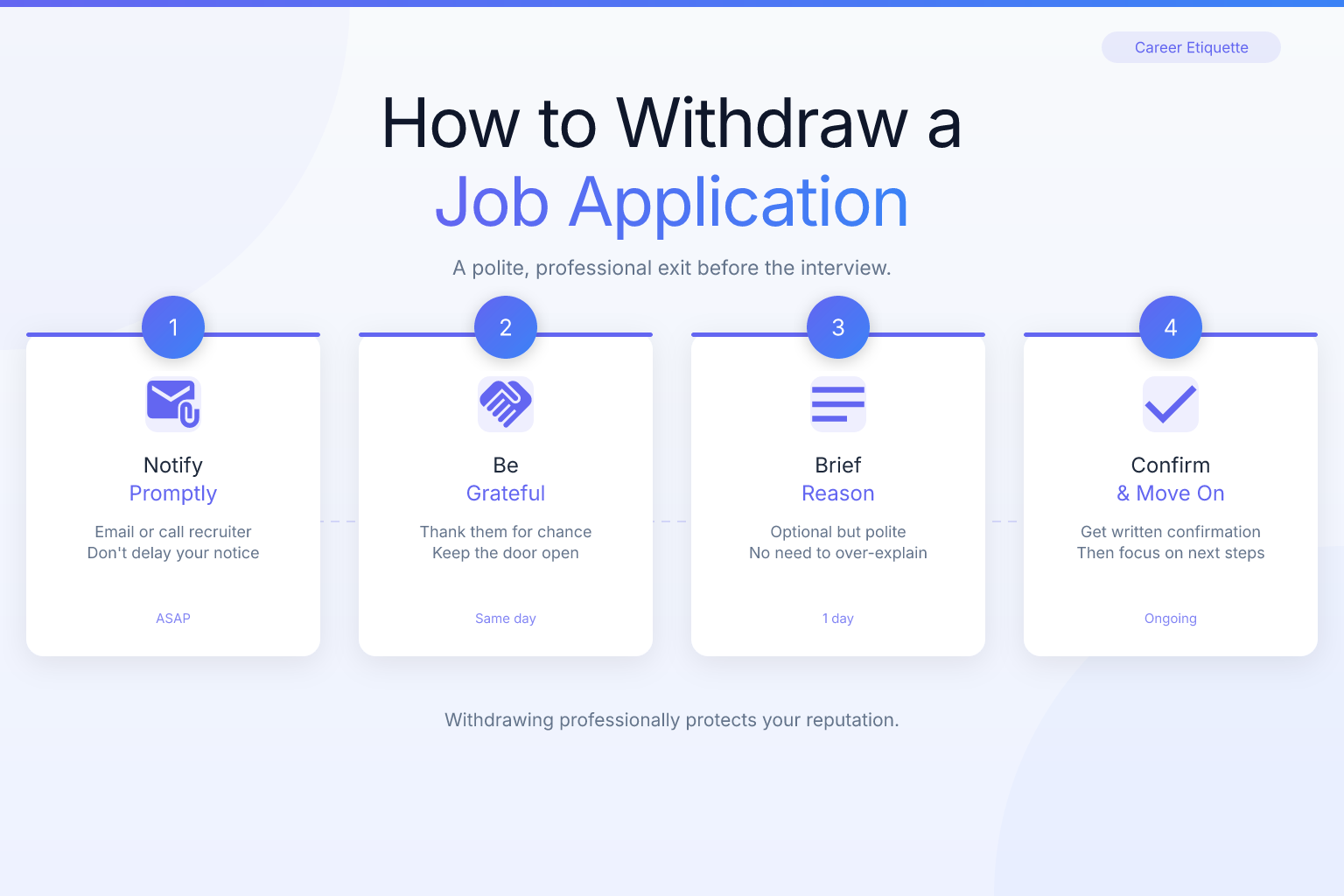
Follow these steps to withdraw cleanly and professionally.
1. Decide and commit
Don’t withdraw on a whim. If you’re unsure, take a day to think it through. But once you’re certain, act quickly. Delaying only makes the situation more awkward.
2. Find the right contact
Look back at your application confirmation email or the job posting. The best person to contact is the recruiter or hiring manager who has been communicating with you. If you applied through a portal and have no direct contact, use the general HR email or the address listed in the job posting. If you can’t find any email, a phone call to the main office is acceptable, but email is usually preferred because it creates a written record.
3. Write a concise, polite email
Your email should include:
- A clear subject line (e.g., “Withdrawing Application – [Your Name] – [Job Title]”)
- A brief statement that you’re withdrawing your application
- A neutral reason (optional but helpful)
- A thank-you for their time and consideration
- A polite closing
Keep it under 150 words. No need to over-explain or apologize excessively.
4. Send it promptly
Send the email as soon as you’ve written it. If you have an interview already scheduled, send it at least 24–48 hours before the interview time, if possible. If the interview is tomorrow, send it immediately.
5. Update your records
If you use a job tracker, mark the application as “withdrawn” so you don’t accidentally reapply or forget what happened. The ResumeMate Job Tracker is a free Chrome extension that lets you track every application, deadline, and follow-up in one place — perfect for keeping your search organized after a withdrawal.
If you’ve already scheduled an interview and then decide to withdraw, the process is nearly identical, but you should acknowledge the scheduled time and apologize for the short notice if applicable. Here’s a template for canceling a scheduled interview:
Subject: Canceling Interview – [Your Name] – [Job Title] – [Date]
Dear [Interviewer’s Name],
I’m writing to let you know that I need to withdraw my application for the [Job Title] position and cancel our interview scheduled for [date and time].
I’ve decided to pursue another opportunity that is a better fit for my current goals. I apologize for any inconvenience this may cause and appreciate your understanding.
Thank you for your time and consideration.
Best regards, [Your Name]
If the interview is within 24 hours, consider also calling the recruiter to ensure they see your email in time.
Email Templates for Withdrawing a Job Application
Here are three templates you can adapt. Replace the bracketed text with your details.
Template 1: Accepted another offer
Subject: Withdrawing Application – [Your Name] – [Job Title]
Dear [Hiring Manager’s Name],
Thank you for considering my application for the [Job Title] position. I’m writing to withdraw my application, as I’ve accepted another opportunity that aligns with my current career goals.
I appreciate the time you and your team have invested in reviewing my application, and I wish you the best in finding the right candidate.
Sincerely, [Your Name]
Template 2: Role mismatch or changed circumstances
Subject: Withdrawing Application – [Your Name] – [Job Title]
Dear [Hiring Manager’s Name],
Thank you for the opportunity to apply for the [Job Title] role. After careful consideration, I’ve decided to withdraw my application at this time.
I’ve realized that this position isn’t the right fit for my current career direction, and I don’t want to take up more of your team’s time. I appreciate your consideration and hope our paths cross again in the future.
Best regards, [Your Name]
Template 3: Personal reasons (no details needed)
Subject: Withdrawing Application – [Your Name] – [Job Title]
Dear [Hiring Manager’s Name],
I’m writing to withdraw my application for the [Job Title] position. Due to personal circumstances, I’m unable to move forward with the interview process at this time.
Thank you for your time and consideration. I’m grateful for the opportunity and wish you success in filling the role.
Sincerely, [Your Name]
What to Avoid When Withdrawing a Job Application
Even with good intentions, some mistakes can damage your professional reputation. Here’s what to steer clear of.
Don’t ghost. Simply not showing up to an interview or ignoring emails is the worst option. It wastes the interviewer’s time and leaves a lasting negative impression. Recruiters talk, and ghosting can follow you within an industry.
Don’t over-explain. You don’t need to give a detailed account of why you’re withdrawing. A sentence or two is enough. Long explanations can come across as defensive or invite unwanted questions.
Don’t burn bridges. Even if you’re withdrawing because you’re frustrated with the company or process, keep your email neutral and professional. You never know when you’ll encounter these people again.
Don’t withdraw via text or social media. Unless the recruiter has been communicating with you exclusively via text (rare), use email. It’s more formal and creates a record.
Don’t wait until the last minute. If you know you’re not going to interview, tell them as soon as possible. Canceling an hour before the interview is almost as bad as ghosting.
What Happens After You Withdraw and How to Keep Your Job Search Organized
After you send your withdrawal email, you may or may not receive a response. Many recruiters will reply with a brief acknowledgment like “Thank you for letting us know. Best of luck.” Some may ask for feedback on why you’re withdrawing, especially if they were excited about your candidacy. You can choose to share a high-level reason or keep it private.
In some cases, the employer might try to convince you to stay in the process — for example, by offering a higher salary or adjusting the role. If you’re open to that, you can continue the conversation. If not, politely reiterate your decision.
Either way, your withdrawal is final unless you choose to re-engage. Don’t feel pressured to explain further.
Withdrawing from one application shouldn’t derail the rest of your search. Here’s how to stay on top of everything.
Update your tracker immediately. Mark the application as withdrawn so you don’t accidentally reapply or forget the status. If you’re not using a tracker yet, the ResumeMate Job Tracker is a free Chrome extension that logs every application, deadline, and follow-up directly from your browser. It’s the easiest way to see your entire pipeline at a glance.
Refocus on active applications. After withdrawing, shift your energy to the roles you’re still excited about. If you withdrew because you accepted another offer, congratulations — you can stop applying altogether. If you withdrew for other reasons, use the time to refine your resume or prepare for upcoming interviews.
Learn from the experience. Ask yourself why you applied to a role you ended up withdrawing from. Was the job description unclear? Did you not research the company enough? Adjust your application strategy to avoid similar situations. For example, if you often realize a role isn’t a fit after applying, spend more time researching companies before you apply.
Keep your resume ready. If you’re continuing your search, make sure your resume is tailored to the roles you actually want. The ResumeMate AI Resume Builder helps you create a clean, ATS-friendly resume in minutes, so you’re always ready to apply to the next opportunity.
FAQ
Q: How to withdraw a job application before interview?
A: Send a brief, polite email to the recruiter or hiring manager stating that you’re withdrawing your application. Include a neutral reason if you wish, thank them for their time, and send it as soon as you’ve made your decision. Use a clear subject line like “Withdrawing Application – [Your Name] – [Job Title].”
Q: How to ask about job application status before interview?
A: If you haven’t heard back after applying and want to check your status, send a short follow-up email to the recruiter. Wait at least one to two weeks after applying, then write something like: “I’m writing to follow up on my application for [Job Title] submitted on [date]. I’m very interested in the role and would appreciate any update on the timeline.” Keep it polite and concise.
Q: How to withdraw from an interview process?
A: The process is the same as withdrawing an application: email your contact, state that you’re withdrawing from the process, and thank them for their time. If an interview is already scheduled, mention that you need to cancel it and apologize for any inconvenience. Send the email as early as possible.
Q: How to ask for a job description before an interview?
A: If you need more details about the role before deciding whether to interview, email the recruiter and ask for a full job description or clarification on specific responsibilities. For example: “Could you share a more detailed job description or clarify the day-to-day responsibilities for this role? I want to make sure I’m a good fit before moving forward.” Most recruiters will happily provide it.
Q: Can you withdraw a job application?
A: Yes, you can withdraw a job application at any point before you accept an offer. There’s no legal or professional obligation to continue the process. Withdrawing politely is always better than ghosting, and it keeps your reputation intact.
Q: Do jobs do background check before interview?
A: Most employers do not conduct background checks before an interview. Background checks typically happen after a conditional job offer is made, not during the initial screening stage. However, some employers may do a basic pre-screening (like verifying your identity or checking for red flags) before scheduling interviews, but full background checks are usually reserved for finalists.
Q: Is it okay to withdraw job application before interview?
A: Yes, it’s completely okay. Employers expect some candidates to withdraw at every stage. Withdrawing before an interview is actually considerate because it saves the employer time and allows them to focus on other candidates. Just be sure to communicate your withdrawal clearly and promptly.
Track Every Application While You Job Hunt
Stop losing track of where you’ve applied. The ResumeMate Job Tracker is a free Chrome extension that tracks every application, deadline, and follow-up in one place — right from your browser.