How to Write a Career Change Resume Summary (No Experience)
A resume summary for career changer with no direct experience can feel like the hardest part of your job search. You’re leaving a field where you had years of proven results, and now you’re trying to convince a hiring manager that your background is exactly what they need — even though you’ve never held the target job title. The good news: a well-written summary can bridge that gap. It reframes your past, spotlights your transferable strengths, and makes the reader want to learn more instead of wondering why you applied.
This guide walks you through every step. You’ll learn what a career change summary is, why it’s different from a traditional summary, how to identify the skills that matter, and how to write a version that gets interviews. You’ll also see real examples, get a template you can adapt in minutes, and discover how to avoid the most common mistakes career changers make.
According to career transition research, 68% of professionals change careers at least once in their working lives. Yet only 23% feel confident about how to present that transition on paper. This guide closes that gap with actionable, tested strategies.
Key Takeaways
- A career change resume summary leads with transferable skills and relevant achievements, not past job titles.
- The summary should connect your previous experience to the new role’s requirements using the employer’s own language.
- Quantify results from any context — volunteer work, side projects, or previous jobs — to prove you can deliver.
- Keep the summary to 3–5 lines and place it at the top of your resume so it’s the first thing a recruiter reads.
- Pair the summary with a skills section and a hybrid resume format to strengthen your positioning.
Summary Table: What to Do and Why
| What to Do | Why It Matters | Time |
|---|---|---|
| Identify 3–5 transferable skills from your past roles | Shows you have the core competencies even without direct experience | 30 min |
| Write a summary that connects your background to the target role | Frames your career change as a strength, not a gap | 20 min |
| Use keywords from the job description | Helps pass ATS filters and signals you understand the role | 15 min |
| Include a measurable achievement from any context | Proves you can deliver results, not just list skills | 15 min |
| Keep the summary to 3–5 lines | Recruiters skim; a focused summary gets read | 10 min |
Why a Resume Summary Matters for Career Changers
When you’re changing careers, your resume can’t just be a list of past jobs. A recruiter who sees an unrelated job title at the top of your experience section may assume you applied by mistake. The summary is your chance to control the narrative before they jump to conclusions.
A strong career change summary does three things:
- It explains the pivot. You’re not hiding your background; you’re framing it as an asset.
- It highlights transferable skills. You pull out the abilities that matter for the new role, even if you developed them in a different industry.
- It shows you understand the target role. By using the right terminology and referencing the employer’s needs, you prove you’ve done your homework.
Without a summary, your resume is just a history of where you’ve been. With one, it becomes a story about where you’re going.
The Recruiter’s Perspective
Recruiters typically spend 6–7 seconds scanning a resume before deciding whether to read further. For career changers, that first impression is even more critical. A hiring manager reviewing 200+ applications needs immediate clarity on why you’re relevant. Your summary answers three questions in those crucial seconds:
- Who are you professionally? (Your reimagined identity)
- What can you do for us? (Your transferable value)
- Why should we care? (Your measurable impact)
If your summary doesn’t answer these questions quickly, your resume lands in the “maybe later” pile — which often means never.
The Biggest Mistake Career Changers Make in Their Summary
Most career changers write a summary that apologizes for their background. They say things like:
- “Although I don’t have direct experience in marketing…”
- “Seeking an opportunity to transition into…”
- “Eager to learn and grow in a new field.”
These phrases signal uncertainty. They tell the hiring manager that you’re focused on what you lack, not what you bring. Instead, write with confidence. Lead with the value you’ll deliver, not the experience you don’t have.
Compare these two openings:
- Weak: “Dedicated teacher with no sales experience looking to transition into a business development role.”
- Strong: “Relationship-builder with 5+ years of influencing decisions, managing stakeholder expectations, and driving measurable outcomes in education. Ready to apply consultative selling skills to a B2B sales role.”
The second version never mentions a lack of experience. It reframes teaching as a sales-adjacent skill set.
Other Common Pitfalls to Avoid
Beyond apologizing, career changers often sabotage their summaries with these missteps:
- Being too vague. “Hardworking professional seeking new challenges” tells a recruiter nothing. Replace generic adjectives with specific skills and results.
- Using insider jargon from your old industry. Terms that made sense in your previous field may confuse a hiring manager in the new one. Translate everything into the language of the target role.
- Listing responsibilities instead of achievements. “Managed a team of 10” is a duty. “Led a team of 10 to exceed quarterly targets by 15% for two consecutive years” is an achievement. Always pair actions with outcomes.
- Writing a summary that’s too long. A dense, 8-line paragraph will get skipped. Stick to 3–5 lines that a recruiter can absorb in seconds.
- Forgetting to tailor the summary for each application. A generic summary signals that you didn’t put in the effort. Even small tweaks — swapping one skill for another, mentioning the company’s industry — can dramatically increase your callback rate.
- Leading with your old job title. If you were a “Restaurant Manager” but you’re targeting “Operations Coordinator,” don’t lead with the restaurant title. Lead with the operations expertise.
How to Identify Your Transferable Skills
Before you write a single word, you need to know what you’re selling. Transferable skills are abilities that apply across industries — communication, project management, data analysis, leadership, problem-solving, and so on. The trick is to name them in the language of your target field.
Step 1: List Every Skill You’ve Used
Grab a blank document and list every skill you’ve used in your career, volunteer work, side projects, or education. Don’t filter yet. Include hard skills (software, tools, methodologies) and soft skills (negotiation, mentoring, conflict resolution).
Dig deeper than your job description. Think about:
- What tasks did you enjoy most?
- What did colleagues ask you for help with?
- What problems did you solve repeatedly?
- What training or certifications have you completed?
Step 2: Find the Overlap with Your Target Role
Open three job descriptions for the role you want. Highlight every required or preferred skill. Then cross-reference with your list. The skills that appear on both are your transferable skills.
Pay attention to how often certain skills appear. If “stakeholder communication” shows up in all three postings, that’s a priority skill to highlight in your summary.
Step 3: Translate the Language
A teacher doesn’t “manage a classroom” — they “facilitate group dynamics and ensure engagement.” A retail manager doesn’t “handle customer complaints” — they “resolve escalations and retain at-risk accounts.” Use the terminology from the job descriptions you collected.
If you’re struggling to translate your experience, our guide on how to list volunteer work on a resume with no experience can help you mine non-traditional roles for relevant skills. And if you’ve held an interim or acting role that brought you closer to your target field, learn how to present it effectively in our article on listing an acting role on a resume.
Common Transferable Skill Categories
To spark ideas, here are skill clusters that appear across many industries, along with examples of how to reframe them:
| Skill Category | Old Industry Example | New Industry Translation |
|---|---|---|
| Communication | Wrote weekly parent newsletters | Created stakeholder updates that increased engagement by 40% |
| Project Management | Organized school fundraisers | Managed end-to-end events with budgets up to $10,000 |
| Data Analysis | Tracked student performance in Excel | Analyzed datasets to identify trends and recommend interventions |
| Leadership | Chaired the social committee | Led cross-functional teams of 15+ volunteers |
| Customer Service | Handled patient intake at a clinic | Managed high-volume client interactions with 98% satisfaction |
| Sales & Persuasion | Convinced parents to volunteer for field trips | Influenced decision-makers and increased participation by 30% |
| Problem-Solving | Resolved scheduling conflicts | Optimized resource allocation reducing delays by 25% |
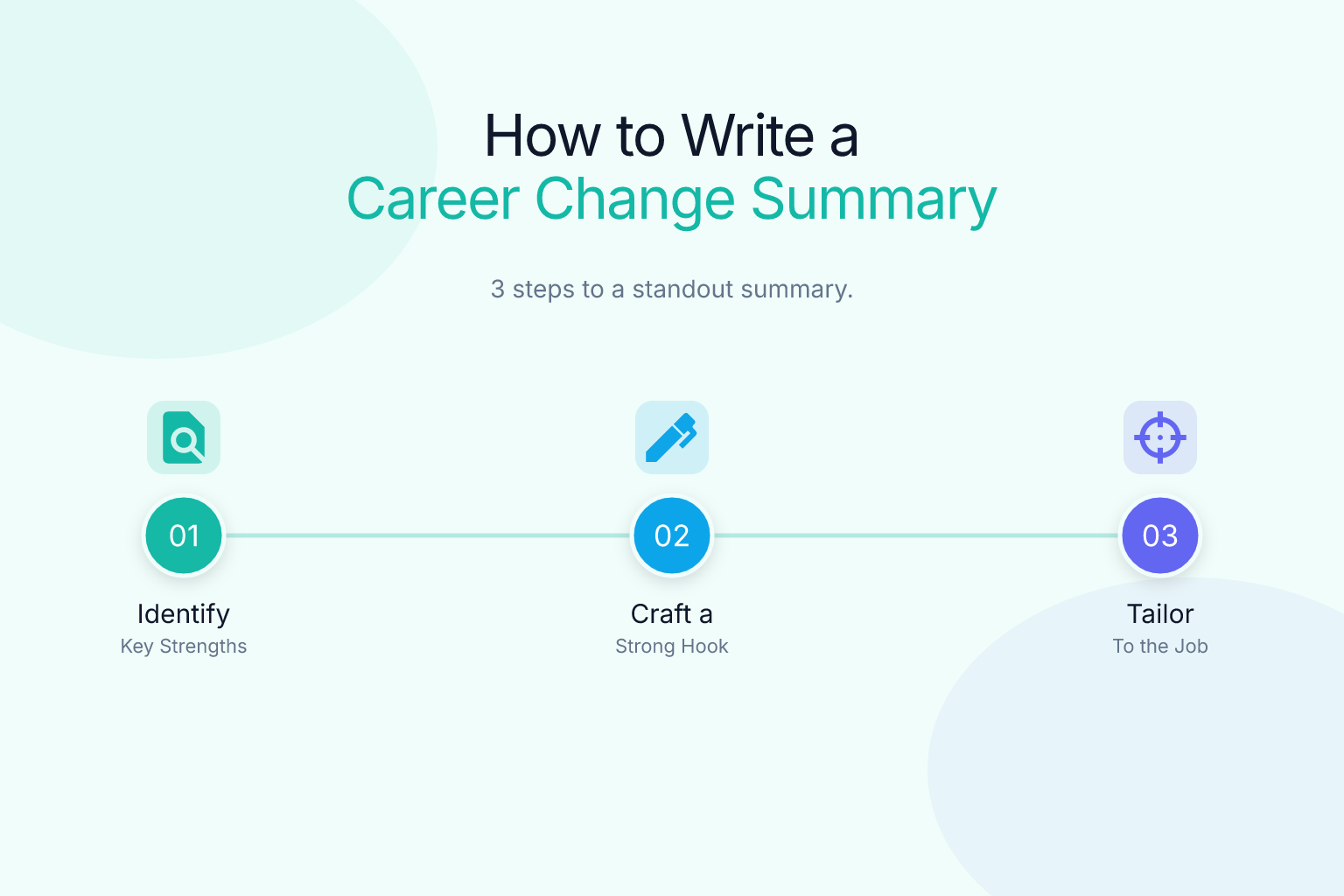
Step-by-Step: Writing a Career Change Summary with No Direct Experience
Follow this four-part formula to build a summary that reads like it was written for the role.
1. Lead with Your Professional Identity (Reimagined)
Start with a title that bridges your past and future. Don’t use your old job title. Instead, use a descriptor that captures your transferable expertise.
Examples:
- “Operations professional with a track record of process improvement” (for a former logistics coordinator moving into HR operations)
- “Data-driven storyteller with 6 years of audience engagement” (for a journalist moving into content marketing)
- “Client success advocate with a history of 95% retention rates” (for a hospitality manager moving into customer success)
Your professional identity should answer: “What am I good at that matters to this employer?”
2. State Your Target Role and the Value You’ll Bring
Make it clear what you’re pursuing and why you’ll excel. This is where you connect your background to the new field.
Example: “Transitioning project coordination expertise into a junior project manager role, bringing a proven ability to manage timelines, budgets, and cross-functional teams.”
Be specific about the role level (junior, senior, coordinator, manager) so recruiters know where you fit in their organization.
3. Highlight 2–3 Transferable Achievements with Numbers
Quantify results from any context. Numbers grab attention and make your claims credible.
- “Reduced event planning costs by 30% through vendor negotiation” (for an event planner moving into procurement)
- “Trained 15 new hires on CRM software, cutting onboarding time by 2 weeks” (for a trainer moving into L&D)
- “Grew a community Facebook group from 500 to 5,000 members in 6 months” (for a community manager moving into social media marketing)
If you don’t have exact numbers, estimate conservatively. “Approximately 200+ customers served weekly” is better than no number at all.
4. Close with a Statement That Aligns with the Employer’s Goals
Show you understand what the company needs. This can be a short sentence that ties your skills to their mission or challenges.
Example: “Eager to apply relationship-building and data-tracking skills to help a SaaS company improve customer onboarding and reduce churn.”
Research the company beforehand. If they’re expanding into new markets, mention growth. If they’re focused on retention, mention customer success.
Full Template
Here’s a fill-in-the-blank template you can adapt:
[Transferable professional identity] with [X years] of experience in [past field]. Transitioning into [target role], bringing [skill 1], [skill 2], and [skill 3]. [Achievement with number]. Ready to [how you’ll help the employer].
Resume Summary Examples for Career Changers (by Industry)
Teacher to Corporate Trainer
“Learning and development professional with 8 years of experience designing curriculum, facilitating workshops, and measuring learner outcomes in K-12 education. Transitioning into corporate training, bringing expertise in adult learning principles, virtual facilitation, and needs assessment. Increased student engagement scores by 40% through interactive lesson redesign. Ready to help a growing company upskill its workforce and reduce onboarding time.”
Retail Manager to HR Coordinator
“People operations specialist with 5 years of experience in hiring, onboarding, scheduling, and conflict resolution in high-volume retail environments. Moving into an HR coordinator role, bringing hands-on experience with applicant tracking, compliance documentation, and employee relations. Reduced turnover by 25% through a structured onboarding program. Eager to support a people-first organization’s talent operations.”
Administrative Assistant to Data Analyst
“Analytical problem-solver with 4 years of experience managing databases, generating reports, and identifying trends in administrative operations. Transitioning into a data analyst role, bringing advanced Excel skills, SQL proficiency, and a track record of translating data into actionable insights. Automated monthly reporting processes, saving 10 hours per month. Ready to help a data-driven team uncover opportunities through analysis.”
Nurse to Medical Sales
“Clinical communicator with 6 years of experience educating patients, collaborating with physicians, and mastering complex medical products in fast-paced hospital settings. Transitioning into medical device sales, bringing deep product knowledge, relationship-building skills, and a consultative approach. Achieved 98% patient satisfaction scores while managing a caseload of 50+ daily. Eager to drive territory growth for an innovative medtech company.”
Customer Service to Marketing Coordinator
“Brand advocate with 4 years of experience driving customer engagement, managing social media responses, and analyzing feedback trends in retail environments. Transitioning into marketing coordination, bringing expertise in audience segmentation, content creation, and campaign performance tracking. Increased social media engagement by 65% through targeted community initiatives. Ready to amplify brand presence for a consumer-focused organization.”
Military to Corporate Operations
“Operations leader with 10 years of experience managing logistics, coordinating cross-functional teams, and executing complex projects under tight deadlines. Transitioning into corporate operations management, bringing expertise in process optimization, risk mitigation, and resource allocation. Reduced operational costs by 18% while maintaining 100% mission readiness. Eager to apply disciplined execution to streamline business operations.”
For more role-specific summary examples, check out our resume summary examples for 20 roles. If you’re targeting a field like accounting, our accountant resume examples with CPA and GAAP skills can help you identify the right keywords and achievements to highlight. Those exploring entry-level opportunities should also review our accounting resume examples for internships to understand how to position limited experience effectively.
Where to Place the Summary on Your Resume
The summary goes at the very top, below your name and contact information. It’s the first section a recruiter or ATS sees. For career changers, I recommend using a hybrid resume format that places a “Relevant Skills” or “Core Competencies” section right after the summary, before your work history. This front-loads the keywords and abilities that matter most.
If you’re unsure about formatting, the ResumeMate resume builder offers ATS-friendly templates that let you easily reorder sections. Most templates are single-column, which is the safest choice for parsing, but multi-column options are available if you prefer a more visual layout. Once you’ve drafted your summary, run your resume through the Resume Score Checker to see how it scores for ATS compatibility and get section-by-section feedback — it’s free and takes less than a minute.
Resume Format Comparison for Career Changers
| Format Type | Best For | ATS Compatibility |
|---|---|---|
| Hybrid/Combination | Career changers, skill-focused roles | Excellent |
| Chronological | Same-field progression, stable history | Excellent |
| Functional | Significant gaps, freelance-heavy | Poor (many ATS reject) |
Stick with hybrid or chronological formats. Functional resumes that hide employment dates often trigger red flags with both recruiters and applicant tracking systems.
Pairing Your Summary with a Strong Skills Section
Your summary tells the story; your skills section provides the evidence. Together, they make a powerful first impression. After your summary, add a bulleted list of 6–10 hard and soft skills pulled directly from the job description.
For a career changer moving into project management, that skills section might look like:
- Agile & Waterfall Methodologies
- Stakeholder Communication
- Budget Tracking & Forecasting
- Risk Management
- Asana, Jira, Trello
- Cross-Functional Team Leadership
If you’ve developed these skills through volunteer work, side projects, or self-study, list them confidently. You don’t need to explain where you learned them in the skills section — that’s what your experience bullets are for. For more on this, read our guide on how to show career growth on a resume without promotions, which covers how to frame skill development outside of traditional job titles.
Skills Section Best Practices
- Mirror job description language exactly. If they say “Stakeholder Management” not “Client Communication,” use their term.
- Group related skills together. Put all technical tools in one area, all methodologies in another.
- Prioritize by relevance. Put the most important skills for this specific role first.
- Include 2–3 industry certifications if you have them (even in-progress ones noted as “Expected 2026”).
How to Tailor Your Summary for Each Application
A generic summary won’t cut it. Recruiters can spot a copy-paste job instantly. Spend 10 minutes customizing your summary for every application.
What to Customize
- The target role title: Use the exact job title from the posting.
- The skills you highlight: Pick the 2–3 skills the job description mentions first or most often.
- The closing statement: Reference the company’s industry, mission, or a specific challenge mentioned in the posting.
Example of Customization
Base summary: “Operations professional transitioning into project management, bringing process improvement and team leadership skills.”
For a healthcare PM role: “Operations professional transitioning into healthcare project management, bringing process improvement, regulatory compliance, and team leadership skills. Ready to support a hospital system’s initiative to reduce patient wait times.”
For a tech PM role: “Operations professional transitioning into technical project management, bringing process improvement, Agile workflows, and cross-functional team leadership. Eager to help a SaaS company streamline product launches.”
Small tweaks make a big difference. And don’t forget to mirror the exact keywords from the job description — many companies use applicant tracking systems that scan for those terms. If the posting asks for “vendor management” and you wrote “supplier relationships,” change it. The closer your language matches, the higher your resume will rank.
Quick Tailoring Checklist
Before submitting each application, verify:
- Job title in summary matches the posting exactly
- Top 3 skills mentioned align with job requirements
- Company name or industry is referenced in closing
- No generic phrases like “seeking opportunity” remain
- Achievement numbers are relevant to the role’s priorities
How to Handle Employment Gaps in a Career Change Summary
If you have gaps in your work history, you might be tempted to explain them in the summary. Don’t. The summary is prime real estate — use it to sell your future, not to justify your past. Gaps are best addressed in a cover letter or, if necessary, in the experience section with a brief, neutral explanation (e.g., “Career break to complete data analytics certification”).
Instead, focus the summary on what you did during any gap that’s relevant. Did you earn a certification, complete a freelance project, or volunteer? Weave that in: “Certified Salesforce Administrator with hands-on project experience from a 6-month volunteer implementation.” That turns a potential red flag into proof of initiative.
When Gaps Actually Help Your Story
Some career changes naturally involve gaps — and that’s okay. If you took time for:
- Education or certification: Frame it as skill-building investment
- Freelance or consulting work: Position it as diverse project experience
- Caregiving or personal reasons: Keep it brief and neutral if mentioned at all
- Military transition: Highlight leadership and operational expertise gained
The key is showing forward momentum, not dwelling on the pause.
LinkedIn Summary vs. Resume Summary for Career Changers
Many job seekers ask whether their LinkedIn summary should match their resume. The answer: similar structure, different depth.
Resume Summary: 3–5 lines, tightly focused on the specific role you’re applying for.
LinkedIn About Section: 3–5 short paragraphs, broader narrative about your career journey and aspirations.
For LinkedIn, you can include more context about why you’re making the change. Example: “After 8 years in education, I discovered my passion for corporate learning through volunteer training programs. Now I’m bringing that experience to help organizations build stronger development programs.”
The core formula remains the same: identity + target direction + proof + value proposition.
Common Questions About Career Change Resume Summaries
Q: Should I use a resume summary or a resume objective?
A: For career changers with work experience, a summary is almost always stronger. An objective states what you want (“seeking a position that…”), while a summary states what you offer. Employers care about what you can do for them. Use a summary unless you’re a student or have zero work history of any kind.
Q: How long should my career change summary be?
A: Aim for 3–5 lines, or about 50–100 words. It should be scannable in under 10 seconds. If it’s longer than a short paragraph, cut filler words and focus on the most compelling points.
Q: What if I have absolutely no related experience — not even transferable skills?
A: You likely have more than you think. Soft skills like communication, organization, and problem-solving are transferable. If you’re truly starting from zero, invest in a certification, online course, or volunteer project before applying. Then your summary can reference that new training: “Certified Salesforce Administrator with hands-on project experience from a 6-month volunteer implementation.”
Q: Can I mention my career change directly in the summary?
A: Yes, but frame it as a strength. Instead of “looking to change careers,” say “transitioning expertise in X into a Y role.” The word “transitioning” is neutral and forward-looking. Avoid phrases like “seeking a career change” or “pivoting away from.”
Q: Should I include soft skills in the summary?
A: Only if they’re specific and relevant. “Hard worker” or “team player” are too vague. Instead, use “cross-functional collaboration” or “stakeholder management.” Better yet, demonstrate soft skills through achievements: “Led a team of 12 volunteers to exceed fundraising goals by 20%.”
Q: What if my past job titles are completely unrelated?
A: That’s exactly why the summary exists. It reframes your identity before the reader sees your job titles. If you were an “Administrative Assistant” but you’re targeting a “Marketing Coordinator” role, your summary leads with “Content and campaign coordinator with 3 years of experience managing social media, email newsletters, and event promotion.” Your job title still appears in the experience section, but the summary has already planted the right impression.
Q: What is the best resume format for a career changer?
A: A hybrid (combination) format works best. It leads with a summary and a key skills section, followed by a chronological work history. This front-loads your transferable qualifications while still showing a clear career timeline. Avoid functional resumes that hide dates — many recruiters and ATS systems distrust them.
Q: Where can I find free career change resume samples?
A: You can build a professional, ATS-optimized resume for free using the ResumeMate resume builder. It includes templates and pre-written phrases tailored to different industries. The examples in this guide also serve as ready-to-adapt samples for common career changes.
Q: How do I write a career change statement for a resume or LinkedIn?
A: A career change statement is essentially your resume summary, repurposed. Keep it to 3–5 lines, lead with your new professional identity, and include a key achievement. For LinkedIn, you can expand slightly and add a sentence about your motivation, but the core formula remains the same: identity + target role + proof + value.
Q: Do career change resumes get rejected by ATS systems?
A: Not if formatted correctly. ATS systems scan for keywords and structure, not career history. Use standard section headings, avoid graphics or tables in the body, and mirror language from the job description. Run your resume through the Resume Score Checker to verify ATS compatibility before applying.
Q: Should I write a different summary for each industry I’m targeting?
A: Yes. If you’re applying to both tech and healthcare roles, create two versions of your resume with tailored summaries. The transferable skills may overlap, but the language, priorities, and value propositions should match each industry’s specific needs.
Related articles:
- Resume Summary After Incarceration: How to Write One
- How to Write a Resume Summary for a Tech Career Pivot (2026)
- How to Write a Paralegal Resume with No Legal Experience
- How to List Volunteer Work on a Resume With No Experience
Track Every Application While You Job Hunt
Changing careers means applying to more roles, often across different industries. It’s easy to lose track of where you’ve applied, when to follow up, and which version of your resume you sent. The ResumeMate Job Tracker is a free Chrome extension that tracks every application, deadline, and follow-up in one place — right from your browser.
Stay organized while managing multiple applications across different industries. The extension automatically captures job details from major job boards and lets you add custom notes, status updates, and reminders for follow-ups.
Install ResumeMate Free on Chrome →
Ready to Build Your Career Change Resume?
Don’t let an unclear summary hold you back from your next opportunity. Start with a free, ATS-optimized resume built for career changers.
Create Your Free Resume with ResumeMate →
Or upload your existing resume to get instant feedback on how well it positions your career transition: