How to Write a Cover Letter for a High School Student
Learning how to write a cover letter for a high school student is the first step to landing your first job, internship, or volunteer role. Even without formal work experience, you have skills, achievements, and enthusiasm that employers want to see. This guide walks you through every part of the process, from what to include to a full sample you can adapt.
Key Takeaways
- A high school student’s cover letter should focus on transferable skills from school, clubs, sports, and volunteering—not on a lack of paid work history.
- Keep the letter to one page, use a professional email address, and tailor every sentence to the specific job you’re applying for.
- Open with a clear statement of the role you want and one specific reason you’re excited about that company or organization.
- Close with a call to action, such as requesting an interview, and always proofread for typos before sending.
- Pair your cover letter with a clean, ATS-friendly resume built for free with ResumeMate’s resume builder.
| What to Do | Why It Matters | Time |
|---|---|---|
| Research the company and job description | Shows genuine interest and lets you match your skills to their needs | 15–20 minutes |
| List 3–5 transferable skills from school or activities | Gives you concrete examples to write about instead of blank space | 10 minutes |
| Write a one-page letter with a clear structure | Keeps the hiring manager’s attention and looks professional | 30–45 minutes |
| Proofread and ask someone to review it | Catches typos and awkward phrasing that can sink your application | 10 minutes |
How to Write a Cover Letter for a High School Student: Step-by-Step
A cover letter is a one-page introduction that explains why you’re the right fit for a job. It’s not a repeat of your resume—it’s your chance to show personality, enthusiasm, and the specific reasons you want that role. For a high school student, the goal is to prove you’re responsible, eager to learn, and ready to contribute, even if you’ve never had a formal job.
Follow these steps in order:
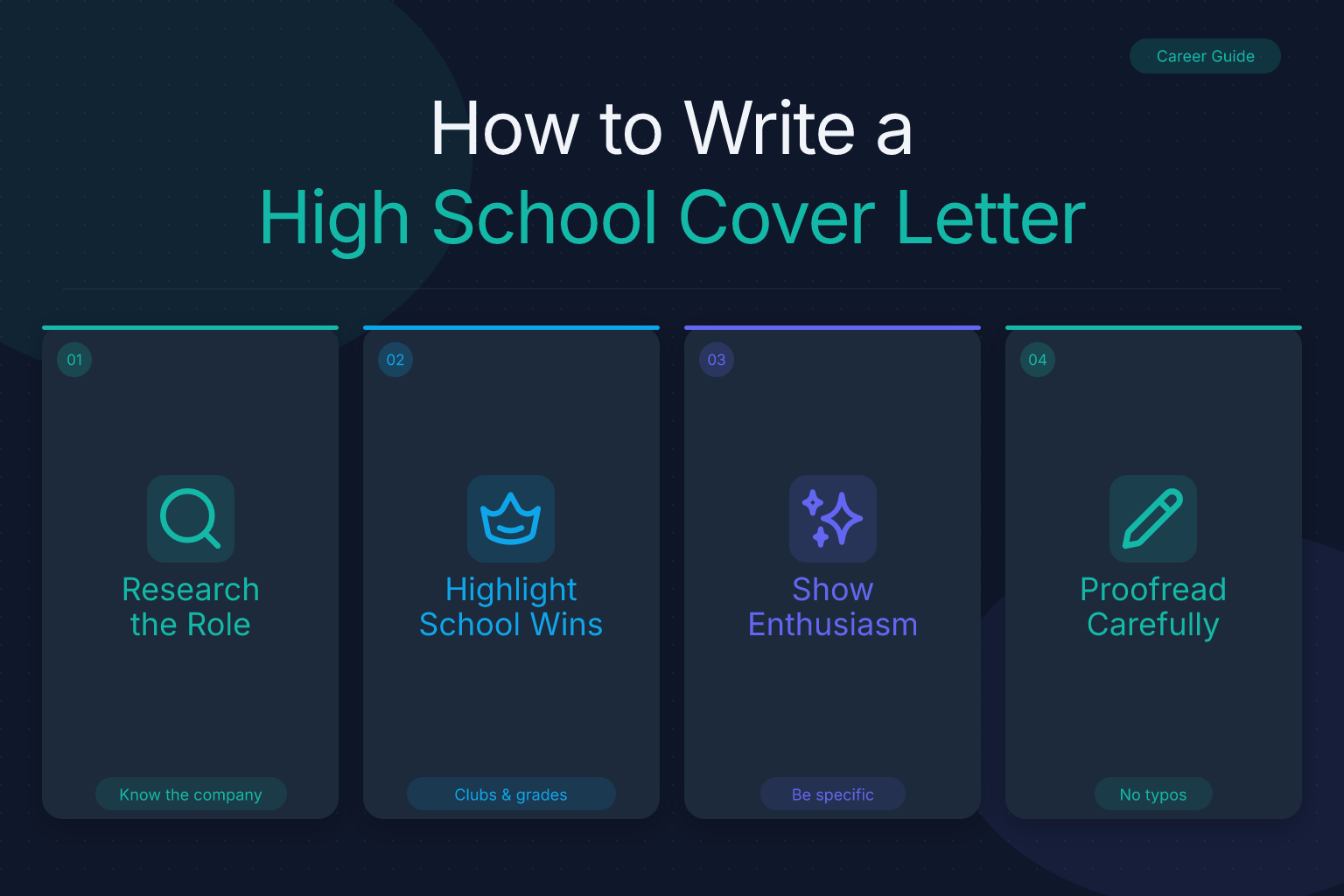
- Research the employer. Look at the company’s website, social media, or job posting. Find one thing you genuinely like—maybe they’re a local business, they value teamwork, or they serve a community you care about. Mention that in your opening.
- Address the hiring manager by name if possible. Check the job ad, the company website, or call the front desk. If you can’t find a name, use “Hiring Manager” or “Dear [Company] Team.” Avoid “To Whom It May Concern.”
- Open with the role and your enthusiasm. State the exact job title and one reason you’re excited. Example: “I’m writing to apply for the part-time cashier position at Green Grocer. As a regular customer, I’ve always admired your friendly staff and commitment to local produce.”
- Highlight 2–3 relevant skills with specific examples. Don’t just say “I’m a hard worker.” Show it: “As captain of my school’s cross-country team, I learned to manage my time between 6 a.m. practices, homework, and weekend meets.”
- Connect your skills to the job’s needs. If the job requires customer service, mention a time you helped customers at a school fundraiser or volunteered at a community event.
- Close with a call to action. Ask for an interview and thank them for their time. Example: “I would love the chance to discuss how my energy and reliability can support your team. Thank you for considering my application.”
- Proofread twice, then ask a parent, teacher, or friend to read it. Typos are the fastest way to get your application ignored.
What to Include When You Have No Work Experience
Most high school students have zero paid work history, and that’s completely normal. Employers hiring for entry-level roles expect this. What they want to see is evidence that you can show up on time, follow instructions, work with others, and handle responsibility. You already have that evidence—you just need to frame it correctly.
Here are the categories to mine for content:
- School projects and coursework: A group presentation shows communication and collaboration. A long-term science project shows organization and follow-through.
- Extracurricular activities: Sports teams prove teamwork, discipline, and time management. Clubs like debate, robotics, or student council show leadership and problem-solving.
- Volunteer work: Any unpaid role—food bank, animal shelter, library, church, community cleanup—counts as experience. Describe what you did and the impact.
- Informal jobs: Babysitting, lawn mowing, tutoring a younger sibling, or helping at a family business are all real work. List them with specific responsibilities.
- Hobbies and personal projects: Running a YouTube channel, coding a simple app, or organizing a neighborhood event shows initiative and skills.
For each example, use the formula: Skill + Context + Result. Instead of “I’m responsible,” write “I managed a weekly schedule of tutoring three middle school students while maintaining a 3.8 GPA, which taught me to prioritize tasks under pressure.”
If you have volunteer experience, check out our guide on volunteer cover letter examples for more ways to frame unpaid work.
Cover Letter Format and Structure for Teens
A cover letter follows a standard business format. It doesn’t need to be fancy—clean and simple is best. Here’s the structure to use:
Your contact information (top left or centered):
- Full name
- Phone number
- Professional email address (firstname.lastname@gmail.com, not partydude2009@yahoo.com)
- City and state (optional)
Date
Employer’s contact information:
- Hiring manager’s name (if known)
- Company name
- Company address
Salutation:
- “Dear Mr. Smith,” or “Dear Ms. Johnson,” if you know the name
- “Dear Hiring Manager,” if you don’t
Body paragraphs (3–4 total):
- Paragraph 1: State the job you’re applying for and why you want it.
- Paragraph 2: Highlight your most relevant skill or experience with a specific example.
- Paragraph 3: Add a second skill or example, and connect it to the company’s needs.
- Paragraph 4 (optional): Briefly mention your availability and enthusiasm.
Closing:
- “Sincerely,” or “Best regards,”
- Your full name
- (If sending by email, include your phone number below your name)
Keep the entire letter to one page. Use a standard font like Arial, Calibri, or Times New Roman at 11–12 pt. Margins should be 1 inch on all sides. If you’re emailing the letter, paste it into the body of the email or attach it as a PDF—never send a Word doc unless the employer specifically asks for one.
High School Student Cover Letter Example (Full Sample)
Here’s a complete sample cover letter for a part-time retail job. Replace the bracketed details with your own.
[Your Name] [Your Phone Number] [Your Email Address] [City, State]
[Date]
[Hiring Manager’s Name, if known] [Company Name] [Company Address]
Dear [Hiring Manager’s Name or “Hiring Manager”],
I’m writing to apply for the part-time sales associate position at [Store Name]. As a frequent shopper at your [location] store, I’ve always been impressed by how helpful and friendly your team is, and I would love to contribute to that environment.
Although I’m still in high school, I’ve developed strong customer service and organizational skills through my involvement in [specific activity]. For example, as treasurer of my school’s student council, I managed a $2,000 budget for our annual charity drive, tracked every expense in a spreadsheet, and communicated with vendors to secure donations. This experience taught me to be detail-oriented, reliable, and comfortable talking with people I don’t know—skills I know are essential for a sales associate.
In addition, I volunteer every Saturday at [local organization], where I greet visitors, answer questions, and help with event setup. I’ve learned to stay calm and positive even when things get busy, and I genuinely enjoy helping others. I’m available to work after school on weekdays and all day on weekends, and I can start immediately.
Thank you for considering my application. I would welcome the opportunity to discuss how my energy and work ethic can support your team. I can be reached at [phone number] or [email address].
Sincerely, [Your Name]
This sample works because it:
- Opens with a specific, genuine reason for wanting the job (not just “I need money”).
- Uses concrete examples from school and volunteering instead of vague claims.
- Connects each skill directly to the job’s requirements.
- States availability clearly, which matters for part-time roles.
- Ends with a polite call to action.
Common Mistakes to Avoid
Even a well-intentioned cover letter can fail if you make these errors. Here’s what to watch out for:
- Writing a generic letter. If you can send the same letter to ten different employers, it’s too vague. Always mention the specific company and role.
- Focusing on what you want instead of what you offer. Don’t say “I need this job to save for a car.” Say “I can help your team by being reliable and eager to learn.”
- Repeating your resume. The cover letter should add context and personality, not list the same bullet points.
- Using an unprofessional email address. Create a new one with your name if needed. It takes two minutes.
- Making it too long. One page maximum. Hiring managers spend less than a minute on most cover letters.
- Typos and grammar errors. Read it out loud, use spell check, and have someone else review it. A single typo can make you look careless.
- Not tailoring to the job type. A cover letter for a restaurant job should emphasize speed and teamwork; a cover letter for a tutoring job should emphasize patience and communication. See the next section for specifics.
How to Tailor Your Cover Letter for Different Jobs
Different part-time jobs value different skills. Here’s how to adjust your letter for common high school job types:
Retail or customer service: Emphasize friendliness, patience, and ability to handle busy periods. Mention any experience helping customers, even informally (school store, bake sale, helping at a family business).
Food service (restaurant, café, fast food): Highlight speed, teamwork, and ability to follow instructions. Mention any experience working in a fast-paced environment, like a concession stand or catering event.
Tutoring or childcare: Focus on patience, communication, and responsibility. Mention any experience helping younger students, babysitting, or leading a club for younger kids.
Camp counselor or recreation: Emphasize leadership, energy, and safety awareness. Mention sports, outdoor activities, or any experience supervising groups.
Office or administrative: Highlight organization, computer skills, and attention to detail. Mention any experience with spreadsheets, data entry, or managing schedules for a club.
For more detailed examples, read our guide on how to write a cover letter for a part-time job.
Using Your Cover Letter with a Strong Resume
Your cover letter and resume work together. The cover letter tells a story and shows personality; the resume provides the facts in a scannable format. If your resume is messy, hard to read, or full of errors, the best cover letter in the world won’t save you.
Start by building a clean, one-page resume that lists your education, skills, activities, and any experience (paid or unpaid). Use a simple, single-column layout that applicant tracking systems (ATS) can parse easily. You can create one for free with ResumeMate’s AI resume builder—it offers ATS-safe templates and exports a clean PDF.
Before you send your application, run your resume through the ResumeMate score checker to see how it scores for ATS readiness and get section-by-section feedback. A high score means your resume won’t get lost in the system before a human even sees it.
For step-by-step resume advice, see our guide on how to write a resume for a part-time job.
Next Steps After Sending Your Cover Letter
Once you hit send, your job isn’t over. Follow these steps to stay organized and increase your chances:
- Track every application. Write down the company, role, date you applied, and any follow-up dates. The free ResumeMate Job Tracker Chrome extension does this automatically from your browser—no spreadsheets needed.
- Follow up after one week. If you haven’t heard back, send a polite email or call to check on your application status. Example: “Hi [Name], I submitted my application for the [role] position last week and wanted to confirm you received it. I’m still very interested and available to interview at your convenience.”
- Keep applying. Don’t wait on one employer. Use the ResumeMate job board to find more part-time, seasonal, and entry-level openings near you.
- Learn from rejections. If you don’t get an interview, ask for feedback. Most employers won’t give detailed reasons, but sometimes you’ll get a useful tip.
FAQ
Q: What should a high school student put in a cover letter with no experience?
A: Focus on transferable skills from school, clubs, sports, volunteering, and informal jobs like babysitting or lawn mowing. Use specific examples that show responsibility, teamwork, communication, and a willingness to learn. Avoid apologizing for a lack of paid work—frame your activities as real experience.
Q: How long should a high school student’s cover letter be?
A: One page, around 200–300 words. Three to four short paragraphs is ideal. Hiring managers spend less than a minute on most cover letters, so get to the point quickly and make every sentence count.
Q: Do high school students need a cover letter for a part-time job?
A: Not always, but it’s strongly recommended. Many part-time job applications don’t require one, but including a short, tailored cover letter sets you apart from other teens who only submit a resume. It shows initiative and gives you a chance to explain why you’re a good fit beyond a list of activities.
Q: How do you address a cover letter if you don’t know the hiring manager’s name?
A: Use “Dear Hiring Manager” or “Dear [Company Name] Team.” Avoid “To Whom It May Concern,” which sounds outdated and impersonal. If you can find the name by checking the company website or calling the front desk, that’s even better.
Q: Can a high school student use a cover letter template?
A: Yes, templates are a great starting point, but you must customize every letter for the specific job and company. A template gives you the structure; your own examples and enthusiasm make it effective. Never send a template without changing the details.
Q: What skills should a high school student highlight in a cover letter?
A: The most valuable skills for entry-level jobs are reliability, punctuality, communication, teamwork, customer service, and a positive attitude. Back each skill with a concrete example from school, sports, volunteering, or an informal job. Avoid listing soft skills without proof.
Track Every Application While You Job Hunt
Stop losing track of where you’ve applied. The ResumeMate Job Tracker is a free Chrome extension that tracks every application, deadline, and follow-up in one place — right from your browser.