How to Write a Cover Letter for a Part-Time Job (Examples)
A cover letter for a part-time job does more than introduce your resume — it shows a hiring manager you understand the role’s unique demands, from flexible scheduling to balancing multiple commitments. Whether you’re a student, a parent returning to work, or someone picking up extra hours, a focused cover letter can set you apart from dozens of applicants who treat the part-time opening as an afterthought.
Key Takeaways
- A part-time cover letter must address availability, scheduling flexibility, and why you want the specific hours — not just why you want the job.
- You can use the same professional structure as a full-time cover letter, but you should lead with your schedule fit and relevant soft skills.
- Tailoring your letter to the job description and mentioning the company by name increases your chances of an interview, even for entry-level part-time roles.
- Including a concrete example of a time you managed competing priorities (school, another job, family) builds immediate trust with the hiring manager.
- A short, error-free cover letter paired with a clean resume — built free on ResumeMate — gives you a complete application in under an hour.
Summary Table
| What to Do | Why It Matters | Time |
|---|---|---|
| State your availability upfront | Part-time hiring hinges on scheduling; being clear saves the manager a phone call | 2 minutes |
| Connect your skills to the job’s specific tasks | Shows you read the posting and aren’t mass-applying | 10 minutes |
| Mention why you want part-time work (student, caregiver, etc.) | Builds authenticity and explains your commitment level | 5 minutes |
| Keep the letter under 250 words | Part-time managers often review applications quickly; brevity respects their time | 15 minutes to write |
| Proofread and use a clean PDF resume | Errors suggest carelessness; a PDF ensures formatting stays intact on any device | 5 minutes |
Why a Part-Time Job Cover Letter Matters
Many job seekers assume part-time roles don’t require a cover letter. The opposite is true. When a manager posts a part-time position, they often receive a flood of applications from people who see the job as a stopgap. A cover letter signals that you’re serious about the specific role, not just any paycheck.
Part-time hiring managers care about three things most full-time managers don’t prioritize as heavily: your schedule, your reliability, and your reason for wanting fewer hours. A cover letter lets you address all three before they even open your resume. If you skip the letter, you leave those questions unanswered — and a competing applicant who wrote one will get the callback.
Writing a part-time cover letter follows the same basic rules as any professional cover letter: a clear subject line or header, a greeting, a strong opening, a body that connects your experience to the job, and a polite closing. The difference is what you emphasize. Instead of leading with career progression, you lead with availability and fit.
What to Include and How to Structure Your Part-Time Cover Letter
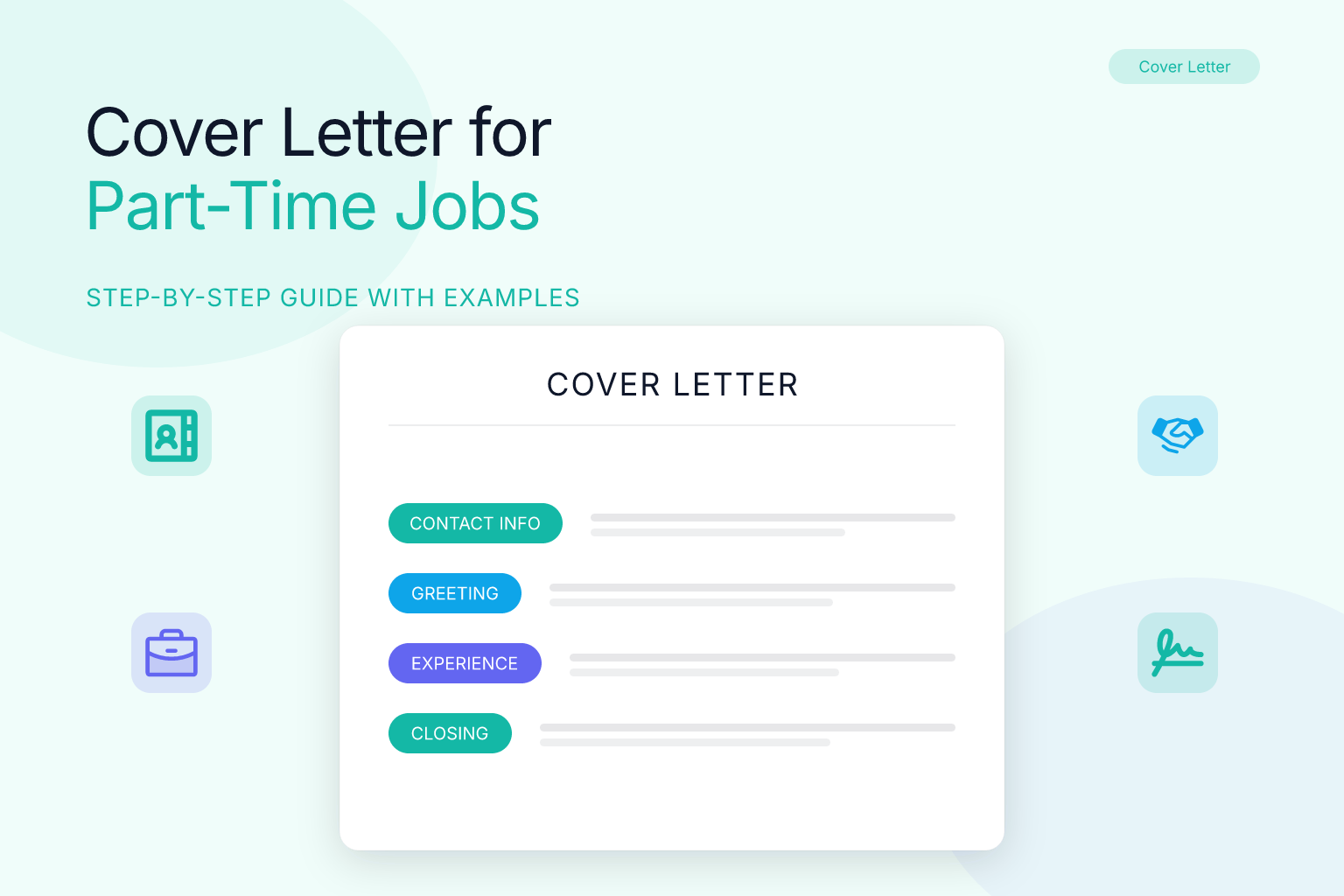
Every part-time cover letter should contain these elements, in this order:
- Your contact information — name, phone number, email, and city (full address isn’t necessary). If you’re emailing the letter, put this in your signature.
- The date and the employer’s contact information — if you’re attaching a formal letter, include the hiring manager’s name, title, and company address. For an email, you can skip the full header and start with “Dear [Name].”
- A specific greeting — “Dear Mr. Patel” or “Dear Hiring Manager” if you can’t find a name. Avoid “To Whom It May Concern.”
- An opening that names the role and your availability — “I’m writing to apply for the part-time Sales Associate position at Greenfield Books. I’m available to work weekday evenings and weekends, and I can start immediately.”
- One or two paragraphs connecting your skills to the job — pick two or three requirements from the posting and show how you’ve done something similar. Use a short example.
- A sentence about why you want part-time work — this isn’t mandatory, but it helps. “I’m a full-time student pursuing a degree in marketing, and this role aligns with my class schedule while letting me build customer service experience.”
- A closing that invites next steps — “I’d welcome the chance to discuss how I can contribute to your team. I’m available for an interview at your convenience.”
- Your signature — for email, a simple “Best regards, [Your Name]” with your phone number below.
If you’re applying through an online portal that only has a text box, paste a shortened version of this structure — keep the greeting, opening, one body paragraph, and closing.
A part-time cover letter doesn’t need to be long. Three to four short paragraphs work best. Here’s a reliable structure:
Paragraph 1: The hook
- Name the job and where you saw it.
- State your availability clearly.
- Mention one reason you’re excited about the company.
Paragraph 2: Your relevant experience
- Pick one or two skills from the job description.
- Give a brief example of using those skills.
- If you lack direct experience, use a transferable skill from school, volunteering, or a side project.
Paragraph 3: Why part-time and why now
- Explain your situation honestly (student, parent, second job).
- Reassure them you’re reliable and committed.
- If the job has irregular hours, mention your flexibility.
Paragraph 4: The close
- Thank them for considering your application.
- Restate your interest.
- Provide your phone number and invite them to contact you.
This structure works for retail, food service, administrative, tutoring, and remote part-time jobs. The content changes; the framework stays the same.
Cover Letter Examples
Retail Example
Here’s a full example for a part-time retail associate position at a bookstore. Use it as a template, but replace the details with your own.
Dear Ms. Rivera,

I’m excited to apply for the part-time Bookseller position at Page & Story, which I saw on your careers page. I’m available to work weekday closing shifts and all day on weekends, and I can start as soon as needed.

In my previous role as a volunteer at the public library’s front desk, I helped patrons find materials, answered questions about events, and handled checkouts during busy after-school hours. I became comfortable with point-of-sale systems and learned how to keep calm when the line grew long. I also organized a weekly children’s reading hour, which taught me to manage a small event from setup to cleanup.

I’m currently a sophomore studying English at State University, and I’m looking for a part-time job that fits around my class schedule. Page & Story has been my go-to bookstore since high school, and I’d love to contribute to the welcoming atmosphere your team is known for.

Thank you for considering my application. I’m available for an interview any weekday after 2 p.m. and can be reached at (555) 123-4567.

Best regards,
Jordan Lee
Notice how the letter leads with availability, gives a concrete example from a non-paid role, and connects the applicant’s personal experience with the company. That’s far more effective than a generic “I’m a hard worker” paragraph.
Remote / Work-from-Home Example
Remote part-time jobs — like virtual assistant, data entry, or customer support — require you to prove you can work independently. This example shows how to address that.
Dear Hiring Manager,

I’m writing to apply for the part-time Remote Customer Support Specialist role at CloudDesk Solutions. I’m available 20–25 hours per week, primarily in the mornings and early afternoons EST, and I have a dedicated home office with reliable high-speed internet.

For the past year, I’ve handled customer inquiries for a small Etsy shop, responding to messages via email and the platform’s chat tool. I maintained a 98% positive rating by resolving order issues within 24 hours and proactively updating customers on shipping delays. I’m comfortable using Zendesk and Slack, and I’m quick to learn new tools.

I’m seeking a part-time remote role because I care for my young child during the day and need a schedule that lets me work while he’s at preschool. I’m organized, self-motivated, and treat every customer interaction as a chance to strengthen the brand.

I’d love to discuss how my experience can support your team. I’m available for a video call most weekdays between 9 a.m. and 1 p.m. EST.

Best regards,
Taylor Kim
(555) 987-6543
This letter works because it addresses the two biggest concerns with remote part-time hires: availability and the ability to work without supervision. The applicant also mentions specific tools, which signals they’ve done their homework.
If you’re applying for a remote role, pair this cover letter with a resume that highlights remote-friendly skills. Our guide on how to write a remote job cover letter goes deeper into tailoring for virtual positions.
How to Address Availability and Scheduling in Your Cover Letter
For part-time jobs, availability isn’t a footnote — it’s often the deciding factor. A manager with a schedule gap on Tuesday mornings will prioritize applicants who can fill that gap. Here’s how to handle it in your letter:
- Be specific, not vague. Instead of “I have a flexible schedule,” write “I’m available Monday through Thursday from 4 p.m. to close, and all day Saturday.”
- Mention any non-negotiable blocks upfront. If you can’t work Wednesday evenings because of a class, say so. It’s better to be ruled out early than to waste time on an interview for a schedule that won’t work.
- If your availability will change soon (e.g., semester ends), note that. “My current availability is weekday evenings, but starting May 15 I can also work daytime hours.”
- For on-call or variable-hour roles, emphasize your responsiveness. “I’m able to pick up shifts on short notice and can usually adjust my schedule with 24 hours’ notice.”
Place your availability in the first paragraph. Don’t bury it at the end. The hiring manager should know within seconds whether your hours match their needs.
Common Mistakes, Tailoring, and Transferable Skills
Common Mistakes to Avoid
Even a well-intentioned cover letter can hurt your chances if it falls into these traps:
- Treating the part-time job as a placeholder. Avoid phrases like “just a part-time job” or “until I find something better.” Managers want someone who will stick around.
- Sending a generic letter. If you use the same letter for a coffee shop and a retail store, it shows. Mention the company name and one specific thing about the role.
- Over-explaining your personal life. You don’t need to share your entire schedule or family situation. A single sentence about why you want part-time work is enough.
- Ignoring the job description’s keywords. If the posting asks for “cash handling” or “weekend availability,” use those exact phrases in your letter. Many applicant tracking systems scan for keywords even for part-time roles.
- Writing too much. A part-time cover letter should rarely exceed 250 words. Managers often review applications on their phone between tasks. Get to the point.
- Forgetting to proofread. A typo in a short letter stands out. Read it aloud, run it through a spell checker, and have someone else look at it if possible.
If you’re also updating your resume, run it through a free resume score checker to catch formatting issues and missing keywords before you apply.
How to Tailor Your Cover Letter to the Job Description
Tailoring doesn’t mean rewriting the whole letter for every application. It means adjusting three key parts:
- The opening line: Reference the specific job title and where you found it. If the posting mentions a team or department, name it.
- The skills paragraph: Pull two or three requirements directly from the job ad and match them with your experience. Use the same words the employer uses.
- The closing: If the posting asks for something specific — like “tell us about a time you solved a problem” — address it briefly in your letter.
Here’s a quick before-and-after for a part-time barista role:
Before (generic): “I have strong customer service skills and work well in fast-paced environments.”
After (tailored): “At my previous café job, I prepared espresso drinks for up to 80 customers during the morning rush while keeping the counter clean and stocked — exactly the kind of high-volume environment you described in your posting.”
The tailored version uses the job ad’s language (“high-volume environment”) and gives a measurable example. That’s what gets an interview.
Using Your Cover Letter to Highlight Transferable Skills
If you’ve never held a part-time job before — or you’re switching industries — your cover letter is where you connect the dots for the employer. Transferable skills are abilities you’ve built in one context that apply to another. Common ones for part-time roles include:
- Communication: from class presentations, group projects, or volunteering.
- Time management: balancing school, family, or another job.
- Customer service: helping people in any setting, even informally.
- Cash handling or money management: managing a club budget, handling transactions at a fundraiser.
- Teamwork: sports, group assignments, community organizations.
When you write about a transferable skill, follow this formula: Skill + Context + Result. For example:
“As treasurer of my school’s environmental club, I managed a $2,000 annual budget, tracked expenses in a spreadsheet, and reported our balance at each meeting. That experience taught me the attention to detail I’d bring to handling cash and reconciling receipts in this role.”
This approach works even if you have no formal work history. If you’re a student, your “context” might be a class project. If you’re a stay-at-home parent returning to work, your context could be managing household finances or coordinating volunteer schedules. The key is to frame it as relevant, not as a gap.
For more on addressing non-traditional backgrounds, read our guide on how to write a cover letter for an employment gap.
How to Pair Your Cover Letter with a Strong Part-Time Resume
Your cover letter gets the manager’s attention; your resume provides the evidence. The two documents should work together, not repeat each other. Here’s how to make them complementary:
- Don’t copy-paste. If your cover letter mentions your availability and a key achievement, your resume should list your work history, skills, and education in a scannable format — not rehash the same story.
- Use the same keywords across both documents. If the job description mentions “inventory management,” that phrase should appear in your cover letter and your resume’s skills or experience section.
- Keep the resume to one page. For part-time roles, a concise one-page resume is standard. Use a clean, single-column layout that’s easy for both humans and applicant tracking systems to read.
- Save and send as a PDF. A PDF preserves your formatting on any device. ResumeMate’s free resume builder exports ATS-friendly PDFs that won’t get scrambled when a manager opens them on their phone.
If you haven’t built your resume yet, start with our guide on how to write a resume for a part-time job. It walks you through every section with examples tailored to part-time applicants.
FAQ
Q: Do I really need a cover letter for a part-time job?
A: Yes, if the application allows one. Many part-time job postings on sites like Indeed or company career pages include an optional cover letter field. Submitting one — even a short one — shows initiative and gives you a chance to address availability and fit before the manager opens your resume. In a stack of 50 applications, the ones with cover letters often get read first.
Q: How long should a part-time cover letter be?
A: Aim for 150–250 words. Three to four short paragraphs is plenty. Part-time hiring managers often review applications quickly, so a concise letter that gets straight to availability and relevant skills is more effective than a full-page essay.
Q: What if I don’t have any work experience?
A: Focus on transferable skills from school, volunteering, clubs, or personal projects. Use the formula: skill + context + result. For example, “As captain of my soccer team, I organized practice schedules for 15 players and communicated last-minute changes via group chat — skills that translate directly to coordinating shifts in a fast-paced work environment.”
Q: Should I mention that I’m a student in my cover letter?
A: Yes, if it explains your availability or your interest in the role. A simple sentence like “I’m a full-time student with classes in the morning, so I’m available weekday afternoons and weekends” is helpful. It also signals to the employer that you’re balancing responsibilities, which can reflect positively on your time management.
Q: Can I use the same cover letter for multiple part-time jobs?
A: You can use the same structure, but you should customize the company name, job title, and at least one skill paragraph for each application. Generic letters are easy to spot and often get skipped. Spending 10 minutes tailoring each letter significantly increases your response rate.
Q: How do I address a cover letter if I don’t know the hiring manager’s name?
A: “Dear Hiring Manager” is acceptable and widely used. Avoid outdated greetings like “To Whom It May Concern.” If the job posting lists a department but no name, “Dear [Department] Team” (e.g., “Dear Customer Service Team”) also works.
Q: Should I include references in my part-time cover letter?
A: No. References belong on a separate document or are provided when requested. Including them in your cover letter takes up valuable space and isn’t expected at the application stage. Use that space to sell your skills and availability instead.
Related articles:
- How to Write a Cover Letter for a High School Student
- How to Ask for Internship Conversion to Full Time
- Short Cover Letter Examples for Busy Recruiters
Track Every Application While You Job Hunt
Stop losing track of where you’ve applied. The ResumeMate Job Tracker is a free Chrome extension that tracks every application, deadline, and follow-up in one place — right from your browser.