How to Write a Cover Letter for an Employment Gap
If you’re wondering how to write a cover letter for a job with an employment gap, you’re not alone — and you’re not at a disadvantage. Career breaks are more common than ever, whether due to layoffs, caregiving, health, education, or personal exploration. The key is to address the gap directly, frame it as a period of growth, and keep the focus on what you’ll bring to the role. This guide walks you through exactly how to do that, with a full sample letter and actionable strategies.
Key Takeaways
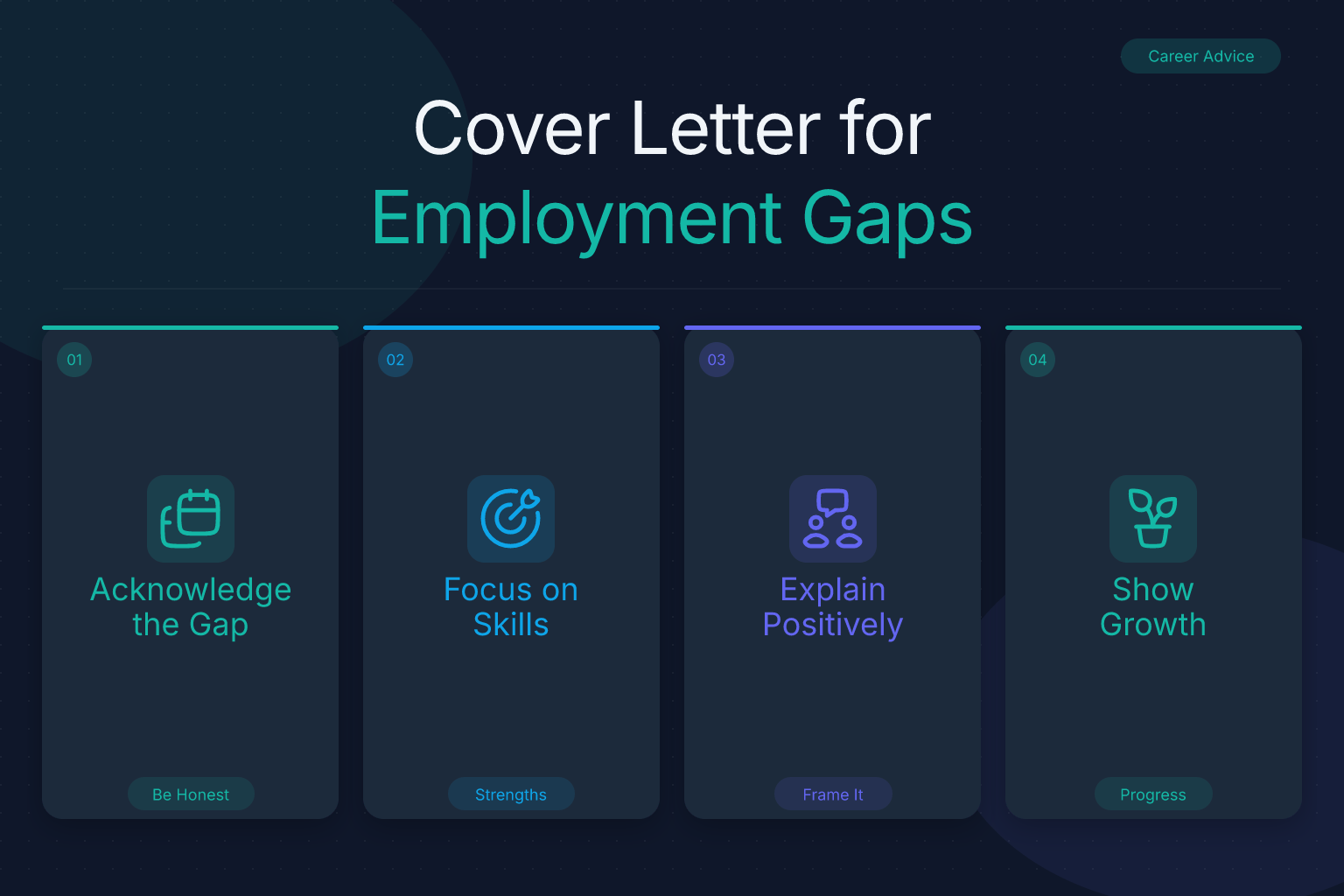
- Address the employment gap in one or two sentences after establishing your qualifications, framing it as a period of growth or skill-building rather than an apology.
- Choose a strategy that fits your situation: state the reason directly, lead with skills and mention the gap in passing, or weave the gap into a larger career narrative.
- Keep the explanation professional and forward-looking, avoiding oversharing personal details or sounding defensive.
- Use a hybrid or functional resume format to draw attention to your skills and accomplishments rather than the timeline of your work history.
- If the gap is under six months, you can omit it from the cover letter, but be prepared to discuss it briefly and positively in an interview.
How to Write a Cover Letter for a Job with an Employment Gap
Writing a cover letter when you have a gap in your work history can feel intimidating, but the right approach turns that gap from a liability into a talking point. The goal is not to hide the gap or over-explain it — it’s to acknowledge it on your terms and then pivot quickly to your value.
Start by deciding where to place the explanation. The first paragraph of your cover letter should hook the reader with your enthusiasm and fit for the role, not with an apology. Save the gap mention for the second or third paragraph, after you’ve already established why you’re a strong candidate. This way, the gap becomes a footnote in a larger story of capability.
When you do address the gap, use a single sentence or two. For example: “After a planned career break to care for a family member, I’m eager to return to full-time marketing with refreshed energy and new certifications in digital analytics.” That’s enough. You’ve named the reason, shown it was intentional, and immediately connected it to your readiness for the job.
Then, spend the rest of the letter proving your qualifications. Use specific achievements from before and after the gap. If you took a course, volunteered, freelanced, or even managed a household project, frame it in professional terms. The hiring manager cares less about the gap itself and more about whether you can do the job today.
A Step-by-Step Approach to Drafting Your Letter
Follow these five steps to build a cover letter that handles the gap with confidence:
- Research the company and role. Before you write a word, understand what the employer values most. Tailor your opening and achievements to their specific needs. This shows you’re not just sending a generic letter — you’re genuinely interested.
- Craft a compelling opening. Start with a sentence that connects your top qualification to the company’s goal. For example: “With a track record of reducing customer churn by 25% through data-driven retention campaigns, I’m excited to bring that same analytical rigor to the Customer Success Manager role at Acme Corp.”
- Showcase your best achievements. In the next paragraph, highlight two or three concrete results from your previous roles. Use numbers whenever possible. This builds credibility before you ever mention the gap.
- Address the gap briefly and positively. Insert one or two sentences that name the reason (if you’re comfortable) and immediately pivot to what you gained or how you stayed current. Keep it forward-looking.
- Close with enthusiasm and a call to action. Reiterate your interest, summarize your fit, and invite the next step. A simple “I’d love to discuss how my background can contribute to your team’s success” works well.
This structure ensures the gap is never the headline — it’s just a small part of a much stronger story.
Why Employers Care About Employment Gaps (and Why You Shouldn’t Panic)
Hiring managers notice gaps because they’re trained to look for patterns — but a gap alone rarely disqualifies a candidate. According to a 2023 LinkedIn survey, nearly two-thirds of professionals have taken a career break at some point, and 79% of hiring managers said they would hire a candidate with a gap if the candidate could explain it well. The stigma has faded significantly, especially in the post-pandemic era where career pauses for caregiving, mental health, or reskilling are widely understood.
What employers actually worry about is not the gap itself, but what it might signal: outdated skills, lack of motivation, or difficulty re-entering the workforce. Your cover letter is the perfect place to preempt those concerns. By showing that you stayed engaged — through learning, freelancing, volunteering, or even thoughtful career planning — you erase the doubt.
If your gap was involuntary, such as a layoff, you can still frame it constructively. Mention that you used the time to upskill, earn certifications, or reflect on your career direction. The key is to demonstrate that you’re not the same candidate who left the workforce; you’re a better one.
3 Cover Letter Strategies for Addressing an Employment Gap
There’s no one-size-fits-all way to handle a gap. Choose the strategy that best fits your situation.
1. The Direct Approach
Best for gaps with a clear, understandable reason (caregiving, health, education, sabbatical). State the reason plainly and move on. Example: “I took a two-year break to raise my children and am now fully prepared to re-enter the workforce with sharpened time-management and prioritization skills.”
2. The Skills-First Approach
If your gap is harder to explain or you’d rather not share personal details, lead with skills and accomplishments. Mention the gap only in passing, if at all, and let your qualifications do the talking. This works well when you’ve done substantial freelance work, consulting, or learning during the gap. You might say: “During my recent career transition, I completed a Google Project Management certificate and led a community fundraising initiative that raised $15,000.”
3. The Narrative Approach
Use the gap as part of a larger story of growth. This is especially effective for career changers or those returning after a long break. Frame the time away as a deliberate pivot. For example: “After a decade in finance, I took a sabbatical to explore my passion for UX design. That year of self-study and pro bono projects confirmed that I’m ready to bring a user-centered mindset to your team.”
Whichever strategy you choose, the golden rule is: don’t dwell. One or two sentences are enough. The rest of the letter should be about the future, not the past.
How to Frame Your Gap and Structure Your Cover Letter
Many job seekers make the mistake of either ignoring the gap entirely or over-explaining it with unnecessary personal details. The sweet spot is a brief, positive reframe that highlights what you gained. Here’s how to frame common gap scenarios:
- Caregiving (children, elderly parents): “I stepped away from the workforce to provide full-time care for a family member. During that time, I honed skills in organization, crisis management, and budgeting — all of which translate directly to project management.”
- Health or medical leave: “I took a planned medical leave and have since made a full recovery. I used the recovery period to earn an online certification in data analysis and am eager to apply those skills.”
- Layoff or unemployment: “After my role was eliminated in a company-wide restructuring, I dedicated six months to upskilling in Python and completed two major freelance data projects.”
- Travel or personal growth: “I took a sabbatical to travel and volunteer abroad, which strengthened my cross-cultural communication and adaptability.”
- Education or upskilling: “I paused my career to pursue a master’s degree in computer science, graduating with a 3.9 GPA and a published research paper on machine learning applications.”
Notice that each example names the reason without apology, then immediately pivots to a skill or achievement. You don’t need to share medical details, family dynamics, or emotional struggles. Keep it professional and forward-looking.
If you’re uncomfortable sharing the reason, you can use a general statement like: “I took a career break to focus on personal and professional development, and I’m now excited to bring my refreshed perspective to a new challenge.” That’s perfectly acceptable.
Where to Mention the Gap in Your Cover Letter
A strong cover letter follows a clear structure. Here’s where the gap fits in:
- Opening paragraph: Hook the reader with your interest in the role and a quick highlight of your most relevant qualification. Do not mention the gap here.
- Second paragraph (optional): Expand on your key achievements and how they align with the job description. If you’re using the skills-first approach, you can weave the gap into this section by mentioning what you did during the break.
- Gap acknowledgment (third paragraph or end of second): In one or two sentences, address the gap. Keep it brief and positive.
- Closing paragraphs: Reiterate your enthusiasm, summarize your fit, and include a call to action.
Example flow:
Dear Hiring Manager,
I’m writing to express my strong interest in the Senior Marketing Manager role at Acme Corp. With over eight years of experience driving B2B campaigns that increased lead generation by 40%, I’m confident I can deliver immediate impact for your team.
In my previous role at XYZ Inc., I led a cross-functional team of 12 and launched a content strategy that grew organic traffic by 200% in 18 months. I also spearheaded the adoption of marketing automation tools, reducing campaign execution time by 30%.
After a planned career break to care for a family member, I’m returning to the workforce with renewed focus and a recent HubSpot Content Marketing certification. I’m eager to apply my strategic mindset and data-driven approach to Acme Corp’s ambitious growth goals.
I would welcome the opportunity to discuss how my background and fresh perspective can contribute to your team’s success…
This structure keeps the gap from being the first thing the reader sees, and it frames the break as a natural part of your career story.
Sample Cover Letter for a Job with an Employment Gap
Here’s a full example you can adapt. This candidate took a two-year break for caregiving and is returning to a project management role.
Subject: Project Manager Application – Jane Doe
Dear Ms. Rodriguez,
I’m thrilled to apply for the Project Manager position at GreenTech Solutions. With six years of experience leading cross-functional software projects and a PMP certification, I’m ready to hit the ground running and help your team deliver on its Q3 product roadmap.
At my previous role with Innovatech, I managed a portfolio of 15+ projects simultaneously, consistently delivering on time and under budget. I introduced Agile methodologies that cut sprint cycle times by 20% and improved stakeholder satisfaction scores by 35%. I also mentored three junior project coordinators, two of whom were promoted within a year.
In 2024, I stepped away from the workforce to provide full-time care for an aging parent. During that period, I maintained my PMP credential, completed a certification in Scrum Mastery, and volunteered as a project coordinator for a local nonprofit’s annual fundraising gala — an event that raised $50,000, a 25% increase over the previous year.
Now that my caregiving responsibilities have concluded, I’m fully prepared to re-enter a fast-paced project environment. I’m particularly drawn to GreenTech’s mission of sustainable innovation and would love to bring my blend of technical project management and people leadership to your team.
I’d welcome the chance to discuss how my experience and recent upskilling can support your upcoming initiatives. Thank you for your time and consideration.
Sincerely, Jane Doe
This letter follows the structure we outlined: hook, achievements, gap acknowledgment with positive framing, and a confident close. It never apologizes, and it turns the gap into evidence of continued growth.
Common Mistakes to Avoid When Explaining a Gap
Even a well-intentioned cover letter can backfire if you fall into these traps:
- Apologizing or sounding defensive. Phrases like “I know my gap looks bad” or “I’m sorry for the break” undermine your confidence. You have nothing to apologize for.
- Oversharing personal details. You don’t need to explain the medical condition, family drama, or emotional toll. Keep it professional.
- Ignoring the gap entirely. If your resume shows a two-year gap and your cover letter doesn’t mention it, the hiring manager may assume you’re trying to hide something. A brief acknowledgment is better than silence.
- Making the gap the centerpiece. Your cover letter should be about your qualifications, not your time away. If the gap takes up more than two sentences, you’re overdoing it.
- Lying or stretching the truth. Never fabricate a reason or claim you were freelancing when you weren’t. Background checks and reference calls can easily uncover dishonesty.
- Using a generic cover letter. A gap is more noticeable when the rest of the letter feels copy-pasted. Tailor every letter to the specific job and company.
How to Strengthen Your Application Beyond the Cover Letter
Your cover letter is just one piece of the puzzle. To overcome any hesitation a gap might cause, make sure the rest of your application is airtight.
1. Update your resume format. A chronological resume can make a gap stand out like a sore thumb. Consider a hybrid or functional format that groups your skills and accomplishments at the top, with a condensed work history below. This keeps the focus on what you can do, not when you did it. For a step-by-step guide, see how to write a resume: the complete guide.
2. Check your resume’s ATS score. Many companies use applicant tracking systems that may flag gaps or formatting issues. Run your resume through a free resume score checker to see how it performs and get section-by-section feedback.
3. Build a strong LinkedIn presence. Update your headline to reflect your target role, not your gap. Use the “About” section to tell your career story, including the break, in a positive light. Ask for recommendations from former colleagues to reinforce your credibility.
4. Prepare for the interview. If your cover letter does its job, you’ll get an interview. Practice a concise, confident answer to the gap question. Rehearse it until it feels natural. For more tips, read our guide on how to prepare for an interview.
5. Network strategically. A referral can bypass the resume screen entirely. Reach out to former colleagues, attend industry events, and let your network know you’re job searching. A personal recommendation often outweighs a gap on paper.
6. Track every application. Use the free ResumeMate Job Tracker Chrome extension to log where you’ve applied, deadlines, and follow-ups. Staying organized shows employers you’re serious and prevents missed opportunities.
7. Tailor for your target industry. If you’re aiming for a specific field, align your entire application with that industry’s expectations. For example, tech roles often value certifications and project portfolios. Check out our deep-dive guides like AWS Jobs 2025: Resume, Skills, Job Search Guide or Azure Developer Israel: Land a Cloud Role in 2025 for sector-specific advice.
8. Consider a career change cover letter approach. If your gap is part of a larger pivot, you may benefit from a cover letter that frames the entire transition. Our career change cover letter guide offers templates and strategies for that scenario.
9. Prepare for salary negotiations. Once you land the offer, you’ll want to maximize it. Read our guide on how to ask for a signing bonus to negotiate confidently.
FAQ
Q: Should I mention my employment gap in the cover letter if it’s only a few months?
A: If the gap is under six months and you have a solid work history otherwise, you can often skip mentioning it. Recruiters typically don’t flag short gaps. If asked in an interview, have a brief, honest answer ready.
Q: What if I was fired or laid off — how do I explain that in a cover letter?
A: You don’t need to say you were fired. If it was a layoff, you can say your role was eliminated. If you were terminated for performance, focus on what you learned and how you’ve grown. A simple line like “After my role ended, I took time to upskill in X and Y” keeps the focus forward.
Q: Can I leave the gap out of my cover letter and only address it in the interview?
A: You can, but it’s risky. If your resume clearly shows a gap of a year or more, a hiring manager may wonder why you didn’t address it. A brief, positive mention in the cover letter shows you’re transparent and in control of the narrative.
Q: How do I explain a gap due to mental health without oversharing?
A: You can say you took a planned medical leave or a personal health break. There’s no need to specify mental health. Follow up immediately with what you did to stay current or what you’re doing now to ensure you’re ready to return.
Q: What if my gap was spent doing something unrelated to my career, like traveling?
A: Frame it as a sabbatical that built transferable skills — adaptability, cross-cultural communication, planning, and problem-solving. Employers often value candidates with diverse life experiences.
Q: Should I use a different resume format to downplay the gap?
A: Yes. A functional or hybrid resume can help. Place a “Skills & Achievements” section at the top, followed by a condensed work history. This draws attention to your capabilities rather than the timeline. Use a free resume builder like ResumeMate to experiment with formats that minimize gaps.
Q: What is a gap letter for employment?
A: A “gap letter” is simply a cover letter that addresses a period of unemployment or a career break. It explains the reason for the gap in a positive, forward-looking way and reassures the employer that you’re ready to return. The term is often used interchangeably with “employment gap cover letter.”
Q: How do I write a cover letter for returning to a previous employer?
A: When reapplying to a company you left on good terms, acknowledge your departure briefly and emphasize what you’ve learned since. For example: “Since leaving Acme Corp in 2022 to pursue an MBA, I’ve gained strategic planning skills that directly align with the Senior Analyst role. I’m excited to bring that new perspective back to a team I already know and respect.” Highlight your familiarity with the company culture as an asset.
Q: Can I use a career break cover letter template?
A: Yes, templates can be a helpful starting point, but always customize them. A generic template won’t address your specific gap or the job you’re targeting. Use the structure and sample in this guide as a foundation, then tailor the achievements, gap explanation, and closing to each application.
Q: How do I address an employment gap in an academic cover letter?
A: In academic contexts, a brief positive mention works well. You might say, “After completing my PhD, I took a year to focus on publishing my research and developing new course materials.” Frame the gap as a period of scholarly productivity or professional development, and connect it to the position you’re seeking.
Q: What are some tips for writing a cover letter addressing employment gaps?
A: Keep it brief (one or two sentences), stay positive, and pivot quickly to your qualifications. Never apologize. Use the gap to showcase skills you gained or maintained. Tailor the explanation to the job, and always proofread carefully — a polished letter builds trust.
Q: Where can I find a sample cover letter explaining a gap in employment?
A: This article includes a full sample cover letter for a candidate returning after a caregiving break. You can adapt it to your own situation. For additional examples, our career change cover letter guide also provides templates that can be modified for gap explanations.
Q: How do I write a cover letter for returning to the workforce after a long break?
A: Lead with your enthusiasm and the value you bring today. Acknowledge the break in one sentence, then immediately highlight any upskilling, volunteering, or freelance work you did during that time. Emphasize that you’re current, motivated, and ready to contribute. The narrative approach works especially well here.
Related articles:
- How to Write a Cover Letter for a High School Student
- How Long Does an Employment Background Check Take?
- How to Write a LinkedIn Summary for a Software Engineer
- How to Write a Creative Cover Letter That Gets Noticed
Track Every Application While You Job Hunt
Stop losing track of where you’ve applied. The ResumeMate Job Tracker is a free Chrome extension that tracks every application, deadline, and follow-up in one place — right from your browser.