How to Write a LinkedIn Summary for a Software Engineer
Your LinkedIn summary for a software engineer is often the first thing a recruiter reads after your headline — and it can determine whether they click “connect” or scroll past. A well-crafted summary doesn’t just list technologies; it tells a story about the problems you solve, the impact you’ve made, and the kind of team you’re looking to join. In this guide, you’ll learn exactly how to structure, write, and optimize your summary so it grabs attention, ranks in recruiter searches, and leads to more interviews.
Key Takeaways
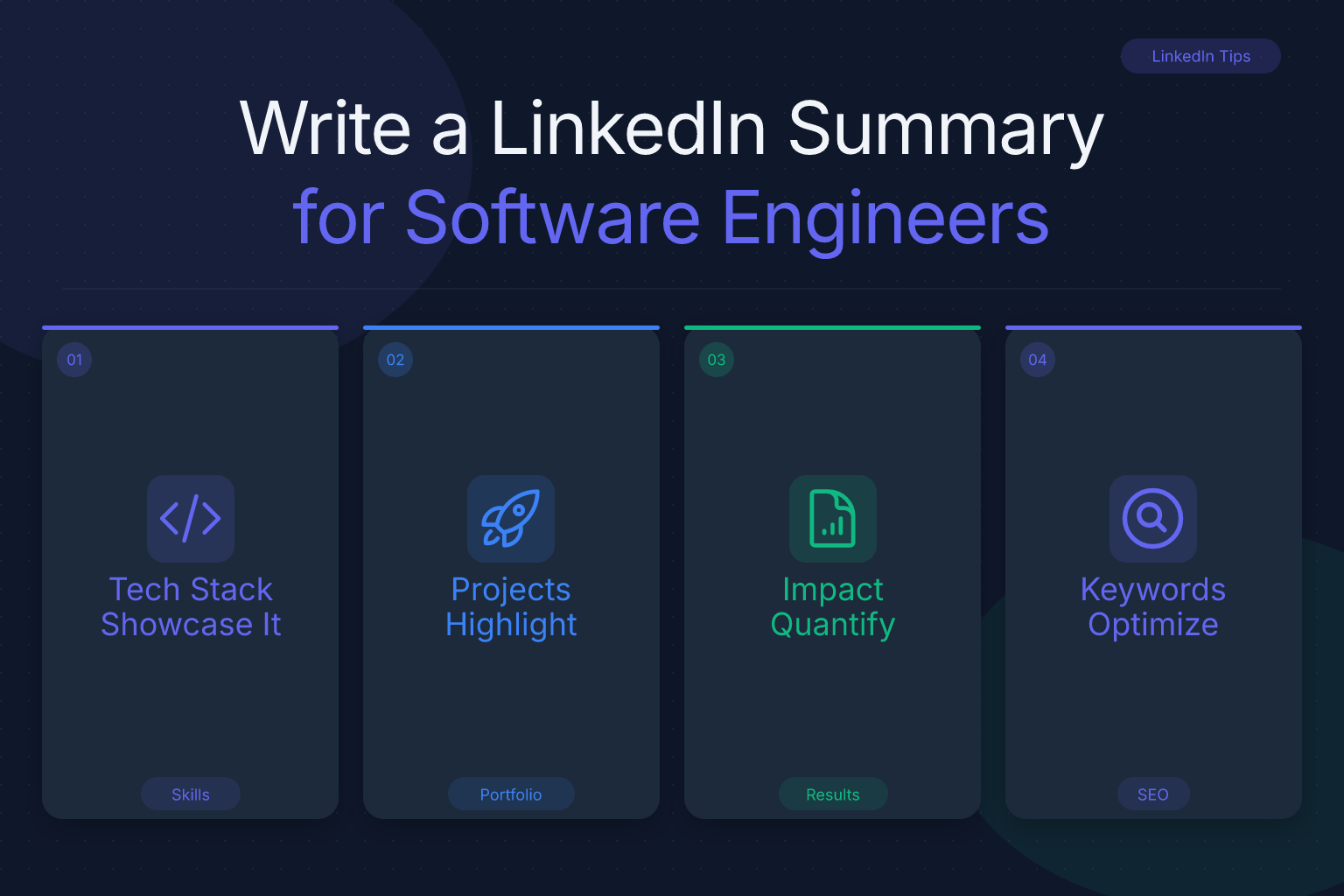
- Start your summary with a hook that states your role and a specific, quantified achievement to immediately capture a recruiter’s attention.
- Integrate technical skills into sentences that show how you apply them, rather than listing keywords, to improve both readability and search visibility.
- Include a clear statement of the type of role or challenge you’re seeking next so recruiters can quickly assess fit.
- End with a call to action inviting connection, such as ‘Let’s connect’ or ‘Open to opportunities in healthtech.’
- Align your LinkedIn summary with your resume by using the same core achievements and keywords to maintain consistency across your professional materials.
Why Your Summary Matters and What Recruiters Look For
Recruiters use LinkedIn as a search engine for talent. When they look for a “React developer with fintech experience” or a “Python backend engineer,” LinkedIn’s algorithm scans headlines, job titles, and — crucially — the summary section. A generic summary that just says “Software engineer with 5 years of experience” won’t surface in those searches. A summary packed with specific skills, project outcomes, and industry keywords will. Profiles with a completed summary are 40% more likely to receive InMail from recruiters.
When a recruiter lands on your profile, they’re scanning for three things in seconds:
- Technical fit: Do you have the languages, frameworks, and tools the role requires?
- Impact: Have you shipped features, improved performance, or led projects that moved a metric?
- Communication: Can you explain complex work clearly and concisely?
Your summary should answer all three without turning into a wall of text. The first two sentences need to pack a punch. Instead of “I am a software engineer with experience in Java and Spring Boot,” try: “Backend engineer who reduced API latency by 40% at a Series B fintech startup. I build scalable microservices in Java and Go that handle 10M+ daily requests.” Notice the difference: the second version names a specific achievement, a business context, and the scale of the work — and uses keywords a recruiter might search for.
How to Structure and Write Your Summary
A software engineer’s summary works best when it follows a clear structure. Here’s a proven framework you can adapt:
- Hook (1–2 sentences): Who you are, what you do, and your biggest result. Example: “Full-stack engineer who led the rebuild of a legacy e-commerce platform, cutting page load time by 60% and increasing conversion by 12%.”
- Technical expertise (2–3 sentences): Your core stack and how you apply it. Avoid laundry lists — pair each skill with a use case. “I work primarily with React, Node.js, and PostgreSQL, building real-time dashboards and payment integrations for SaaS products.”
- Soft skills and collaboration (1–2 sentences): Show how you work with others. “I’ve mentored junior developers through code reviews and pair programming, and I regularly collaborate with product and design to scope features.”
- What you’re looking for (1 sentence): Be specific about the role or challenge you want next. “Currently seeking a senior frontend role where I can lead a team building accessible, high-performance web applications.”
- Call to action (1 sentence): Invite connection. “Open to messages about opportunities in healthtech or climate tech — let’s connect.”
Follow these steps to draft a summary that works for both human readers and LinkedIn’s search algorithm.
1. Brainstorm Your Key Achievements
List three to five accomplishments from your career. Think about performance improvements, features you shipped and their user impact, cost savings, team leadership, or open-source contributions. Quantify wherever possible: “Reduced average query time from 2.3s to 0.4s by rewriting SQL and adding indexes” is concrete. If you are targeting cloud-specific roles, highlight infrastructure wins; for more on landing cloud positions, see our guide on AWS Jobs 2025: Resume, Skills, Job Search Guide.
2. Identify Your Core Technical Keywords
Make a list of the languages, frameworks, databases, cloud platforms, and tools you use most. Narrow it to the 5–8 most relevant to the roles you want. Sprinkle these naturally throughout your summary — never as a comma-separated list. For example, instead of “Skills: Python, Django, AWS, Docker, Kubernetes,” write: “I build and deploy Python microservices with Django, containerized with Docker and orchestrated on Kubernetes, all running on AWS.”
3. Write a Hook That Shows Impact
Your first two sentences are the most valuable real estate on your profile. Use this formula: [Role] who [achieved X] by [doing Y] at [company type/industry]. Examples:
- “iOS engineer who grew daily active users by 25% after redesigning the onboarding flow for a fitness app.”
- “Data-focused backend engineer who built a real-time fraud detection system that saved $2M annually for a payments company.”
If you’re early in your career, focus on a project: “Computer science grad who built a full-stack campus event app used by 3,000 students, handling auth, payments, and real-time chat.”
Note on Headlines: While the summary provides depth, your LinkedIn headline appears everywhere you comment or post. Ensure it mirrors your summary’s hook. A strong headline looks like: “Senior Backend Engineer | Go, Kubernetes, AWS | Building Scalable Fintech Systems.” This consistency boosts your visibility when recruiters search for specific titles.
4. Expand on Your Technical Approach
Add 2–3 sentences that explain how you work. Connect your skills to outcomes. “I write clean, tested TypeScript on the frontend and design RESTful APIs in Node.js. I’m comfortable owning features from spec to deployment, including CI/CD pipelines and monitoring with Datadog.”
5. Add a Human Element
Mention one or two soft skills with a brief example. “I’ve led sprint planning for a team of five engineers and enjoy breaking down complex problems into clear, actionable tickets. I also regularly give internal tech talks on topics like accessibility and performance.”
6. State What You Want Next
Be direct about the type of role, industry, or challenge you’re targeting. “I’m looking for a remote-first backend role where I can work on distributed systems at scale, ideally in the developer tools or infrastructure space.” If you are actively applying, track your outreach using the ResumeMate Job Board to find roles that match these criteria.
7. End with an Invitation
Close with a friendly call to action. “Let’s connect” or “If you’re hiring engineers who care about code quality and user experience, I’d love to hear from you.”
LinkedIn Summary Examples for Software Engineers (by Specialization)
Here are full summary examples for different engineering paths. Use them as inspiration, not copy-paste templates.
Frontend Engineer “Frontend engineer who led the migration of a legacy jQuery app to React and TypeScript, reducing bundle size by 45% and improving Lighthouse performance scores from 32 to 92. I specialize in building accessible, responsive interfaces and have a deep understanding of CSS architecture, state management, and design systems. At my current role, I collaborated with UX researchers to redesign a checkout flow that lifted conversion by 8%. I’m looking for a senior frontend role where I can mentor junior developers and push for web performance best practices. Let’s connect if you’re building products that prioritize user experience.”
Backend Engineer “Backend engineer with 6 years of experience building high-throughput APIs and data pipelines. I architected a real-time analytics service in Go that processes 500K events per minute, deployed on Kubernetes and monitored with Prometheus and Grafana. I’m comfortable with PostgreSQL, Redis, and Kafka, and I’ve led migrations from monoliths to microservices. I value clean documentation, thorough code reviews, and on-call reliability. Currently seeking a backend role on a platform team where I can solve infrastructure challenges at scale. Open to remote opportunities in the US and Europe.”
Full-Stack Engineer “Full-stack engineer who built a SaaS product from zero to 10K users, handling everything from React frontends to Node.js backends and AWS infrastructure. I thrive in early-stage environments where I can wear multiple hats — shipping features in the morning and debugging production issues in the afternoon. My recent work includes implementing a multi-tenant architecture that reduced infrastructure costs by 30%. I’m looking for a full-stack role at a startup where I can have ownership over the product and grow into a tech lead. Reach out if you’re building something ambitious.”
DevOps / Platform Engineer “Platform engineer who reduced deployment time from 45 minutes to under 5 by building a self-service CI/CD pipeline with GitHub Actions, Terraform, and ArgoCD. I’ve managed Kubernetes clusters serving 200+ microservices and implemented observability with OpenTelemetry and Grafana. I’m passionate about developer experience — I write internal tools and documentation that help engineers ship faster and safer. Looking for a platform engineering role where I can drive reliability and automation initiatives. Let’s connect if your team values infrastructure as code and blameless postmortems.”
Engineering Student / Fresher If you are still studying or recently graduated, focus on academic projects, internships, and hackathons. Recruiters know you lack commercial experience, so show potential through code quality and initiative.
“Computer Science senior with a focus on distributed systems and cloud architecture. During my internship at [Company], I optimized database queries that reduced load times by 30%. I built a capstone project using Azure Functions and React that helps local non-profits manage volunteers. Proficient in Java, Python, and SQL, with a strong foundation in data structures and algorithms. Seeking a software engineer internship or junior role where I can contribute to scalable backend solutions. Open to relocation and remote opportunities.”
Career Changer into Software Engineering If you’re transitioning into tech, your summary should bridge your past experience with your new skills. For more on this, see our guide on how to write a career change resume summary with no experience.
“Former mechanical engineer turned full-stack developer after completing a 6-month intensive bootcamp. I bring a systems-thinking mindset from my previous career, where I designed manufacturing processes that reduced waste by 20%. Now I build web applications with React and Python, and I recently contributed to an open-source project that helps small businesses manage inventory. I’m looking for a junior developer role where I can combine my engineering background with my new coding skills. Open to contract and full-time opportunities — let’s chat.”
Mistakes to Avoid and How to Optimize for Search
Even strong engineers write summaries that work against them. Here are the most frequent missteps and how to fix them:
- The generic opener: “Experienced software engineer seeking new opportunities.” Replace it with a specific achievement.
- The keyword dump: “Java, Python, C++, JavaScript, React, Angular, AWS, Docker, Kubernetes, SQL, NoSQL…” Weave keywords into sentences that show how you use them.
- No measurable results: “Worked on the payments team.” Add numbers: “Reduced payment failures by 15% by refactoring the retry logic.”
- Ignoring the “see more” cutoff: On desktop, only the first 3 lines show before a user clicks “see more.” Put your strongest statement first.
- No call to action: You’ve told your story — now tell the reader what to do. “Let’s connect” or “I’m open to roles in X” gives a clear next step.
To rank higher in recruiter searches, use the exact terms they search for. If you want a “React Native developer” role, that phrase should appear in your summary — not just “mobile developer.” Include location and remote preferences if they matter. Mention industry-specific keywords like “payments,” “PCI compliance,” or “fraud detection” if you have that experience. Avoid overused buzzwords like “passionate” and “leadership” without evidence. Many companies also use applicant tracking systems (ATS) that parse your LinkedIn profile when you apply through Easy Apply. A keyword-rich summary increases the chance your profile gets flagged as a strong match. For a deeper dive into making your entire application ATS-friendly, use a tool like the ResumeMate score checker to see how your resume stacks up — and make sure your LinkedIn summary aligns with the same keywords.
Align Your LinkedIn Summary with Your Resume and Cover Letter
Your LinkedIn summary shouldn’t exist in a vacuum. When a recruiter finds you on LinkedIn, they’ll often cross-reference your resume. If your summary says “led a team of five engineers” but your resume shows only individual contributor work, you’ll lose credibility. Consistency matters.
- Use the same core achievements across your summary, resume, and cover letter — just adapt the level of detail. Your summary might say “reduced deployment time by 90%,” while your resume bullet adds the how: “Built a CI/CD pipeline with GitHub Actions and Terraform.”
- Match your technical keywords. If your resume highlights “Python, FastAPI, and PostgreSQL,” those same terms should appear in your LinkedIn summary.
- Tell a cohesive story. Your cover letter can expand on the “why” behind a career move, your resume proves the “what,” and your LinkedIn summary ties it all together with personality.
If you’re also working on a cover letter, check out our guide on how to write a software engineer cover letter that gets hired. And once your summary is polished, make sure your resume matches the same level of impact — you can build an ATS-friendly PDF in minutes with the free ResumeMate AI resume builder.
FAQ
Q: How long should a LinkedIn summary be for a software engineer?
A: Aim for 150–300 words, or roughly 1,000–2,000 characters. This gives you enough space to tell a compelling story without overwhelming the reader. The first three lines (about 300 characters) are the most critical — they appear before the “see more” link and must hook the reader immediately.
Q: What should I put in my LinkedIn summary if I’m a junior developer?
A: Focus on projects, internships, and the specific technologies you’ve used. Lead with a strong project outcome: “Computer science grad who built a full-stack task management app with React and Node.js, used by 200 beta testers.” Mention your coursework only if it’s directly relevant, and end with the type of role you’re seeking and your eagerness to learn.
Q: What is a good LinkedIn headline for a software engineer?
A: Your headline should be concise and keyword-rich, appearing right under your name. Use the format: “Role | Key Skills | Value Prop.” For example: “Full Stack Engineer | React, Node.js | Building Scalable SaaS Solutions.” This complements your summary and ensures you appear in search results even when recruiters don’t click into your profile.
Q: How do I write a LinkedIn summary for a career change into software engineering?
A: Bridge your past experience with your new technical skills. Start with a sentence that connects your previous career to engineering: “Former financial analyst who automated reporting workflows with Python, now building full-stack applications.” Highlight a bootcamp, self-study, or project that demonstrates your coding ability, and state clearly that you’re seeking a junior or associate role. For more detailed advice, see our guide on how to write a career change resume summary with no experience.
Q: What keywords should a software engineer include in their LinkedIn summary?
A: Include the programming languages, frameworks, databases, cloud platforms, and tools that are most relevant to the roles you want. Also add industry-specific terms (e.g., “HIPAA compliance” for healthtech, “PCI DSS” for fintech) and role descriptors like “backend,” “frontend,” “full-stack,” or “DevOps.” Avoid stuffing — each keyword should appear naturally in a sentence that shows how you use it.
Q: Should I include my GitHub or portfolio link in the summary?
A: Yes, but keep it subtle. You can add a line like “Check out my projects at [portfolio URL]” near the end. However, ensure your pinned repositories are clean and documented. Recruiters often check GitHub to verify code quality before reaching out, so treat your profile README as an extension of your summary.
Q: Can I copy a software engineer LinkedIn profile example?
A: You can use examples for structure and inspiration, but never copy them word-for-word. Recruiters can spot generic templates, and duplicate content may hurt your search ranking. Use the examples above to understand the tone and flow, then customize every sentence to reflect your unique achievements and voice.
Related articles:
Track Every Application While You Job Hunt
Stop losing track of where you’ve applied. The ResumeMate Job Tracker is a free Chrome extension that tracks every application, deadline, and follow-up in one place — right from your browser.