How to Write a Remote Job Cover Letter (With Examples)
Writing a cover letter for a remote job isn’t just about tweaking a few words in your standard template. Remote hiring managers look for specific signals: self-discipline, async communication skills, and comfort with digital tools. A generic cover letter that ignores these signals will get passed over, no matter how strong your resume is.
Key Takeaways
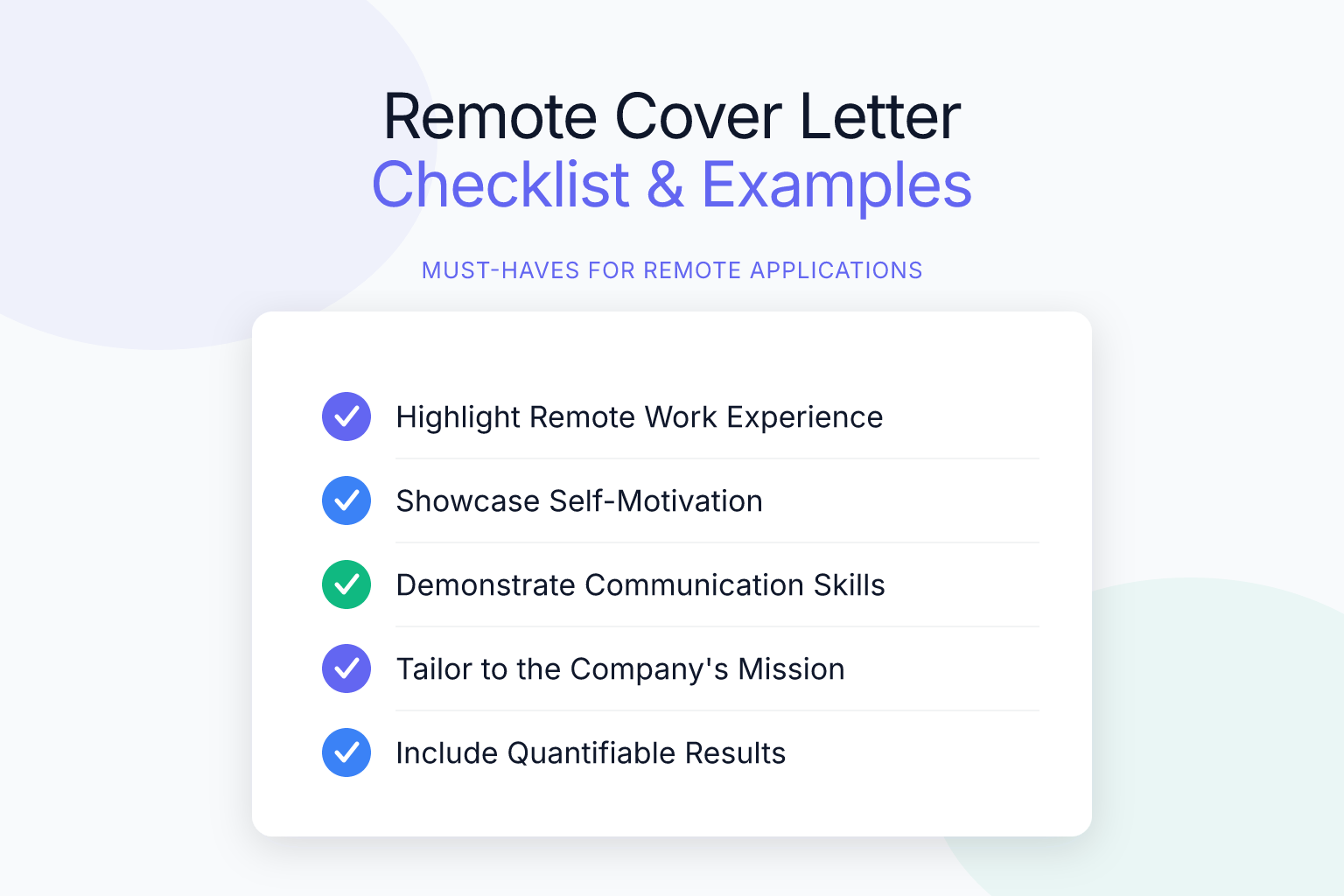
- Open your cover letter with a hook that immediately references your remote work experience and the specific company to show you understand the distributed nature of the role.
- Demonstrate remote readiness by providing specific, quantified examples of self-management, async communication, and tool proficiency rather than just claiming you have those skills.
- Research the company’s remote tools and culture, then mirror their language and mention how you’ve used similar tools to achieve results, proving you can integrate into their workflow.
- Keep the cover letter under 300 words with a scannable structure—a strong opening, body paragraphs with remote-relevant achievements, and a clear call to action—to signal strong written communication.
- If you lack direct remote experience, reframe independent projects, self-directed learning, or autonomous in-office work in remote terms and briefly confirm you have a reliable home office setup.
This guide walks you through exactly how to structure, write, and tailor a cover letter that proves you’re ready to thrive in a distributed team — with a full example you can adapt.
How to Write a Remote Job Cover Letter: The Essentials
A remote cover letter follows the same basic structure as any professional cover letter — opening, body, closing — but the content must shift. You’re not just selling your skills; you’re selling your ability to deliver those skills from a home office, across time zones, without someone looking over your shoulder.
Start with these three non-negotiables:
- Address the hiring manager by name whenever possible. Check the job posting, LinkedIn, or the company’s website. If you can’t find a name, “Dear Hiring Manager” is acceptable, but a name always performs better.
- Open with a hook that references the remote nature of the role. For example: “I’ve spent the last three years leading distributed customer success teams across four time zones, and I’m excited to bring that experience to [Company Name]’s fully remote operations.”
- Close with a clear call to action that respects remote hiring norms — offer to hop on a video call, share a Loom walkthrough of a relevant project, or provide references who can speak to your remote work ethic.
If you’re unsure whether a cover letter is even expected, check the job posting. Many remote roles still request one, and even when it’s optional, a well-written letter can set you apart. For a deeper dive on when cover letters matter, read our guide on whether you need a cover letter.
Research the Company and Structure Your Letter
Generic cover letters fail because they treat every remote job the same. A startup that’s fully async with no mandatory meetings has different expectations than a company that’s remote-first but requires core overlap hours. Spend 30 minutes digging into the company’s careers page, employee reviews on Glassdoor, the job description itself, and any leadership interviews or blog posts. Look for phrases like “work from anywhere,” “distributed team,” or specific remote requirements like “must be available 9am–12pm EST.” Then weave one or two of those insights into your cover letter. For example:
“I noticed that Acme Corp uses a combination of async Loom updates and weekly Zoom standups. In my current role, I introduced a similar cadence that reduced meeting time by 30% while keeping cross-functional projects on track.”
This shows you’ve done your homework and already picture yourself in their workflow.
Once you’ve researched, structure your letter for maximum impact. Hiring managers for remote roles often skim cover letters quickly — they’re looking for proof you can communicate clearly in writing. A clean, scannable structure helps. Use a subject line like “Application for [Job Title] – [Your Name]” if emailing, a personalized salutation, and an opening paragraph that states the role, your remote background, and why you’re drawn to the opportunity. Follow with 2–3 short body paragraphs: one highlighting a specific remote-relevant achievement with numbers, one connecting your skills to the company’s tools or culture, and an optional paragraph addressing any potential concerns like time zone gaps. Close by reiterating enthusiasm and offering a next step (video call, portfolio review). Keep the entire letter under 300 words — brevity and clarity signal strong written communication.
Showcase Remote Skills and Tools
Don’t just say you’re “self-motivated” or “a great communicator.” Every remote candidate claims that. Instead, show it through specific stories. For self-management, describe a project you led independently across time zones. For written communication, mention how your async updates reduced meetings or Slack pings. For tech adaptability, share how you quickly learned a new tool and helped onboard others. For collaboration across time zones, explain how you scheduled calls to accommodate teammates. If you’ve never held a fully remote job, pull examples from freelance work, side projects, or even hybrid arrangements — frame the experience in remote terms.
One of the fastest ways to signal remote readiness is to name the tools you’re comfortable with. Many remote job descriptions list specific platforms — Slack, Zoom, Microsoft Teams, Asana, Notion, Loom, Miro, Google Workspace, etc. If you’ve used them, say so. But don’t just list tools. Show how you used them to get results:
“I use Slack’s shared channels to collaborate with external partners, cutting email threads by half. In Notion, I built a team wiki that new hires use to ramp up in their first week without a buddy.”
If the company uses a tool you haven’t used, mention your ability to pick up new software quickly — and back it up with an example of a tool you learned on the fly.
Tailor Your Application to the Job
Remote job postings often include specific keywords related to remote work: “asynchronous communication,” “self-starter,” “distributed team,” “home office setup,” “reliable internet connection.” Mirror those phrases in your cover letter — not robotically, but naturally. This helps your application pass ATS filters that scan for remote-related terms and shows the human reader you actually read the posting. For example, if the job description says “must be comfortable with ambiguity and fast-paced environments,” you could write:
“I thrive in fast-paced, ambiguous settings. At my last startup, priorities shifted weekly, and I developed a lightweight prioritization system in Notion that kept my work visible to the team even when direction changed.”
Pair your cover letter with a resume that’s equally tailored. Use ResumeMate’s free AI resume builder to create a clean, ATS-friendly resume that matches the remote job’s keywords. Then run it through the resume score checker to see how well it aligns with the job description and where you can improve. For a step-by-step guide on tailoring your resume to any job description, read our post on how to tailor a resume to a job description for ATS success.
Cover Letter Example for a Remote Job
Here’s a full example for a remote Customer Success Manager role. Adapt it to your industry and experience.
Subject: Application for Customer Success Manager – Alex Rivera, Remote CSM Experience
Dear Ms. Chen,
I’ve spent the last four years managing customer success for SaaS companies with fully distributed teams, and I’m excited about the opportunity to bring that experience to BrightPath’s remote-first CS team.
At CloudKit, I onboarded over 200 enterprise customers across North America and EMEA — all remotely. I built a scalable onboarding process using Intercom, Loom, and Notion that reduced time-to-value by 25% and earned a 98% satisfaction rating. Because my team was spread across five time zones, I relied on async video updates and clear documentation to keep everyone aligned without endless meetings.
I noticed BrightPath uses a similar stack — Intercom, Slack, and Notion — and emphasizes “proactive, high-empathy communication” in your job description. That’s exactly the approach I take: I send personalized check-in videos at key milestones, and I maintain a shared success plan in Notion so customers always know what’s next.
I work from a dedicated home office with fiber internet and a quiet background, and I’m comfortable with core overlap hours of 9am–1pm EST. I’d welcome the chance to hop on a Zoom call and walk you through how I’d approach onboarding for your top-tier accounts.
Thank you for your time and consideration.
Best regards, Alex Rivera alex.rivera@email.com | (555) 123-4567 linkedin.com/in/alexrivera
Notice how the letter opens with remote experience right away, uses specific numbers and tools, references the company’s stack and values, addresses time zone and home office setup, and ends with a clear, low-friction next step.
Avoid Common Mistakes and Address Experience Gaps
Even strong candidates sabotage their applications with avoidable errors. Using a generic template that could apply to any job is a red flag — remote hiring managers can spot a copy-paste job instantly. Ignoring the remote aspect entirely is another missed opportunity; if you never mention remote work, you fail to address the employer’s biggest concern. Focusing only on what you want (“I want a remote job so I can travel”) centers your needs, not the employer’s. Frame remote work as a way you deliver more value. Over-explaining your home office setup is unnecessary — a quick mention of reliable internet and a quiet workspace is enough. Skipping proofreading is especially damaging because typos undermine your claim of strong written communication. And writing too much signals poor communication skills; keep it tight.
If you’ve never worked remotely, you can still write a compelling cover letter. Focus on transferable skills and demonstrate remote readiness through other experiences. Highlight independent projects like building a Shopify store from your home office. Emphasize self-directed learning, such as completing an online certification while collaborating via Slack and Zoom. Reframe in-office autonomy: if your manager was in another office and you operated with minimal supervision, describe how you set priorities and reported progress asynchronously. Show you’ve thought about remote work by mentioning your dedicated workspace with a standing desk, dual monitors, and gigabit internet. Be honest — don’t exaggerate — but don’t undersell the remote-adjacent experiences you do have.
FAQ
Q: Do I really need a cover letter for a remote job?
A: It depends on the employer, but a tailored cover letter often gives you an edge. Many remote hiring managers use it to assess written communication skills and genuine interest. If the application portal has an optional cover letter field, filling it with a short, remote-specific letter can set you apart from candidates who skip it.
Q: How long should a remote cover letter be?
A: Aim for 200–300 words. Remote hiring managers value concise, clear writing. A short letter that directly addresses remote readiness is more effective than a long, generic one.
Q: What if I don’t have any remote work experience?
A: Focus on transferable skills like self-management, written communication, and comfort with digital tools. Draw from freelance projects, online courses, or times you worked independently in an office. Be honest and show you’ve prepared a productive home workspace.
Q: Should I mention my home office setup in the cover letter?
A: Briefly, if it’s relevant. A sentence like “I have a dedicated home office with reliable high-speed internet and a quiet background” reassures employers you can work without disruptions. Avoid listing every piece of equipment unless the job posting specifically asks for it.
Q: How do I address time zone differences in a cover letter?
A: If you’re in a different time zone than the company’s core hours, acknowledge it and explain how you’ll manage. For example: “I’m based in PT but am fully available during your core hours of 9am–5pm ET. I’ve worked East Coast hours for the past two years and have a routine that keeps me productive and responsive.”
Q: Can I use the same cover letter for multiple remote jobs?
A: No. Each cover letter should be tailored to the specific company and role. At minimum, customize the opening paragraph, mention the company’s remote tools or culture, and align your examples with the job description. A generic letter is easy to spot and rarely leads to an interview.
Related articles:
- How to Explain a Layoff in a Cover Letter (With Examples)
- Volunteer Cover Letter: Examples & How to Write
- How to Address a Cover Letter When You Don’t Know the Name
- What to Put in a Cover Letter Subject Line
- How to Write a Cover Letter for a Part-Time Job (Examples)
- How to Accept a Job Offer Email Template (With Examples)
- What to Put in a Cover Letter When There Is No Job Posting
- How to Write a Creative Cover Letter That Gets Noticed
- How to Write a Cover Letter for an Employment Gap
Track Every Application While You Job Hunt
Stop losing track of where you’ve applied. The ResumeMate Job Tracker is a free Chrome extension that tracks every application, deadline, and follow-up in one place — right from your browser.