How to Write a Resume for a Government Job Outside USAJOBS
If you’re applying for a government job outside USAJOBS — at the state, county, city, or special district level — your resume needs a different approach than the federal resume format. While USAJOBS is the portal for most federal positions, thousands of public sector jobs are posted on state and local government websites, NeoGov, GovernmentJobs.com, and agency-specific portals. These employers often expect a resume that looks more like a private sector document but with a clear emphasis on public service, specific qualifications, and compliance with their application instructions.
Navigating these applications requires precision. Unlike private sector roles where culture fit might sway a hiring manager, government hiring is often rules-based. If you don’t meet the minimum qualifications exactly as stated, or if your resume fails to parse correctly in their system, you may be automatically disqualified. This guide walks you through the specific formatting, keyword strategies, and content requirements to secure an interview in the public sector.
Key Takeaways
- A resume for a state or local government job is typically 1–2 pages, unlike the 3–5 page federal resume, and should focus on relevant experience, certifications, and quantified results.
- Always read the specific job posting for required keywords, formatting instructions, and mandatory sections — many agencies use applicant tracking systems that screen for exact terms.
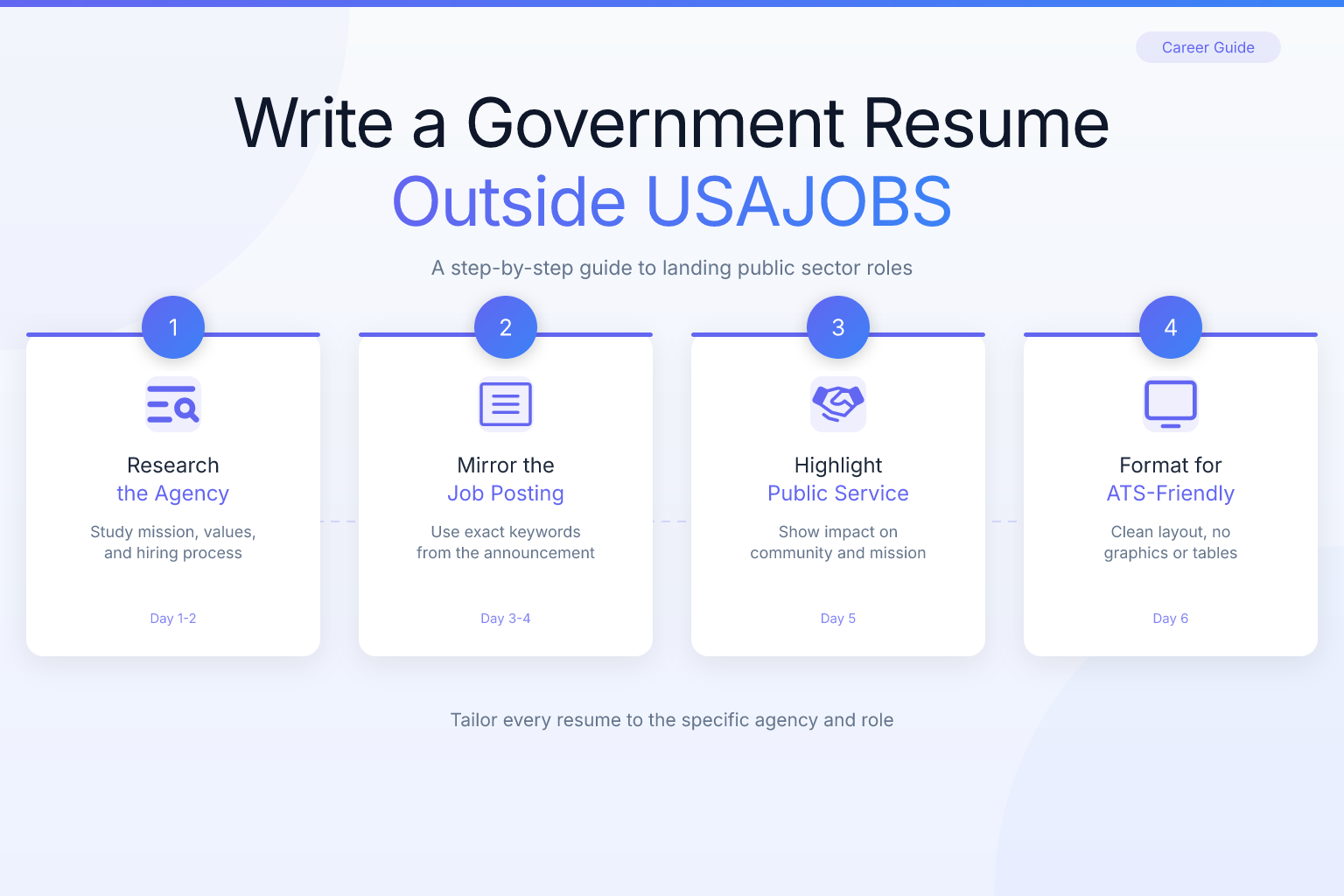
- Use a clean single-column layout with standard headings and no graphics or tables, because many government portals parse resumes through ATS software.
- Include any required licenses, certifications, or security clearances near the top of your resume, as these are often non-negotiable screening criteria.
- Tailor your resume for every application by mirroring the language of the job description and addressing each “must-have” qualification explicitly.
| What to Do | Why It Matters | Time |
|---|---|---|
| Use a single-column, ATS-friendly layout | Ensures your resume parses correctly in government applicant tracking systems | 10 minutes |
| Mirror keywords from the job posting | Gets your resume past automated screening and shows you read the announcement | 15 minutes per application |
| Quantify achievements with numbers and outcomes | Demonstrates impact and public service value, not just duties | 20 minutes |
| List certifications, licenses, and clearances prominently | Many government roles have hard requirements that screen out unqualified applicants | 5 minutes |
| Follow the agency’s specific instructions (page limits, file format, required sections) | Non-compliance can disqualify you before a human ever sees your resume | 10 minutes |
How Government Resumes Outside USAJOBS Differ from Federal Resumes
The first thing to understand is that a resume for a state, county, or city government job is not the same as a federal resume. Federal resumes submitted through USAJOBS are famously long — often 3 to 5 pages — and require details like hours worked per week, supervisor names, and salary history. State and local government agencies, on the other hand, usually expect a resume that is 1 to 2 pages and formatted more like a traditional private sector resume.
That said, government resumes outside USAJOBS still differ from corporate resumes in a few important ways:
- Public service focus: Hiring managers want to see that you understand the mission of the agency and are motivated by serving the community, not just by a paycheck.
- Keyword specificity: Government job postings are often written by HR specialists who use very precise language. If the posting says “experience with municipal budgeting software,” your resume should use that exact phrase.
- Required qualifications: Many public sector jobs have minimum qualifications (e.g., a bachelor’s degree, a specific certification, or a certain number of years of experience) that are non-negotiable. Your resume must clearly demonstrate you meet them.
- Application instructions: Some agencies require you to fill out a separate application form in addition to uploading a resume. Others ask for a specific file format or page limit. Ignoring these instructions is the fastest way to get rejected.
Before you start writing, identify the exact agency and job posting. A resume for a city parks department will look different from one for a state health agency or a county sheriff’s office. Research the agency’s mission, recent initiatives, and the specific duties of the role.
Research the Agency and Job Posting Before You Write
You cannot write an effective government resume without first dissecting the job announcement. Unlike private sector postings that may be vague, government job descriptions are often extremely detailed. They list required qualifications, preferred qualifications, essential duties, and sometimes even the exact screening criteria used by HR.
Follow these steps before you write a single word:
- Read the entire job posting twice. Highlight every “must-have” qualification, every preferred qualification, and every specific skill or software mentioned. Create a checklist to ensure every requirement is addressed in your resume.
- Identify the agency’s mission and values. Look at the agency’s website, recent press releases, and strategic plan. Note any language about public service, equity, efficiency, or community impact. Incorporating this language into your summary shows alignment with their goals.
- Check for application instructions. Does the posting specify a page limit? A file format? A required section like “References” or “Salary History”? Follow these exactly. Some portals reject files larger than 5MB or non-PDF formats automatically.
- Look for keywords. Government ATS software often scans for exact phrases from the job description. If the posting says “experience with grant administration,” use that phrase — not “managed grants.”
- Note any required forms or supplemental questions. Some agencies require a separate questionnaire or a statement of qualifications. Complete these carefully; they are often scored separately from your resume.
While you’re searching for openings, you can use the ResumeMate job board to filter by location, role, and remote options. It won’t replace agency-specific portals, but it can help you discover public sector opportunities you might otherwise miss.
Format Your Resume for ATS and Human Review
Many state and local government agencies now use applicant tracking systems (ATS) to screen resumes before a human ever sees them. That means your resume must be both machine-readable and easy for a hiring manager to skim. The safest approach is a clean, single-column layout with standard section headings and no graphics, tables, or text boxes.
There is a common misconception that Word documents are always safer than PDFs for government jobs. While some legacy systems prefer DOCX, modern ATS platforms (like NeoGov or TalentED) parse clean, text-based PDFs reliably. The real risk comes from scanned images, complex tables, or graphics — not the PDF format itself. ResumeMate’s AI resume builder exports ATS-safe PDFs that work for most government portals. If a specific agency asks for a Word document, follow that instruction — but otherwise, a text-based PDF is fine and preserves your formatting.
Here are the formatting rules that work for nearly every government portal:
- Use a single-column layout. Multi-column resumes can confuse older ATS software. While modern systems often parse two-column layouts fine, single-column is the safest choice for government applications.
- Stick to standard fonts. Arial, Calibri, or Times New Roman at 10–12 point size. Avoid decorative fonts.
- Use standard section headings. “Work Experience,” “Education,” “Skills,” “Certifications,” and “Professional Summary” are universally recognized by ATS.
- Avoid tables, graphics, and images. These can cause parsing errors. Use simple bullet points instead.
- Keep it to 1–2 pages. Unless the posting explicitly asks for a longer resume, two pages is the maximum for state and local government roles.
Before you submit, run your resume through the ResumeMate score checker to see how well it parses and whether any sections are missing or unclear. It’s free and gives you section-by-section feedback to ensure you haven’t missed critical elements.
Write a Strong Professional Summary
A professional summary at the top of your resume is your chance to tell the hiring manager who you are and why you’re a fit for this specific government role. Unlike a private sector summary that might focus on revenue growth or market share, a government summary should emphasize public service, relevant experience, and any certifications or clearances that make you immediately qualified.
Many candidates ask whether to use an “Objective” or a “Summary.” For government roles, a Professional Summary is almost always better. An objective states what you want; a summary states what you offer. However, if you are an entry-level candidate with no direct experience, you can blend the two by stating your career goal alongside your relevant skills.
Here’s a formula that works well:
[Job title or years of experience] with [key qualification] and a track record of [specific public service outcome]. Seeking to apply [skill] to support [agency mission or specific program].
Example for a city budget analyst role:
Budget analyst with 6 years of experience in municipal finance and a master’s degree in public administration. Managed a $12 million annual budget and reduced departmental overspending by 8% through data-driven forecasting. Seeking to apply grant administration and financial modeling skills to support the City of Austin’s Office of Budget and Finance.
Example for an entry-level administrative role:
Motivated public administration graduate with internship experience in records management and community outreach. Proficient in Microsoft Office Suite and customer service protocols. Eager to contribute organizational skills to the County Clerk’s office to improve citizen service delivery.
Notice how the summaries include specific numbers, relevant degrees, and a direct reference to the agency’s mission. That’s far more compelling than a generic statement like “dedicated professional seeking a challenging position.”
If you’re changing careers into government, focus on transferable skills and any volunteer or community work that demonstrates your commitment to public service. For more guidance on writing a summary that works, see our complete guide to writing a resume.
Detail Your Work Experience with Quantified Results
Government hiring managers are tired of reading resumes that list job duties without any evidence of impact. They want to know what you accomplished, how you improved processes, and how your work served the public. The best way to show that is with numbers, percentages, and concrete outcomes.
Compare these two bullet points:
- Weak: “Responsible for managing the department budget.”
- Strong: “Managed a $2.3 million departmental budget, identified $180,000 in cost savings through vendor renegotiation, and presented quarterly financial reports to the city council.”
The second version tells the reader exactly what you did, the scale of your responsibility, and the result. It also uses keywords like “budget,” “cost savings,” and “city council” that are likely to appear in the job posting.
How to List Government Contractor Experience
If you have worked as a contractor for a government agency, clarity is key. Hiring managers need to know you understand government protocols even if you weren’t a direct employee. List the agency name clearly, followed by your contractor role.
- Example: “Senior IT Consultant (Contractor) | Department of Transportation | 2020–2022”
- Bullet: “Led a team of 5 to migrate legacy data systems for the state DOT, ensuring compliance with NIST security standards.”
This distinguishes your employment status while highlighting your direct government experience.
Handling Interim or Acting Titles
Government roles often have “Interim” or “Acting” titles during transitions. Don’t hide these; they show you were trusted to lead. List the title exactly as it appeared on your pay stub or official offer letter. For advice on formatting these correctly, see our guide on Acting vs Interim: How to List on Resume.
When writing your experience section, follow these rules:
- Start each bullet with a strong action verb. Use words like “managed,” “led,” “implemented,” “coordinated,” “analyzed,” or “streamlined.”
- Quantify whenever possible. Include dollar amounts, percentages, number of people served, time saved, or any other measurable outcome.
- Tie your work to public service. If you improved a process that helped citizens, say so. For example: “Reduced permit processing time from 10 days to 3 days, improving service for 500+ applicants per month.”
- Use the exact language from the job posting. If the posting asks for “experience with community outreach,” use that phrase in your bullets.
- Keep bullets to 1–2 lines. Dense paragraphs are hard to skim, and government HR staff often review dozens of resumes per day.
For a deeper dive into writing an experience section that gets results, check out our complete resume writing guide.
Include Required Certifications, Licenses, and Clearances
Many government jobs outside USAJOBS have hard requirements that you must meet to even be considered. These might include:
- Professional licenses (e.g., PE for engineers, RN for nurses, teaching credential for educators)
- Certifications (e.g., PMP, CPA, GISP, or state-specific credentials)
- Security clearances (e.g., Secret, Top Secret, or public trust)
- Driver’s license requirements (e.g., Class B CDL for transit or public works roles)
- Language proficiency (e.g., bilingual Spanish/English for many social services positions)
If you have any of these, list them prominently — ideally in a dedicated “Certifications & Licenses” section near the top of your resume, right after your summary. Do not bury them at the bottom. Government HR screeners often check for these first, and if they can’t find them quickly, they may move on to the next candidate. For roles requiring specific financial credentials, seeing a layout like our Accountant Resume Examples with CPA and GAAP Skills can help you visualize how to prioritize these hard skills.
For security clearances, be specific but careful. You can write “Active Secret Clearance” or “Eligible for Top Secret Clearance” if that’s accurate. Do not include classified details about your work. If you have a public trust clearance, list it as “Public Trust Clearance.”
If the job posting lists a certification as “required,” and you don’t have it, do not apply unless you are actively in the process of obtaining it and can demonstrate that. Government agencies are strict about minimum qualifications, and applying without them wastes your time and theirs.
Tailor Your Resume for Each Application
One of the biggest mistakes job seekers make is sending the same resume to every government job they apply for. Government postings are highly specific, and a generic resume will almost never pass the ATS screen or impress a hiring manager. Tailoring your resume means adjusting the wording, emphasis, and even the order of your bullet points to match the exact job description.
Here’s a step-by-step tailoring process:
- Print or copy the job description. Highlight every required qualification, preferred qualification, and specific skill.
- Create a keyword list. Write down every term that appears more than once or that seems central to the role (e.g., “grant management,” “community engagement,” “budget forecasting”).
- Match your experience to each requirement. For every “must-have,” find a bullet point in your resume that demonstrates you meet it. If you don’t have a direct match, think of a transferable skill or a related accomplishment.
- Rewrite your summary and bullets. Use the exact keywords from the posting. If the posting says “experience with public records requests,” change your bullet from “handled FOIA requests” to “managed public records requests in compliance with state law.”
- Reorder sections if needed. If the job emphasizes a particular certification, move that section higher. If it emphasizes a specific project, make sure that project appears in your first few bullets.
- Check the length. After tailoring, your resume should still be 1–2 pages. If it’s too long, cut the least relevant bullets.
For a more detailed strategy on tailoring, read our guide on how to tailor a resume to a job description for ATS success.
Common Mistakes to Avoid
Even strong candidates get rejected from government jobs because of avoidable resume mistakes. Here are the most common ones and how to fix them:
- Using a federal resume format for a state or local job. A 4-page resume with hours worked and supervisor names will look out of place. Keep it to 1–2 pages and focus on relevant experience.
- Ignoring the application instructions. If the posting says “submit a PDF,” don’t send a Word document. If it says “include your salary history,” include it. Non-compliance is an automatic disqualification in many agencies.
- Failing to address minimum qualifications. If the posting requires a bachelor’s degree and 3 years of experience, make sure your resume clearly shows both. Don’t assume the reader will infer it.
- Using vague language. “Assisted with various tasks” tells the hiring manager nothing. Be specific: “Processed 200+ permit applications per month with a 98% accuracy rate.”
- Omitting public service context. Government agencies want to see that you care about the mission. If you volunteered for a community organization or worked on a public initiative, include it.
- Submitting a generic resume. As discussed above, tailoring is non-negotiable for government jobs. A generic resume will almost never make it past the ATS.
FAQ
Q: What are the best keywords for a government resume?
A: The best keywords come directly from the job posting. Look for repeated terms like “grant administration,” “compliance,” “stakeholder engagement,” or specific software names. Mirror these exact phrases in your summary and experience bullets to pass ATS screening.
Q: How do I write an entry level government resume?
A: Focus on transferable skills, internships, volunteer work, and education. Use a strong summary to connect your academic background to the agency’s mission. Quantify any projects or coursework that demonstrate relevant skills like research, analysis, or public communication.
Q: How do I list government contractor experience on a resume?
A: Clearly state the agency name and note your contractor status in the job title (e.g., “IT Specialist (Contractor)”). Highlight your knowledge of government protocols, compliance standards, and specific agency projects to show you understand the public sector environment.
Q: What is the best resume format for a government job?
A: A clean, single-column reverse-chronological format is best. Avoid graphics, tables, or photos. Export as a text-based PDF unless the agency specifically requests a Word document. This ensures ATS software can read your content without errors.
Q: Should I use an objective or summary for a government job?
A: Use a professional summary. Objectives are outdated. A summary allows you to immediately highlight your qualifications and public service value. Only use an objective blend if you are a complete career changer or entry-level candidate needing to state your career goal.
Q: Do government agencies outside USAJOBS use applicant tracking systems?
A: Yes, many state and local government agencies now use ATS software to screen resumes. That’s why it’s critical to use a clean single-column layout, standard headings, and keywords from the job posting. A text-based PDF from a tool like ResumeMate’s resume builder parses reliably in most systems.
Q: How do I list government clearances or certifications on my resume?
A: Create a dedicated “Certifications & Licenses” section near the top of your resume, right after your summary. List each item clearly, e.g., “Active Secret Clearance,” “Certified Public Accountant (CPA),” or “Class B Commercial Driver’s License.” Do not include classified details about your work.
Track Every Application While You Job Hunt
Stop losing track of where you’ve applied. The ResumeMate Job Tracker is a free Chrome extension that tracks every application, deadline, and follow-up in one place — right from your browser.