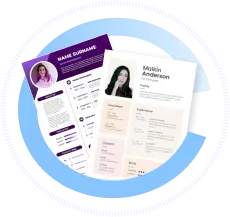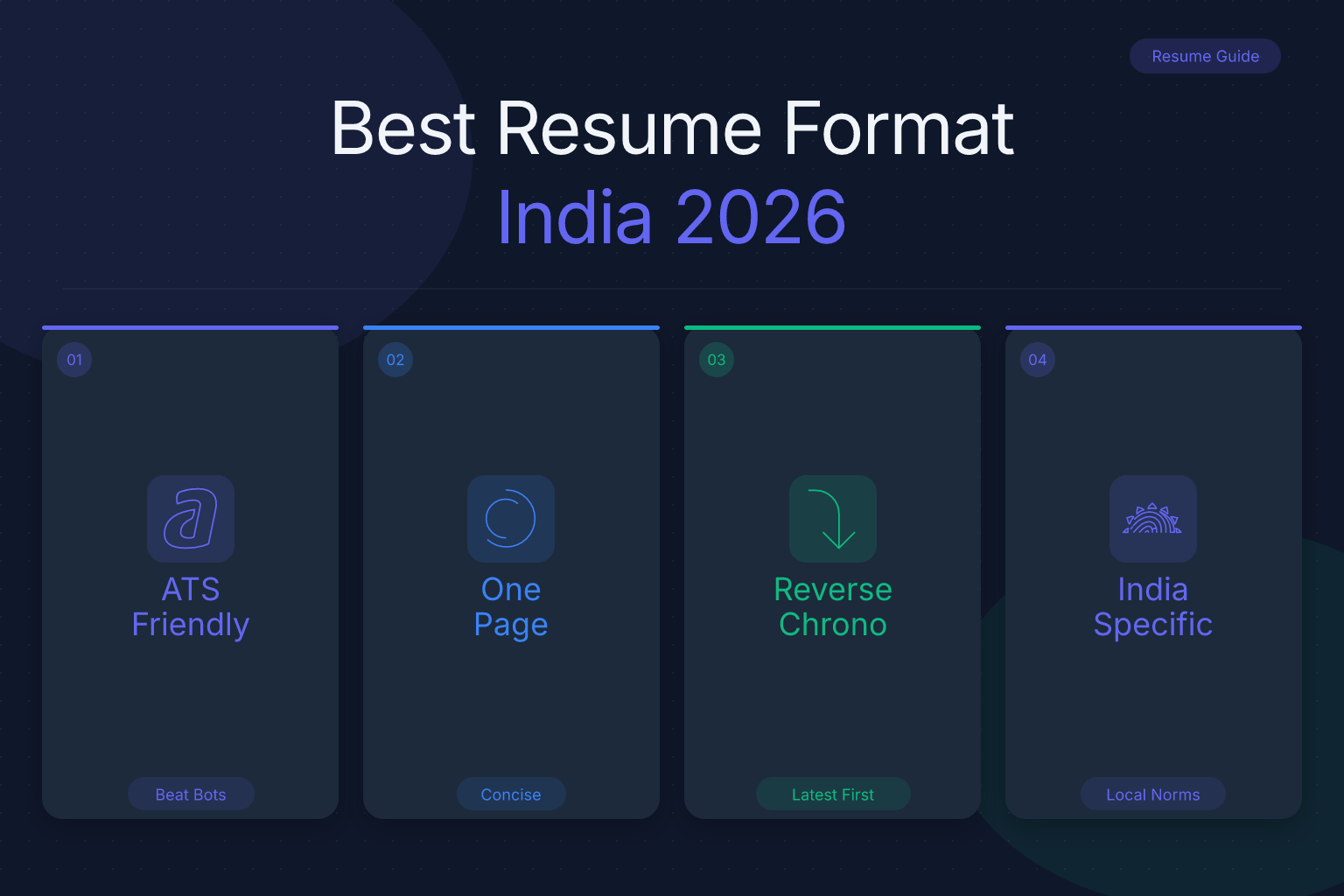
Best Resume & CV Format for India 2026 – Free Template & Job Guide
If you’re applying for jobs in India, you need a resume format that matches what Indian recruiters and ATS systems expect. While the core principles of a strong resume are universal, the Indian job market has its own preferences — from the personal details you include to the way you structure your experience. This guide breaks down the standard India resume format, gives you a ready-to-use CV template, and shows you how to tailor your application so it gets shortlisted.
Key Takeaways
- Use a reverse-chronological, single-column resume format with standard section headings like ‘Work Experience’ and ‘Education’ to ensure compatibility with Indian ATS systems and recruiter expectations.
- Include personal details such as date of birth, gender, and languages known, as many Indian employers in traditional sectors still expect this information on a resume.
- Tailor your resume for each job by mirroring keywords from the job description in your skills and experience sections to improve your ATS ranking and shortlist chances.
- Export your resume as a text-based PDF to preserve formatting across devices and avoid issues with older ATS systems that cannot parse images, tables, or graphics.
- Keep your resume concise: one page for freshers and early-career professionals, and no more than two pages for senior roles, focusing on quantifiable achievements rather than duties.
Quick Overview
Here’s a quick overview of the most important do’s and don’ts for your Indian resume.
| What to Do | Why It Matters | Time |
|---|---|---|
| Use a clean, single-column layout | Ensures ATS can parse your resume correctly | 5 min |
| Include a professional summary | Gives recruiters a quick snapshot of your profile | 10 min |
| Add personal details (DOB, languages) | Expected by Indian employers and HR departments | 2 min |
| Tailor skills and keywords to each job | Boosts your ATS score and shortlist chances | 15 min |
| Export as a text-based PDF | Maintains formatting across all devices and portals | 1 min |
What Is the Standard Indian Resume Format?
In India, the most widely accepted resume format is the reverse-chronological resume. This means you list your most recent work experience first and work backwards. It’s the format recruiters expect because it immediately shows your career progression and current role.
There are two other formats — functional (skills-focused) and combination (hybrid) — but these are rarely used in India unless you’re making a major career change or have significant employment gaps. For most job seekers, the reverse-chronological format is the safest and most effective choice.
A typical Indian resume includes these sections in order:
- Contact information and personal details
- Professional summary or career objective
- Work experience
- Education
- Skills
- Additional sections (certifications, languages, interests)
Unlike resumes in the US or UK, Indian resumes often include personal details like date of birth, gender, marital status, and languages known. While not mandatory, many Indian employers still expect this information, especially in traditional sectors like manufacturing, banking, and government jobs.
Resume vs. CV in India: What’s the Difference?
In India, the terms “resume” and “CV” are used interchangeably in most private-sector job applications. However, there is a technical difference:
- Resume: A concise 1–2 page summary of your skills, experience, and education tailored to a specific job. This is what you’ll submit for most corporate, IT, and private-sector roles.
- CV (Curriculum Vitae): A longer, more detailed document (often 3+ pages) that covers your entire career history, including publications, research, conferences, and awards. In India, CVs are typically used for academic, medical, and research positions.
For 90% of job applications on portals like Naukri, Indeed, and LinkedIn, you need a resume — not a full CV. Keep it short, focused, and relevant to the role you’re targeting.
Quick comparison:
| Feature | Resume | CV |
|---|---|---|
| Length | 1–2 pages | 3+ pages |
| Purpose | Tailored to a specific job | Comprehensive career record |
| Best for | Corporate, IT, private-sector roles | Academic, research, medical roles |
| Personal details | Optional but common in India | More detailed |
| Focus | Relevant skills and achievements | Complete history, publications, awards |
Essential Sections and Resume Template
Here are the key sections every Indian resume should include, with tips and examples for each.
1. Contact Information and Personal Details
At the top of your resume, include:
- Full name (as on your official documents)
- Phone number (with country code +91)
- Professional email address
- City and state (full address is optional and often unnecessary)
- LinkedIn profile URL (if updated)
Personal details that are common in India but optional elsewhere:
- Date of birth or age
- Gender
- Marital status
- Nationality
- Languages known (with proficiency levels)
These details are still requested by many Indian employers, especially in government, banking, and manufacturing. For IT and startup roles, they’re less critical — but including them rarely hurts. If you’re uncomfortable sharing marital status or gender, you can omit them; the trend is moving toward skills-only applications.
Why Indian employers still ask for personal details:
- Government and PSU jobs: Application forms often require DOB, category, and nationality for eligibility verification.
- Traditional sectors: Banking, manufacturing, and FMCG companies may use age and gender for workforce planning.
- Regional preferences: Some employers in smaller cities still expect a full bio-data format with family details.
If you’re applying to a modern startup or MNC, you can safely omit marital status and gender. But DOB and languages known are still widely expected across most Indian employers.
2. Professional Summary or Career Objective
This 3–4 line section sits right below your contact details and gives the recruiter a quick snapshot of who you are. For experienced professionals, use a professional summary that highlights your years of experience, key skills, and notable achievements. For freshers, a career objective that states your goal and what you bring to the role works better.
Example for experienced (IT professional):
Results-driven Software Developer with 5+ years of experience building scalable web applications using Java and Spring Boot. Reduced page load times by 40% at Infosys and led a team of 4 junior developers. Seeking a challenging role in a product-based company.
Example for fresher (MBA graduate):
MBA graduate with a specialization in Marketing and a summer internship at Hindustan Unilever. Skilled in market research, campaign analysis, and content strategy. Looking to contribute to a dynamic brand team and grow into a marketing manager role.
Tips for writing a strong summary:
- Keep it to 3–4 lines maximum
- Include your years of experience and top 2–3 skills
- Add one quantifiable achievement if possible
- Tailor the last line to the specific role you’re applying for
3. Work Experience
List your roles in reverse-chronological order. For each position, include:
- Job title
- Company name and location
- Employment dates (month and year)
- 3–5 bullet points describing your responsibilities and achievements
Use action verbs and quantify results wherever possible. Instead of “Responsible for sales,” write “Increased territory sales by 25% in 12 months by onboarding 15 new retail partners.”
Strong bullet point examples:
- “Reduced customer complaint resolution time by 35% by implementing a new ticketing system.”
- “Managed a portfolio of 50+ B2B clients worth ₹2.5 crore in annual revenue.”
- “Trained and mentored 8 junior developers, improving team productivity by 20%.”
If you have gaps in employment, address them briefly in a cover letter or be prepared to explain in an interview. For freshers, this section can be replaced or supplemented with internships, projects, and volunteer work.
4. Education
In India, education carries significant weight. List your degrees in reverse-chronological order, including:
- Degree name and specialization
- University/institution name
- Year of completion
- Percentage or CGPA (if above 7.0 or 70%)
If you’re a recent graduate with a strong academic record, place the education section above work experience. For experienced professionals, education moves below experience.
What to include for freshers:
- 10th and 12th details (school name, board, year, percentage)
- Bachelor’s degree (university, specialization, CGPA/percentage)
- Master’s degree if applicable
- Relevant coursework or academic projects
What to include for experienced professionals:
- Highest degree first
- Professional certifications (can be a separate section)
- Omit 10th/12th details if you have 5+ years of experience
5. Skills
Create a dedicated skills section with 8–12 relevant hard and soft skills. Hard skills might include programming languages, tools, or certifications. Soft skills like communication, teamwork, and problem-solving are valued but should be demonstrated through your experience bullets rather than just listed.
Pro tip: Mirror the keywords from the job description. If the JD asks for “Advanced Excel, VLOOKUP, Pivot Tables,” list those exact terms in your skills section.
Example skills section for a marketing role:
- Hard skills: Google Analytics, SEO, SEM, Content Marketing, Email Marketing, HubSpot, Canva
- Soft skills: Communication, Team Leadership, Stakeholder Management, Problem-Solving
- Tools: WordPress, Mailchimp, Google Ads, Meta Ads Manager
6. Additional Sections (Optional but Recommended)
- Certifications: Include any industry-recognized certifications (e.g., AWS Certified Solutions Architect, Six Sigma Green Belt).
- Languages Known: List languages and proficiency (Read, Write, Speak). This is especially important in multilingual Indian workplaces.
- Interests and Hobbies: Keep this brief and professional. Avoid generic entries like “listening to music” — instead, mention interests that show leadership or relevant skills (e.g., “Organizing community blood donation camps”).
Sample Resume Template
Here’s a text-based template you can copy and adapt. Replace the bracketed details with your own information.
[Full Name]
[City, State] | +91 [Phone Number] | [Email Address]
[LinkedIn Profile URL]

Date of Birth: [DD/MM/YYYY] | Languages: [Language 1 (Native), Language 2 (Fluent), Language 3 (Intermediate)]

PROFESSIONAL SUMMARY
[3-4 lines summarizing your experience, top skills, and career goal. Tailor this to the job.]

WORK EXPERIENCE
[Job Title] | [Company Name, Location] | [Month Year – Month Year]
- [Achievement or responsibility bullet using action verb + quantifiable result]
- [Achievement or responsibility bullet]
- [Achievement or responsibility bullet]

[Previous Job Title] | [Company Name, Location] | [Month Year – Month Year]
- [Bullet]
- [Bullet]

EDUCATION
[Degree, Specialization] | [University Name] | [Year] | [Percentage/CGPA]
[12th/HSC] | [School Name] | [Year] | [Percentage]
[10th/SSC] | [School Name] | [Year] | [Percentage]

SKILLS
- [Hard Skill 1], [Hard Skill 2], [Hard Skill 3]
- [Soft Skill 1], [Soft Skill 2]
- [Tools/Software]

CERTIFICATIONS
- [Certification Name] | [Issuing Organization] | [Year]

ADDITIONAL INFORMATION
- Interests: [Relevant interest 1], [Relevant interest 2]
- Volunteer Experience: [Brief description]
You can build a polished, ATS-friendly version of this template in minutes using ResumeMate’s free resume builder. It comes with single-column templates that match Indian employer expectations and exports a clean PDF.
Formatting and Optimization Tips
Layout and Design
- Single-column layout: The safest choice for ATS compatibility. Multi-column resumes can confuse older ATS systems still used by some Indian companies.
- Font: Use standard fonts like Arial, Calibri, or Times New Roman at 10–12 pt size. Avoid decorative fonts.
- Margins: 0.5–1 inch on all sides.
- File format: Export as a text-based PDF. Modern ATS parse PDFs well, and PDF preserves your formatting across devices. Avoid scanned or image-based PDFs. If a specific portal explicitly asks for a Word document, provide a .docx — but PDF is the default.
Length guidelines:
- Freshers and early-career (0–5 years): Stick to 1 page.
- Mid-career (5–15 years): 1–2 pages.
- Senior-level (15+ years): 2 pages maximum. If you have extensive publications or projects, consider a separate addendum.
Indian recruiters often spend less than 30 seconds scanning a resume. A concise, well-structured document gets more attention than a lengthy one.
ATS-Friendly Tips
Many large Indian companies and MNCs use Applicant Tracking Systems (ATS) to filter resumes before a human ever sees them. To ensure your resume passes the ATS screen:
- Use standard section headings: “Work Experience,” “Education,” “Skills.” Avoid creative labels like “My Journey” or “What I Bring.”
- Incorporate keywords naturally: Pull key terms from the job description and weave them into your summary, skills, and experience bullets.
- Avoid tables, text boxes, and graphics: These elements can break parsing. Stick to plain text formatting.
- Don’t use headers or footers for critical info: Some ATS can’t read content placed in headers/footers.
- Save as a text-based PDF: As mentioned, this is the standard. You can check your resume’s ATS score free with ResumeMate’s score checker to see exactly how well your resume will perform.
For a deeper dive into ATS optimization, read our guide on ATS-friendly resume formatting.
Common Mistakes to Avoid
Even strong candidates get rejected because of avoidable resume errors. Here are the most common ones:
- Including a photo: Unless you’re applying for a role in acting, modeling, or hospitality where appearance is relevant, skip the photo. It can introduce unconscious bias and is not expected in Indian corporate resumes.
- Using an unprofessional email address: Create a simple email with your name (e.g., rahul.sharma@gmail.com). Avoid nicknames or outdated domains.
- Writing long paragraphs: Recruiters skim. Use bullet points with one idea per bullet.
- Listing every job since college: Focus on the last 10–15 years of relevant experience. Early-career roles that don’t add value can be omitted.
- Spelling and grammar errors: A single typo can signal carelessness. Proofread multiple times and use a tool like Grammarly.
- Using a generic resume for all applications: Tailoring your resume to each job increases your shortlist chances dramatically. Even small tweaks to your summary and skills section make a difference.
- Including salary details: Never mention your current or expected salary on your resume. This is discussed during interviews or in the application form.
- Using a functional resume format: Unless you have significant employment gaps or are changing careers, avoid the functional format. Indian recruiters prefer reverse-chronological.
Tailoring Your Resume for Different Scenarios
How to Tailor for Indian Job Portals
Sites like Naukri.com, Indeed India, and Shine.com have their own algorithms for ranking resumes. To improve your visibility:
- Complete all profile fields: Portals give higher rankings to 100% complete profiles.
- Use the exact job title you’re targeting in your resume headline and summary.
- Upload a keyword-rich resume: Recruiters search for candidates using specific skills. Ensure your resume contains those terms.
- Update your resume regularly: Even a small edit can bump your profile to the top of recruiter searches.
- Keep a master resume: Maintain a comprehensive document with all your experience, then trim and tailor it for each application. This saves time and ensures consistency.
If you’re applying directly on company career pages, follow the same tailoring principles. Many Indian companies use ATS like Workday or Zoho Recruit, which scan for keyword matches.
Naukri-specific tips:
- Use the “Resume Headline” field wisely — it’s the first thing recruiters see in search results.
- Add skills to the “Key Skills” section, not just in your resume body.
- Keep your profile updated every 2–3 weeks to stay visible in recruiter searches.
Fresher vs. Experienced: How the Format Changes
For freshers:
- Place the Education section right after your career objective.
- Add a Projects section detailing academic or personal projects with technologies used and outcomes.
- Include Internships under work experience, even if unpaid.
- Highlight extracurricular activities that demonstrate leadership or teamwork.
For experienced professionals:
- Lead with a strong Professional Summary.
- Focus on achievements and impact in your work experience bullets, not just duties.
- Move education below experience.
- Include a Key Achievements or Awards section if you have notable recognitions.
For a deeper dive into fresher resumes, read our guide on how to write a resume with no experience.
Regional Variations Within India
While the standard format works across India, some cities and industries have subtle preferences:
- Bangalore/Hyderabad (IT/Startups): Skills and projects matter more than personal details. A clean, one-page resume with GitHub and LinkedIn links is common.
- Mumbai (Finance/BFSI): Conservative format with full personal details, academic consistency, and professional certifications highlighted.
- Delhi NCR (Corporate/Government): Detailed resumes with a focus on stability, tenure, and educational pedigree. Government applications often require a separate bio-data format.
- Chennai/Pune (Manufacturing/Automotive): Emphasis on technical skills, certifications, and hands-on project experience.
When in doubt, default to the standard reverse-chronological format and adjust based on the company culture.
How ResumeMate Helps You Build an India-Ready Resume
Building a resume that meets Indian employer expectations doesn’t have to be time-consuming. ResumeMate’s AI resume builder offers:
- Single-column templates that are ATS-friendly and preferred by Indian recruiters.
- Guided section prompts that ensure you include all the right details — from personal information to skills.
- Instant PDF export that’s clean, text-based, and ready to upload to Naukri, LinkedIn, or company portals.
- Free resume score checker that analyzes your resume against ATS criteria and gives you section-by-section feedback.
You can also use the ResumeMate job board to find openings across India and track every application with the free Chrome extension.
Frequently Asked Questions
Q: What is the best resume format for India?
A: The reverse-chronological format is the most widely accepted. It lists your most recent job first and works well for both ATS and human recruiters. Stick to a single-column layout with standard fonts.
Q: Should I include a photo on my Indian resume?
A: No. Unless you’re applying for a role in modeling, acting, or hospitality where appearance is a job requirement, avoid adding a photo. It’s not expected in Indian corporate resumes and can introduce bias.
Q: Is a one-page or two-page resume better in India?
A: For freshers and professionals with less than 5 years of experience, a one-page resume is ideal. Mid-career professionals can use two pages if needed, but keep it concise. Senior executives should limit to two pages.
Q: Do Indian companies use ATS for resume screening?
A: Yes, many large Indian companies and MNCs use ATS like Workday, Zoho Recruit, and Naukri’s own screening tools. To pass, use standard headings, incorporate keywords from the job description, and avoid graphics or tables.
Q: What personal details are mandatory on an Indian resume?
A: Name, phone number, email, and city are essential. Date of birth, gender, and languages known are commonly included and expected by many traditional employers. Marital status is optional and increasingly omitted.
Q: Can I use the same resume for Naukri and LinkedIn?
A: You can, but it’s better to tailor your resume for each platform. Naukri relies heavily on keyword matching, so your uploaded resume should be dense with relevant skills. LinkedIn has its own profile format; your resume can complement it but doesn’t replace a complete LinkedIn profile.
Q: Should I mention my percentage or CGPA if it’s low?
A: If your percentage is below 60% or CGPA below 6.0, it’s better to omit it. Focus on your skills, projects, and work experience. Once you have a few years of work experience, academic scores matter less.
Q: What is the difference between a CV and a resume in India?
A: In India, a resume is a concise 1–2 page document tailored to a specific job, while a CV is a longer, more detailed document (3+ pages) covering your entire career history. Most private-sector jobs require a resume; academic and research positions typically ask for a CV.
Q: How do I write a CV for a job in India?
A: Start with your contact information and personal details, followed by a professional summary. List your work experience in reverse-chronological order with quantifiable achievements, then add education, skills, and certifications. Keep it to 1–2 pages and tailor it to the specific job description.
Q: What is the best CV format for Indian companies?
A: The best CV format for Indian companies is a clean, single-column, reverse-chronological resume. Use standard section headings, include personal details like DOB and languages, and export as a text-based PDF. Avoid photos, tables, and graphics unless specifically requested.
Q: Should I include my 10th and 12th marks on my resume?
A: If you’re a fresher with less than 2 years of experience, include your 10th and 12th details with percentages. Once you have 3+ years of work experience, you can omit school-level details and focus on your highest degree and professional achievements.
Q: What is a bio-data format in India?
A: A bio-data is a traditional Indian document that includes extensive personal details like family background, religion, caste, and marital status. It’s primarily used for government jobs and matrimonial purposes. For corporate jobs, a standard resume is preferred.
Related articles:
- Japan Resume Format: Rirekisho & English CV Guide
- South Africa CV Format: Template & Tips
- UAE Resume Format: Your Guide to Gulf Job Success
Track Every Application While You Job Hunt
Stop losing track of where you’ve applied. The ResumeMate Job Tracker is a free Chrome extension that tracks every application, deadline, and follow-up in one place — right from your browser.