Informational Interview Request Email Template: How to Ask for a Meeting
An informational interview request email is one of the most underused tools in a job seeker’s arsenal. It’s not a pitch for a job — it’s a short, respectful message asking someone for 15–20 minutes of their time to learn about their career path, industry, or company. When done well, it opens doors to referrals, insider knowledge, and relationships that can change the trajectory of your search. This guide gives you the exact templates, subject lines, and follow-up strategies to send requests that actually get a “yes.”
Key Takeaways
- An informational interview request email should be concise, specific about why you’re reaching out, and focused on learning — not asking for a job.
- Personalization is the single biggest factor in getting a response; mention a shared connection, alma mater, or something you genuinely admire about their work.
- Always propose a short, time-bound meeting (15–20 minutes) and offer flexible options like a phone call or coffee.
- Follow up once after 5–7 days if you don’t hear back, and always send a thank-you note after the conversation.
- Use the templates in this post as a starting point, but customize every email to the recipient and your specific goal.
| What to Do | Why It Matters | Time |
|---|---|---|
| Research the person before emailing | Shows genuine interest and increases response rates | 10–15 min |
| Write a clear, specific subject line | Helps your email stand out in a crowded inbox | 2 min |
| Keep the body under 150 words | Respects their time and makes it easy to say yes | 5 min |
| Offer a concrete time frame and format | Removes friction from scheduling | 1 min |
| Send a polite follow-up after one week | Gently reminds without being pushy | 2 min |
How to Write an Informational Interview Request Email
An effective informational interview request email does three things: it introduces you, explains why you’re reaching out to this specific person, and makes a low-pressure ask. The goal is to make it as easy as possible for the recipient to say yes — or at least to respond.
Start with a subject line that signals the email is personal and not a mass message. Then, in the body, lead with a genuine compliment or connection point. Mention how you found them (LinkedIn, a mutual contact, an article they wrote, a talk they gave). State clearly that you’re not asking for a job — you’re asking for advice. Finally, propose a short meeting (15–20 minutes) and offer flexibility: a phone call, video chat, or coffee if you’re in the same city.
Before you even draft the email, spend 10–15 minutes researching the person. Look at their LinkedIn activity, recent posts, articles they’ve shared, and any mutual connections. Find one specific detail you can reference — a project they led, a career pivot they made, or a talk they gave. This research is what separates a generic template from a message that feels personal and worth answering. If you can’t find their email address, tools like Hunter.io or Apollo can help, but always double-check the address before sending.
Timing matters more than most people realize. Sending your request on a Tuesday, Wednesday, or Thursday morning tends to get better response rates than late Friday afternoons or Monday mornings, when inboxes are either overflowing or being cleared. Avoid sending during major holidays or known busy seasons for your target industry. If the person is active on LinkedIn, you can also check when they typically post or engage — that’s often a signal of when they’re checking messages.
Tone is everything. You want to sound confident but not entitled, curious but not desperate. Avoid self-deprecating openers like “I know you’re super busy and probably get a million of these…” — it wastes words and frames your request as a burden. Instead, lead with respect and genuine interest. A simple “I’ve been following your work in [area] and would love to learn from your experience” sets the right tone without groveling.
Make scheduling effortless. If you use a scheduling tool like Calendly, include the link so they can pick a time that works without a back-and-forth email chain. If you don’t, propose two or three specific time windows (e.g., “Would Tuesday or Thursday afternoon work for you?”). The less friction between “yes” and a confirmed meeting, the better your odds.
Here’s a simple structure you can follow:
- Subject line: Keep it under 50 characters. Include their name or a shared connection if possible.
- Opening: One sentence about who you are and why you’re writing.
- Connection: One sentence that shows you’ve done your homework — mention a specific project, article, or career move.
- The ask: One or two sentences requesting a brief conversation to learn from their experience.
- Logistics: Suggest a 15–20 minute call or coffee, and offer to work around their schedule.
- Closing: Thank them for considering, and sign off with your full name and LinkedIn profile link.
How to Find People for Informational Interviews
You can’t send a great request if you don’t know who to ask. The best informational interviews come from people whose careers genuinely interest you — not just anyone with a job title you want.
Start with your existing network. LinkedIn is the obvious first stop: search for alumni from your university, former colleagues, or second-degree connections who work in your target industry. Alumni are often more willing to help because of the shared experience. Use LinkedIn’s “Alumni” tool on your university’s page to filter by company, location, and job function.
Next, look at people who create content you admire. If someone writes a blog, hosts a podcast, or posts thoughtful commentary on LinkedIn about your field, they’re already demonstrating a willingness to share knowledge. Reference that content in your email — it’s an instant icebreaker.
Industry events, conferences, and webinars are also goldmines. Even if you attend virtually, you can follow up with speakers or panelists afterward. Mention the specific session and what you learned; it shows you were paying attention and gives them a reason to reply.
Finally, don’t overlook recruiters and hiring managers — not to ask for a job, but to learn about the skills and backgrounds that succeed in their organization. A 15-minute chat with a recruiter can give you a clearer picture of what to emphasize on your resume and in interviews. If you’re targeting a specific role, understanding what hiring managers look for is invaluable. For example, if you’re exploring sales roles, our account executive roles and responsibilities guide breaks down exactly what the job entails — knowledge that makes your informational interview questions sharper and more relevant. If you’re making a career change, a career change resume format that highlights transferable skills can make those conversations even more productive.
Subject Lines That Get Opened
Your subject line determines whether your email gets opened or ignored. Avoid generic lines like “Quick question” or “Hello.” Instead, make it clear you’re reaching out for a specific reason — and that you’ve done your homework.
Here are five subject line formulas that work:
- Shared connection: “Referred by [Name] — would love to learn from you”
- Alumni connection: “[University] alum hoping to learn about your path”
- Admiration for their work: “Your article on [Topic] really resonated — quick question”
- Industry transition: “Inspired by your move from [Field A] to [Field B]”
- Role-specific curiosity: “Learning more about life as a [Job Title]”
Each of these signals that you’re not sending a mass email. You’ve identified something specific about the person, and you’re reaching out for a reason that’s relevant to them. To make these even more effective, include the recipient’s first name when possible. Research shows that personalized subject lines can increase open rates by up to 26%. Also, avoid spam trigger words like “free” or “opportunity” — keep it professional and specific. Test a few variations if you’re sending multiple requests to see what resonates.
One more tip: don’t overthink the subject line. A clear, specific line that references a real connection point will outperform a clever or cryptic one every time. If you’re stuck, the “Referred by [Name]” or “[University] alum” formulas are consistently reliable because they immediately answer the recipient’s first question: “Why is this person emailing me, and do I have any reason to care?”
5 Informational Interview Request Email Templates
Use these templates as starting points. Customize the bracketed sections with your details, and always add one or two personal sentences so the email doesn’t feel like a form letter.
1. Cold Outreach to Someone in Your Target Role
Subject: Quick question about your experience in [Industry/Role]
Hi [Name],
I’ve been following your career in [Industry/Company] and really admire the work you’ve done on [specific project or achievement]. I’m currently exploring a transition into [field/role] and would be grateful for the chance to learn from your experience.
Would you be open to a 15-minute call sometime in the next two weeks? I’m flexible and happy to work around your schedule.
Thank you for considering — I know you’re busy, and I appreciate any time you can spare.
Best, [Your Name] [LinkedIn Profile]
2. Reaching Out to an Alumnus
Subject: [University] alum hoping to learn about your path
Hi [Name],
I came across your profile on LinkedIn and noticed we both graduated from [University] — go [Mascot]! I’m currently exploring careers in [Industry] and was really impressed by your trajectory at [Company].
If you’re open to it, I’d love to ask you a few questions about how you got started and what the day-to-day looks like in your role. I promise to keep it brief — 15 minutes by phone or video, whenever works for you.
Thanks so much for considering.
Best, [Your Name] [LinkedIn Profile]
3. Request Through a Mutual Connection
Subject: [Mutual Contact] suggested I reach out
Hi [Name],
[Mutual Contact] recommended I get in touch with you after we spoke about my interest in [Industry/Role]. They thought you’d be a great person to learn from, and after reading about your work on [Project/Article], I can see why.
I’d love to hear more about your journey and any advice you might have for someone starting out. Would you have 15–20 minutes for a quick call in the coming weeks?
Thank you — I really appreciate your time.
Best, [Your Name] [LinkedIn Profile]
4. After a Conference or Event
Subject: Great to hear you speak at [Event Name]
Hi [Name],
I attended your session at [Event] last week and found your insights on [Topic] incredibly helpful. I’m currently working toward a career in [Field], and your perspective gave me a lot to think about.
If you’re open to it, I’d love to continue the conversation with a brief call. I know you’re busy, so even 15 minutes would mean a lot.
Thanks for a great talk, and for considering my request.
Best, [Your Name] [LinkedIn Profile]
5. Requesting an Informational Interview with a Recruiter
Subject: Learning more about opportunities in [Industry]
Hi [Name],
I’ve been following [Company]’s growth in [Area] and am really impressed by the team you’re building. I’m not reaching out about a specific role — I’d just love to learn more about the skills and backgrounds that tend to thrive at [Company] as I plan my next career move.
Would you be open to a 15-minute chat in the next few weeks? I’m flexible on timing and format.
Thank you for your time.
Best, [Your Name] [LinkedIn Profile]
Sample Informational Interview Questions to Ask
Once someone says yes, the real work begins. Walking into an informational interview without prepared questions wastes their time and yours. Here’s a sample set of questions organized by theme — pick 5–7 that feel most relevant to your situation and the person you’re speaking with.
About their career path:
- “What led you to pursue a career in [field], and what would you do differently if you were starting today?”
- “What was the most unexpected part of your journey from [previous role] to [current role]?”
- “What skills or experiences do you think made the biggest difference in getting to where you are now?”
About the day-to-day:
- “What does a typical week look like in your role? What takes up most of your time?”
- “What’s the most challenging part of your job that people outside the industry don’t see?”
- “How has your role changed in the last few years, and where do you see it heading?”
About the industry:
- “What trends or changes in [industry] should someone entering the field be paying attention to right now?”
- “What’s one thing you wish you’d known about this industry before you got started?”
- “Who else in the field do you think I should talk to?”
About advice for you:
- “Based on what you’ve heard about my background, what gaps should I focus on filling?”
- “If you were in my position, what would your next three steps be?”
- “What resources — books, courses, communities — would you recommend for someone at my stage?”
The last question in every informational interview should be: “Is there anyone else you’d recommend I speak with?” This is how one conversation becomes a network. Most people are happy to make introductions if you’ve been respectful of their time and shown genuine curiosity.
How to Follow Up Without Being Pushy
Most people don’t respond to the first email — not because they’re uninterested, but because they’re busy. A single, well-timed follow-up can double your response rate.
Wait 5–7 days after your initial email. Keep the follow-up shorter than the original. Reference your first message, acknowledge their busy schedule, and make it easy to say yes or no.
Follow-up template:
Subject: Quick follow-up on my note
Hi [Name],
I wanted to follow up on my email from last week. I know you’re busy, so I’ll keep this brief. If you have 15 minutes in the next few weeks, I’d still love to learn from your experience in [Field]. If now isn’t a good time, no worries at all.
Thanks again for considering.
Best, [Your Name]
If you don’t hear back after the follow-up, let it go. Sending a third email crosses the line from persistent to annoying.
A note on follow-up timing: If you sent your initial email on a Tuesday and haven’t heard back by the following Tuesday, that’s your window. But if you know the person is traveling, speaking at a conference, or in a busy season (tax season for accountants, Q4 for sales teams), give them extra time. A follow-up that lands during a genuinely chaotic period will get deleted — or worse, remembered for the wrong reasons.
What if they say no? It happens. Maybe they’re too busy, maybe they don’t do informational interviews, or maybe the timing is just bad. Respond graciously: “Thanks for letting me know — I completely understand. If it’s okay, I’ll check back in a few months. Best of luck with [project or initiative they mentioned].” A graceful response to a “no” can sometimes turn into a “yes” down the road.
Common Mistakes That Kill Your Chances
Even a well-intentioned email can fall flat if you make these errors.
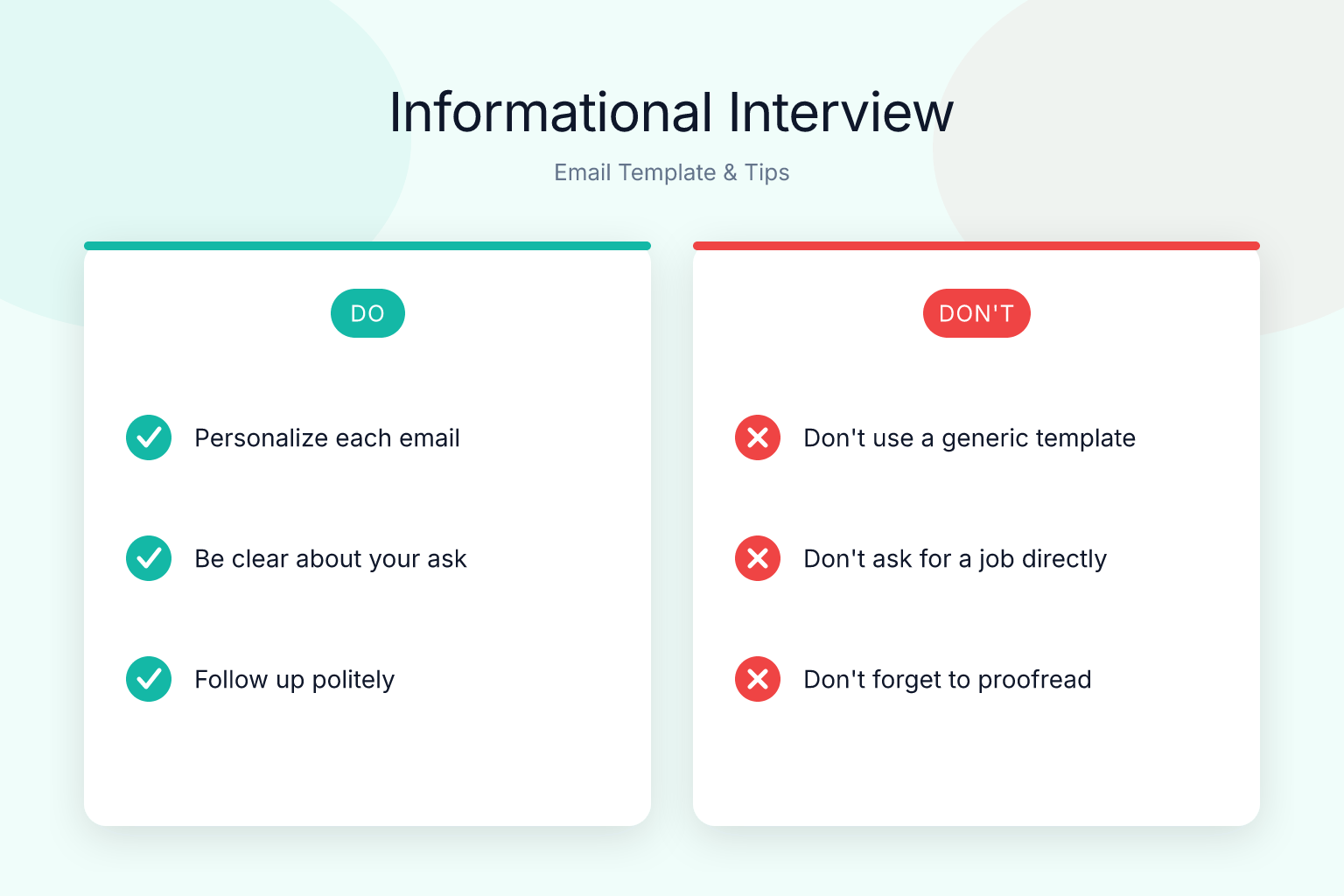
- Asking for a job. The moment you mention a specific opening or ask for a referral, you’ve changed the dynamic. An informational interview is about learning, not pitching yourself. If the conversation goes well, the person may offer to help — but let them bring it up.
- Writing a novel. Long emails signal that you’ll take up a lot of their time. Keep your request to 100–150 words. If you can’t say it in a few sentences, you haven’t thought it through.
- No personalization. Sending a generic template without any mention of the person’s work, background, or achievements is the fastest way to get ignored. Take 10 minutes to research before you write.
- Vague ask. “I’d love to pick your brain” is overused and unclear. Be specific: “I’d love to hear how you transitioned from marketing to product management” or “I’m curious about the skills that matter most in your role.”
- Demanding an in-person meeting. Many people prefer a phone or video call. Offer multiple formats and let them choose.
- Sending the same email to multiple people at once. If you BCC ten people with the same template, at least a few will notice — especially if they work in the same industry or know each other. Personalize every single email, even if it takes an extra five minutes per message.
- Forgetting to proofread. A typo in someone’s name or company is an instant credibility killer. It signals carelessness, and no one wants to give their time to someone who can’t be bothered to spell their name correctly. Read your email out loud before hitting send.
- Asking for too much time. Requesting 45 minutes or an hour for a first conversation is a big ask. Stick to 15–20 minutes. If the conversation goes well, they’ll often offer more time — but let them make that call.
What to Do After the Informational Interview
The conversation itself is only half the value. What you do afterward determines whether the relationship continues.
Send a thank-you email within 24 hours. Reference something specific you discussed, and express genuine gratitude. If they offered to connect you with someone else, mention that you’ll follow up. A well-written thank-you note keeps the door open for future interactions. Here’s a simple template you can adapt:
Subject: Thank you for your time today
Hi [Name],
Thank you so much for taking the time to speak with me earlier. I really appreciated hearing about [specific insight or story they shared] — it gave me a much clearer picture of [topic]. I’m already looking into [resource or advice they mentioned].
If it’s okay, I’ll keep you posted on my progress. Thanks again for your generosity.
Best, [Your Name]
For more on crafting these messages, see our guide on networking thank-you email templates and best practices.
Connect on LinkedIn if you haven’t already. Include a short note with your request that references your conversation. While you’re there, make sure your own profile is polished — the person you just spoke with will likely check it. If you have certifications or skills worth highlighting, our guide on adding verified skills to your LinkedIn profile walks you through the process step by step.
Follow through on any promises. If you said you’d send an article, share a resource, or apply a piece of advice, do it within a few days. Reliability builds trust.
Stay in touch periodically. You don’t need to email every week, but a quick update every few months — “I took your advice and enrolled in that course, thank you!” — keeps the relationship warm without being transactional.
How Informational Interviews Fit Into Your Job Search
Informational interviews aren’t just for students or career changers. They’re a strategic tool at every stage of a job search. Before you apply to a company, talking to someone inside can reveal whether the culture and day-to-day work actually match your expectations. After an application, a conversation with a team member can give you insights that sharpen your interview answers.
If you’re preparing for interviews, the knowledge you gain from these conversations can help you answer questions with more depth. For example, understanding the challenges a team is facing lets you tailor your responses to show how you’d solve real problems. Combine that with strong preparation using our tips to prepare for an interview and you’ll walk into every conversation with an edge.
And when you do land the interview, make sure your resume is ready. Run it through the ResumeMate score checker to see how it performs with applicant tracking systems and get section-by-section feedback before you hit submit. If you’re worried about ATS myths, our ATS myths vs. facts guide separates truth from fiction so you can format your resume with confidence.
FAQ
Q: How do you write an email requesting an informational interview?
A: Start with a clear subject line that includes a connection point. In the body, introduce yourself briefly, explain why you’re reaching out to them specifically (mention a shared alma mater, a project, or a mutual contact), and ask for 15–20 minutes of their time to learn about their career path. Close by offering flexibility and thanking them for considering.
Q: How do you ask for an informational interview email?
A: The key is to make a low-pressure, specific ask. Use a subject line that signals personalization (like “Referred by [Name]” or “[University] alum”), keep the body under 150 words, state clearly that you’re not asking for a job, and propose a short 15–20 minute call or coffee. Offer two or three specific time windows to reduce scheduling friction.
Q: What should the subject line of an informational interview request be?
A: A good subject line is specific and personal. Examples: “Referred by [Name] — would love to learn from you,” “[University] alum hoping to learn about your path,” or “Your article on [Topic] really resonated — quick question.” Avoid generic lines like “Quick question” or “Hello.”
Q: How do you ask for an informational interview without sounding like you’re asking for a job?
A: State explicitly that you’re not reaching out about a specific opening. Use phrases like “I’m not asking about a job — I’d just love to learn from your experience” or “I’m exploring careers in [field] and would be grateful for your advice.” Focus the entire email on learning, not pitching.
Q: How long should an informational interview request email be?
A: Aim for 100–150 words. A short email respects the recipient’s time and increases the likelihood of a response. If you can’t make your request in a few sentences, you’re probably overcomplicating it.
Q: How do you follow up on an informational interview request?
A: Wait 5–7 days, then send a brief follow-up that references your original email. Keep it to 2–3 sentences, acknowledge their busy schedule, and reiterate your request. If you don’t hear back after one follow-up, move on.
Q: What is a sample informational interview?
A: A sample informational interview is a structured 15–20 minute conversation where you ask someone about their career path, day-to-day work, industry trends, and advice for someone at your stage. Sample questions include: “What led you to pursue a career in [field]?” “What does a typical week look like in your role?” and “What skills made the biggest difference in your career?” Always end by asking if they’d recommend anyone else to speak with.
Q: Is it okay to ask for an informational interview on LinkedIn instead of email?
A: Yes, but keep the same principles: a short, personalized message that focuses on learning. LinkedIn InMail or connection requests with a note can work well, especially if you don’t have the person’s email address. Just avoid the default “I’d like to add you to my network” message — always include a note.
Q: What do you say in an informational interview?
A: Prepare 5–7 open-ended questions about their career path, day-to-day work, industry trends, and advice for someone starting out. Let the conversation flow naturally. At the end, ask if there’s anyone else they’d recommend you speak with. And always respect the time limit you proposed.
Q: What should I include in a thank-you email after an informational interview?
A: Send it within 24 hours. Thank them for their time, mention one specific insight you gained, and show that you’re acting on their advice (e.g., “I’ve already started looking into the course you recommended”). Keep it warm and brief — 3–4 sentences is plenty. If they offered to introduce you to someone, politely mention you’ll follow up on that.
Q: How many informational interviews should I do?
A: There’s no magic number, but aim for 5–10 conversations during an active job search or career exploration phase. Quality matters more than quantity — a few deep, well-prepared conversations with the right people will teach you more than twenty rushed ones. Space them out so you can apply what you learn between each conversation.
Q: What’s the best time to send an informational interview request?
A: Tuesday, Wednesday, or Thursday mornings tend to get the best response rates. Avoid Monday mornings (when inboxes are overflowing), Friday afternoons (when people are wrapping up), and major holidays. If the person is active on LinkedIn, check when they typically post or engage — that’s often a signal of when they’re checking messages.
Track Every Application While You Job Hunt
Stop losing track of where you’ve applied. The ResumeMate Job Tracker is a free Chrome extension that tracks every application, deadline, and follow-up in one place — right from your browser.