A cover letter for internal promotion is your chance to show why you’re the best candidate for a new role inside your own company — not just someone who’s been around a while. You already have institutional knowledge, relationships, and a track record. But you still need to connect those advantages to the specific job you want, just like any external applicant would. This guide walks you through exactly what to include, how to structure your letter, and provides full examples you can adapt.
Key Takeaways
- Mention your current role and tenure to establish your internal perspective, but immediately pivot to quantified achievements that show your impact.
- Quantify your internal achievements with specific numbers (e.g., ‘increased lead conversion by 25%’) to demonstrate measurable value beyond familiarity.
- Explain your genuine motivation for the new role to avoid the impression that you’re simply bored or entitled to a promotion.
- Proactively address any skill gaps by describing concrete steps you’ve taken to close them, such as completing courses or shadowing colleagues.
- Keep the cover letter to one page and tailor it to the specific job description, referencing the team’s current projects and challenges.
Here’s a quick overview of what to focus on:
| What to Do | Why It Matters | Time |
|---|---|---|
| Mention your tenure and institutional knowledge | Demonstrates you can hit the ground running | 5 min |
| Quantify your internal achievements | Shows measurable impact, not just familiarity | 10 min |
| Explain your motivation for the new role | Prevents assumption you’re just bored or entitled | 5 min |
| Address potential concerns (e.g., skill gaps) | Proactively reassures the hiring manager | 5 min |
| Keep it to one page | Respects busy internal reviewers’ time | N/A |
How to Write a Cover Letter for an Internal Promotion
Unlike external cover letters, an internal one doesn’t need to sell the company—you already know it. Instead, focus on your track record, institutional knowledge, and readiness for the new role. Here’s a step-by-step breakdown.
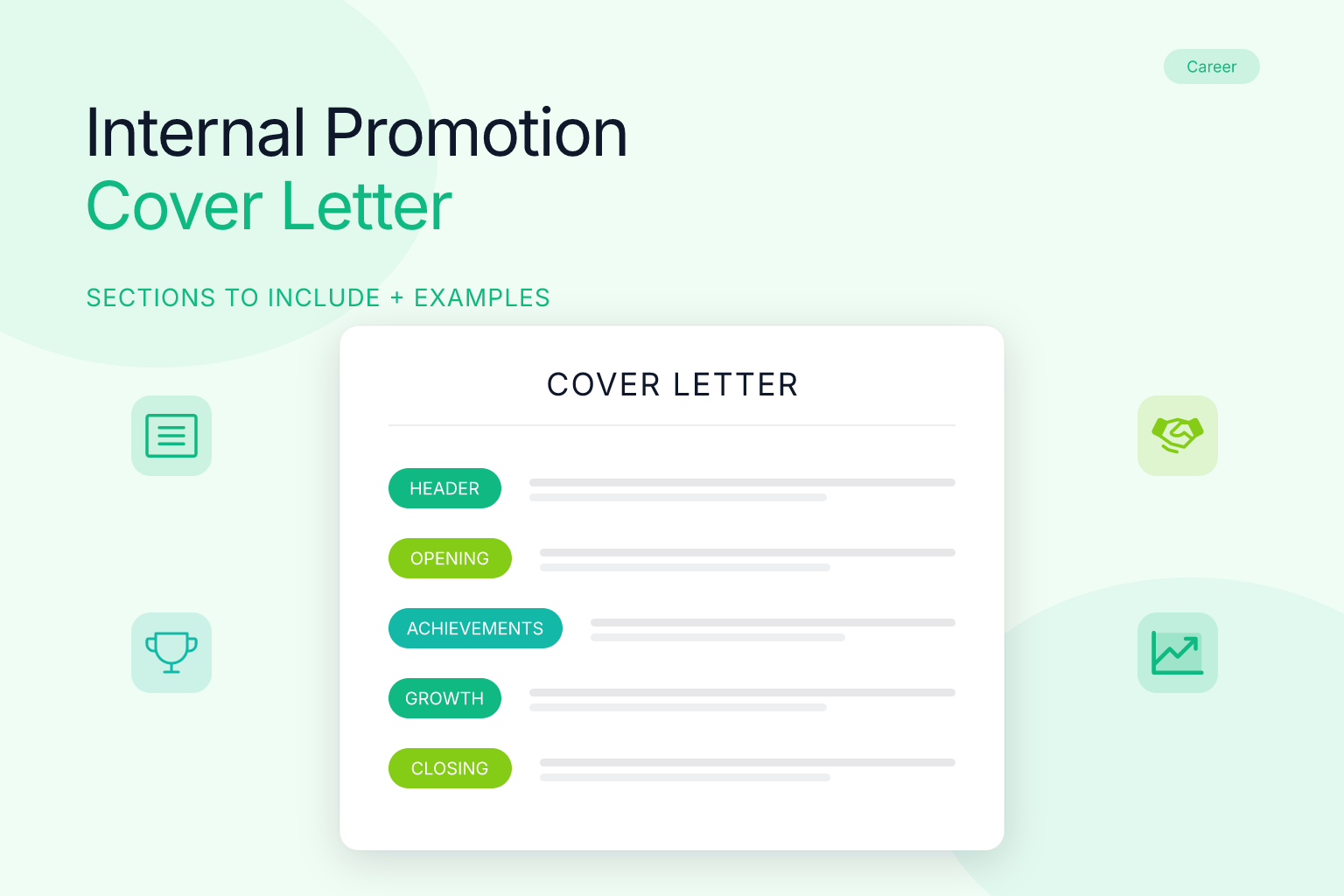
1. Start with a professional header
Use the same format you would for an external application. Include your name, current job title, phone number, and email. If you’re emailing the letter, a simple subject line like “Application for [Role Title] – [Your Name]” works.
2. Address the hiring manager directly
Even if you know the person, use a formal salutation: “Dear [Hiring Manager’s Name].” Avoid “Hey” or overly casual openings. If you’re unsure who will review applications, “Dear Hiring Committee” is acceptable.
3. Open with enthusiasm and context
Your first paragraph should state the role you’re applying for and express genuine excitement. Mention your current position and how long you’ve been with the company. This immediately establishes your internal perspective.
Example: “I’m writing to express my interest in the Senior Marketing Manager role. As a Marketing Specialist at [Company] for the past three years, I’ve had the opportunity to contribute to campaigns that increased lead generation by 40%, and I’m eager to bring that momentum to a leadership position.”
4. Highlight your internal achievements
This is where you differentiate yourself from external candidates. Instead of listing responsibilities, focus on results you’ve delivered that directly relate to the new role. Use numbers whenever possible.
- “Redesigned the onboarding process, cutting new-hire ramp-up time by 20%.”
- “Led a cross-functional team that launched a product feature generating $500K in new revenue.”
- “Mentored three junior team members who were later promoted.”
5. Connect your company knowledge to the role’s needs
Show that you understand the department’s goals, challenges, and culture. Reference specific initiatives or company values. This proves you’re not just applying because it’s convenient — you’ve thought about how you can contribute.
Example: “Having collaborated with the product team on the Q3 roadmap, I know the upcoming launch requires tight coordination between marketing and engineering. My experience bridging those two groups will help us hit the aggressive timeline.”
6. Address any skill gaps honestly
If the role requires something you haven’t done yet, acknowledge it and explain your plan to close the gap. This shows self-awareness and initiative.
Example: “While I haven’t directly managed a P&L, I’ve been working closely with our finance team on budget forecasting for the past year and recently completed a financial management course through our L&D platform.”
7. Close with a forward-looking statement
Reiterate your interest and suggest a conversation. Since you’re internal, you can offer to discuss the role informally before a formal interview.
Example: “I’d welcome the chance to discuss how my background aligns with the team’s goals. I’m happy to grab coffee or schedule a brief call at your convenience.”
8. Sign off professionally
Use “Sincerely” or “Best regards,” followed by your name and current title.
What to Include in an Internal Cover Letter
Every internal cover letter should contain these five elements, each backed by a concrete example:
- Your current role and tenure – “As a Sales Development Representative for two years, I’ve consistently exceeded quota while building the client relationships that make me a strong fit for this role.”
- Specific, quantified achievements – “I increased lead conversion by 25% through a new follow-up process that the team still uses today.”
- Why you want this particular role – “I’m drawn to the Customer Success Manager position because it lets me deepen long-term client partnerships, which is where I’ve received my highest satisfaction scores.”
- How your internal perspective adds unique value – “Having worked cross-functionally with the product team, I understand the upcoming feature rollout and can immediately align support resources to reduce friction.”
- A brief, honest note on any development areas – “While I haven’t managed a P&L, I’ve completed the internal finance course and shadowed our budget lead for two quarters, so I’m prepared to step into that responsibility quickly.”
Internal Promotion Cover Letter Examples
Here are two full examples you can adapt. The first is for a promotion within the same department; the second is for a lateral move to a different team.
Example 1: Promotion from Specialist to Manager (Same Department)
Subject: Application for Marketing Manager Position – Alex Chen
Dear Ms. Rodriguez,
I’m excited to apply for the Marketing Manager role on the brand team. As a Marketing Specialist here for the past four years, I’ve had the privilege of helping shape our social media strategy and watching our engagement grow by 150%. I’m ready to take on the challenge of leading the team that made that growth possible.
In my current role, I’ve:
- Developed and executed a TikTok campaign that generated 2.3 million views and a 12% conversion rate — our highest-performing organic content to date.
- Mentored two interns who were later hired full-time and now manage their own channels.
- Collaborated with the product team on three launches, ensuring messaging consistency across all touchpoints.
I know the brand team’s Q4 goals center on expanding into short-form video and improving cross-channel attribution. I’ve already built relationships with the creative and analytics teams that will be critical to that work, and I have a detailed proposal for a pilot program I’d love to share.
I’m aware that the manager role requires more budget ownership than I’ve had. Over the past six months, I’ve been shadowing our finance partner during quarterly planning and completed the company’s internal “Finance for Non-Finance Managers” course. I’m confident I can step into that responsibility quickly.
Thank you for considering my application. I’d be glad to discuss how I can contribute to the team’s success — coffee is on me.
Sincerely, Alex Chen Marketing Specialist
Example 2: Lateral Move to a Different Department
Subject: Application for Customer Success Manager Role – Jamie Ortiz
Dear Mr. Thompson,
I’m writing to apply for the Customer Success Manager position on the enterprise team. I’ve been a Sales Development Representative at [Company] for two years, and while I’ve loved the fast pace of outbound sales, I’ve discovered that my strongest skills — listening, problem-solving, and building long-term relationships — align more closely with customer success.
During my time in sales, I:
- Maintained a 95% satisfaction rating on post-call surveys, with several clients specifically requesting to work with me again.
- Identified a recurring onboarding pain point and worked with the product team to create a self-service guide that reduced support tickets by 18%.
- Consistently exceeded quota by 20% or more, but my proudest moments came from turning frustrated prospects into loyal advocates.
Because I’ve been on the front lines of the sales-to-onboarding handoff, I understand exactly where communication breaks down and how to fix it. I’ve already built strong relationships with three of the enterprise CSMs, and I’ve been informally learning their workflow for the past quarter.
I don’t have direct experience managing a book of business, but I’ve completed the Customer Success Management certification through our learning platform and have been meeting biweekly with a mentor on the CS team. I’m ready to hit the ground running.
I’d appreciate the opportunity to discuss how my sales background can bring a fresh perspective to the customer success team. Thank you for your time.
Best regards, Jamie Ortiz Sales Development Representative
Should You Write an Internal Cover Letter? (And How to Submit It)
In most cases, yes. Even if the job posting doesn’t require one, a cover letter shows initiative and gives the hiring manager a written narrative to share with other decision-makers. If the application system lacks an upload field, email your cover letter and resume directly to the hiring manager or combine them into one PDF.
When addressing the letter, use the same formality as an external application: “Dear [First Name] [Last Name].” If you have a close working relationship, you might use their first name, but err on the side of professionalism. Avoid casual greetings like “Hey.” As an internal candidate, you can often find out who the hiring manager is by asking HR—use that advantage.
When you’re updating your resume for the internal role, make sure it’s tailored to the new position — our internal promotion resume guide walks you through that process step by step.
Tailoring Your Cover Letter and Avoiding Common Mistakes
A generic internal cover letter won’t cut it. Research the team’s recent projects, goals, and challenges. Mention specific initiatives by name. For example, if the department just adopted a new BI platform, reference your familiarity with it or your track record of learning new tools quickly. This level of detail shows you’ve done your homework — something external candidates often can’t match. If you need inspiration for structuring your letter, our cover letter templates and examples by role can help you adapt a proven format.
Meanwhile, avoid these common missteps:
- Assuming you don’t need a cover letter. Some companies require one; even when optional, skipping it can signal a lack of effort. If you’re unsure, check our guide on whether you need a cover letter.
- Rehashing your resume. The cover letter should add context and narrative, not repeat bullet points. Use it to tell a story your resume can’t.
- Being too casual. You may know the hiring manager, but this is still a professional document. Avoid inside jokes, slang, or overly familiar language.
- Focusing on tenure instead of impact. “I’ve been here five years” isn’t a qualification. Show what you’ve accomplished in those five years.
- Ignoring the job description. Internal candidates sometimes assume everyone knows what they do. Tailor your letter to the specific requirements of the new role, just as an external applicant would.
- Badmouthing your current team or boss. Even if you’re frustrated, keep the tone positive. Frame your move as a desire for growth, not an escape.
FAQ
Q: What should I include in a cover letter for an internal position?
A: Include your current role and tenure, specific quantified achievements, a clear explanation of why you want the new role, how your internal knowledge adds unique value, and a brief note on any skill gaps you’re actively addressing. Keep it to one page and tailor it to the job description.
Q: Should you write a cover letter for an internal position?
A: Yes, in most cases. Even if it’s optional, a cover letter demonstrates initiative and gives you a chance to frame your candidacy beyond what your resume shows. It also provides a written narrative that hiring managers can share with other stakeholders.
Q: Should you include a cover letter for an internal position if you already know the hiring manager?
A: Absolutely. Knowing the hiring manager doesn’t replace the need to formally present your qualifications. A cover letter ensures your application is evaluated on merit, not just familiarity, and it gives the manager a document to reference during the decision-making process.
Q: How to write an internal cover letter?
A: Start with a professional header and salutation. Open with enthusiasm and context about your current role. Highlight internal achievements with numbers, connect your company knowledge to the new role’s needs, address any skill gaps honestly, and close with a forward-looking statement. Keep the tone professional but warm.
Q: Do I need a cover letter for an internal promotion if the job posting doesn’t ask for one?
A: You don’t technically need one, but submitting one can set you apart. Many internal candidates skip the cover letter, so including one shows extra effort. If the application system doesn’t have a field for it, email it to the hiring manager or combine it with your resume PDF.
Q: How long should an internal cover letter be?
A: Aim for half a page to one full page. Busy internal reviewers appreciate brevity. Focus on the most relevant achievements and insights — don’t try to list everything you’ve ever done.
Q: Can I use the same cover letter for multiple internal applications?
A: No. Each role has different requirements and team dynamics. Tailor every cover letter to the specific position, just as you would for external applications. Reusing a generic letter signals a lack of genuine interest.
Related articles:
- Volunteer Cover Letter: Examples & How to Write
- Short Cover Letter Examples for Busy Recruiters
- Data Analyst Cover Letter: How to Write (With Examples)
- Cover Letter Stats: 2026 Hiring Data
- Software Engineer Cover Letter: Write to Get Hired
- Employee Referral Cover Letter: Examples
- Cover Letter: Email Body vs Attached - Which Gets Hired?
Track Every Application While You Job Hunt
Stop losing track of where you’ve applied. The ResumeMate Job Tracker is a free Chrome extension that tracks every application, deadline, and follow-up in one place — right from your browser.