Cover Letter for Internal Transfer vs New Job: Key Differences and How to Write Each
Writing a cover letter for internal transfer vs new job requires two very different approaches — even though both documents share the same goal of landing you an interview. When you apply inside your own company, you already have a track record, relationships, and institutional knowledge. When you apply externally, you’re a stranger who needs to prove you’re worth the risk. This guide breaks down exactly how to tailor each type of cover letter, what to emphasize, and what to leave out, so you can move forward with confidence.
Key Takeaways
- An internal transfer cover letter should focus on your existing contributions, cross-departmental relationships, and how you’ll solve problems faster because you already know the company.
- A new job cover letter must connect your external experience to the company’s specific needs, showing you’ve done your research and can adapt quickly.
- For internal moves, always mention your current manager’s support (if you have it) and frame the move as a natural next step, not an escape.
- Both cover letters need a clear, tailored opening that names the role and explains why you’re the right fit — generic intros get skipped.
- Update your resume alongside your cover letter; an internal application still requires a polished, ATS-friendly resume.
| What to Do | Why It Matters | Time |
|---|---|---|
| Highlight internal achievements and company knowledge (internal) | Proves you’re already a proven asset who can deliver faster | 30–45 min |
| Connect your external experience to the company’s specific needs (new job) | Shows you understand their industry and can hit the ground running | 45–60 min |
| Address the hiring manager by name in both types | Personalization increases the chance your letter gets read | 5 min |
| Mention your current manager’s support (internal) | Builds trust and transparency; avoids the appearance of going behind anyone’s back | 5 min |
Why the Cover Letter for an Internal Transfer Is Different
A cover letter for an internal transfer isn’t just a shorter version of an external one. It serves a different purpose. When you apply inside your own organization, the hiring manager may already know your name, your department, or even your work. That means you can skip the lengthy introduction and dive straight into why you’re the best person for this role — not just any role.
Internal cover letters work because they leverage three things external candidates don’t have:
- Institutional knowledge. You understand the company’s tools, processes, and culture. You can point to specific projects where you saved time or improved a workflow because you already knew the system.
- Existing relationships. You’ve collaborated with people in other departments. Mentioning a cross-functional project shows you can integrate into the new team without the usual ramp-up.
- A track record they can verify. Your manager and colleagues can vouch for your work. You don’t need to prove you’re reliable — you can reference performance reviews, metrics, or internal recognition.
For example, instead of writing “I have five years of project management experience,” an internal candidate might write: “As the lead on the Q3 inventory overhaul, I coordinated with the very team I’d be joining — and we cut processing time by 20%.” That’s a concrete, verifiable claim that an external applicant can’t make.
If you’re aiming for a promotion rather than a lateral move, the internal cover letter becomes even more critical. Check out our guide on internal promotion cover letter examples for specific phrasing and templates.
When You Need a Cover Letter for an Internal Move
Not every internal application requires a formal cover letter. Some companies use internal job boards where you simply submit your updated resume and a short note. But in many cases, a well-written cover letter can set you apart — especially when:
- The role is in a different department and the hiring manager doesn’t know you.
- You’re competing against external candidates who will submit cover letters.
- The internal application portal has a field for “additional information” or “cover letter.”
- You want to explain why you’re moving from, say, marketing to operations — a shift that might raise questions.
Even if a cover letter isn’t required, attaching one shows initiative. It signals that you’re serious about the move, not just casually browsing. And because you’re internal, you can often find out who the hiring manager is and address them directly — something external candidates struggle with. If you’re unsure whether a cover letter is necessary, our post on do I need a cover letter breaks down when it’s worth the effort.
How to Structure a Cover Letter for an Internal Transfer
An internal transfer cover letter should be concise — half to two-thirds of a page is plenty. Follow this structure:
- Header with your internal contact info. Include your name, current title, department, and internal extension or email. No need for a full street address.
- Salutation. Use the hiring manager’s name. If you don’t know it, check the company directory or ask your network.
- Opening paragraph. State the role you’re applying for, your current position, and one sentence on why you’re excited about the move. Example: “I’m writing to express my interest in the Senior Analyst role on the Product team. As a Data Analyst in Marketing for the past two years, I’ve collaborated with Product on three major launches and am eager to contribute full-time to that work.”
- Body paragraph(s). Highlight 2–3 specific achievements that directly relate to the new role. Use internal metrics, project names, or tools the company uses. If you’ve already worked with the new team, mention it. If you’ve taken on stretch assignments that prepared you, describe them.
- Optional: manager support. If your current manager supports your move, include a line like: “My manager, [Name], is aware of my application and supports my growth in this direction.” This removes any awkwardness and shows transparency.
- Closing. Reiterate your enthusiasm and offer to discuss further. Keep it warm but professional.
Here’s a short example body paragraph for an internal transfer from customer support to sales:
“In my two years on the Support team, I’ve resolved over 1,200 tickets and consistently received 98% satisfaction ratings. More importantly, I’ve identified upsell opportunities that led to $40K in additional revenue last quarter. I’ve also shadowed the Sales team during our weekly pipeline reviews, so I’m already familiar with the CRM and the current outreach cadence.”
Notice how every sentence ties back to the new role. There’s no need to explain the company’s mission or values — you already live them.
How to Structure a Cover Letter for a New Job (External)
An external cover letter has a different job: it must convince a stranger that you’re worth interviewing. The structure is similar, but the content shifts from “here’s what I’ve done here” to “here’s what I’ve done elsewhere and how it applies to you.”
- Header with your external contact info. Name, phone number, email, LinkedIn profile, and city/state.
- Salutation. Again, use the hiring manager’s name. If you can’t find it, “Dear Hiring Team” is acceptable, but avoid “To Whom It May Concern.”
- Opening paragraph. Name the role, where you found it, and a hook that connects your background to the company’s needs. Example: “When I saw the Marketing Manager opening at GreenLeaf, I immediately thought of the campaign I led at EcoGoods that increased organic traffic by 60% — a result I’d love to replicate for your growing DTC brand.”
- Body paragraph(s). Choose 2–3 accomplishments from previous roles that mirror the job description. Use numbers and results. If you’re changing industries, focus on transferable skills. Our career change cover letter guide walks through how to frame a pivot.
- Company connection. Show you’ve done your homework. Mention a recent product launch, a news article, or a company value that resonates with you. This proves you’re not blasting the same letter everywhere.
- Closing. A confident call to action: “I’d welcome the chance to discuss how my experience with [specific skill] can help [Company] achieve [specific goal].”
For external applications, the cover letter also serves as a writing sample. Typos, vague language, or a generic template will hurt you. If you’re unsure about the best format to send it, read our breakdown of cover letter email body vs attached to avoid common mistakes.
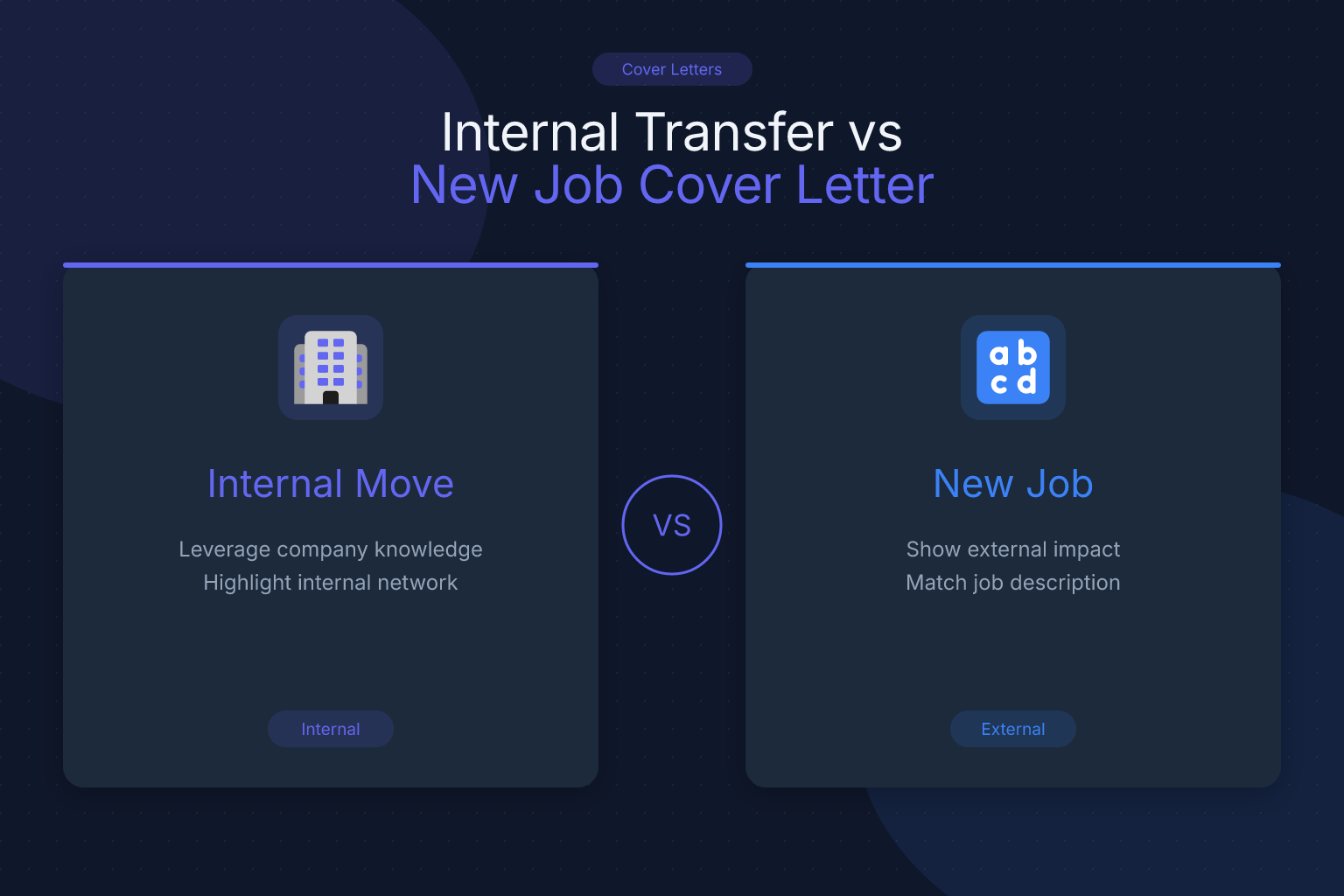
Side-by-Side Comparison: Internal Transfer vs. New Job Cover Letter
To make the differences crystal clear, here’s how the same section plays out in each type:
Opening line
- Internal: “As a Senior Designer on the Brand team, I’ve partnered with UX on our app redesign — and I’m excited to apply for the UX Designer role to deepen that collaboration.”
- External: “With five years of UX design experience at two SaaS startups, I’m drawn to FinTechPro’s mission to simplify personal finance — and I’d love to bring my expertise in onboarding flows to your team.”
Achievement highlight
- Internal: “I led the migration of our internal wiki to Notion, which reduced onboarding time for new hires by 30% — a project that required close coordination with the very department I’d be joining.”
- External: “At my current company, I led a wiki migration that cut onboarding time by 30% and improved knowledge retention across four departments.”
Why this company/role
- Internal: “I’ve seen firsthand how the Operations team streamlines our supply chain, and I want to contribute my logistics background to the upcoming warehouse expansion.”
- External: “Your recent expansion into the Midwest, covered in Logistics Today, aligns with my experience scaling distribution networks in similar markets.”
Closing
- Internal: “I’d appreciate the opportunity to discuss how my cross-functional experience can support the team’s Q4 goals.”
- External: “I look forward to the possibility of discussing how my background in distribution can support your Midwest growth.”
The internal version assumes shared context; the external version builds context from scratch.
Common Mistakes to Avoid in Both Types
Even experienced professionals slip up. Here are the most frequent errors — and how to sidestep them.
For internal transfers:
- Assuming the hiring manager knows everything about you. They might recognize your name but not your specific results. Spell out your achievements as if you were an external candidate, but with internal proof points.
- Skipping the cover letter entirely. Some employees think an internal move is a casual conversation. If there’s a formal application process, treat it seriously.
- Badmouthing your current team. Never frame the move as an escape from a bad manager or boring work. Focus on growth, not grievances.
- Forgetting to update your resume. An internal application still goes through HR or an ATS. Use a clean, single-column format that parses correctly. You can build one quickly with ResumeMate’s free AI resume builder.
For new job applications:
- Using a generic template. Hiring managers can spot a copy-paste letter in seconds. Customize at least the opening and one body paragraph for each application.
- Rehashing your resume. The cover letter should add context, not repeat bullet points. Explain the why and how behind a key achievement.
- Focusing on what you want instead of what you offer. Phrases like “I’m looking for a challenging role” are about you. Flip it: “I can help your team solve X because I’ve done Y.”
- Ignoring ATS keywords. Many companies use software to scan cover letters and resumes. Mirror the language from the job description naturally. Before submitting, run your resume through the ResumeMate score checker to see how well it matches.
How to Tailor Your Resume Alongside Your Cover Letter
Your cover letter and resume work as a pair. If one is tailored and the other is generic, the mismatch raises red flags. Here’s how to align them for each scenario.
For an internal transfer:
- Update your resume to highlight cross-departmental projects, internal tools, and any training or certifications you’ve completed inside the company.
- Use the same terminology the new department uses. If they call customers “clients,” switch your language.
- Add a “Key Projects” section that lists initiatives relevant to the new role, even if they weren’t part of your official job description.
For a new job:
- Reorder your bullet points so the most relevant experience appears first, even if it’s not your most recent role.
- Include a skills section that mirrors the job posting’s requirements. If the ad asks for “Tableau” and you know it, make sure it’s listed.
- Remove irrelevant details that dilute your focus. A part-time retail job from eight years ago doesn’t belong on a senior marketing resume.
In both cases, keep the formatting clean. Stick to a single-column layout, standard fonts, and clear section headings. Most modern ATS platforms parse text-based PDFs without issue, so you can confidently export your resume as a PDF from ResumeMate. If a specific portal asks for a DOCX, follow that instruction — but otherwise, a well-structured PDF is the standard.
FAQ
Q: Do I really need a cover letter for an internal transfer if I already know the hiring manager?
A: Yes, in most cases. Even if you have a casual relationship, a cover letter formalizes your interest and gives the hiring manager a document to share with HR or other decision-makers. It also shows you’re taking the process seriously, not just relying on a hallway conversation.
Q: How long should an internal transfer cover letter be?
A: Aim for half a page, or about 200–250 words. You don’t need to introduce yourself or explain the company’s mission. Get straight to your relevant achievements and why you want the role.
Q: Should I tell my current manager before applying internally?
A: It depends on your company culture. Many organizations expect you to inform your manager before applying. If you’re unsure, check your employee handbook or ask HR. If you have a supportive manager, giving them a heads-up can lead to a stronger referral.
Q: Can I use the same cover letter for internal and external applications?
A: No. An internal cover letter should leverage your insider knowledge and relationships. An external one needs to build credibility from scratch. Using the same letter for both will feel off — either too casual for an external role or too generic for an internal one.
Q: What if I’m applying for an internal role in a completely different department where no one knows me?
A: Treat it like a hybrid. You still have company knowledge, but you’ll need to introduce yourself more thoroughly. Mention your current role, then focus on transferable skills and any cross-departmental exposure you’ve had. If you’ve never interacted with that team, acknowledge it and express genuine interest in learning their work.
Q: How do I address employment gaps in a cover letter for a new job?
A: Briefly and forward-looking. If the gap is recent, you can mention it in one sentence — for example, “After taking two years to care for a family member, I’m eager to return to full-time project management.” Then pivot immediately to your qualifications. For more detailed strategies, see our guide on cover letters for employment gaps.
Related articles:
- Cover Letter for Internal Transfer No Opening: 2026 Guide
- Company Website vs Job Board: Pros, Cons & Strategy
Track Every Application While You Job Hunt
Stop losing track of where you’ve applied. The ResumeMate Job Tracker is a free Chrome extension that tracks every application, deadline, and follow-up in one place — right from your browser.