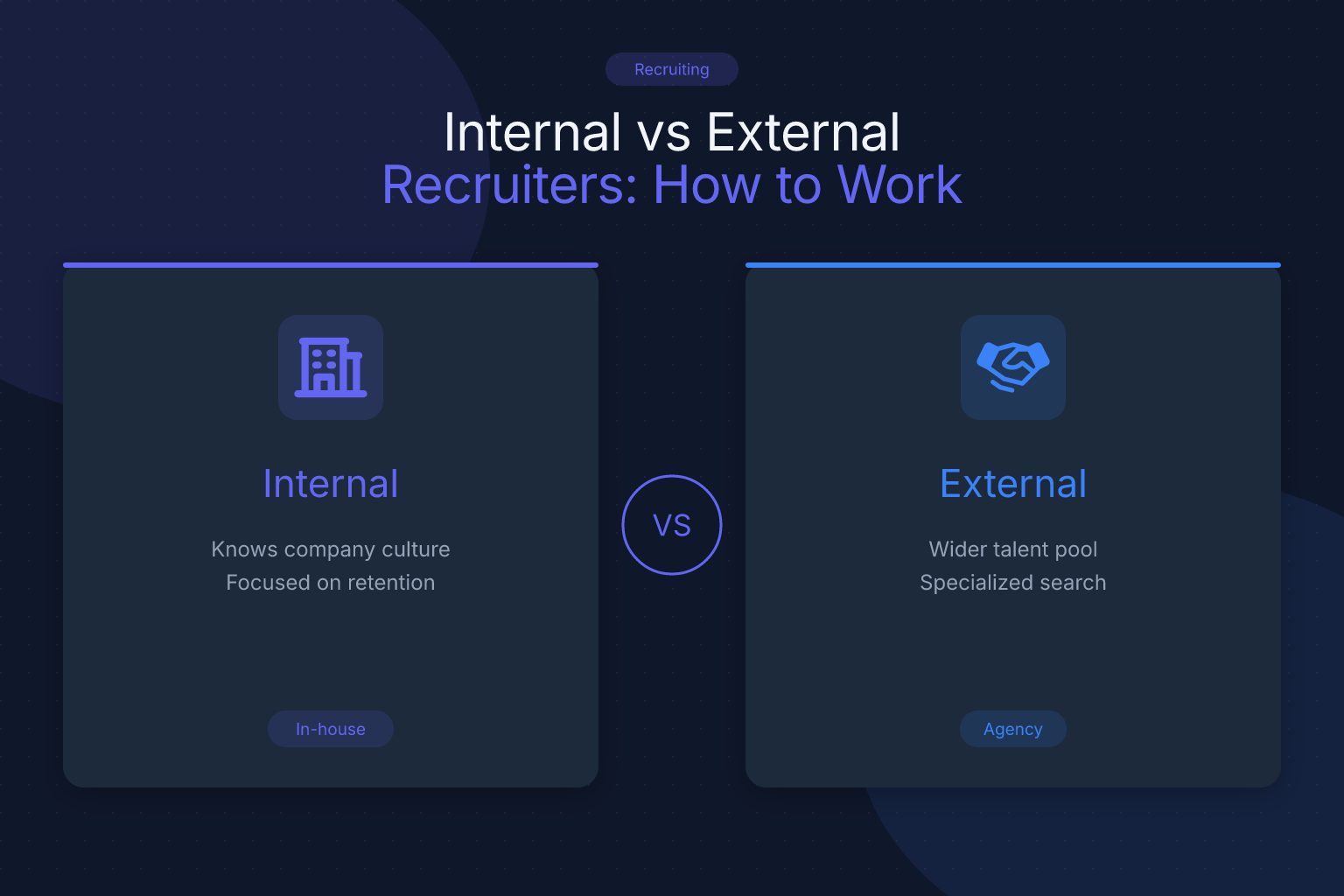
Internal Recruiter vs External Agency Recruiter: Key Differences and How to Work With Each
Understanding the internal recruiter vs external agency recruiter differences can change how you approach your job search. Both types of recruiters can connect you with opportunities, but they operate with different incentives, access levels, and processes. Knowing which one you’re talking to—and what they can actually do for you—helps you tailor your resume, manage your expectations, and avoid wasted effort.
Key Takeaways
- Internal recruiters work directly for the hiring company and focus on filling roles within that one organization; external agency recruiters work for staffing firms and represent multiple client companies at once.
- Internal recruiters have direct access to hiring managers and can give you more detailed, company-specific feedback; agency recruiters act as intermediaries and often have less visibility into the final hiring decision.
- Agency recruiters are usually paid a commission when they place a candidate, which makes them more proactive about pitching you to multiple roles; internal recruiters are salaried and may be more selective about which candidates they advance.
- Tailor your resume differently for each: emphasize cultural fit and long-term potential for internal recruiters, and highlight transferable skills and flexibility for agency recruiters.
- You can work with both types simultaneously, but you need to understand their constraints to build effective relationships and avoid common pitfalls.
Summary Table
| What to Do | Why It Matters | Time |
|---|---|---|
| Identify whether the recruiter is internal or external before the first call | Sets expectations for how much influence they have and how to communicate | 5 minutes |
| Customize your resume for the specific company when working with an internal recruiter | Shows you’re serious about that role and understand the company’s needs | 15–30 minutes |
| Ask agency recruiters detailed questions about the client, role, and pay upfront | Avoids wasting time on mismatched or low-quality opportunities | 5–10 minutes |
| Adjust your follow-up cadence based on recruiter type | Internal processes are often slower; agency recruiters expect quick responses to keep you top-of-mind | Ongoing |
| Run your resume through an ATS score checker before sending it to either type | Both internal and agency recruiters rely on applicant tracking systems to filter candidates | 10 minutes |
Internal Recruiter vs External Agency Recruiter: The Core Differences
Before you can work effectively with either type, you need to know exactly what each one is and how they operate.
Internal recruiters are employees of the company that’s hiring. They work in the HR or talent acquisition department and focus exclusively on filling roles for that one organization. They may handle everything from sourcing candidates to scheduling interviews to negotiating offers. Because they’re part of the company, they have direct access to hiring managers, understand the company culture deeply, and can advocate for you internally.
External agency recruiters work for a staffing agency, search firm, or recruitment consultancy. They are hired by client companies to find candidates for specific roles, often on a contract or contingency basis. Agency recruiters may work on multiple searches for multiple clients at the same time. They act as a bridge between you and the hiring company, but they don’t work for that company—they work for the agency.
The key differences boil down to three areas:
- Incentives: Internal recruiters are salaried and evaluated on quality of hire, time-to-fill, and retention. Agency recruiters typically earn a commission (often 15–25% of the candidate’s first-year salary) only when a placement is made. This makes agency recruiters more sales-driven and eager to submit candidates quickly.
- Access: Internal recruiters can walk down the hall to talk to the hiring manager. Agency recruiters usually communicate with the client through a point of contact and may not know the full details of the role or team.
- Process: Internal recruiters follow the company’s structured hiring process, which can be slow and involve multiple rounds. Agency recruiters often move faster because they’re competing with other agencies to fill the same role.
How Internal Recruiters Evaluate Candidates
When you work with an internal recruiter, you’re being evaluated as a potential long-term employee of that specific company. That changes what they look for.
Internal recruiters care about:
- Cultural fit: Will you mesh with the team and the company’s values? They may ask behavioral questions or look for clues in your resume about how you’ve worked in similar environments.
- Specific skill alignment: They have the exact job description and know which skills are non-negotiable. They’ll scan your resume for those keywords and experiences.
- Long-term potential: They want to hire someone who will stay and grow. If your resume shows a pattern of job-hopping, they may probe for reasons.
- Internal advocacy: Because they can speak directly to the hiring manager, a strong internal recruiter can champion your candidacy even if you’re not a perfect match on paper.
What this means for you: When applying through an internal recruiter, customize your resume for that specific company. Use the job description as a checklist. Highlight projects, achievements, and values that align with the company’s mission. If you have a connection to the company (e.g., you’ve used their product or admire their work), mention it early—it signals genuine interest.
How External Agency Recruiters Evaluate Candidates
Agency recruiters have a different lens. They’re matching you to a client’s needs, but they also have to sell you to that client—and they may be juggling multiple roles at once.
Agency recruiters care about:
- Transferable skills: Since they may pitch you to different clients, they look for skills that apply across industries or roles. A strong summary section on your resume helps them quickly see where you fit.
- Flexibility and availability: They often work on contract, temp, or temp-to-perm roles. If you’re open to different arrangements, say so.
- Quick wins: Because they’re paid on placement, they favor candidates who are easy to place—clear experience, no red flags, and responsive communication.
- Marketability: They need to present you to a client in a compelling way. A clean, ATS-friendly resume makes their job easier and increases your chances of being submitted.
What this means for you: When working with an agency recruiter, keep your resume more general but still polished. Use a strong professional summary that highlights your most versatile skills. Be responsive—agency recruiters often work on tight deadlines and may move on if you don’t reply quickly. And don’t be afraid to ask them directly: “What does the client need most?” or “What’s the pay range?” A good agency recruiter will be transparent.
How to Tailor Your Resume for Each Type
Your resume is the first thing both types of recruiters see, but they use it differently. Here’s how to adjust.
For internal recruiters:
- Mirror the language from the job posting. If the company uses specific terms (e.g., “customer success” vs. “account management”), use theirs.
- Add a short “Why This Company” section or a tailored summary that shows you’ve done your research.
- Emphasize achievements that demonstrate long-term impact, not just short-term wins.
- Use a clean, single-column layout that parses well in the company’s ATS. You can check your resume’s ATS score free to catch formatting issues before you apply.
For agency recruiters:
- Keep your resume broad enough to fit multiple roles, but still specific enough to show expertise. A strong summary like “Marketing generalist with 5 years in B2B SaaS, open to full-time or contract roles” works well.
- List skills in a dedicated section so recruiters can quickly scan for keywords.
- Include a note about your availability and preferred work arrangement (remote, hybrid, contract, etc.) if relevant.
- Make sure your resume file name is professional and includes your name—agency recruiters often forward resumes to clients, and a file named “resume_final_v2.pdf” looks sloppy. See how to name your resume file for recruiters for specifics.
If you’re starting from scratch or want a template that works for both, the free ResumeMate resume builder offers ATS-safe templates you can customize in minutes.
Communication and Follow-Up: What to Expect
The way you communicate with each type of recruiter should differ because their response times and feedback loops are different.
Internal recruiters:
- Expect slower responses. They’re often managing dozens of open roles and coordinating with multiple hiring managers.
- Feedback may be more detailed if you’re rejected—they can tell you exactly why the team passed.
- Follow up politely after 5–7 business days if you haven’t heard back. A short email like “Just checking in on the status of my application for [role]” is appropriate.
- Don’t take ghosting personally. Internal recruiters are often overwhelmed, and silence usually means the role was filled or put on hold.
Agency recruiters:
- Expect faster initial responses—they want to move quickly to submit you before competitors do.
- Feedback may be vaguer because they may not get detailed reasons from the client.
- Follow up within 24–48 hours if they’ve asked for something (updated resume, references, etc.).
- If an agency recruiter goes silent after you’ve interviewed, it’s often because the client went with someone else or the role was canceled. A polite check-in is fine, but don’t chase repeatedly.
For word-for-word scripts on handling recruiter calls—especially cold calls from agencies—see how to respond to recruiter cold calls.
Red Flags and How to Protect Yourself
Not all recruiters are created equal. Here’s what to watch for with each type.
Agency recruiter red flags:
- They submit your resume to a client without your permission. Always ask before they send your information anywhere.
- They pressure you to accept a role quickly or hide the client’s name until the last minute.
- They can’t answer basic questions about the role, team, or pay range.
- They ask you to pay any fee. Legitimate agency recruiters are paid by the client, never by the candidate.
Internal recruiter red flags:
- They promise a decision by a certain date and then go silent for weeks without explanation.
- They ask illegal interview questions (age, marital status, religion, etc.).
- They seem disorganized or don’t know the details of the role they’re hiring for.
If you encounter any of these, it’s okay to step back. You’re not obligated to work with a recruiter who isn’t professional. For agency recruiters, you can simply say, “I’m not comfortable moving forward without more information.” For internal recruiters, you can withdraw your application or ask to speak with someone else in HR.
Which Recruiter Type Should You Work With?
The short answer: both, but strategically.
- Use internal recruiters for direct-hire, full-time roles at specific companies you’re targeting. If you have a dream company, find their internal recruiter on LinkedIn and reach out directly. They have the most influence over the hiring process.
- Use agency recruiters for contract, temp, or hard-to-find roles. They often have access to positions that aren’t posted publicly. They can also help you get your foot in the door at companies that use agencies for all hiring.
- Don’t rely on one exclusively. Many job seekers work with 2–3 agency recruiters while also applying directly through company career pages. Just keep track of where you’ve applied to avoid duplicate submissions—the ResumeMate Job Tracker can help you log every application and follow-up in one place.
Remember: a recruiter—internal or external—is not your advocate in the same way a friend or mentor is. They have their own goals and constraints. Treat them as a professional contact, be clear about what you want, and always keep your own job search moving forward.
Common Myths About Recruiters
Let’s clear up a few misconceptions that can trip you up.
Myth: Agency recruiters will find you a job. Reality: Agency recruiters fill specific client roles. If you don’t match what they’re currently working on, they won’t have anything for you. Stay in touch, but don’t wait for them.
Myth: Internal recruiters are just gatekeepers with no power. Reality: A good internal recruiter can influence the hiring manager, push your resume to the top of the pile, and give you insider tips on the interview process. Treat them with respect.
Myth: You should only work with one recruiter at a time. Reality: You can work with multiple agency recruiters and internal recruiters simultaneously. Just be transparent if you’re already in process with a company through another channel to avoid conflicts.
Myth: Recruiters read every resume carefully. Reality: Most recruiters spend less than 10 seconds on an initial resume scan. That’s why a clean, keyword-optimized resume is critical. If you’re unsure whether your resume passes the ATS, run it through a free score check before sending it out.
FAQ
Q: What is the main difference between an internal recruiter and an external agency recruiter?
A: An internal recruiter is employed by the hiring company and works only on that company’s open roles. An external agency recruiter works for a staffing firm and is hired by client companies to find candidates, often for multiple clients at once. The main difference is who pays them and whose interests they represent.
Q: Do agency recruiters get paid by the candidate or the company?
A: Agency recruiters are paid by the client company, never by the candidate. If a recruiter asks you for money, that’s a scam. Legitimate agency recruiters earn a commission from the employer when a placement is made.
Q: Should I tailor my resume differently for internal vs. agency recruiters?
A: Yes. For internal recruiters, customize your resume to the specific company and role, using keywords from the job description and emphasizing cultural fit. For agency recruiters, keep your resume more general but highlight transferable skills and flexibility, since they may pitch you to multiple clients.
Q: Can I work with both an internal recruiter and an agency recruiter for the same company?
A: It’s possible, but you need to be careful. If an agency recruiter submits you to a company and you also apply directly through the company’s internal recruiter, it can create a conflict over who gets credit. Always tell both parties if you’re already in process through another channel.
Q: How do I know if a recruiter is internal or external?
A: Check their email domain and LinkedIn profile. Internal recruiters usually have an email address from the company itself (e.g., name@company.com) and list the company as their employer. Agency recruiters have an email from the staffing firm (e.g., name@agency.com) and list the agency as their employer. You can also just ask directly: “Are you an internal recruiter or with an agency?”
Q: Why do agency recruiters sometimes ghost candidates?
A: Agency recruiters often ghost candidates when the client role is filled, canceled, or put on hold, and they don’t have time to update everyone. It’s frustrating, but it’s usually not personal. If you haven’t heard back in a week, send a polite follow-up, then move on.
Q: Is it better to apply through an internal recruiter or an agency recruiter?
A: For direct-hire, full-time roles at a specific company, applying through the internal recruiter is usually better because they have direct access to the hiring manager. For contract, temp, or roles that aren’t publicly posted, an agency recruiter can be more helpful. Use both strategically.
Track Every Application While You Job Hunt
Stop losing track of where you’ve applied. The ResumeMate Job Tracker is a free Chrome extension that tracks every application, deadline, and follow-up in one place — right from your browser.