Interview Mistakes: 7 That Cost You the Job
Even the most qualified candidates can lose out on a job offer because of avoidable interview mistakes. You might have the perfect resume and all the right skills, but a few missteps during the conversation can undo weeks of effort. The good news: most interview mistakes are easy to fix once you know what to look for. This guide walks you through the seven most common errors, why they matter, and exactly what to do instead.
| What to Do | Why It Matters | Time |
|---|---|---|
| Research the company and role | Shows genuine interest and preparation | 1–2 hours |
| Practice answers to common questions | Reduces rambling and nervousness | 30–60 minutes |
| Prepare thoughtful questions to ask | Demonstrates engagement and critical thinking | 15–30 minutes |
| Send a thank-you email within 24 hours | Reinforces your interest and professionalism | 10 minutes |
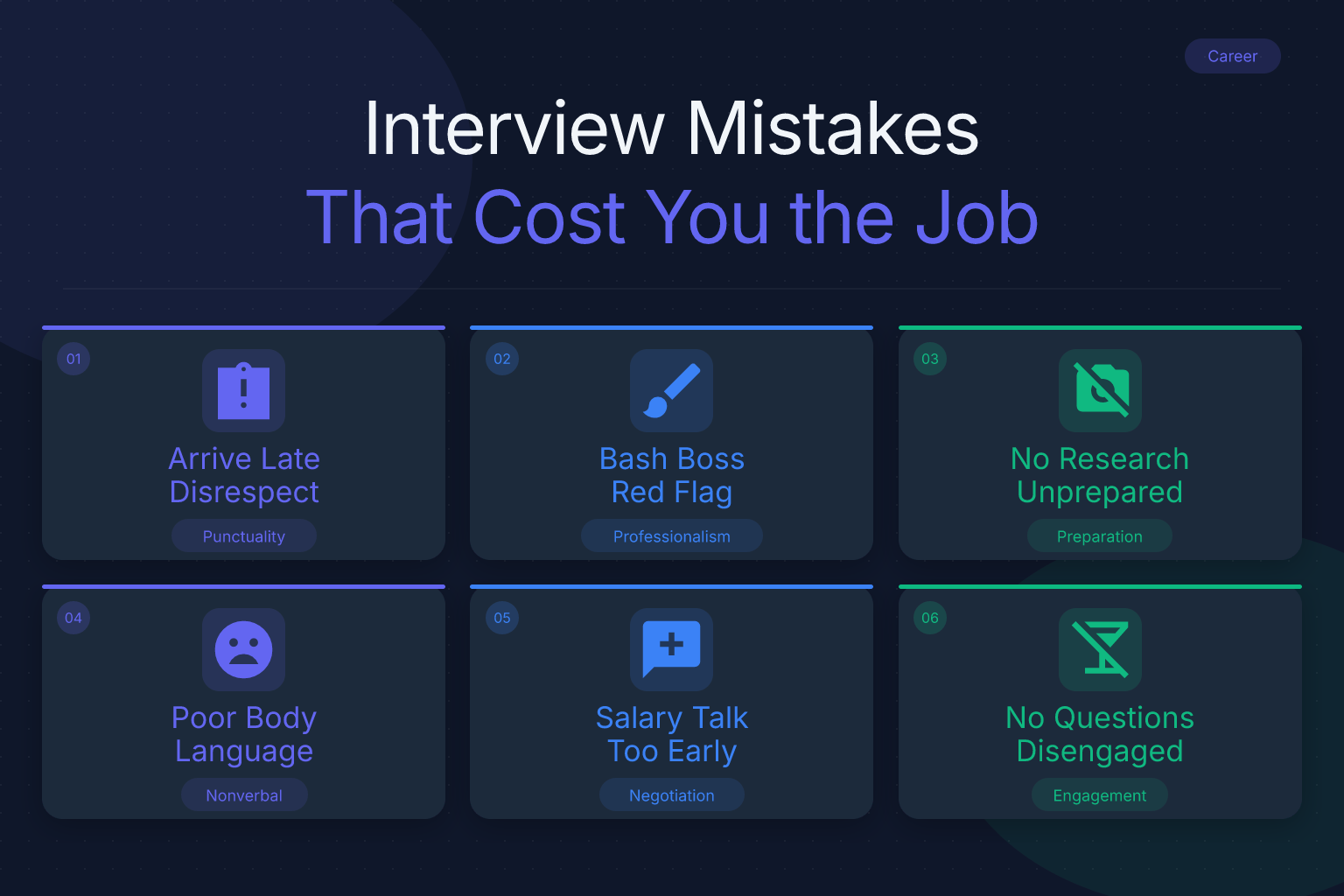
Interviewers see the same mistakes over and over. According to a CareerBuilder survey, 50% of employers know within the first five minutes whether a candidate is a good fit—and many of those snap judgments come down to avoidable errors. These blunders can overshadow your qualifications, but each one is fixable with a little preparation. Here are the seven that most often cost candidates the job:
- Failing to research the company
- Badmouthing a previous employer
- Rambling or giving unfocused answers
- Not asking any questions
- Arriving late or unprepared
- Forgetting to follow up
- Underselling your accomplishments
Let’s break down each one and how to steer clear.
Mistake #1: Failing to Research the Company
Walking into an interview without knowing what the company does is a fast way to get rejected. When you can’t speak to the organization’s products, mission, or recent news, you signal that you’re not genuinely interested—you’re just looking for any job.
How to fix it:
- Study the company website—especially the “About Us” page, recent blog posts, and press releases.
- Read recent news articles or industry reports that mention the company.
- Check LinkedIn to understand the team structure and the background of your interviewer.
- Know the competitors and be ready to discuss how the company differentiates itself.
- Review the job description and match your skills to the specific requirements.
Example: A candidate for a marketing role at a SaaS company couldn’t name a single product during the interview. The hiring manager later said, “If you don’t care enough to spend 30 minutes on our website, why should we invest in you?” Don’t be that candidate.
Mistake #2: Badmouthing a Previous Employer
It’s tempting to vent about a toxic boss or a frustrating workplace, but speaking negatively about a past employer almost always backfires. It makes you look unprofessional, raises doubts about your ability to handle conflict, and can even make the interviewer wonder what you’ll say about them someday.
How to fix it:
- Reframe the experience around what you learned or what you’re looking for now. Instead of “My manager was a micromanager,” say “I thrive in environments that give me more autonomy to own projects.”
- Focus on the positive aspects of the role, even if it was a tough situation.
- If asked directly about a conflict, keep it brief, neutral, and forward-looking.
Example: Instead of “The company was disorganized and nobody knew what they were doing,” try “I realized I work best in a structured environment with clear processes, which is why I’m excited about this role.”
Mistake #3: Rambling or Giving Unfocused Answers
When you’re nervous, it’s easy to start talking and not stop. But long, meandering answers lose the interviewer’s attention and bury your key points. A study by Twin Employment found that 33% of hiring managers make up their mind within the first 90 seconds—so you need to be concise and compelling from the start.
How to fix it:
- Use the STAR method (Situation, Task, Action, Result) to structure behavioral answers. This keeps you on track and highlights your impact. For a deep dive, check out our guide on mastering the STAR method for behavioral interview questions.
- Practice out loud with a timer. Aim for answers that are 1–2 minutes long.
- Pause before answering to collect your thoughts. A 3-second pause feels long to you but shows confidence to the interviewer.
Example of a rambling answer: “So, um, I was working on this project and there were a lot of moving parts, and I had to coordinate with the design team and the developers, and we had some delays but eventually we got it done and the client was happy.”
STAR version: “When our biggest client requested a feature we hadn’t planned for (Situation), I stepped up to lead the cross-functional team (Task). I created a revised timeline, held daily stand-ups, and negotiated scope with the client (Action). We delivered the feature two weeks early, and the client increased their contract by 30% (Result).”
Mistake #4: Not Asking Any Questions
When the interviewer asks, “Do you have any questions for me?” and you say “No, I think you covered everything,” you miss a critical opportunity. Not asking questions can signal a lack of curiosity, preparation, or genuine interest in the role.
How to fix it:
- Prepare 3–5 questions in advance. Tailor them to the company and the conversation.
- Ask about the team, culture, and challenges—not just logistics. For example: “What does success look like in the first 90 days?” or “What’s the biggest challenge the team is facing right now?”
- Avoid questions that could be answered by a quick Google search (e.g., “What does your company do?”).
For a full list of smart questions, see our post on 30 smart questions to ask an interviewer.
Mistake #5: Arriving Late, Unprepared, or Forgetting to Follow Up
Showing up late—even by a few minutes—immediately raises red flags about your reliability. The same goes for technical glitches in a virtual interview or forgetting to bring copies of your resume. And after the interview, skipping the thank-you note is a missed opportunity: a survey by Accountemps found that 57% of job seekers don’t send one, so a simple note can instantly put you in the top tier of candidates.
How to fix arriving late or unprepared:
- For in-person interviews: Plan your route ahead of time, account for traffic, and aim to arrive 10–15 minutes early. Wait in a nearby coffee shop if you’re too early.
- For virtual interviews: Test your camera, microphone, and internet connection the day before. Have a backup plan (phone hotspot) in case of outages. Log in 5 minutes early.
- Bring essentials: Printed copies of your resume, a notepad, and a pen. Even if they have your resume on screen, having a physical copy shows you’re prepared.
- Dress appropriately—when in doubt, go slightly more formal than the company’s everyday dress code.
How to fix forgetting to follow up:
- Send a thank-you email within 24 hours. Keep it brief, personalized, and professional.
- Reference something specific from the conversation to show you were engaged.
- Reiterate your interest and briefly connect your skills to the role.
Template:
Subject: Thank you – [Job Title] interview
Hi [Interviewer Name],
Thank you for taking the time to speak with me today. I especially enjoyed hearing about [specific topic discussed]. It reinforced my excitement about the [Job Title] role and how my experience with [relevant skill] could contribute to [company goal].
Please let me know if I can provide any additional information. I look forward to hearing about next steps.
Best, [Your Name]
For more templates, check out our thank-you email templates for every situation.
Mistake #6: Underselling Your Accomplishments
Many candidates downplay their achievements out of modesty or a fear of sounding arrogant. But if you don’t clearly communicate your value, the interviewer won’t guess it. Vague statements like “I helped improve sales” don’t land nearly as well as specific, quantified results.
How to fix it:
- Use numbers whenever possible. Instead of “I managed a team,” say “I led a team of 8 and reduced project turnaround time by 25%.”
- Focus on results, not just responsibilities. Describe the impact of your work, not just your daily tasks.
- Prepare a “brag sheet” before the interview: a list of your top 5–7 accomplishments with metrics. Refer to it when answering questions.
Example:
- Weak: “I was responsible for social media.”
- Strong: “I grew our Instagram following from 2,000 to 15,000 in six months by launching a user-generated content campaign, which directly led to a 12% increase in website traffic from social channels.”
FAQ
Q: Why do I keep failing interviews even though I’m qualified?
A: Often, it’s not your qualifications but how you present them. Common culprits include rambling answers, failing to research the company, or not asking thoughtful questions. Review the seven mistakes above and practice with a friend or record yourself to spot patterns.
Q: What are the most common interview mistakes?
A: The most frequent errors are lack of company research, speaking negatively about past employers, unfocused answers, not asking questions, arriving late, skipping the thank-you note, and underselling accomplishments. Each is fixable with preparation.
Q: What questions should I ask the interviewer?
A: Ask questions that show you’ve done your homework and are thinking about the role strategically. Examples: “What does success look like in the first six months?” “How does the team handle [specific challenge]?” “What’s the biggest opportunity for the company right now?” Avoid questions about salary or benefits until later stages.
Q: What interview questions should I prepare for?
A: Prepare for behavioral questions (“Tell me about a time you failed”), situational questions (“What would you do if…”), and the classic “Tell me about yourself.” Use the STAR method to structure answers and practice out loud. Also be ready to explain why you want the role and what you know about the company.
Q: How can I stop messing up interviews?
A: Start by identifying your specific weak spots. Do you ramble? Practice concise answers with a timer. Do you freeze? Prepare a few go-to stories that highlight your skills. Mock interviews with a trusted friend or using AI tools can build confidence. And always send a thank-you note—it’s a small step that makes a big difference.
Q: What should I do if I made a mistake during the interview?
A: If you realize mid-interview that you misspoke, briefly correct yourself and move on. If you forgot to mention a key point, you can address it in your thank-you email. For example: “I wanted to add that my experience with [skill] directly aligns with the project you mentioned.” Don’t dwell on the mistake—focus on what you can control next.
Track Every Application While You Job Hunt
Stop losing track of where you’ve applied. The ResumeMate Job Tracker is a free Chrome extension that tracks every application, deadline, and follow-up in one place — right from your browser.