Interview Questions & Best Answers: Prep & Respond in 2025
Whether you’re a first-time job seeker or a seasoned professional, knowing the most common interview questions and best answers guide can make the difference between a callback and a rejection. Interviewers aren’t just testing your skills — they’re evaluating how you think, communicate, and fit into the team. This guide gives you a clear, actionable framework for answering the questions that come up in nearly every interview, plus strategies for behavioral, technical, and remote scenarios.
But first, your resume needs to land you the interview. If you haven’t already, use ResumeMate’s free AI resume builder to create a clean, ATS-friendly PDF resume that gets past filters and highlights your achievements.
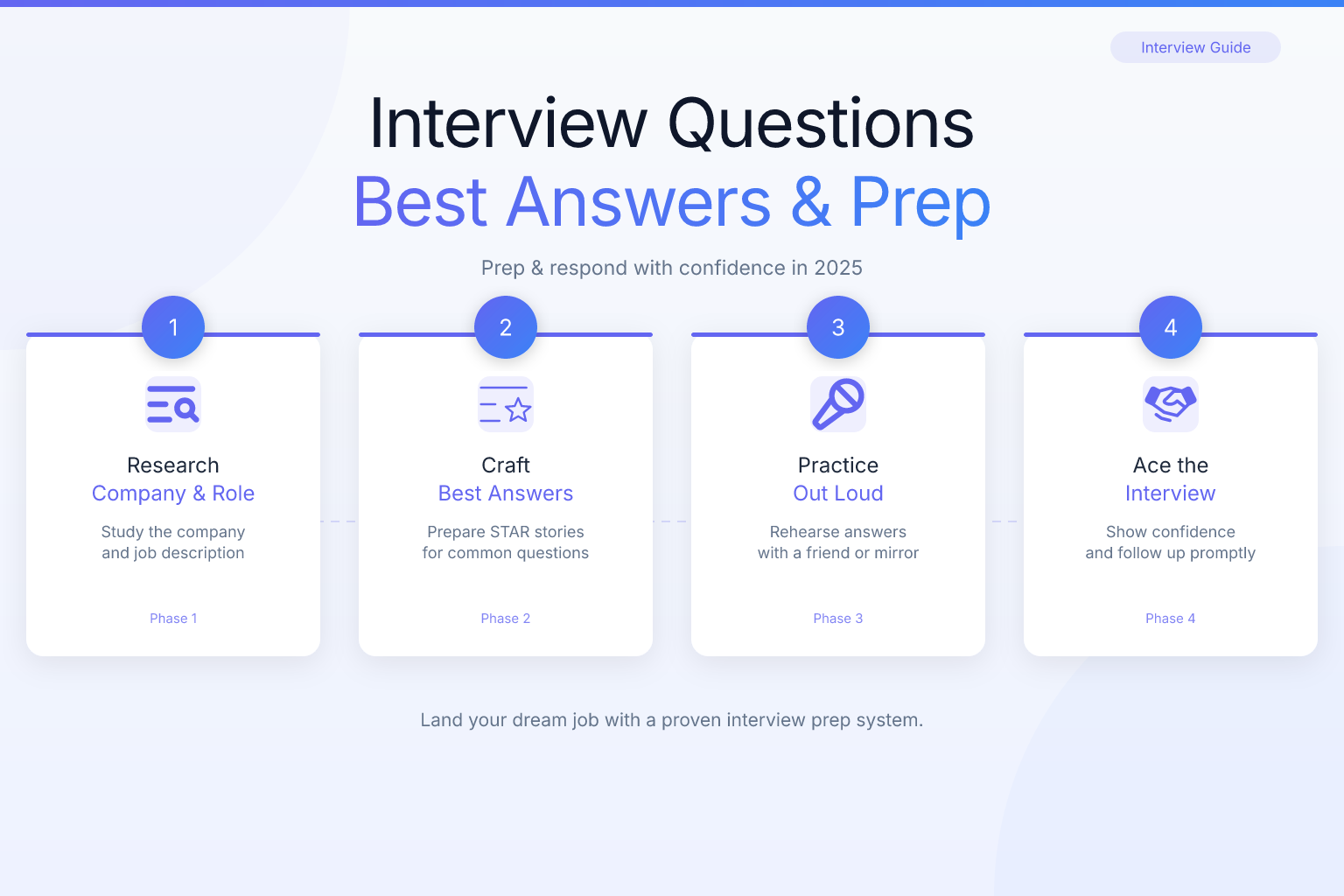
| What to Do | Why It Matters | Time |
|---|---|---|
| Research the company, role, and interviewer | Tailored answers show genuine interest and preparation | 1–2 hours |
| Practice common questions out loud | Builds confidence and helps you refine phrasing | 30–60 minutes |
| Use the STAR method for behavioral questions | Keeps answers structured, specific, and memorable | 15 minutes to learn, ongoing practice |
| Prepare 3–5 smart questions to ask | Demonstrates engagement and critical thinking | 20–30 minutes |
Common Interview Questions and Best Answers Guide
Most interviews follow a predictable pattern. Here are the questions you’ll almost certainly face, along with a best-answer framework and a concrete example you can adapt.
1. “Tell me about yourself.”
Framework: Present → Past → Future. Start with your current role and a key strength, briefly touch on relevant past experience, and end with why you’re excited about this opportunity.
Example: “I’m a digital marketing specialist with five years of experience driving B2B lead generation. In my current role at Acme Corp, I increased qualified leads by 40% through a content strategy overhaul. Before that, I built the social media program at StartupX from scratch. I’m looking to bring that growth mindset to a larger team like yours, where I can scale campaigns across multiple channels.”
2. “Why do you want this job?”
Framework: Connect three dots: what the company does, what the role requires, and what you love doing. Avoid generic praise; cite a specific project, value, or challenge.
Example: “I’ve followed your company’s work in renewable energy storage for years. When I saw this product manager role focused on grid-scale battery software, it felt like a natural fit — I’ve spent the last three years leading SaaS products in the energy sector, and I’m eager to apply that experience to a mission I genuinely care about.”
3. “What are your greatest strengths?”
Framework: Pick one or two strengths that directly match the job description. For each, give a brief example of how you’ve used it to create impact.
Example: “My biggest strength is translating complex technical concepts for non-technical stakeholders. At my last job, I led cross-functional workshops that cut project miscommunication by 30% and helped us ship two major features ahead of schedule.”
4. “What is your greatest weakness?”
Framework: Choose a real but non-critical weakness, and immediately explain the steps you’re taking to improve. Never use a humblebrag (“I work too hard”).
Example: “I tend to get deep into the details and can lose sight of the big picture when I’m under pressure. I’ve started using a weekly priority-setting session every Monday morning, and I ask my manager for a quick check-in mid-week to make sure I’m still focused on the right outcomes.”
5. “Where do you see yourself in five years?”
Framework: Show ambition that aligns with the company’s growth path, not a departure plan. Focus on skills you want to build and impact you want to have.
Example: “I’d like to grow into a senior engineering lead who mentors junior developers and drives architecture decisions. I see this role as a chance to deepen my technical expertise on large-scale systems, and in five years I hope to be helping shape the technical direction of a team like this one.”
6. “Why should we hire you?”
Framework: Summarize your top 2–3 selling points and tie them directly to the company’s needs. This is your closing pitch.
Example: “You need someone who can hit the ground running with Salesforce automation and also train the sales team. I’ve done exactly that — I implemented a lead scoring system that increased conversion by 25% and created a training program that onboarded 15 reps in two months. I can bring that same playbook here.”
7. “Tell me about a time you failed.”
Framework: Use a lightweight STAR structure (Situation, Task, Action, Result) but emphasize the lesson learned and what you do differently now.
Example: “In my first project management role, I underestimated the stakeholder sign-off time and we missed a launch deadline by two weeks. I took ownership, communicated transparently with the client, and built a buffer into every future project timeline. Since then, I haven’t missed a single deadline.”
8. “How do you handle stress or pressure?”
Framework: Describe a specific coping strategy and give a brief example of it working under real pressure.
Example: “When things get intense, I break the workload into a prioritized list and tackle the top three items first. During a product recall at my last company, I used that method to coordinate the customer communication plan while keeping the team calm — we resolved the issue in half the expected time.”
9. “What is your greatest professional accomplishment?”
Framework: Choose an accomplishment that mirrors the impact this role expects. Use numbers if possible.
Example: “I led a cross-department initiative to automate our invoice processing, which reduced errors by 60% and saved the finance team 15 hours a week. It taught me how to drive change without formal authority — a skill I know is important for this operations role.”
10. “Why are you leaving your current job?”
Framework: Stay positive. Frame it as seeking growth, new challenges, or alignment with the new company’s direction — never badmouth a previous employer.
Example: “I’ve learned a ton in my current role, but I’ve reached a point where the opportunities to work on large-scale data infrastructure are limited. This position offers exactly the kind of challenges I’m looking for next.”
Behavioral Interview Questions and How to Answer Them
Behavioral questions (“Tell me about a time when…”) are designed to predict your future performance based on past behavior. The most reliable way to answer them is the STAR method: Situation, Task, Action, Result. For a deep dive into crafting STAR stories, see our complete guide to the STAR method.
Here’s how to build a STAR answer in four steps:
- Situation: Set the scene in one sentence. Give just enough context so the interviewer understands the stakes.
- Task: Describe your specific responsibility or the challenge you faced.
- Action: Explain what you did, step by step. Focus on your individual contribution — use “I” not “we.”
- Result: Share the outcome, ideally with a measurable impact. If the result was a lesson, frame it as growth.
Example for “Tell me about a time you resolved a conflict within a team”:
- Situation: “Two senior developers on my team disagreed on the architecture for a new microservice, and the debate was delaying the sprint.”
- Task: “As the scrum master, I needed to get the team to a decision without damaging relationships.”
- Action: “I facilitated a structured decision-making session: each person presented their approach with pros and cons, we defined objective criteria, and I guided the team to a vote. I also scheduled a follow-up to review the decision after one sprint.”
- Result: “We chose a hybrid approach that combined the best of both ideas, shipped on time, and the two developers later co-presented the solution at an internal tech talk.”
Prepare 5–7 STAR stories that cover common themes: leadership, teamwork, problem-solving, failure, conflict, and adaptability. You can often adapt one story to answer multiple questions.
Technical and Role-Specific Questions: Preparation Strategies
For technical roles, you’ll face questions that test your hard skills — coding challenges, case studies, or domain-specific scenarios. Even non-technical roles may include exercises like writing a sample email or analyzing a dataset.
How to prepare:
- Deconstruct the job description. Highlight every tool, methodology, and skill mentioned. For each, prepare a concrete example of how you’ve used it.
- Review common technical questions in your field. For software engineers, practice data structures and algorithms on platforms like LeetCode or HackerRank. For marketers, be ready to walk through a campaign you designed and its metrics.
- Prepare a portfolio of work samples. If the role involves writing, design, or analysis, have 2–3 examples ready to share (with confidential details redacted).
- Do a mock technical interview. Use a friend in the industry or a service like Pramp to simulate the pressure.
When answering, think out loud. Interviewers care as much about your problem-solving process as the final answer. If you get stuck, explain what you would try next and why.
Questions to Ask the Interviewer
Asking thoughtful questions signals confidence and genuine interest. It also helps you evaluate whether the role is right for you. We’ve compiled a full list of 30 smart questions in our questions to ask an interviewer guide, but here are three you can always use, along with why they work:
- “What does success look like in this role after the first six months?” This shows you’re goal-oriented and want to meet expectations. It also reveals whether the company has clear performance metrics.
- “How does the team handle disagreements on priorities or approach?” This uncovers the team’s communication style and conflict resolution culture — crucial for your day-to-day experience.
- “What’s the biggest challenge the team is facing right now?” This demonstrates you’re ready to contribute to solving real problems, not just fill a seat.
Tailor your questions to the interviewer. For a hiring manager, ask about team goals and success metrics. For a peer, ask about daily workflows and collaboration. For a senior leader, ask about company vision and how the role contributes to larger objectives. Aim for 3–5 questions, and avoid topics you could have Googled (like basic company facts).
How to Structure Your Answers for Maximum Impact
Beyond STAR, several frameworks can help you deliver crisp, memorable answers:
- CAR (Challenge, Action, Result): A streamlined version of STAR that works well for shorter responses. For instance, when asked “How do you handle tight deadlines?”, you might say: “Challenge: Our client moved the launch date up by two weeks. Action: I re-prioritized the feature list, negotiated a reduced scope with stakeholders, and had the team focus on core deliverables. Result: We shipped on time with the client’s must-have features, and they praised our flexibility.”
- PAR (Problem, Action, Result): Similar to CAR, useful when the situation is obvious.
- The 3-Point Rule: For opinion or hypothetical questions, structure your answer around three key points. Example: “I believe a good manager does three things: sets clear expectations, removes obstacles, and gives honest feedback.”
Delivery tips:
- Pause for 2–3 seconds before answering a tough question. It shows composure and gives you time to organize your thoughts.
- Keep answers under two minutes unless the interviewer asks for more detail.
- Use concrete numbers whenever possible: percentages, dollar amounts, time saved.
- End strong answers with a bridge back to the role: “…and that’s exactly the kind of problem I’d love to solve here.”
Preparing for Virtual and Remote Job Interviews
Remote interviews have their own dynamics. For a complete walkthrough, read our guide to nailing virtual interviews. Here are the essentials:
- Test your tech the day before. Check your camera, microphone, internet speed, and the video platform (Zoom, Teams, etc.). Have a backup phone number ready.
- Control your environment. Choose a quiet, well-lit space with a neutral background. Position your camera at eye level.
- Look at the camera, not the screen. It simulates eye contact and builds connection.
- Have notes ready, but don’t read from them. Keep a sticky note with key points near your camera.
- Speak slightly slower than in person. Audio compression can make fast speech hard to understand.
Common Interview Mistakes and How to Avoid Them
Even strong candidates sabotage themselves with avoidable errors. Here are the most frequent ones:
- Rambling. Practice answers with a timer. If you catch yourself going over two minutes, stop and ask, “Would you like me to go deeper on any part?”
- Badmouthing past employers. It makes you look unprofessional. Reframe any negative experience as a learning opportunity.
- Not answering the question. Listen carefully. If you’re unsure, paraphrase the question back: “Just to confirm, you’re asking about a time I had to influence without authority — is that right?”
- Failing to research the company. You should know their products, recent news, and competitors. One candidate who asks “What does your company do?” is instantly disqualified.
- Talking about salary or benefits too early. Unless the interviewer brings it up, save it for later stages.
- Forgetting to follow up. Send a thank-you email within 24 hours, referencing something specific from the conversation.
Using AI and Tools to Practice Interview Questions
AI can be a powerful practice partner. Our ChatGPT interview prompts guide shows you exactly how to use AI to generate role-specific questions, get feedback on your answers, and run mock interviews. Here’s a quick prompt to try:
“You are a hiring manager for a [job title] role at a [industry] company. Ask me 5 common interview questions, one at a time. After each answer, give me constructive feedback on clarity, specificity, and relevance. Then ask the next question.”
Beyond AI, record yourself answering questions on your phone. Play it back to catch filler words, pacing issues, and weak spots. Even 15 minutes of recorded practice can dramatically improve your delivery.
FAQ
Q: What are the most common interview questions?
A: The most frequent questions include “Tell me about yourself,” “Why do you want this job?,” “What are your strengths and weaknesses?,” “Where do you see yourself in five years?,” “Why should we hire you?,” and behavioral prompts like “Tell me about a time you failed.” This guide covers all of them with answer frameworks.
Q: How do I answer “Tell me about yourself”?
A: Use the Present → Past → Future structure. Start with your current role and a key strength, briefly mention relevant past experience, and end with why you’re excited about this opportunity. Keep it under 90 seconds and avoid reciting your resume.
Q: What is the STAR method and how do I use it?
A: STAR stands for Situation, Task, Action, Result. It’s a framework for answering behavioral questions by telling a specific story. Describe the context (Situation), your responsibility (Task), the steps you took (Action), and the outcome (Result). Prepare 5–7 STAR stories before your interview.
Q: How do I answer “What is your greatest weakness”?
A: Choose a real but non-critical weakness, and immediately explain the steps you’re taking to improve. Avoid clichés like “I’m a perfectionist.” For example, you might say you struggle with public speaking and have joined Toastmasters to build that skill.
Q: What questions should I ask the interviewer?
A: Ask 3–5 questions that show you’ve researched the company and are thinking about the role. Good options: “What does success look like in the first six months?” “How does the team handle disagreements?” “What’s the biggest challenge the team is facing?” Avoid questions about salary or basic facts you could Google.
Q: How do I handle a question I don’t know the answer to?
A: Stay calm. If it’s a factual question, admit you don’t know but explain how you’d find the answer. If it’s a problem-solving question, think out loud: describe your approach, what you’d try first, and what you’d do if that didn’t work. Interviewers value problem-solving process over perfect recall.
Q: How can I practice interview questions effectively?
A: Practice out loud, not just in your head. Record yourself on your phone, use AI tools like ChatGPT for mock interviews, and do a live practice session with a friend. Focus on one category of questions at a time (e.g., behavioral, technical) and refine your answers until they feel natural.
Related articles:
Track Every Application While You Job Hunt
Stop losing track of where you’ve applied. The ResumeMate Job Tracker is a free Chrome extension that tracks every application, deadline, and follow-up in one place — right from your browser.