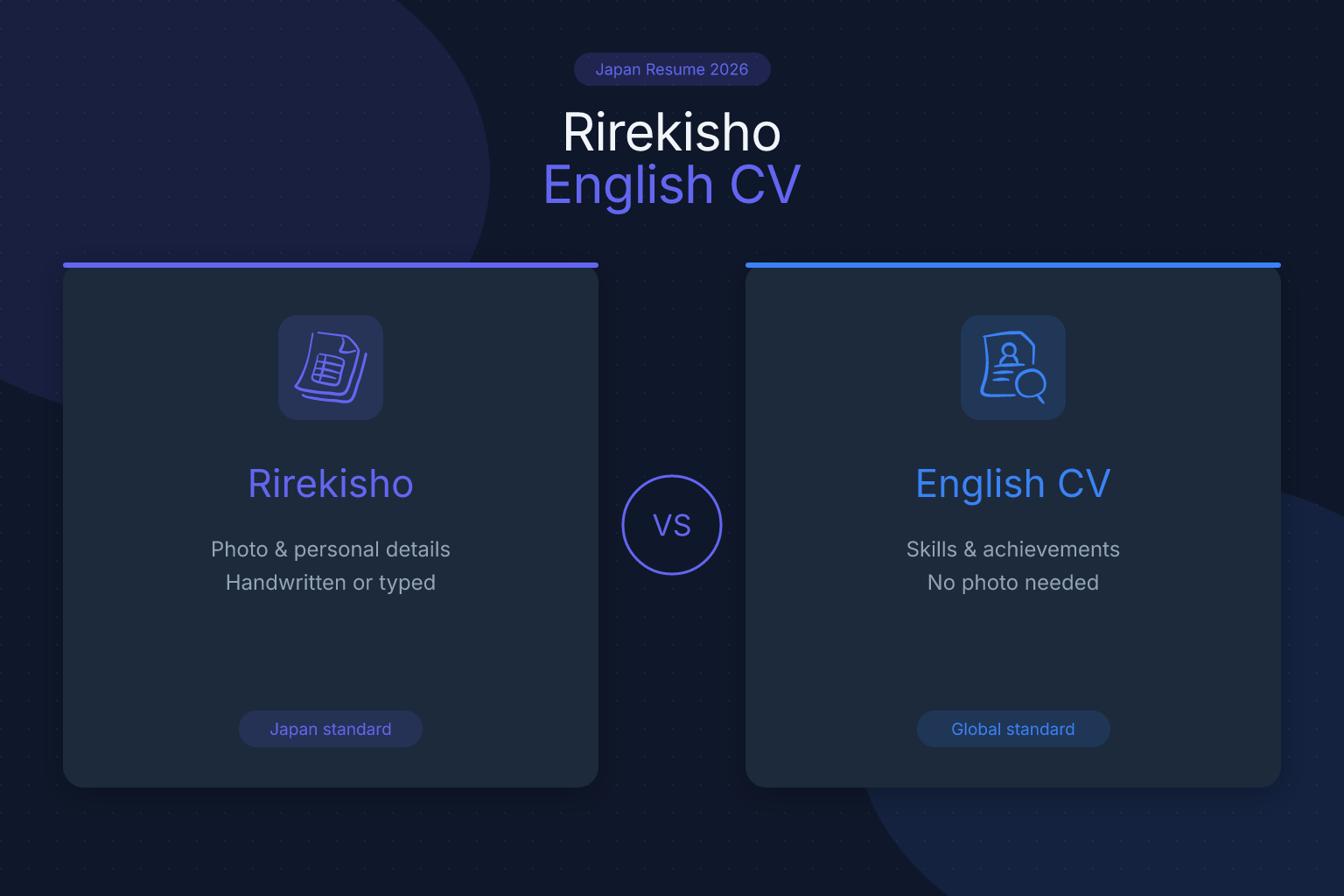
Japan Resume Format 2026: How to Write a Rirekisho and English CV for Job Search
If you’re targeting jobs in Japan, understanding the Japan resume format — specifically the traditional rirekisho and the English CV — is the first step to getting your application noticed. Japanese employers expect a level of detail and structure that differs from Western resumes, and using the wrong format can get your application discarded before anyone reads your qualifications. This guide breaks down both the rirekisho and the English resume for Japan, with step-by-step instructions, cultural insights, and practical tips to help you land interviews.
Key Takeaways
- The rirekisho is a standardized Japanese resume form that lists personal details, education, and work history in a fixed chronological order — it is still widely required by Japanese companies.
- An English CV for Japan should follow a clean, single-column layout with a professional photo (optional but common), and it must emphasize stability, loyalty, and concrete achievements.
- Handwritten rirekisho are still requested by some traditional firms, but typed rirekisho and English resumes are now accepted by most employers, especially international companies.
- Tailoring your resume to each job description is critical in Japan; generic applications are easily spotted and rejected.
- Using a free resume builder can help you create an ATS-friendly English resume that meets Japanese expectations while saving hours of formatting.
| What to Do | Why It Matters | Time |
|---|---|---|
| Download the official rirekisho template from a Japanese job site | Ensures you use the exact format expected by recruiters | 5 minutes |
| Prepare a professional headshot photo for the rirekisho | Many Japanese employers still expect a photo on the rirekisho | 10 minutes |
| Write a separate English CV for international firms | English CVs highlight skills and achievements in a way rirekisho cannot | 30–60 minutes |
| Tailor your resume to each job description | Shows you understand the company’s needs and increases interview chances | 20–30 minutes per application |
| Use a resume builder to maintain consistent formatting | Avoids layout errors that confuse ATS and hiring managers | 15–20 minutes |
Understanding the Two Main Japanese Resume Formats: Rirekisho vs. English CV
When job hunting in Japan, you’ll encounter two distinct resume formats: the rirekisho (履歴書) and the shokumu keirekisho (職務経歴書), often accompanied by an English CV. The rirekisho is a standardized personal history form used by virtually all Japanese companies. It’s a pre-printed or digital template that you fill out with your personal details, education, and employment history in chronological order. The shokumu keirekisho is a more detailed career summary that expands on your work experience, skills, and achievements — similar to a Western resume but still following Japanese conventions.
For foreign job seekers, you’ll typically need both: a rirekisho for the initial screening and an English CV (or a shokumu keirekisho) to showcase your professional background. Some international companies in Japan accept only an English resume, but having a rirekisho ready shows cultural awareness and respect for local norms.
What Is a Resume Called in Japanese?
If you’re searching for “what is resume in Japanese,” the answer depends on which document you mean. The word rirekisho (履歴書) translates literally to “personal history document” and is the closest equivalent to a standard resume or CV. The shokumu keirekisho (職務経歴書) means “work history document” and functions more like a detailed professional resume or career summary. In everyday conversation, Japanese speakers may also use the loanword rejume (レジュメ), borrowed from the French “résumé,” though this is less formal. When a Japanese job posting asks for a “rirekisho,” they mean the standardized form — not a Western-style resume.
When to Use Each Format
- Rirekisho: Required for most Japanese companies, especially traditional firms, government positions, and part-time jobs. It’s often the first document screened.
- Shokumu keirekisho: Used alongside the rirekisho for mid-career hires and professional roles. It’s where you detail your accomplishments.
- English CV/Resume: Preferred by foreign-affiliated companies, tech startups, and academic institutions. Even if a company asks for a rirekisho, submitting a well-formatted English resume can strengthen your application.
Rirekisho vs. Shokumu Keirekisho: A Side-by-Side Comparison
Many job seekers — especially foreigners — confuse these two documents. Here’s how they differ:
| Feature | Rirekisho (履歴書) | Shokumu Keirekisho (職務経歴書) |
|---|---|---|
| Purpose | Personal history and basic facts | Detailed career narrative and achievements |
| Format | Fixed template with predefined fields | Free-form, but follows Japanese conventions |
| Length | 1–2 pages (A4 or A3 folded) | 1–3 pages, sometimes longer for senior roles |
| Content | Dates, education, employment, licenses | Project details, responsibilities, results, skills |
| Tone | Factual, minimal | Descriptive, but still modest and team-oriented |
| Photo | Required (attached to top right) | Usually not included |
| Used for | All applications, initial screening | Mid-career and professional roles |
Understanding this distinction is critical. A rirekisho alone rarely lands you a professional job — it’s the shokumu keirekisho or English CV that convinces a hiring manager you can do the work.
The Standard Rirekisho Format: Sections and How to Fill Them Out
The rirekisho follows a rigid structure. You can download the official template from Japanese job sites like Rikunabi or Mynavi, or pick up a physical form at convenience stores. Here’s a section-by-section breakdown:
1. Date and Personal Information
- Date of submission: Write the date you’re submitting the form (year/month/day in Japanese format, e.g., 2025年4月1日).
- Name: Full name in kanji (if you have it) and furigana (phonetic reading). Foreigners should write their name in katakana or romaji as it appears on official documents.
- Photo: A 4cm x 3cm passport-style photo attached to the top right. Dress formally, neutral background. Some digital submissions allow an uploaded photo.
- Address: Full address in Japanese order (postal code, prefecture, city, etc.).
- Contact: Phone number and email.
For foreigners specifically: If your name doesn’t have kanji, write it in katakana in the furigana field and in romaji (or katakana) in the main name field. Use the exact spelling from your passport or residence card to avoid discrepancies during background checks. For your address, follow the Japanese format: 〒 postal code, prefecture, city, ward, block, building, room number. If you’re living abroad and applying from overseas, write your home country address in the same structured format.
2. Education and Employment History
This section is the core of the rirekisho. List your education and work history in reverse chronological order (most recent first) but within separate blocks: education first, then employment. Use the Japanese academic year (April to March) if applicable.
- Education: Start with your highest degree. Include school name, faculty, and graduation date. For example: “2022年3月 ○○大学 ○○学部 卒業”.
- Employment: List each company name, department, and a brief title. If you have gaps, explain them briefly (e.g., “language study”).
- Current status: If currently employed, write “現在に至る” (currently working).
For foreigners: If you graduated from a university outside Japan, write the country name in parentheses after the university name. For example: “2019年6月 University of California, Berkeley (USA) 卒業”. If your education system doesn’t align with the Japanese April–March academic year, use your actual graduation month and year — accuracy matters more than forcing the Japanese calendar.
3. Licenses and Qualifications
List any certifications, especially those recognized in Japan (e.g., JLPT N1, TOEIC score, IT certifications). Write the full official name and date obtained.
For foreigners: Prioritize certifications that Japanese employers recognize. The JLPT (Japanese Language Proficiency Test) is the gold standard — N2 or N1 significantly boosts your application. TOEIC scores are also widely understood. If you hold a professional license from your home country (e.g., CPA, PMP, AWS certification), list it with the issuing body and year. Japanese employers value formal credentials, so don’t leave this section sparse.
4. Self-Promotion / Personal Statement
A short paragraph (2-3 sentences) about your strengths, career goals, and why you want to work at the company. Keep it modest and focused on how you can contribute.
For foreigners: This is your chance to address the “why Japan?” question implicitly. Instead of saying “I’ve always dreamed of living in Japan,” frame it around professional contribution: “With five years of experience in software development and JLPT N2 proficiency, I aim to contribute to your team’s international projects while continuing to grow as an engineer.” Modesty is valued — avoid superlatives like “best” or “top performer.”
5. Commute Time and Dependents
Some templates ask for your commute time from home to the office and number of dependents. Fill these in honestly.
For foreigners: If you’re applying from overseas, write your intended commute time based on where you plan to live, or leave it blank if you haven’t secured housing. For dependents, include spouse and children if they will accompany you to Japan. This information helps employers assess relocation logistics and salary expectations.
6. Reason for Application (Optional)
A separate field where you can briefly state your motivation. This is often left blank if you’re submitting a cover letter separately.
Pro tip: Always use a black pen if handwriting. Mistakes are not allowed — use correction tape sparingly or start over. Typed rirekisho are now accepted by most employers, but if a company specifically requests a handwritten one, treat it as a test of your attention to detail.
Japanese Resume Sample for Foreigners: What a Complete Application Looks Like
If you’re searching for a “Japanese resume sample for foreigners,” here’s what a complete application package typically includes:
1. Rirekisho (1 page, A4 or A3 folded)
- Top right: 4cm x 3cm professional photo
- Date of submission in Japanese format
- Name in katakana and romaji
- Address in Japanese order
- Education history (university, country, graduation date)
- Employment history (company, title, dates)
- Licenses: JLPT N2, TOEIC 850, AWS Certified Solutions Architect
- Self-promotion: 2–3 sentences on strengths and motivation
- Commute time and dependents
2. Shokumu Keirekisho or English CV (1–2 pages)
- Career objective tailored to the specific company
- Work experience with 3–5 bullet points per role, emphasizing team contributions and measurable results
- Skills section: Japanese (JLPT N2), English (native), technical skills
- Education with graduation year
- Visa status: “Engineer/Specialist in Humanities visa, valid until 2027”
3. Cover letter (optional but recommended)
- Formal Japanese or English letter explaining motivation and fit
- Structured with opening, body, and closing
- References to specific company projects or values
This three-document package covers all bases: the rirekisho satisfies the formal requirement, the shokumu keirekisho or English CV demonstrates your professional value, and the cover letter shows genuine interest. For international companies, you may only need the English CV and cover letter — but having a rirekisho ready shows you understand Japanese business culture.
Writing an English Resume for Japan: Key Differences from Western Resumes
When applying to international companies or as a supplement to your rirekisho, an English resume is essential. However, a Japanese-style English resume differs from a typical US or UK resume in subtle but important ways.
Layout and Design
- Single-column, clean format: Avoid multi-column layouts, graphics, or excessive design. Japanese recruiters value simplicity and readability. A single-column template is the safest choice for ATS compatibility. If you’re using a resume builder, pick a professional, minimal template.
- Photo: While not mandatory on an English CV, including a professional headshot is still common in Japan and can increase your chances. Place it at the top right, similar to the rirekisho.
- Length: One to two pages is standard. For mid-career professionals, two pages are acceptable if you have extensive experience.
Content and Tone
- Personal details: Include your date of birth, nationality, and visa status (e.g., “Engineer/Specialist in Humanities visa, valid until 2027”). This is expected in Japan and helps employers assess your eligibility.
- Career objective: A brief summary at the top that states your professional background and what you’re looking for. Keep it factual, not overly ambitious.
- Work experience: Use bullet points to describe achievements, but frame them in terms of team contribution and long-term results. Japanese employers value loyalty and stability, so highlight tenure and progression within companies.
- Education: Include your degree, university, and graduation year. If you studied at a Japanese university, mention it prominently.
- Skills: Language skills (Japanese, English, others) with proficiency levels (e.g., JLPT N2, TOEIC 900). Also list technical skills relevant to the job.
The Japanese CV Format in English: What Changes
If you’re searching for the “Japanese CV format in English” or a “Japanese style resume in English,” here’s what distinguishes it from a standard Western resume:
- Personal details come first: Unlike US resumes that omit age, marital status, and nationality for legal reasons, Japanese CVs in English typically include date of birth, nationality, and visa status at the top. This is expected and not considered discriminatory in Japan.
- Photo is common: While optional, a professional headshot is still widely used. If you include one, use a formal passport-style photo, not a casual LinkedIn-style shot.
- Chronological order is standard: Japanese CVs almost always use reverse chronological order. Functional or skills-based resumes are rare and may confuse Japanese recruiters.
- Modest language: Replace “led,” “drove,” and “spearheaded” with “contributed to,” “supported,” and “participated in.” Japanese business culture values collective achievement over individual heroics.
- Tenure is highlighted: If you stayed at a company for 3+ years, make that visible. Job-hopping is viewed more negatively in Japan than in Western markets.
Cultural Nuances
- Avoid aggressive self-promotion. Instead of “I single-handedly increased sales by 50%,” write “Contributed to a 50% sales increase through team collaboration and process improvements.”
- Use polite, formal language. Contractions are fine, but the overall tone should be respectful.
- If you have a Japanese name or have adopted a Japanese alias, use it consistently.
How to Tailor Your Resume for Japanese Employers
Generic resumes rarely succeed in Japan. Recruiters expect you to have researched the company and aligned your application with their values. Here’s how to tailor both your rirekisho and English CV:
- Research the company’s culture: Read the company’s mission statement and recent news. If they emphasize “teamwork” and “customer first,” weave those themes into your self-promotion section.
- Match keywords from the job description: Japanese job postings often list specific required skills and desired personality traits. Use the exact same terms in your resume. For example, if they ask for “communication skills” (コミュニケーション能力), mention it explicitly.
- Adjust your career objective: For each application, rewrite your summary to reflect why you want to work at that particular company. Mention the company name and a specific reason.
- Highlight relevant experience: If the job requires experience with Japanese clients, move that experience to the top of your bullet points. If you have JLPT certification, place it prominently.
- Use a consistent format: When applying to multiple companies, keep your core resume structure but tweak the content. A resume builder can help you maintain a clean template while you customize each version.
For a deeper dive into tailoring, read our guide on how to tailor a resume to a job description.
Common Mistakes to Avoid on a Japanese Resume
Even small errors can signal carelessness to a Japanese recruiter. Here are the most frequent pitfalls:
- Incorrect date format: Always use the Japanese year-month-day order (e.g., 2025/4/1) or the current Japanese era name (e.g., Reiwa 7). Mixing formats looks sloppy.
- Missing furigana: If your name is in kanji, always provide the furigana reading. For foreign names, write in katakana.
- Leaving blank spaces: Fill every field. If something doesn’t apply, write “なし” (none) or “特になし” (nothing special).
- Overly long self-promotion: Keep it concise. A rambling paragraph suggests you can’t communicate efficiently.
- Using a Western resume as a rirekisho: Never submit a US-style resume when a rirekisho is requested. It shows a lack of understanding of Japanese business etiquette.
- Inconsistent employment dates: Japanese companies often verify employment history. Ensure your dates match your official records exactly.
- Ignoring the photo requirement: If the template has a photo box, attach a photo. Leaving it empty can be seen as incomplete.
- Using a casual photo: A selfie, cropped social media photo, or casual outfit photo is a serious mistake. Always use a formal, passport-style headshot with a neutral background.
- Translating your resume word-for-word: A direct translation of a Western resume often sounds arrogant or confusing in Japanese. Rewrite the content to match Japanese conventions, not just the language.
Using a Resume Builder to Create ATS-Friendly Japanese Resumes
Many Japanese companies now use applicant tracking systems (ATS) to screen resumes, especially larger firms and international companies. An ATS scans your resume for keywords and parses the text. If your formatting is complex or uses tables, the system may misread your information.
A free resume builder like ResumeMate can help you create a clean, single-column English resume that passes ATS scans without sacrificing professional design. You can also use the resume score checker to see how well your resume matches typical ATS criteria and get section-by-section feedback.
For the rirekisho, you’ll still need to use the official Japanese template, but your English CV can be built and stored in ResumeMate, making it easy to update and export as a PDF. This is especially useful when you’re applying to multiple companies and need to tailor each version quickly.
Concrete example of an ATS-friendly format: An ideal English resume for Japan uses a single-column layout with clearly labeled sections (e.g., “Work Experience,” “Education,” “Skills”). Each job entry includes the company name, dates, and 3–5 bullet points that start with action verbs and incorporate keywords from the job description. Avoid tables, text boxes, and graphics — these can confuse ATS parsing. Use a standard font like Arial or Noto Sans at 10–12pt, and save the file as a PDF with a simple filename. This structure ensures both ATS and human recruiters can quickly scan your qualifications. For more on ATS-friendly formatting, see our guide on ATS resume tips.
Job Search Tips for Foreigners in Japan
Beyond the resume, your job search strategy matters. Here are actionable tips to improve your chances:
- Use Japanese job boards: Sites like Rikunabi, Mynavi, and Daijob cater to bilingual professionals. Also check the ResumeMate job board for international opportunities.
- Network actively: Attend industry events, join LinkedIn groups, and connect with recruiters who specialize in placing foreigners. Personal introductions carry weight in Japan.
- Prepare a Japanese-style cover letter: Called a “shokumu keirekisho” or “cover letter,” it should explain your motivation and how your skills match the company’s needs. Keep it formal and structured.
- Understand visa requirements: Ensure you have the correct visa status for the job. Some companies sponsor visas, but having an existing eligible visa makes you a more attractive candidate.
- Track your applications: With multiple documents and deadlines, it’s easy to lose track. The ResumeMate Job Tracker Chrome extension lets you log every application, follow-up date, and status directly from your browser.
Special Considerations for ALT and Teaching Positions
If you’re searching for “ALT in Japan” (Assistant Language Teacher), the application process differs slightly. ALT positions — typically arranged through programs like JET or private dispatch companies — usually require a simpler resume format. Many ALT employers accept a standard English resume with a photo, and the rirekisho may be optional or provided as a form to fill out during orientation. However, even for ALT roles, including your Japanese language ability (even basic) and any teaching or tutoring experience will strengthen your application. The same principles of modesty, attention to detail, and cultural awareness apply.
Tech and International Roles in Japan
For tech professionals targeting Japan, the landscape is more flexible. International companies, startups, and foreign-affiliated firms in Tokyo and Osaka often accept English-only resumes and may skip the rirekisho entirely. If you’re coming from a cloud computing background, our guides on AWS jobs and Azure developer roles offer transferable strategies for tailoring your technical resume — many of the same principles apply when targeting Japanese tech employers. The key difference: even in tech, Japanese companies value team contribution language and stability signals more than their Western counterparts.
For a systematic approach to your search, read our guide on how to organize your job search step by step.
Digital vs. Handwritten: What’s Expected Today
The tradition of handwritten rirekisho is fading, but it hasn’t disappeared. Currently, most large corporations and tech companies accept typed rirekisho submitted online through job portals or email. However, some traditional industries — such as banking, manufacturing, and government — still prefer handwritten forms as a way to assess your character, diligence, and attention to detail. Even in 2025, a handwritten rirekisho can set you apart if done well, but it’s no longer a universal requirement.
When to handwrite:
- The job posting explicitly requests a handwritten rirekisho.
- You’re applying to a very traditional company or a role where meticulousness is critical (e.g., administrative positions in finance).
- You have excellent handwriting and want to make a positive impression — a neat, error-free form reflects discipline.
When to type:
- The company accepts online applications or email submissions (most modern firms).
- You’re applying to an international firm, a startup, or a tech company where digital efficiency is valued.
- You’re submitting an English CV — always type these, as handwritten English resumes are not standard.
If you do handwrite, use a black ballpoint pen, write slowly, and practice on a copy first. Mistakes can be corrected with correction tape, but a clean, error-free form is best. Some job seekers even hire a professional calligrapher for the final version, though this is rare. Ultimately, the decision should be guided by the company’s culture and the specific instructions in the job posting.
FAQ
Q: What is a resume called in Japanese?
A: The standard Japanese resume is called a rirekisho (履歴書), which translates to “personal history document.” A more detailed career summary is called a shokumu keirekisho (職務経歴書), meaning “work history document.” Some Japanese speakers also use the loanword “rejume” (レジュメ), but rirekisho is the formal term you’ll see in job postings.
Q: Do I need a photo on my English resume for Japan?
A: It’s not mandatory, but including a professional headshot is still common and can be advantageous. If you choose to include one, use a formal passport-style photo placed at the top right, similar to the rirekisho format.
Q: Can I use a US-style resume instead of a rirekisho?
A: Only if the company specifically requests an English resume or is a foreign-affiliated firm. For most Japanese companies, you must submit a rirekisho. Submitting a Western resume when a rirekisho is expected signals a lack of cultural understanding and may disqualify you.
Q: What is the difference between a rirekisho and a shokumu keirekisho?
A: The rirekisho is a standardized personal history form focusing on dates and basic facts. The shokumu keirekisho is a detailed career summary where you describe your work experience, skills, and achievements in paragraph or bullet form. Both are often required for mid-career positions.
Q: Should I write my rirekisho in Japanese or English?
A: If the job posting is in Japanese and the company is Japanese, write the rirekisho in Japanese. If the company operates in English or the posting is bilingual, you may submit an English CV alongside a Japanese rirekisho. Always follow the language of the job advertisement.
Q: How do I explain employment gaps on a Japanese resume?
A: Japanese employers are sensitive to gaps. Briefly explain any gap in the education/employment history section, such as “language study abroad,” “family care,” or “job search.” Honesty and a clear reason are expected.
Q: Where can I download a rirekisho format template?
A: You can download the official rirekisho template from Japanese job sites like Rikunabi (rikunabi.com) or Mynavi (mynavi.jp), both of which offer free PDF and Excel versions. Physical forms are also available at convenience stores (konbini) like 7-Eleven, Lawson, and FamilyMart. For your English CV, a resume builder can generate a clean, ATS-friendly template in minutes.
Q: How do I make a Japanese resume from scratch?
A: Start by downloading the official rirekisho template, then fill in each section in order: date, personal information (name, photo, address, contact), education history, employment history, licenses, self-promotion, and optional fields. For the English CV, use a single-column template and include personal details (date of birth, nationality, visa status), career objective, work experience with team-focused bullet points, education, and skills. If you’re unsure about formatting, a resume score checker can review your English resume for ATS compatibility.
Q: Is it okay to use a resume builder for a Japanese-style resume?
A: Yes, for your English CV. A resume builder like ResumeMate can help you create a clean, ATS-friendly English resume that meets Japanese expectations. For the rirekisho, you’ll need to use the official Japanese template, but you can still use a builder to manage your English documents.
Track Every Application While You Job Hunt
Stop losing track of where you’ve applied. The ResumeMate Job Tracker is a free Chrome extension that tracks every application, deadline, and follow-up in one place — right from your browser.