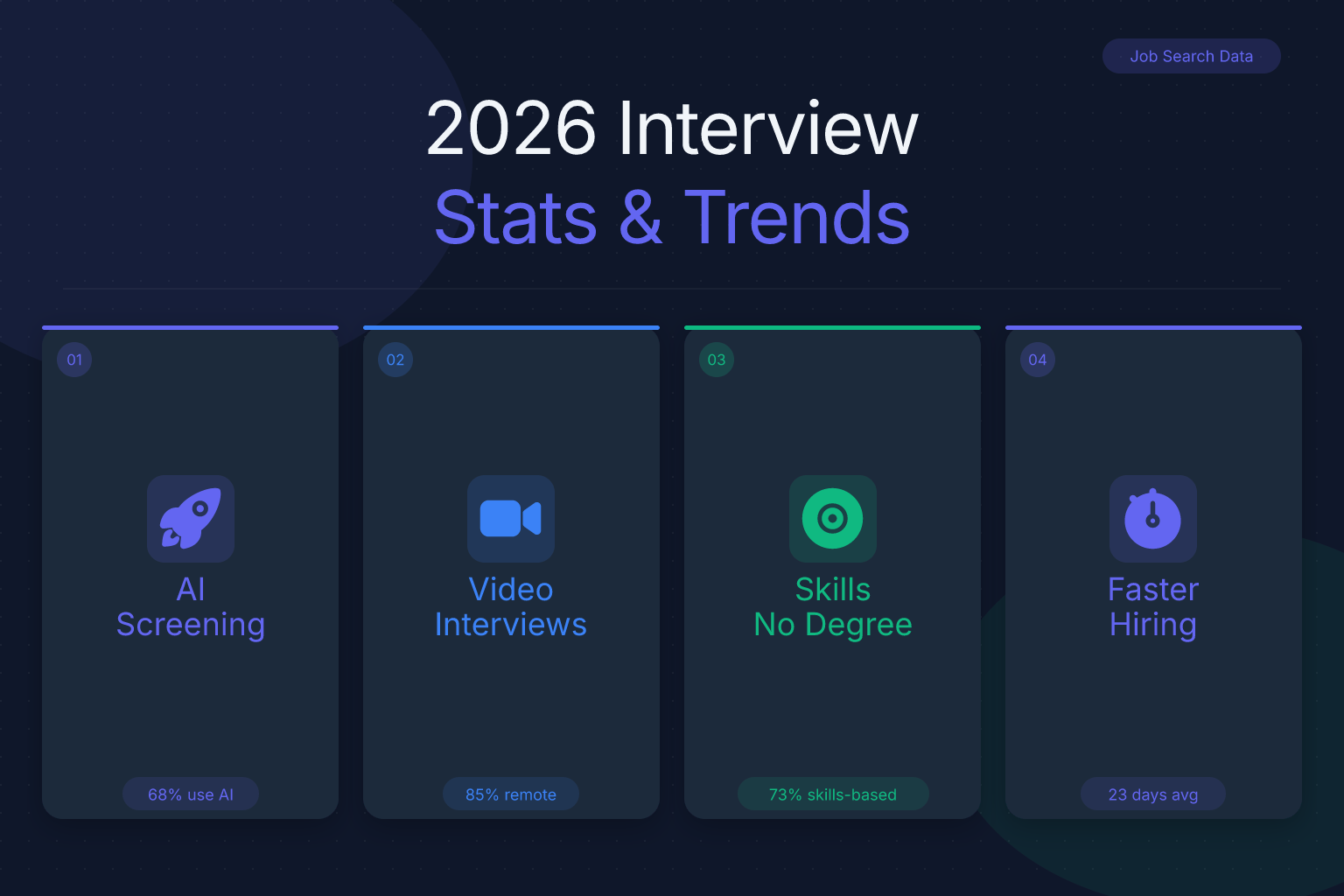
2026 Job Interview Statistics: Must-Know Trends & Data for Job Seekers
If you’re preparing for a job search, understanding job interview statistics can give you a clear edge. Numbers don’t lie—they reveal how many interviews you’ll likely face, what employers really care about, and where most candidates stumble. This post breaks down the latest data on interview success rates, virtual hiring, common mistakes, and more, so you can walk into every conversation with confidence.
Summary: What the Numbers Mean for Your Job Search
| What to Do | Why It Matters | Time |
|---|---|---|
| Research the company and role thoroughly | 47% of candidates are rejected because they don’t know enough about the employer (CareerBuilder survey) | 2–3 hours per application |
| Practice answering common questions out loud | Structured interviews are twice as predictive of job performance as unstructured ones, so rehearsing for a consistent format pays off | 1–2 hours per interview round |
| Prepare for video interviews | 86% of organizations now use video interviewing (Gartner), and technical glitches or poor setup can sink your chances | 30 minutes to test equipment and background |
| Send a thank-you email within 24 hours | 80% of hiring managers say thank-you notes influence their decision, yet only 24% of candidates send them (Accountemps) | 15 minutes |
| Track every interview date, contact, and follow-up | Missing a scheduled call or forgetting to follow up is a top reason candidates fall out of the process | 5 minutes per application with a tracker |
Key Job Interview Statistics You Should Know in 2026
Before diving into strategy, let’s look at the numbers that shape today’s hiring landscape. These statistics come from reputable surveys and industry reports, and they paint a clear picture of what to expect.
- Average number of interviews per job: Most roles require 2–3 interviews before an offer, according to Glassdoor data. Senior or technical positions can stretch to 5 or more.
- Time to hire: LinkedIn’s 2024 Global Talent Trends report puts the average time-to-hire at 42 days. That means from application to signed offer, you’re looking at roughly six weeks—and interviews eat up a big chunk of that.
- Virtual interview adoption: Gartner’s 2022 survey found that 86% of organizations use video interviews at some stage. By 2026, that number is even higher, with many companies conducting fully remote hiring processes.
- Candidate ghosting: A 2023 Indeed survey revealed that 60% of job seekers have ghosted an employer—skipping a scheduled interview or disappearing mid-process. Employers notice, and it often burns bridges.
- First impressions: Research from Twin Employment & Training suggests that 33% of hiring managers know within the first 90 seconds whether they’ll move a candidate forward. Your opening moments matter enormously.
- Cultural fit failures: A Leadership IQ study found that 89% of new-hire failures stem from attitude or motivational mismatches, not a lack of technical skills. Interviews are the primary tool for assessing that fit.
- Structured interviews win: A meta-analysis published in the Journal of Applied Psychology shows that structured interviews—where every candidate gets the same questions in the same order—are more than twice as accurate at predicting job performance compared to free-form conversations.
These numbers aren’t just trivia. They tell you where to focus your preparation time.
How Many Interviews Does It Take to Land a Job?
One of the most common questions job seekers ask is, “How many interviews will I have to go through?” The answer depends on the industry, level, and company size, but the data gives a reliable range.
A typical corporate hiring funnel looks like this:
- Phone or video screen (15–30 minutes) with a recruiter or HR coordinator.
- First-round interview (30–60 minutes) with the hiring manager.
- Second-round interview (often a panel or series of 1-on-1s) with team members or cross-functional stakeholders.
- Final round (sometimes a presentation, case study, or executive chat).
According to Jobvite’s annual recruiting benchmark report, the average number of interviews per hire is 2.5. For individual contributor roles, you might get an offer after two solid conversations. For management or highly specialized roles, expect three to five.
Conversion rates at each stage are sobering. A typical corporate job posting attracts 250 applications. About 4–6 candidates get a phone screen, and 2–3 make it to the final round. That means your odds of landing an interview from a cold application are around 2%, but once you’re in the interview stage, your chances of eventually getting an offer jump to roughly 20–25%.
This is why it’s critical to treat every interview as a high-stakes opportunity. You’ve already beaten the odds just by getting the call.
Why Job Interviews Matter More Than Your Resume
Your resume gets you in the door. The interview decides whether you walk out with an offer. Employers use interviews to assess three things a piece of paper can’t fully capture:
- Soft skills and communication: Can you explain complex ideas clearly? Do you listen well? Are you likable?
- Cultural alignment: Will you thrive in the company’s environment, or will you clash with the team?
- Motivation and attitude: Are you genuinely excited about the work, or just looking for a paycheck?
The Leadership IQ study mentioned earlier underscores this: 89% of new hires who fail within 18 months do so because of attitude, coachability, or emotional intelligence—not because they couldn’t do the technical work. Interviews are the employer’s best shot at spotting those red flags early.
First impressions also carry disproportionate weight. While the 90-second stat is often cited, even more conservative research shows that interviewers form strong impressions within the first 5–7 minutes. That means your greeting, your appearance, and your initial answer to “Tell me about yourself” can set the tone for everything that follows. If you want to nail that opener, our guide on how to answer “Tell me about yourself” walks you through a proven formula.
Virtual Interview Statistics and Trends
Remote hiring isn’t a pandemic-era blip—it’s the new standard. The numbers prove it:
- 86% of organizations use video interviews (Gartner).
- 70% of talent professionals say virtual interviews are now a permanent part of their process (LinkedIn).
- 60% of hiring managers believe video interviews are just as effective as in-person meetings for evaluating candidates (Robert Half).
Virtual interviews bring clear benefits: they slash scheduling time, widen the candidate pool, and reduce travel costs. But they also introduce new pitfalls. A survey by Wyzowl found that 39% of candidates have experienced technical issues during a video interview—frozen screens, audio dropouts, or poor lighting. Another 28% admitted they didn’t test their setup beforehand.
To avoid becoming a statistic, treat a video interview with the same seriousness as an in-person meeting. Test your camera, microphone, and internet connection the day before. Choose a quiet, well-lit space with a neutral background. Dress professionally from head to toe—you never know when you’ll need to stand up. For a deeper dive, check out our complete guide on nailing your remote job interview.
Interview Formats: Which Ones Do Employers Prefer?
Not all interviews are created equal. The format an employer chooses tells you a lot about what they value.
- Phone screens: Still the most common first step. A 2023 SHRM survey found that 65% of companies use a phone call to filter candidates before investing time in a longer conversation. These are usually short and focused on logistics, salary expectations, and basic qualifications.
- One-on-one interviews: The classic format. You’ll face this in nearly every process, often with the hiring manager.
- Panel interviews: Common for mid-to-senior roles. You sit across from 2–5 people at once. They’re efficient for the employer but can feel intimidating. Preparation is key—know each panelist’s role if possible.
- One-way video interviews: Growing fast. Platforms like HireVue let employers send questions, and you record your answers on your own time. A 2022 survey by HireVue found that 30% of large companies use this method for initial screening. The upside is flexibility; the downside is you get no real-time feedback or rapport.
- Structured vs. unstructured: The data is clear. Structured interviews, where every candidate answers the same predetermined questions, reduce bias and improve hiring accuracy. Unstructured, conversational interviews feel friendlier but are far less predictive. When you encounter a structured interview, your ability to give crisp, example-driven answers using a framework like STAR (Situation, Task, Action, Result) becomes critical. Our STAR method guide breaks down exactly how to build those stories.
Common Interview Mistakes That Candidates Make (and the Stats to Prove It)
Knowing what trips up other candidates helps you avoid the same traps. Here are the most frequent interview mistakes, backed by survey data:
- Lack of company research: A CareerBuilder survey found that 47% of hiring managers have rejected a candidate because they didn’t know enough about the organization. You don’t need to memorize the annual report, but you should understand the company’s products, competitors, and recent news.
- Arriving late (or too early): An OfficeTeam survey reported that 20% of candidates have been late to an interview. Even a few minutes can signal poor time management. Conversely, showing up more than 10 minutes early can fluster the interviewer. Aim for 5 minutes early for in-person; for video, log on 2–3 minutes before the scheduled time.
- Badmouthing a previous employer: 34% of hiring managers say negative comments about a past boss or company are a major red flag (Accountemps). Even if your last job was toxic, frame your departure around what you’re looking for next, not what you’re running from.
- Not asking questions: 32% of interviewers say a candidate who asks no questions appears disinterested or unprepared (Robert Half). Always have 3–5 thoughtful questions ready that show you’ve done your homework.
- Skipping the thank-you note: As mentioned earlier, 80% of hiring managers consider thank-you emails influential, but only 24% of candidates send them. That’s a huge missed opportunity. A short, specific note within 24 hours can tip the scales in your favor. For templates, see our thank-you email examples.
How to Use These Statistics to Improve Your Interview Performance
Data is only useful if you act on it. Here’s how to translate the numbers into a concrete preparation plan:
- Research like your offer depends on it—because it does. Spend at least two hours on the company’s website, LinkedIn page, recent press releases, and competitor landscape. Know their mission, values, and any challenges they’re facing. When 47% of rejections stem from lack of research, this is non-negotiable.
- Practice structured answers. Since structured interviews are the gold standard, prepare 5–7 STAR stories that cover teamwork, problem-solving, leadership, failure, and conflict. Rehearse them out loud until they sound natural, not scripted.
- Master your virtual setup. With 86% of companies using video interviews, your tech and environment are part of your first impression. Invest in a decent webcam and microphone if needed, and do a dry run with a friend.
- Show up on time, every time. For in-person interviews, plan to arrive 5 minutes early. For video, be in the waiting room 2 minutes before. Punctuality is a baseline expectation, and 20% of candidates fail it.
- Ask smart questions. Prepare questions that show strategic thinking: “What would success look like in the first 90 days?” or “How does this role contribute to the company’s top priorities this year?” Avoid questions about vacation policy or perks until you have an offer.
- Send a thank-you email within 24 hours. Reference something specific from the conversation. It takes 15 minutes and puts you in the top 24% of candidates who actually follow through.
- Track every interview detail. When you’re juggling multiple applications, it’s easy to forget a scheduled call or mix up company names. Use a simple tracker to log dates, contacts, and follow-up tasks. The free ResumeMate Job Tracker Chrome extension does exactly this—it captures application details right from your browser so you never miss a step.
The Future of Job Interviews: AI, Automation, and Data-Driven Hiring
Interviewing is evolving fast. Here’s what the data says about where things are headed:
- AI-powered screening: A 2023 survey by Eightfold found that 55% of HR leaders already use AI for resume screening and initial candidate matching. In the interview phase, AI is increasingly used to analyze one-way video responses—evaluating word choice, tone, and even facial expressions.
- On-demand video interviews: As mentioned, 30% of large companies now use one-way video platforms. Expect that number to grow as employers seek to screen more candidates in less time.
- Predictive analytics: Some organizations are building models that predict a candidate’s likelihood of success based on interview performance data combined with assessment results. This means your answers may be scored against a benchmark, not just a gut feeling.
- The human element remains: Despite the tech, final-round interviews are still overwhelmingly human-led. A Harvard Business Review study found that managers trust their own conversation far more than any algorithm. So while you need to pass the AI gatekeepers, your ability to connect with a real person still decides the outcome.
This shift means you should be comfortable recording yourself and speaking to a camera with no audience. Practice with a timer and a webcam; watch your recordings back to spot filler words, pacing issues, or awkward pauses.
FAQ
Q: What is an interview in statistics?
A: In statistics, an interview is a data collection method where a researcher asks participants questions to gather information for a study. It’s different from a job interview. This article focuses on job interview statistics—the numbers and trends related to employment interviews—not the statistical technique.
Q: What percentage of job applicants get an interview?
A: On average, only about 2–3% of applicants are invited to interview for a typical corporate job posting. For a role that receives 250 applications, roughly 4–6 people will get a phone screen. However, this varies widely by industry and how well your resume matches the job description.
Q: How long does the average job interview last?
A: Phone screens usually last 15–30 minutes. First-round interviews typically run 30–60 minutes. Final-round or panel interviews can last 60–90 minutes. The total time you’ll spend in interviews for one job often adds up to 2–4 hours across multiple rounds.
Q: What is the success rate of job interviews?
A: Once you reach the interview stage, your chance of eventually receiving an offer is roughly 20–25%. That means for every 4–5 people interviewed, one gets hired. Your odds improve significantly if you prepare thoroughly and avoid common mistakes.
Q: Why are job interviews important?
A: Interviews let employers assess soft skills, cultural fit, and motivation—factors that resumes can’t fully convey. Research shows that 89% of new-hire failures are due to attitude or interpersonal issues, not technical ability. The interview is the primary tool for evaluating those traits.
Q: How many interviews does it take to get a job?
A: Most job offers come after 2–3 interviews. Entry-level roles may require just one or two, while senior or technical positions often involve 4–5 rounds. The key is to treat each conversation as a separate hurdle and prepare accordingly.
Q: What is the most common interview mistake?
A: The most frequent mistake is failing to research the company. Surveys show that 47% of hiring managers have rejected a candidate for not knowing basic facts about the organization. Other top mistakes include arriving late, speaking negatively about past employers, and not asking any questions.
Related articles:
- Gen Z Workplace Statistics: Key Data and Trends
- Best Days of the Week to Apply for Jobs: 2026 Trends & Data
Track Every Application While You Job Hunt
Stop losing track of where you’ve applied. The ResumeMate Job Tracker is a free Chrome extension that tracks every application, deadline, and follow-up in one place — right from your browser.