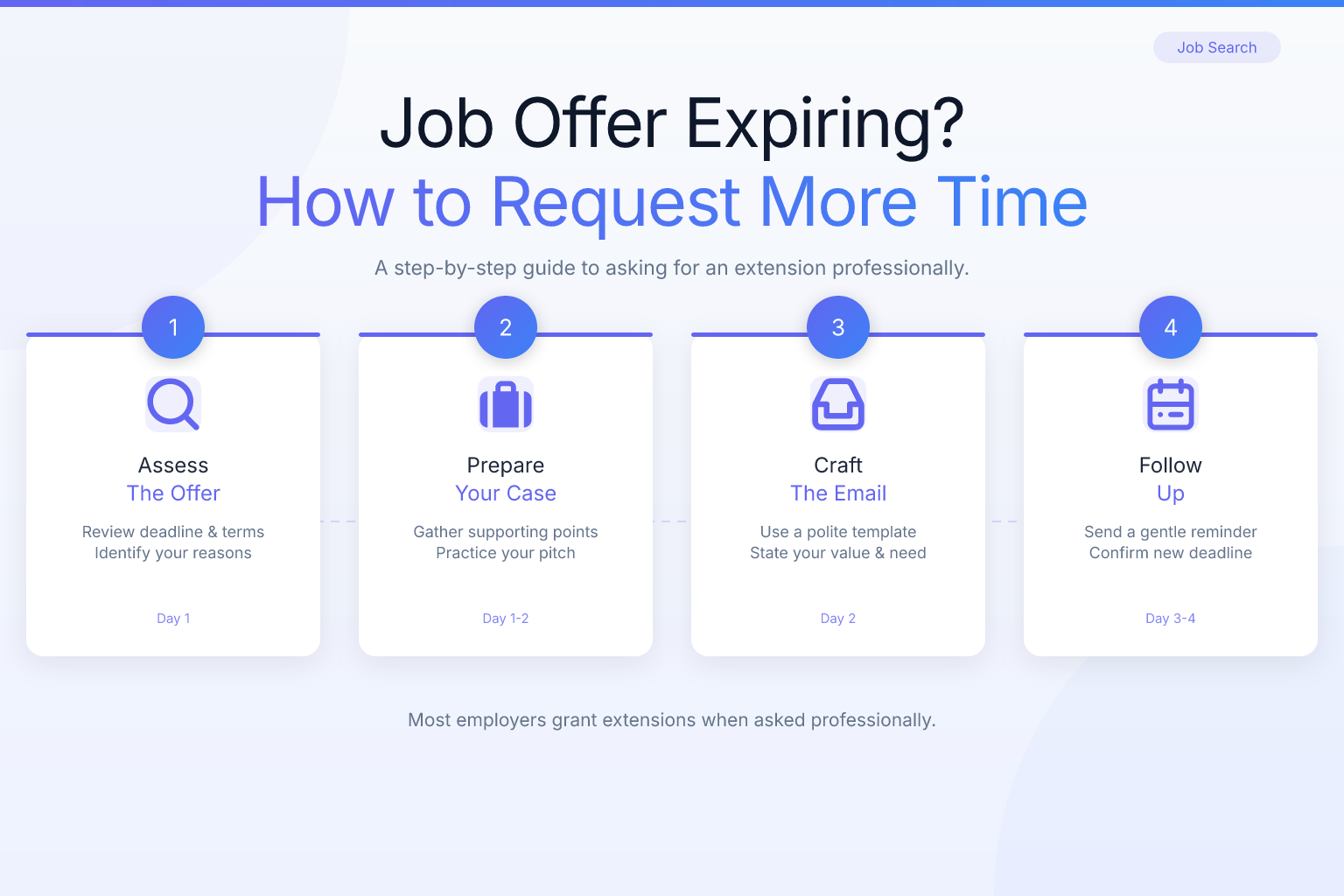
Job Offer Extension: How to Ask for More Time (2026 Guide)
You’ve received a job offer — congratulations. But the offer letter includes a job offer expiration date, and the clock is ticking. That deadline can feel like pressure, but it’s actually a standard part of the hiring process. How you handle it determines whether you accept a great role, negotiate better terms, or lose the opportunity entirely. This guide walks you through exactly what to do when you’re up against a tight offer deadline, with scripts, strategies, and common pitfalls to avoid.
Key Takeaways
- A job offer expiration date is a firm deadline set by the employer, typically 3 to 7 business days, to keep the hiring process moving and prevent candidates from shopping the offer indefinitely.
- You can request an extension by being transparent about your timeline, reaffirming your enthusiasm, and giving a specific new date — most recruiters will grant a few extra days if you ask professionally.
- Never accept an offer and then renege later; it can burn bridges with the employer and damage your reputation in the industry.
- Use the deadline to accelerate other interviews or negotiate competing offers, but always communicate honestly with all parties.
- If you miss the expiration date, the offer is usually rescinded, but you can sometimes revive it with a sincere explanation and a quick follow-up.
Summary Table
| What to Do | Why It Matters | Time |
|---|---|---|
| Clarify the exact deadline and any contingencies | Prevents misunderstandings about when the offer expires | 5 minutes |
| Request an extension if you need more time | Buys space to evaluate, negotiate, or finish other interviews | 1–2 days to hear back |
| Communicate with other employers about your timeline | Can surface competing offers or speed up decisions | Ongoing |
| Decide and respond before the deadline | Avoids losing the offer and shows professionalism | Varies |
| Log the deadline in a tracker | Ensures you never miss a critical date | 1 minute |
What Is a Job Offer Expiration Date and Why Do Employers Use It?
A job offer expiration date is the date and time by which you must accept or decline a written offer. It’s usually stated clearly in the offer letter — something like “This offer is valid until 5:00 PM EST on March 15, 2026.” Employers use expiration dates for a few practical reasons:
- Keep the hiring process moving. If you decline, they need to move quickly to the next candidate before that person accepts another role.
- Prevent offer shopping. Without a deadline, a candidate could hold an offer for weeks while interviewing elsewhere, leaving the employer in limbo.
- Signal seriousness. A reasonable deadline shows the company is organized and values decisiveness.
Most deadlines fall between 3 and 7 business days, though startups or roles with urgent needs may give as little as 24 hours. Government or academic positions sometimes allow two weeks or more. The key is to treat the date as firm until you’ve confirmed otherwise.
How to find the exact deadline: Look for a specific date and time in the offer letter, often near the signature block or in a section titled “Offer Validity” or “Acceptance Deadline.” Pay attention to the time zone — an offer that expires at “5:00 PM” without a time zone could mean 5 PM in the employer’s location, not yours. If the letter doesn’t state a deadline, ask the recruiter directly: “Could you confirm the date by which you need my decision?” This shows professionalism and prevents last-minute surprises.
Some employers use exploding offers — deadlines of 24 to 48 hours designed to pressure you into a quick yes. While these are less common, they do happen, especially in competitive fields like sales or startups. If you receive an exploding offer, treat it like any other deadline: ask for more time if you need it, but be prepared for a “no.”
To see how this plays out in real life, imagine you receive an offer on Monday morning with a Friday 5 PM deadline. You also have a final interview with another company scheduled for Wednesday. The expiration date forces you to either ask for an extension, try to expedite the other interview, or make a decision by Friday. This scenario is common, and understanding the deadline’s purpose helps you navigate it without panic.
How to Evaluate a Job Offer Before the Deadline
Before you even think about asking for more time, do a thorough evaluation of the offer. Rushing into a decision because of a deadline can lead to regret. Break it down into four buckets:
1. Compensation and Benefits
Look beyond base salary. Consider:
- Bonus structure and equity
- Health insurance, retirement contributions
- Paid time off and sick leave
- Remote work flexibility or relocation assistance
- Signing bonus and its repayment terms (if any)
If the offer is strong but missing something — like enough PTO — you can negotiate. Our guide on how to negotiate PTO in a job offer walks through scripts that work without jeopardizing the offer. If a signing bonus is on the table, make sure you understand the fine print — see our guide on asking for a signing bonus for examples and timing.
2. Role and Growth
Ask yourself:
- Does this role align with your long-term career goals?
- Will you learn skills that increase your market value?
- Is the team and manager someone you’d enjoy working with?
- What does the promotion path look like? Are there clear milestones?
3. Logistics and Lifestyle
- Commute or remote setup
- Work hours and travel expectations
- Start date flexibility
- Relocation requirements or assistance
If the role is fully remote but the offer doesn’t explicitly state it, you may want to negotiate that term. See our advice on negotiating remote work in a job offer for exact language to use.
4. Company Culture and Stability
- What do recent employee reviews say (Glassdoor, Blind, etc.)?
- Is the company profitable or well-funded? Any recent layoffs?
- What’s the turnover rate in the department you’d join?
- Does the company’s mission and values resonate with you?
This fourth bucket is often overlooked when a deadline looms, but it’s just as important as salary. A great paycheck at a toxic company will cost you more in the long run.
Once you’ve evaluated the offer, you’ll know whether you need more time to decide, want to negotiate, or are ready to accept.
When to Ask for an Extension on a Job Offer
Requesting an extension is common and, when done right, rarely hurts your candidacy. The key is to have a legitimate reason and to ask before the deadline looms. You should consider asking for more time if:
- You’re waiting on a decision from another employer that could arrive within a few days. This is one of the most common and acceptable reasons, especially if you’re transparent about it.
- You need to discuss the offer with a partner or family member who isn’t available immediately. A short delay to align on a major life decision is reasonable.
- The offer arrived right before a planned vacation or personal commitment. If you’re about to be out of pocket, a brief extension lets you give the offer the attention it deserves.
- You’re still negotiating terms and need time to review a revised offer. If the employer has already adjusted the package, a day or two to consider the new numbers is fair.
- You want to consult a mentor, career coach, or trusted advisor whose input you value before making a big commitment.
Don’t ask for an extension just to stall or because you’re hoping for a better offer that may never materialize. Recruiters can sense hesitation, and dragging things out can make you look disinterested. Also, avoid asking at the last minute — give the employer at least 24 hours’ notice before the deadline if possible. When you do ask, always reaffirm your enthusiasm and propose a specific new date (2–4 business days is typical). This shows you’re serious and respectful of their time.
How to Request More Time Without Losing the Offer
The way you ask matters. Be direct, appreciative, and give a concrete new date. Here’s a script you can adapt for email or a phone call:
Subject: Request for extension on job offer – [Your Name]
Hi [Recruiter Name],
Thank you again for the offer to join [Company] as [Role]. I’m genuinely excited about the team and the work.
I’m carefully reviewing the details and would like to request a short extension until [new date, e.g., Friday, March 20] to finalize my decision. This will give me time to discuss the offer with my family and ensure I’m making the best long-term commitment.
I completely understand if the timeline is firm, and I’ll respect whatever works best for your process. Thank you for considering this.
Best, [Your Name]
Key points:
- Reaffirm your interest upfront.
- Give a specific, reasonable extension (2–4 business days is typical).
- Offer a genuine reason — family discussion, waiting on one other final interview, etc.
- Acknowledge that the deadline may be firm, which shows respect.
If you prefer to ask by phone, here’s a short script:
“Hi [Recruiter], thanks again for the offer. I’m really excited about this opportunity. I’m still finalizing a few personal details and was hoping I could have until [new date] to give you my decision. Would that work on your end? I completely understand if the timeline is fixed.”
Most recruiters will grant a few extra days, especially if you’ve been communicative throughout the process. If they say no, you’ll need to decide by the original date. In that case, ask if a shorter extension (even 24 hours) is possible, or if you can schedule a final conversation with the hiring manager to resolve any remaining questions.
What to Do If You Can’t Decide Before the Expiration Date
If the deadline arrives and you’re still uncertain, you have a few options — none ideal, but better than ghosting the employer.
Option 1: Accept and Keep Your Word
If the offer is good enough and you can’t get an extension, accept it. Once you accept, stop interviewing elsewhere. Reneging after accepting is a fast way to damage your professional reputation. Recruiters move between companies, and word travels.
Option 2: Decline Gracefully
If you’re leaning no, decline before the deadline. A polite decline keeps the door open for future roles. You can say:
“After careful thought, I’ve decided to pursue another opportunity that aligns more closely with my current goals. I’ve really enjoyed getting to know the team and hope we can stay in touch.”
Option 3: Ask for a Final Conversation
Sometimes a 15-minute call with the hiring manager can clarify doubts. You might say:
“I’m very interested but have a few remaining questions about the role’s day-to-day and growth path. Would it be possible to have a quick call before the deadline?”
This shows engagement and can tip the scales.
If you have a competing offer that isn’t yet finalized, you can ask both employers for a short extension (1–2 days) to compare. Be transparent: “I’ve received another offer and want to make a fully informed decision. Could I have until [date] to respond?” This is a reasonable request and often granted.
Negotiating After the Expiration Date: Is It Possible?
Technically, once the expiration date passes, the offer is void. But in practice, if you reach out immediately with a compelling reason, some employers will reinstate it — especially if you were a top candidate.
If you miss the deadline because of a genuine emergency (family crisis, medical issue), send a brief, honest email as soon as possible:
“I apologize for missing the offer deadline. I had an unexpected family emergency and wasn’t able to respond in time. I remain very interested in the role and would be grateful for the chance to discuss if the offer is still available.”
Don’t expect this to work if you simply procrastinated. And never try to negotiate salary or terms after the deadline has passed — that’s a quick way to get the offer pulled permanently.
Using a Job Offer Expiration to Your Advantage
A firm deadline can actually work in your favor if you’re juggling multiple opportunities. Here’s how:
- Leverage it with other employers. If you have a final interview elsewhere, let that company know you have an offer with a deadline. Say: “I’ve received an offer from another company and need to respond by [date]. I’m still very interested in [their company] — is there any way to expedite the final steps?” This often speeds up their process.
- Create urgency for a counteroffer. If you’re hoping your current employer will counter, the deadline gives you a concrete timeline to present. You can say to your manager: “I’ve received an offer with a deadline of [date]. I’d love to stay if we can align on [specific ask], but I need to know by [date minus one day].”
- Clarify your own priorities. A ticking clock forces you to decide what you really want, which can prevent months of indecision.
Just be careful not to fabricate an offer or deadline. Honesty is critical — if you’re caught bluffing, you’ll lose credibility with everyone involved.
Common Mistakes to Avoid When Facing a Tight Deadline
Even seasoned professionals slip up under pressure. Avoid these missteps:
- Ghosting the employer. Not responding at all is unprofessional and burns a bridge permanently.
- Accepting and then continuing to interview. This is a breach of trust. If you later renege, you may be blacklisted by that company and its recruiters.
- Asking for an extension without a reason. Vague requests like “I need more time” without context make you seem indecisive.
- Negotiating at the last minute without preparation. If you plan to negotiate, start the conversation early — not hours before the deadline.
- Assuming the deadline is flexible without asking. Some employers will extend, but never assume. Always confirm in writing.
- Not reading the offer letter carefully for contingencies. Some offers are contingent on background checks, references, or drug tests. If you miss a contingency deadline, the offer could be void even if you accepted.
- Forgetting to log the deadline. While you’re managing multiple applications, it’s easy to lose track. Use a tool like the ResumeMate Job Tracker — a free Chrome extension that logs every application, deadline, and follow-up date so you never miss a critical date.
How to Prepare for Future Offer Deadlines
Once you’ve navigated one expiration date, set yourself up to handle the next one with less stress:
- Keep a running list of your must-haves and deal-breakers. When an offer arrives, you can evaluate it against your criteria quickly.
- Maintain a master application tracker. The ResumeMate Job Tracker extension automatically captures job details as you apply, so you always know where you stand.
- Build relationships with recruiters. If you’ve been communicative and respectful throughout the process, they’re more likely to grant extensions or work with you on timing.
- Practice negotiating. The more comfortable you are discussing salary, PTO, and remote work, the less likely you’ll need extra time to decide. Review our guides on negotiating PTO and remote work terms so you’re ready to respond confidently.
- If you’re targeting specific companies or niches, study their hiring patterns. For example, if you’re aiming for cloud roles, check our guides on AWS jobs and Azure developer roles in Israel to understand typical offer timelines and negotiation norms in those markets.
FAQ
Q: How long do most job offers last before they expire?
A: Most employers give 3 to 7 business days. Some startups or urgent hires may require a decision within 24 to 48 hours, while government or academic roles can allow two weeks or more. Always check the offer letter for the exact date and time.
Q: What is the “last date for offer” mentioned in some job postings?
A: “Last date for offer” typically refers to the deadline by which the employer expects to extend an offer to a candidate, not the candidate’s acceptance deadline. However, in some contexts it may mean the expiration date of the offer itself. Clarify with the recruiter if the wording is ambiguous.
Q: Can I ask for an extension on a job offer without looking uninterested?
A: Yes, if you frame it correctly. Reaffirm your excitement about the role, give a specific reason (like waiting on one other final interview or needing to discuss with family), and propose a short, concrete new deadline. Most recruiters will grant a few extra days.
Q: How do I ask for an extension on a job offer via email?
A: Use a short, polite email. Start by thanking them for the offer, express enthusiasm, state the reason for the extension, propose a specific new date (2–4 business days out), and acknowledge that the timeline may be firm. See the script in the “How to Request More Time” section above for a template.
Q: What happens if I miss the job offer expiration date?
A: The offer is typically rescinded automatically. However, if you reach out immediately with a genuine explanation (family emergency, technical issue), some employers may reinstate it — especially if you were a top candidate. Don’t count on this, and never miss a deadline intentionally.
Q: Is it okay to accept a job offer and then decline later if I get a better one?
A: No. Reneging on an accepted offer is considered unprofessional and can damage your reputation. Recruiters talk, and you may be blacklisted from that company and its network. Only accept when you’re fully committed.
Q: Can I negotiate salary after the expiration date?
A: No. Once the deadline passes, the offer is void. If you want to negotiate, do it well before the expiration date. Trying to reopen negotiations after the deadline will almost certainly result in the offer being pulled.
Q: How do I use a job offer deadline to speed up another interview process?
A: Contact the other employer and say something like: “I’ve received an offer with a deadline of [date]. I’m still very interested in your role — is there any way to expedite the final steps?” Be honest and polite. This often prompts faster decisions.
Q: Should I tell the employer about other offers I’m considering?
A: You can, but be strategic. Mentioning another offer can create urgency and may lead to a better offer or faster process. However, only share this if you’re genuinely interested in both roles and are prepared for either outcome. Never fabricate an offer.
Q: What should I do if the employer refuses to extend the deadline?
A: You have two choices: accept the offer by the original deadline or decline it. If you’re still uncertain, ask if a shorter extension (even 24 hours) is possible, or request a final conversation with the hiring manager to resolve any remaining questions. Do not ghost them.
Q: How do I handle an exploding offer (24–48 hour deadline)?
A: Treat it like any other deadline, but act fast. Immediately ask for more time if you need it, using the same script but with a shorter requested extension (1–2 days). If they refuse, evaluate the offer against your criteria and decide quickly. Exploding offers are often a red flag about company culture, so weigh that in your decision.
Related articles:
- How to Ask About Benefits Package Before Job Offer
- Ask for Signing Bonus: Examples, Scripts, Timing
- AWS Jobs 2025: Resume, Skills, Job Search Guide
- Azure Developer Israel: Land a Cloud Role in 2025
Track Every Application While You Job Hunt
Stop losing track of where you’ve applied. The ResumeMate Job Tracker is a free Chrome extension that tracks every application, deadline, and follow-up in one place — right from your browser.